

Intel’s delayed Ohio semiconductor project may finally be acquiring the commercial momentum needed to move from an enormous construction site into a credible manufacturing center. A reported preliminary chipmaking agreement with Apple has given Intel Foundry a potentially transformative anchor customer, while separate reporting suggests Intel could be exploring an operating partnership for part of its New Albany campus with South Korean memory giant SK hynix.
Neither development should be treated as a completed Ohio production plan. Apple and Intel have not publicly detailed a final manufacturing contract tied specifically to New Albany, and SK hynix has explicitly rejected reports that it is pursuing the purchase of Intel’s Ohio land and fabrication facilities. Still, the distinction between a sale and a partnership is crucial. A shared operating arrangement, capacity agreement, joint venture, or customer relationship could deliver many of the same benefits for Intel’s Ohio build-out without requiring SK hynix to acquire the campus outright.
For central Ohio, the implications are significant. Intel has consistently said demand will determine how fast it completes and equips the two initial fabs at its Ohio One campus. New customers—or a strategic manufacturing partner with a clear need for U.S.-based capacity—could change the project’s pace, its product mix, and its long-term role in America’s semiconductor supply chain.
Intel announced its Ohio investment in early 2022 and broke ground in September of that year, pitching the New Albany site as a new anchor for the American semiconductor industry. The initial phase centers on two leading-edge chip factories, with an investment that has grown to more than $28 billion.
The physical footprint is even more ambitious than the first two fabs suggest. The nearly 1,000-acre site can eventually support as many as eight fabs, supporting facilities, suppliers, research partnerships, and a substantial regional workforce pipeline. At full development, the project has been associated with a potential investment approaching $100 billion over a decade.
That scale made Ohio One a powerful symbol of U.S. industrial policy. It also made the project unusually exposed to Intel’s financial condition, execution challenges, and ability to attract foundry customers.
Intel’s original timeline anticipated an earlier start. But the company slowed construction as it worked to conserve capital and align capacity additions with actual market demand. Under Intel’s current public plan, construction on the first Ohio fab is expected to finish in 2030, with operations beginning between 2030 and 2031. The second fab is expected to be completed in 2031 and begin operations in 2032.
That schedule matters because semiconductor fabs are not ordinary industrial buildings. A structure may appear visually complete long before it is useful for volume manufacturing. The most expensive and technically demanding phase comes when clean rooms are equipped with lithography systems, deposition tools, etching equipment, inspection systems, advanced automation, water treatment, power infrastructure, and the many specialized components required to process wafers reliably.
In other words, a faster Ohio build-out cannot simply mean pouring concrete faster. It must be supported by enough customer demand to justify billions of dollars in equipment purchases and operating costs.
If finalized and executed at meaningful scale, Apple would be one of the most important external customers Intel Foundry has secured. Apple is not just a large buyer of semiconductors; it is also an exceptionally demanding customer. Its products require advanced manufacturing processes, predictable supply, strict quality control, secure handling of proprietary designs, and dependable volume ramps.
For Intel, even a limited Apple manufacturing relationship would matter because it would demonstrate that a major chip designer is willing to trust Intel’s factory network. That is the central challenge facing Intel Foundry: convincing external customers that Intel can provide world-class manufacturing services while also producing chips for its own products.
However, the available reporting does not establish that Apple production will occur in Ohio, nor does it provide details on process technology, chip types, volume, contract duration, or the start of manufacturing. Readers should be cautious about treating the Apple news as a guaranteed lifeline for the New Albany fabs specifically.
SK hynix rejected that scenario in a regulatory disclosure, saying it had not pursued or decided on acquiring Intel’s Ohio site and fab facilities. That denial is meaningful and should end speculation that a sale is imminent.
But it does not necessarily rule out every possible relationship between the companies.
The more recent reporting points to a potential operating partnership rather than an outright acquisition. Such an arrangement would be materially different from selling the campus. Intel could retain ownership of the land and core manufacturing assets while allowing a partner to use designated capacity, share infrastructure, commit to long-term wafer demand, or help finance a production line.
That remains unconfirmed. Intel has not publicly announced a signed partnership with SK hynix, and reports indicate that formal operating negotiations have not been completed. Still, the possibility is credible enough that Ohio Sen. Jon Husted said Intel had informed him that it had a potential partner that could help accelerate development if an agreement comes together.
A partnership, by contrast, could reinforce Intel’s plan.
Intel has been under pressure to control spending while continuing to invest in competitive process technology. If an outside partner committed capital, equipment purchases, long-term orders, or some combination of all three, it could reduce the financial burden associated with fully equipping Ohio One.
That does not make the arrangement simple. Fab equipment, clean-room layouts, process flows, intellectual property protections, and customer requirements are highly specialized. But an operating partner could give Intel a more direct path to utilization—one of the most important measures of fab profitability.
A fab without enough wafer starts wastes an enormous amount of fixed investment. Yet delaying too long can leave a manufacturer unable to meet demand when it arrives. The answer is a measured construction model that retains the option to accelerate when commercial commitments justify it.
This is why an Apple deal and a prospective SK hynix arrangement are more meaningful together than separately. Apple could validate Intel’s ability to win high-profile logic-chip business. A memory manufacturer could create a separate, potentially substantial demand stream for U.S. production capacity.
Even if neither customer used the first Ohio fab directly, their presence could strengthen Intel Foundry’s financial outlook and increase confidence in the broader manufacturing network that Ohio will eventually join.
A partner could potentially occupy a dedicated portion of the campus, use shared site infrastructure, or operate alongside Intel manufacturing lines while keeping proprietary process technology and customer designs segregated. Depending on the terms, Intel could provide construction, facilities management, automation expertise, supply-chain support, or manufacturing services.
The exact model would determine whether the arrangement is strategically elegant or operationally awkward. A successful partnership would need clear governance, strict separation of proprietary information, reliable access to utilities, and an agreement on how future expansion is funded.
Intel is best known to PC users for CPUs such as Core Ultra processors and enterprise Xeon chips. But a modern semiconductor ecosystem also depends on memory, storage, advanced packaging, networking silicon, power management components, and specialized accelerators.
SK hynix is a major producer of DRAM, NAND flash, and high-bandwidth memory used in AI systems. Its products are foundational to the data centers that power cloud computing, artificial intelligence workloads, enterprise databases, and high-performance computing.
That makes high-bandwidth memory particularly valuable. It also exposes an uncomfortable reality for the United States: much of the world’s advanced memory capacity remains concentrated in East Asia.
A U.S.-based SK hynix manufacturing presence could therefore have strategic value beyond the immediate commercial benefit to Intel. It could strengthen supply-chain resilience for server makers, cloud providers, defense contractors, automakers, and PC manufacturers that depend on a steady flow of memory components.
For Windows users and enterprise IT departments, that is not an abstract policy issue. PC prices, laptop availability, server procurement, SSD supply, and AI workstation costs can all be affected by memory shortages or regional disruptions.
A meaningful Intel relationship would signal that Apple sees value in adding manufacturing diversity. That could be driven by capacity requirements, geopolitical risk management, competitive economics, or the need to secure U.S.-based production options.
Instead, Apple could use Intel for a defined product line, a future process node, a particular region, or supplemental capacity. A smaller initial program could still be enormously valuable to Intel because winning the work would establish a relationship that can expand if execution meets Apple’s standards.
This type of customer can also impose discipline. Apple is unlikely to accept vague roadmaps or inconsistent delivery. Any supplier hoping to serve Apple must demonstrate process maturity, volume capability, security, power efficiency, yield stability, and long-term reliability.
That does not mean Apple’s reported deal guarantees additional customers. Every chip designer has different requirements, competitive sensitivities, and architecture needs. But the symbolism is difficult to overstate: if Intel can successfully manufacture for Apple, it becomes easier to argue that the company can manufacture for other large technology firms.
For Intel’s Ohio ambitions, that matters because the campus was never meant to depend entirely on Intel’s own chips. Its size, cost, and strategic importance make much more sense if it becomes part of a multi-customer foundry network.
Instead, the more realistic interpretation is that commercial traction could give Intel a reason to accelerate selected portions of the project. That acceleration could occur in phases.
But it would mean Ohio One is moving from an option on future demand toward a more tangible production roadmap.
Any claim that an Apple arrangement or SK hynix partnership has already altered those dates should be treated cautiously. Intel has long retained flexibility to move faster if customer demand warrants it, but flexibility is not the same as a revised schedule.
The key event to watch is a formal announcement that identifies a customer, partner, manufacturing role, capital commitment, or timeline change. Until then, the Ohio story remains one of promising signals rather than finalized execution.
Intel has projected approximately 3,000 direct jobs for the initial Ohio investment, alongside thousands of construction jobs and longer-term employment across the surrounding supplier network.
A credible partner could expand those benefits in several ways.
Communities around New Albany should welcome positive developments while remaining realistic about the long time horizon. Semiconductor manufacturing does not produce the quick employment surge associated with a warehouse opening or a conventional assembly plant. It creates high-value jobs, but it does so through a lengthy and technically demanding ramp.
The company’s recent strategy has centered on regaining manufacturing leadership while serving external clients. That is a larger cultural and operational shift than it may appear. Intel must act both as a chip designer competing with other designers and as a neutral manufacturer serving their needs.
The company has made progress in laying out a more customer-oriented foundry model, but customers will judge it by results, not presentations.
These include:
Ohio taxpayers and federal policymakers will want evidence that public investment is translating into actual construction progress, workforce development, manufacturing capacity, and durable jobs. A partner could strengthen that case if it brings concrete investment and production commitments. It could weaken confidence if it appears to be a temporary workaround for a site that Intel cannot fully support on its own.
Windows laptops and desktops depend on an interconnected supply chain that includes processors, memory, SSDs, graphics hardware, networking chips, displays, power components, and packaging technologies. Supply constraints in any one of those categories can affect prices, availability, system configurations, and upgrade cycles.
A stronger domestic manufacturing base could help diversify that supply chain. It would not make PCs immune to disruption, nor would it guarantee lower prices. But more geographically distributed capacity can provide technology companies with more options when global shipping, trade rules, regional disasters, or geopolitical tensions disrupt established production patterns.
There is also a direct competitive dimension. Intel’s ability to become a successful contract manufacturer could influence how future PC processors, AI chips, and custom silicon are produced. If Intel wins prominent external customers, it gains revenue that can be reinvested in advanced manufacturing and product development.
That would matter in a Windows market increasingly shaped by AI PCs, efficient Arm-based systems, powerful integrated graphics, on-device neural processing, and heightened demand for memory bandwidth. The health of Intel’s manufacturing strategy is no longer only an Intel investor story. It is increasingly part of the broader computing-platform story.
Yet the direction of travel is more encouraging than it was when Ohio One appeared to be a giant project waiting for demand to materialize. Intel now has reported evidence of interest from one of the world’s most influential chip buyers and a potential path to partnership with a leading memory manufacturer.
For the New Albany campus, that is the essential shift. The project’s biggest question was never whether Intel could build structures in Ohio. It was whether the company could build a business case strong enough to fill those structures with tools, engineers, wafers, and long-term customer orders.
A completed Apple manufacturing agreement, a credible operating partner, or both could help provide that answer. Until contracts, capacity plans, and revised construction milestones are formally announced, the Ohio fab remains a high-stakes bet still awaiting its most consequential proof: sustained customer demand.
Neither development should be treated as a completed Ohio production plan. Apple and Intel have not publicly detailed a final manufacturing contract tied specifically to New Albany, and SK hynix has explicitly rejected reports that it is pursuing the purchase of Intel’s Ohio land and fabrication facilities. Still, the distinction between a sale and a partnership is crucial. A shared operating arrangement, capacity agreement, joint venture, or customer relationship could deliver many of the same benefits for Intel’s Ohio build-out without requiring SK hynix to acquire the campus outright.
For central Ohio, the implications are significant. Intel has consistently said demand will determine how fast it completes and equips the two initial fabs at its Ohio One campus. New customers—or a strategic manufacturing partner with a clear need for U.S.-based capacity—could change the project’s pace, its product mix, and its long-term role in America’s semiconductor supply chain.
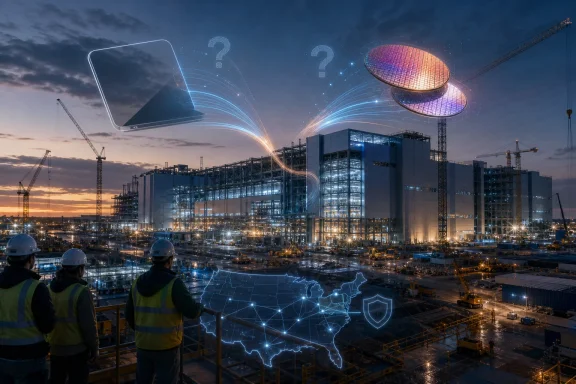 Background: Ohio One Was Built for Scale, Not Speed
Intel announced its Ohio investment in early 2022 and broke ground in September of that year, pitching the New Albany site as a new anchor for the American semiconductor industry. The initial phase centers on two leading-edge chip factories, with an investment that has grown to more than $28 billion.The physical footprint is even more ambitious than the first two fabs suggest. The nearly 1,000-acre site can eventually support as many as eight fabs, supporting facilities, suppliers, research partnerships, and a substantial regional workforce pipeline. At full development, the project has been associated with a potential investment approaching $100 billion over a decade.
That scale made Ohio One a powerful symbol of U.S. industrial policy. It also made the project unusually exposed to Intel’s financial condition, execution challenges, and ability to attract foundry customers.
Intel’s original timeline anticipated an earlier start. But the company slowed construction as it worked to conserve capital and align capacity additions with actual market demand. Under Intel’s current public plan, construction on the first Ohio fab is expected to finish in 2030, with operations beginning between 2030 and 2031. The second fab is expected to be completed in 2031 and begin operations in 2032.
That schedule matters because semiconductor fabs are not ordinary industrial buildings. A structure may appear visually complete long before it is useful for volume manufacturing. The most expensive and technically demanding phase comes when clean rooms are equipped with lithography systems, deposition tools, etching equipment, inspection systems, advanced automation, water treatment, power infrastructure, and the many specialized components required to process wafers reliably.
In other words, a faster Ohio build-out cannot simply mean pouring concrete faster. It must be supported by enough customer demand to justify billions of dollars in equipment purchases and operating costs.
What Is Actually Confirmed—and What Remains Speculation
The discussion around Intel’s Ohio project has become more optimistic, but it requires careful separation between confirmed information, reported negotiations, and unverified assumptions.The Apple relationship is strategically important
Reports in May indicated that Intel and Apple reached a preliminary agreement under which Intel would manufacture chips used in some Apple products. The reported talks were extensive and were described as part of a broader push to strengthen domestic chip production.If finalized and executed at meaningful scale, Apple would be one of the most important external customers Intel Foundry has secured. Apple is not just a large buyer of semiconductors; it is also an exceptionally demanding customer. Its products require advanced manufacturing processes, predictable supply, strict quality control, secure handling of proprietary designs, and dependable volume ramps.
For Intel, even a limited Apple manufacturing relationship would matter because it would demonstrate that a major chip designer is willing to trust Intel’s factory network. That is the central challenge facing Intel Foundry: convincing external customers that Intel can provide world-class manufacturing services while also producing chips for its own products.
However, the available reporting does not establish that Apple production will occur in Ohio, nor does it provide details on process technology, chip types, volume, contract duration, or the start of manufacturing. Readers should be cautious about treating the Apple news as a guaranteed lifeline for the New Albany fabs specifically.
SK hynix has denied a campus acquisition
The SK hynix story is equally important, but more complicated. Reports initially suggested that the South Korean memory manufacturer could be considering the purchase of Intel’s Ohio semiconductor campus to establish U.S. memory-chip production.SK hynix rejected that scenario in a regulatory disclosure, saying it had not pursued or decided on acquiring Intel’s Ohio site and fab facilities. That denial is meaningful and should end speculation that a sale is imminent.
But it does not necessarily rule out every possible relationship between the companies.
The more recent reporting points to a potential operating partnership rather than an outright acquisition. Such an arrangement would be materially different from selling the campus. Intel could retain ownership of the land and core manufacturing assets while allowing a partner to use designated capacity, share infrastructure, commit to long-term wafer demand, or help finance a production line.
That remains unconfirmed. Intel has not publicly announced a signed partnership with SK hynix, and reports indicate that formal operating negotiations have not been completed. Still, the possibility is credible enough that Ohio Sen. Jon Husted said Intel had informed him that it had a potential partner that could help accelerate development if an agreement comes together.
Why a Partnership Could Matter More Than a Sale
A sale of the Ohio campus would have raised difficult questions about Intel’s strategic direction. The project was designed to support Intel’s manufacturing revival and its bid to become a major global foundry. Handing the site to another company would have looked like a retreat from that ambition.A partnership, by contrast, could reinforce Intel’s plan.
Shared economics could reduce Intel’s capital burden
Semiconductor manufacturing requires extraordinary capital investment. A modern fab can consume tens of billions of dollars before it produces its first commercial wafer, and each new manufacturing generation requires expensive upgrades.Intel has been under pressure to control spending while continuing to invest in competitive process technology. If an outside partner committed capital, equipment purchases, long-term orders, or some combination of all three, it could reduce the financial burden associated with fully equipping Ohio One.
That does not make the arrangement simple. Fab equipment, clean-room layouts, process flows, intellectual property protections, and customer requirements are highly specialized. But an operating partner could give Intel a more direct path to utilization—one of the most important measures of fab profitability.
A customer commitment can unlock construction decisions
Intel has repeatedly tied Ohio’s pace to demand. That is not merely corporate caution. It reflects the basic economics of semiconductor manufacturing.A fab without enough wafer starts wastes an enormous amount of fixed investment. Yet delaying too long can leave a manufacturer unable to meet demand when it arrives. The answer is a measured construction model that retains the option to accelerate when commercial commitments justify it.
This is why an Apple deal and a prospective SK hynix arrangement are more meaningful together than separately. Apple could validate Intel’s ability to win high-profile logic-chip business. A memory manufacturer could create a separate, potentially substantial demand stream for U.S. production capacity.
Even if neither customer used the first Ohio fab directly, their presence could strengthen Intel Foundry’s financial outlook and increase confidence in the broader manufacturing network that Ohio will eventually join.
The campus has room for specialized operations
Ohio One was planned as a large manufacturing campus, not simply two isolated factories. That makes it more adaptable than a single-fab project.A partner could potentially occupy a dedicated portion of the campus, use shared site infrastructure, or operate alongside Intel manufacturing lines while keeping proprietary process technology and customer designs segregated. Depending on the terms, Intel could provide construction, facilities management, automation expertise, supply-chain support, or manufacturing services.
The exact model would determine whether the arrangement is strategically elegant or operationally awkward. A successful partnership would need clear governance, strict separation of proprietary information, reliable access to utilities, and an agreement on how future expansion is funded.
The Memory-Chip Angle Changes the Conversation
The prospect of SK hynix involvement is especially notable because it would broaden Ohio’s potential beyond Intel’s traditional focus on logic processors.Intel is best known to PC users for CPUs such as Core Ultra processors and enterprise Xeon chips. But a modern semiconductor ecosystem also depends on memory, storage, advanced packaging, networking silicon, power management components, and specialized accelerators.
SK hynix is a major producer of DRAM, NAND flash, and high-bandwidth memory used in AI systems. Its products are foundational to the data centers that power cloud computing, artificial intelligence workloads, enterprise databases, and high-performance computing.
Logic and memory are different businesses
Logic chips perform computation. They include CPUs, GPUs, system-on-chips, and many specialized processors. Memory chips store data temporarily or permanently, depending on the technology.- DRAM provides high-speed working memory for PCs, servers, and graphics systems.
- NAND flash provides persistent storage used in SSDs, phones, and many embedded devices.
- HBM, or high-bandwidth memory, stacks memory dies vertically and connects them closely to high-performance processors and AI accelerators.
AI has turned memory into a strategic bottleneck
The AI boom has increased attention on high-performance memory because advanced accelerators need enormous memory bandwidth. A powerful AI processor is less useful if it cannot rapidly access the data needed to keep its compute units busy.That makes high-bandwidth memory particularly valuable. It also exposes an uncomfortable reality for the United States: much of the world’s advanced memory capacity remains concentrated in East Asia.
A U.S.-based SK hynix manufacturing presence could therefore have strategic value beyond the immediate commercial benefit to Intel. It could strengthen supply-chain resilience for server makers, cloud providers, defense contractors, automakers, and PC manufacturers that depend on a steady flow of memory components.
For Windows users and enterprise IT departments, that is not an abstract policy issue. PC prices, laptop availability, server procurement, SSD supply, and AI workstation costs can all be affected by memory shortages or regional disruptions.
Why Apple Would Be a Transformational Foundry Customer
Apple’s reported interest in Intel manufacturing carries a different kind of significance. Apple has historically relied heavily on Taiwan Semiconductor Manufacturing Co. for production of its custom silicon, including processors used across Macs, iPhones, iPads, and other devices.A meaningful Intel relationship would signal that Apple sees value in adding manufacturing diversity. That could be driven by capacity requirements, geopolitical risk management, competitive economics, or the need to secure U.S.-based production options.
Apple does not need to abandon its current suppliers
A preliminary agreement with Intel should not be read as a wholesale shift away from Apple’s existing manufacturing partners. High-volume semiconductor supply chains are rarely replaced overnight.Instead, Apple could use Intel for a defined product line, a future process node, a particular region, or supplemental capacity. A smaller initial program could still be enormously valuable to Intel because winning the work would establish a relationship that can expand if execution meets Apple’s standards.
This type of customer can also impose discipline. Apple is unlikely to accept vague roadmaps or inconsistent delivery. Any supplier hoping to serve Apple must demonstrate process maturity, volume capability, security, power efficiency, yield stability, and long-term reliability.
The impact on Intel Foundry could extend beyond Apple
In foundry manufacturing, one respected customer win can influence the decisions of others. A major customer validates the supplier’s process technology and operational credibility.That does not mean Apple’s reported deal guarantees additional customers. Every chip designer has different requirements, competitive sensitivities, and architecture needs. But the symbolism is difficult to overstate: if Intel can successfully manufacture for Apple, it becomes easier to argue that the company can manufacture for other large technology firms.
For Intel’s Ohio ambitions, that matters because the campus was never meant to depend entirely on Intel’s own chips. Its size, cost, and strategic importance make much more sense if it becomes part of a multi-customer foundry network.
What This Means for Intel’s Delayed Ohio Timeline
The strongest immediate takeaway is not that Ohio One will suddenly open years ahead of schedule. There is no evidence of that.Instead, the more realistic interpretation is that commercial traction could give Intel a reason to accelerate selected portions of the project. That acceleration could occur in phases.
A plausible path to earlier momentum
If Intel secures firm demand, the company could potentially:- Speed up remaining structural work on the first fab.
- Advance procurement decisions for long-lead manufacturing tools.
- Increase hiring and training for engineers, technicians, facilities specialists, and manufacturing operators.
- Expand supplier commitments across central Ohio and the broader Midwest.
- Prepare additional factory modules sooner than the current demand-aligned plan would otherwise require.
But it would mean Ohio One is moving from an option on future demand toward a more tangible production roadmap.
The 2030-to-2032 plan is still the baseline
Intel’s official Ohio construction schedule remains the benchmark until the company announces a change. The first fab is expected to start operating between 2030 and 2031, while the second is planned to begin operations in 2032.Any claim that an Apple arrangement or SK hynix partnership has already altered those dates should be treated cautiously. Intel has long retained flexibility to move faster if customer demand warrants it, but flexibility is not the same as a revised schedule.
The key event to watch is a formal announcement that identifies a customer, partner, manufacturing role, capital commitment, or timeline change. Until then, the Ohio story remains one of promising signals rather than finalized execution.
Jobs, Suppliers, and the Silicon Heartland Promise
Ohio One has always been about more than Intel’s own payroll. The project is intended to foster a semiconductor ecosystem involving construction firms, materials suppliers, tool vendors, chemical providers, logistics operators, water and power infrastructure, universities, community colleges, and specialized workforce programs.Intel has projected approximately 3,000 direct jobs for the initial Ohio investment, alongside thousands of construction jobs and longer-term employment across the surrounding supplier network.
A credible partner could expand those benefits in several ways.
- It could increase demand for construction labor and specialty trades.
- It could create a second stream of technical hiring tied to memory production or shared facilities.
- It could strengthen the case for suppliers to establish permanent Midwest operations.
- It could increase demand for semiconductor-focused education and training programs.
- It could give local governments more confidence in planning infrastructure around a long-term manufacturing cluster.
Communities around New Albany should welcome positive developments while remaining realistic about the long time horizon. Semiconductor manufacturing does not produce the quick employment surge associated with a warehouse opening or a conventional assembly plant. It creates high-value jobs, but it does so through a lengthy and technically demanding ramp.
The Risks Intel Still Must Manage
The Ohio news is encouraging, but Intel’s path remains difficult. A potential partner is not a substitute for a completed deal, and a reported preliminary customer agreement is not the same as high-volume revenue.Intel Foundry must prove execution
Intel’s foundry strategy faces a credibility test. Customers need confidence that Intel can meet process-roadmap commitments, deliver competitive yields, protect confidential designs, and provide stable economics over many years.The company’s recent strategy has centered on regaining manufacturing leadership while serving external clients. That is a larger cultural and operational shift than it may appear. Intel must act both as a chip designer competing with other designers and as a neutral manufacturer serving their needs.
The company has made progress in laying out a more customer-oriented foundry model, but customers will judge it by results, not presentations.
A memory partnership could be complex
If SK hynix or another memory company becomes involved, the relationship would need to solve practical challenges that are not visible in headline coverage.These include:
- Which company controls the production line and day-to-day operations.
- Whether manufacturing tools are owned, leased, or jointly funded.
- How process technologies are licensed and protected.
- How clean-room capacity, utilities, and site infrastructure are allocated.
- Whether the partner is a customer of Intel Foundry or a co-operator.
- How future fab expansions are approved and financed.
- Whether the product mix can shift with volatile memory-market conditions.
Public incentives and accountability will remain under scrutiny
Intel’s U.S. expansion has benefited from significant public support, including federal semiconductor incentives and state-level economic development commitments. That increases the strategic importance of the project, but it also raises the standard for transparency and delivery.Ohio taxpayers and federal policymakers will want evidence that public investment is translating into actual construction progress, workforce development, manufacturing capacity, and durable jobs. A partner could strengthen that case if it brings concrete investment and production commitments. It could weaken confidence if it appears to be a temporary workaround for a site that Intel cannot fully support on its own.
Why Windows Users Should Pay Attention
The Ohio project may seem distant from everyday Windows computing, but its consequences could eventually reach the entire PC ecosystem.Windows laptops and desktops depend on an interconnected supply chain that includes processors, memory, SSDs, graphics hardware, networking chips, displays, power components, and packaging technologies. Supply constraints in any one of those categories can affect prices, availability, system configurations, and upgrade cycles.
A stronger domestic manufacturing base could help diversify that supply chain. It would not make PCs immune to disruption, nor would it guarantee lower prices. But more geographically distributed capacity can provide technology companies with more options when global shipping, trade rules, regional disasters, or geopolitical tensions disrupt established production patterns.
There is also a direct competitive dimension. Intel’s ability to become a successful contract manufacturer could influence how future PC processors, AI chips, and custom silicon are produced. If Intel wins prominent external customers, it gains revenue that can be reinvested in advanced manufacturing and product development.
That would matter in a Windows market increasingly shaped by AI PCs, efficient Arm-based systems, powerful integrated graphics, on-device neural processing, and heightened demand for memory bandwidth. The health of Intel’s manufacturing strategy is no longer only an Intel investor story. It is increasingly part of the broader computing-platform story.
The Bottom Line
Intel’s Ohio project has not suddenly become a finished fab, and the reports surrounding SK hynix should not be overstated. SK hynix has denied pursuing an acquisition of Intel’s Ohio campus, while no public agreement has confirmed a formal operating partnership. Likewise, the reported Apple arrangement is strategically significant but does not yet establish that Apple chips will be manufactured in New Albany.Yet the direction of travel is more encouraging than it was when Ohio One appeared to be a giant project waiting for demand to materialize. Intel now has reported evidence of interest from one of the world’s most influential chip buyers and a potential path to partnership with a leading memory manufacturer.
For the New Albany campus, that is the essential shift. The project’s biggest question was never whether Intel could build structures in Ohio. It was whether the company could build a business case strong enough to fill those structures with tools, engineers, wafers, and long-term customer orders.
A completed Apple manufacturing agreement, a credible operating partner, or both could help provide that answer. Until contracts, capacity plans, and revised construction milestones are formally announced, the Ohio fab remains a high-stakes bet still awaiting its most consequential proof: sustained customer demand.
References
- Primary source: The Columbus Dispatch
Published: 2026-07-23T19:45:38+00:00
Loading…
www.buckeyextra.com - Related coverage: es.investing.com
Loading…
es.investing.com - Related coverage: fanaticosdelhardware.com
Loading…
fanaticosdelhardware.com - Related coverage: id.investing.com
Loading…
id.investing.com - Related coverage: gate.com
Loading…
www.gate.com - Related coverage: download.intel.com
Loading…
download.intel.com