
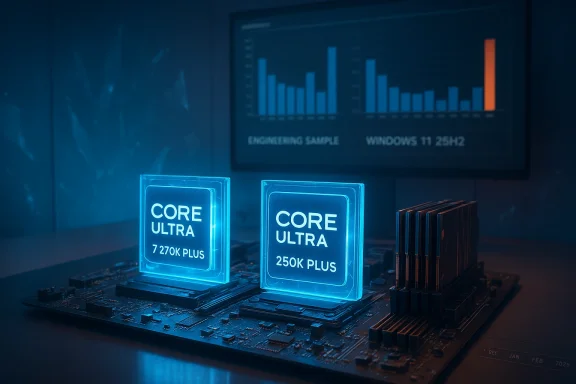
 Background: what are the “Plus” SKUs and where these leaks come from
Intel’s Arrow Lake refresh—commonly discussed as the “Plus” series—appears to be a modest, tactical update rather than a full architectural generation shift. The two chips in the spotlight are:
- Core Ultra 7 270K Plus — reported to move to an 8P + 16E core configuration in some listings, up from earlier Ultra 7 configurations that contained fewer E-cores. Leaked and database entries published in December 2025 through early 2026 have shown Geekbench and PassMark results attributed to this SKU that suggest single-thread and multi-thread improvements over the Core Ultra 7 265K.
- Core Ultra 5 250K Plus — reported to receive a core-count bump and tuned clocks. Early Geekbench appearances in February 2026 show respectable single-core results and middling multi-core results in some samples.
These sightings are coming from benchmark databases and hardware-detection utilities (Geekbench entries, PassMark listings, and AIDA64 beta detection logs) that have a long history of surfacing pre-release or engineering-sample data. They offer a useful early glimpse but are not a substitute for controlled, vendor-neutral reviews using retail silicon and standardized test beds.
Overview: what the leaks actually show, in plain numbers
Leaked benchmark entries and early reporting between December 2025 and February 2026 converged on a few measurable points:
- Reported Geekbench runs for the Core Ultra 7 270K Plus showed single-core scores in the low 3,000s and multi-core runs in the ~22,000 range on some entries. These runs were positioned around a 5–10% multi-core improvement compared to the 265K in the same benchmark listings.
- The Core Ultra 5 250K Plus appeared in Geekbench with a single-core score around 3,113 and a multi-core score near 15,251, which situates it between the current Ultra 5 and some lower-end Ultra 7 results in synthetic tests.
- PassMark database leaks and a few aggregated charts circulated with larger-margin claims — in one leak the 270K Plus showed a substantial lift versus older Intel parts and, by extension in the headline framing, versus some AMD Ryzen chips. Those PassMark numbers were more variable and sometimes amplified the gains seen in Geekbench.
On the system side, leaked detection in utilities and reporting suggested:
- DDR5-7200 memory support surfaced in early leak write-ups, implying a platform-level update that could influence memory-sensitive workloads.
- Processor identification strings and AIDA64 beta reports flagged the new “Plus” SKU names, suggesting Intel is internally testing refreshed bins and clock profiles.
These data points appeared across multiple independent outlets between December 2025 and February 2026, but it’s important to emphasize: the numbers are dataset fragments, not final validation.
Why “demolish” is an overstatement: the limits of leaked benchmarks
There are several important reasons to be skeptical of headlines claiming Intel has “demolished” Ryzen because of these leaks:
- Synthetic benchmarks are narrow. Geekbench and PassMark focus on specific microbenchmarks that stress particular CPU subsystems; they do not reliably predict gaming frame rates, real-world productivity timelines, or multi-app workstation responsiveness.
- Leaked entries often come from engineering samples with atypical firmware and microcode. Performance on pre-release silicon can be artificially high (engineer-tuned bins) or artificially low (incomplete firmware).
- Testing variables matter: memory speed, platform BIOS, power delivery, cooling, and OS build all influence results. The leaked entries rarely include a complete test methodology or platform spec list, so reproducing or verifying them is impossible without additional data.
- Database noise and bogus entries exist. Public benchmark trackers sometimes host corrupted or misattributed results. Security researchers and hardware sites routinely advise caution until reputable reviewers validate the numbers on final retail hardware.
In short: a handful of synthetic wins in a few leaked runs do not equate to a platform-level upheaval.
Windows 11 25H2: does the OS change tilt the playing field?
One of the more provocative elements in circulation is the idea that Windows 11 25H2 helped Intel widen a lead over AMD. This requires careful scrutiny.
- Independent testing of Windows 11 25H2 conducted in the months before these chip leaks found no broad, cross-workload uplift for either vendor; in many cases, benchmark performance was essentially unchanged from prior Windows versions. Some Linux vs Windows comparisons even showed Linux outperforming Windows 11 25H2 in certain compute workloads.
- Earlier Windows 11 updates (23H2, 24H2) produced observable scheduler and security-related changes that benefited some workloads and, in a few cases, favored AMD because optimizations aligned well with different cache/scheduling characteristics. That history means an OS update can shift relative performance, but the effect is workload- and platform-specific — not a reliable mechanism to flip the competitive landscape overnight.
Taken together, the evidence does not support a tidy narrative where Windows 11 25H2 is the decisive factor that suddenly hands Intel a universal advantage. It’s far more plausible that leaked silicon, tuned memory or power settings, and the narrow selection of synthetic tests created a snapshot where Intel looked especially strong.
Technical anatomy: what changed in the “Plus” revisions
From the leaks and detection traces, the Plus series appears to be incremental and surgical rather than revolutionary. Notable technical signals include:
- More E-cores in some SKUs: Several leaks list the 270K Plus as 8P + 16E — adding efficiency cores increases aggregate thread capacity for background tasks and throughput-oriented multi-threaded jobs without changing P-core single-thread characteristics dramatically.
- Clock tuning and bin shifts: Boost targets and E-core boost behavior appear to be nudged upward in certain Plus SKUs. These changes often come from tighter binning and minor voltage/frequency curve optimizations.
- Potential DDR5-7200 support: If the platform truly supports DDR5-7200, memory-bound or latency-sensitive workloads could see a relative improvement; however, real-world gains depend heavily on whether OEMs and memory vendors ship validated kits and whether platform memory controllers are configured identically in comparative tests.
- Naming and SKU strategy: The “Plus” suffix looks to be a marketing and product-stack tactic to reposition existing silicon with a refreshed spec sheet, rather than introducing a radically new microarchitecture.
These are important, practical engineering changes. But incremental hardware changes tend to produce incremental benefits, and the distribution of those benefits depends on the workload.
Real-world implications: gaming, content creation, and workstation use
When consumers and IT pros ask “What does this mean for me?”, they’re usually trying to answer three core questions: gaming performance, content-creation throughput, and the value proposition for workstation deployments.
Gaming
- Gaming is sensitive to single-thread performance, memory latency, GPU pairing, and platform overhead. Historically, Intel has had an edge in many gaming scenarios that prioritize single-thread latency, but AMD’s Ryzen chips with 3D V-Cache or higher core counts routinely close or reverse those gaps depending on the title, engine, and resolution.
- Small synthetic wins in multi-thread suites don’t necessarily translate to more frames. Until independent reviews publish gaming data across a broad mix of titles and GPU pairings, any “demolition” claim is unproven.
Content creation and productivity
- Where workloads are heavily multi-threaded and memory-bandwidth bound (e.g., large-scale video rendering, complex compile workloads, scientific compute), extra E-cores plus higher DDR5 speeds could help—but only if scaling across E-cores and thread scheduling is effective for the application.
- AMD’s higher thread counts in many Ryzen parts, along with favorable multi-core scaling in many professional applications, means Intel would need broad, repeatable advantages across both single- and multi-thread engines to be the clear victor. The leaks don’t show that.
Workstation and enterprise
- Platform longevity, power envelope, thermals, and total cost of ownership matter far more than a single synthetic score. AMD’s AM5 platform longevity and aggressive pricing have been meaningful factors for buyers; Intel’s platform roadmap, socket changes, and ecosystem support remain major purchasing considerations.
The testing and validation checklist: what to watch for in final reviews
Serious buyers and IT decision-makers should wait for independent labs to address the following checklist before accepting early claims:
- Retail silicon vs engineering samples — confirm tests use boxed, shipping CPUs.
- Identical motherboards, BIOS versions, and DRAM kits across comparative runs.
- Transparent test methodologies and full platform power/thermal telemetry.
- A wide mix of real-world workloads: multiple games at several resolutions, real-life productivity tasks (export timelines in video editors, compile times, data science pipelines), and long-duration thermally-stressed runs.
- Driver and microcode parity — ensure the latest vendor drivers and microcode patches are applied uniformly.
- Repeatability and statistics — significant results should be reproducible across multiple runs and systems.
Only when these boxes are ticked can consumers rely on claims of major generational shifts.
Strengths in the leaks — what Intel might actually have improved
Despite the caveats, the leaks do reveal legitimate engineering progress:
- Targeted performance boosts: Adding E-cores and modest clock increases is a low-risk way to improve multi-threaded throughput for mixed desktop workloads without increasing P-core power substantially.
- Memory support uplift: If DDR5-7200 support is real and validated by OEMs, it could lift some memory-sensitive workloads and improve benchmark responsiveness.
- SKU segmentation: Intel’s Plus naming and core-count shuffles give it flexibility to better hit price/performance points across the desktop stack.
These are real, actionable strengths that could make the Plus SKUs more attractive in specific scenarios — particularly where parallel background workload handling and platform memory speed are meaningful.
Risks and open questions: where the leaks fall short
There are also concrete risks and unknowns the leaks don’t address:
- Power and thermals: Boost clocks and more active cores can produce higher instantaneous power draw. Without platform power charts and thermal data, it’s impossible to know whether these chips require more robust cooling or if they sustain performance long-term.
- Driver and OS sensitivity: Heterogeneous core scheduling depends heavily on the OS scheduler and driver maturity. Edge cases could create regressions in gaming or latency-sensitive apps if scheduling doesn’t place threads optimally.
- Pricing and positioning: Intel’s refresh could undercut AMD on some price points or it could be positioned at premium price brackets that leave AMD’s value proposition intact. Leaks rarely include MSRP or suggested channel pricing.
- Comparative breadth: Most leaks compare an unreleased Intel chip to a single AMD part in one synthetic benchmark. A true competitive comparison requires a matrix of AMD and Intel SKUs across multiple benchmarks.
Until the community has retail samples and controlled tests, these risks remain material and unresolved.
What buyers should do now
If you’re building a system, considering an upgrade, or advising IT procurement, here are practical steps:
- If you need immediate purchase: Buy what meets your workload needs now. A one-off synthetic lead in a leaked benchmark is not a sound basis to delay a project.
- If you can wait: Hold for independent reviews from reputable testing labs and outlets that use retail silicon and standardized test beds.
- For enthusiasts and overclockers: Track BIOS releases and early retail board support. DDR5 kit validation and motherboard memory training will be essential to unlock claimed gains.
- For IT and OEMs: Plan to validate Windows and Linux workloads on pre-production boards; be ready for BIOS/microcode updates and driver tuning before mass deployment.
The broader competitive picture: incremental evolution, not an upset
Intel’s Plus SKUs—based on the available leak evidence—look like incremental evolution. That’s a familiar pattern in the CPU industry: mid-cycle refreshes that re-balance product stacks, squeeze extra clocks out of existing silicon, and adjust feature lists to better match market demand.
AMD retains several structural advantages in certain segments:
- Thread count and SMT in many Ryzen SKUs remain strong for massively parallel workloads.
- AMD’s 3D V-Cache and chiplet approach deliver specific gaming and cache-bound advantages that simple core-count increases do not eliminate.
- Platform longevity and price/performance ratios still matter a great deal in buyer decision-making.
Intel’s tactical gains can translate to real consumer benefits in targeted workloads, but they do not, on the basis of the current leaks, represent a universal or platform-defining shift.
Conclusion
The early leaks around the Core Ultra 7 270K Plus and Core Ultra 5 250K Plus show Intel making smart, surgical improvements to Arrow Lake silicon: more efficiency cores in some SKUs, modest clock boosts, and possible platform memory updates. In narrow synthetic tests these chips can look impressive, and certain leaked runs place them ahead of some Ryzen parts in specific benchmarks.
However, the claim that these unreleased chips “demolish” AMD across Windows 11 25H2 is not supported by the broader evidence. The leaked results are fragmentary, synthetic, and inherently fragile; they omit crucial context such as platform parity, cooling and power telemetry, full workload coverage, and retail hardware validation. Windows 11 25H2, by itself, does not explain or justify a wholesale performance reordering.
For anyone making buying or upgrade decisions, the prudent course is clear: wait for comprehensive, vendor-neutral reviews that test retail hardware across real-world workloads. When those reviews arrive, examine not only headline scores but power, thermals, price, and platform roadmap — the factors that determine real value more reliably than early benchmark snapshots ever can.
