

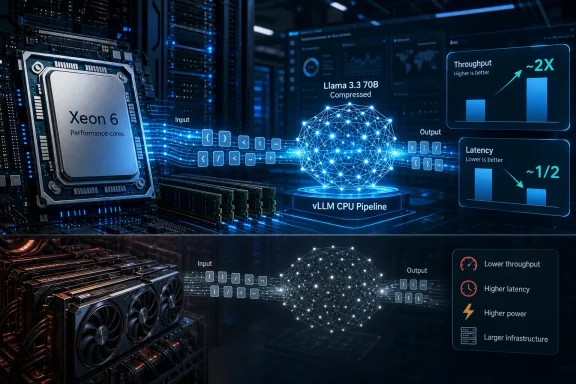
Multiverse Computing’s latest CompactifAI announcement points to a meaningful shift in how enterprises may deploy large language models: rather than treating a 70-billion-parameter model as an automatic GPU workload, organizations can now consider a CPU-based inference path built around Intel Xeon 6 processors, vLLM CPU, and model compression. The headline claim is ambitious—support for all CompactifAI models on Intel Xeon 6 systems with Performance-cores—but the concrete benchmark behind it is more specific: a compressed version of Llama 3.3 70B delivered nearly twice the throughput of an uncompressed baseline while cutting measured response latency by roughly half.
For Windows-focused IT teams, the news is less about running a local AI chatbot on a workstation and more about the changing economics of enterprise AI infrastructure. A model that once appeared to require costly, power-hungry accelerator capacity can potentially serve retrieval-augmented generation, internal knowledge search, document analysis, and domain-specific assistants from conventional server hardware—provided that the model, software stack, memory configuration, and workload are all carefully matched.
That caveat matters. This is a vendor-announced benchmark, not an industry-standard bake-off across multiple platforms. Still, the details supplied around hardware, concurrency, token counts, and measured latency provide enough information to examine what the result means, where it looks compelling, and what Windows and datacenter administrators should validate before making architecture decisions.
The central development is the availability of CompactifAI-compressed models for deployment on Intel Xeon 6 processors with Performance-cores, using the CPU implementation of vLLM and Intel’s Advanced Matrix Extensions (AMX).
CompactifAI is Multiverse Computing’s proprietary model-compression technology. In practical terms, it reduces the storage and compute requirements of a foundation model while attempting to preserve its useful reasoning, language, and instruction-following capabilities. The company describes its process as combining parameter reduction with a subsequent targeted retraining phase, sometimes referred to as “healing.”
The result, according to the announcement, is that a compressed Llama 3.3 70B model can run on a single Intel Xeon 6737P processor with approximately 1 TB of system memory. That configuration is significant because it represents a conventional high-end server platform rather than a GPU node.
The claimed benefit is straightforward:
The test used:
That is a reported improvement of 93.6%.
Total token throughput, which accounts for both prompt and generated tokens, rose from 4.02 tokens per second to 7.81 tokens per second, an increase of 94.1%.
Those figures are notable, but they should be interpreted carefully. A jump from roughly two to nearly four generated tokens per second is substantial in percentage terms, yet it is not the kind of instantaneous, consumer-chatbot responsiveness many users associate with GPU-backed services. It is best understood as an improvement in a CPU-serving scenario for a very large model.
For the one-user scenario, the announcement reports the following changes:
The compressed model therefore reaches its first token in under four seconds on average, compared with nearly seven seconds for the baseline. It also reduces the delay between generated tokens from about half a second to roughly a quarter second.
That difference changes the perceived quality of an interactive application. A model that takes several seconds to begin answering may still be acceptable for internal research, summarization, document workflows, or batch-adjacent assistant tasks. Cutting that initial delay by almost half makes the same model much more plausible for user-facing enterprise chat interfaces.
The release also says the largest relative gain appeared at 256 concurrent users, where throughput increased by 107.0% and latency declined by 51.7%. If reproducible under production-style workloads, that is arguably more important than the low-concurrency result. Datacenter economics depend on how much useful work a server can sustain when many users or automated tasks arrive at once.
In this deployment, three layers matter:
The announcement lists a reduction in model disk size from about 130 GiB to 65 GiB. That is useful for storage, image distribution, checkpoint loading, backups, and provisioning. But disk footprint is not equivalent to real-world runtime memory use.
An inference server also needs capacity for:
Organizations should therefore avoid translating the 65 GiB figure into an assumption that a 128 GB or 256 GB server will comfortably host the model under meaningful concurrency. Model deployment sizing must account for the entire inference stack, not just the checkpoint file.
The benchmarked model reportedly retained more than 97% of baseline accuracy across several common evaluation datasets.
The reported scores were:
However, one higher benchmark result should not be interpreted as proof that compression generally improves intelligence. Benchmark outcomes vary based on prompts, evaluation harnesses, model versions, training data, decoding configuration, quantization format, and the statistical noise inherent in some evaluations.
The appropriate conclusion is more measured: the reported results suggest that the compression process may preserve model quality better than simplistic size reduction alone, and can occasionally improve performance on individual tasks. It does not establish that every compressed model will outperform its original version in real-world reasoning or domain-specific accuracy.
The stated test methodology includes:
Real enterprise requests often include:
The methodology explains why: each configuration issued approximately ten times the concurrency in requests. At one concurrent user, that implies around ten sequential requests rather than a single request. The figure is therefore best interpreted as overall benchmark duration for the request set, not the response time of one individual request.
This distinction matters. The TTFT and TPOT metrics are more useful for assessing individual user experience, while total duration and aggregate throughput better reflect server capacity.
That said, Windows remains highly relevant to the deployment story.
The practical architecture could look like this:
For local Windows AI experimentation, smaller models such as 7B, 8B, or selectively compressed 14B-class models remain more realistic targets. The larger story here is about server-side AI inference, not local device inference.
But CPUs have strategic advantages that should not be dismissed.
This can reduce friction in environments where GPU expertise is limited or where accelerators are reserved for training and more demanding inference workloads.
Potential use cases include:
That flexibility should not be confused with unlimited consolidation. Large-model inference can consume memory bandwidth and CPU cycles aggressively. Still, general-purpose infrastructure can be an attractive alternative for predictable, moderate-scale AI demand.
A model that retains benchmark performance can still behave differently in specialized tasks such as:
A full infrastructure decision should also compare:
Longer input contexts can alter:
A disciplined proof of concept should include the following steps:
A 70B model once implied a narrow set of infrastructure choices. Compression, quantization, improved CPU kernels, better batching, and dedicated matrix instructions are widening those choices. The question is no longer simply whether a large model can run on a CPU. It can. The more important question is whether it can run well enough, at a price and latency level that fit a particular business service.
Based on the published figures, CompactifAI’s compressed Llama 3.3 70B model appears to make a substantial improvement over an uncompressed CPU baseline: nearly double the measured throughput, about half the latency, and half the model disk footprint while preserving strong scores across standard evaluations.
That does not make CPU inference a universal replacement for GPUs, nor does it remove the need for rigorous workload-specific validation. It does, however, make Intel Xeon 6-based AI inference a more credible option for organizations that need private, scalable, and operationally familiar large-language-model deployments.
For Windows-focused IT teams, the news is less about running a local AI chatbot on a workstation and more about the changing economics of enterprise AI infrastructure. A model that once appeared to require costly, power-hungry accelerator capacity can potentially serve retrieval-augmented generation, internal knowledge search, document analysis, and domain-specific assistants from conventional server hardware—provided that the model, software stack, memory configuration, and workload are all carefully matched.
That caveat matters. This is a vendor-announced benchmark, not an industry-standard bake-off across multiple platforms. Still, the details supplied around hardware, concurrency, token counts, and measured latency provide enough information to examine what the result means, where it looks compelling, and what Windows and datacenter administrators should validate before making architecture decisions.
 Overview: Compression Meets CPU AI Inference
The central development is the availability of CompactifAI-compressed models for deployment on Intel Xeon 6 processors with Performance-cores, using the CPU implementation of vLLM and Intel’s Advanced Matrix Extensions (AMX).CompactifAI is Multiverse Computing’s proprietary model-compression technology. In practical terms, it reduces the storage and compute requirements of a foundation model while attempting to preserve its useful reasoning, language, and instruction-following capabilities. The company describes its process as combining parameter reduction with a subsequent targeted retraining phase, sometimes referred to as “healing.”
The result, according to the announcement, is that a compressed Llama 3.3 70B model can run on a single Intel Xeon 6737P processor with approximately 1 TB of system memory. That configuration is significant because it represents a conventional high-end server platform rather than a GPU node.
The claimed benefit is straightforward:
- Higher output throughput for generative AI serving
- Lower token-generation latency
- Roughly 50% less model storage
- Compatibility with mainstream AI tooling
- A possible route to lower-cost, lower-complexity inference infrastructure
What the Benchmark Actually Shows
The headline performance figures compare an uncompressed Llama 3.3 70B baseline against its CompactifAI-compressed counterpart on an Intel Xeon 6737P platform.The test used:
- One Intel Xeon 6737P processor
- 32 physical cores and 64 hardware threads
- Approximately 1 TB of RAM
- vLLM CPU running in a Docker container
- A synthetic workload of 1,024 input tokens and 1,024 output tokens
- Concurrency levels ranging from one to 256 users
- Tensor parallelism set to 1
That is a reported improvement of 93.6%.
Total token throughput, which accounts for both prompt and generated tokens, rose from 4.02 tokens per second to 7.81 tokens per second, an increase of 94.1%.
Those figures are notable, but they should be interpreted carefully. A jump from roughly two to nearly four generated tokens per second is substantial in percentage terms, yet it is not the kind of instantaneous, consumer-chatbot responsiveness many users associate with GPU-backed services. It is best understood as an improvement in a CPU-serving scenario for a very large model.
Latency Results Tell the More Important Story
The more revealing metrics concern latency.For the one-user scenario, the announcement reports the following changes:
| Metric | Uncompressed Llama 3.3 70B | CompactifAI-Compressed Model | Reported Change |
|---|---|---|---|
| Mean inter-token latency | 493.36 ms | 252.08 ms | 48.9% lower |
| Mean time per output token | 494.71 ms | 255.76 ms | 48.3% lower |
| Mean time to first token | 6,939.20 ms | 3,705.64 ms | 46.6% lower |
| Output throughput | 2.00 tokens/s | 3.86 tokens/s | 93.6% higher |
| Total token throughput | 4.02 tokens/s | 7.81 tokens/s | 94.1% higher |
That difference changes the perceived quality of an interactive application. A model that takes several seconds to begin answering may still be acceptable for internal research, summarization, document workflows, or batch-adjacent assistant tasks. Cutting that initial delay by almost half makes the same model much more plausible for user-facing enterprise chat interfaces.
The release also says the largest relative gain appeared at 256 concurrent users, where throughput increased by 107.0% and latency declined by 51.7%. If reproducible under production-style workloads, that is arguably more important than the low-concurrency result. Datacenter economics depend on how much useful work a server can sustain when many users or automated tasks arrive at once.
Why Intel Xeon 6 Is Relevant to This Result
The tested Intel Xeon 6737P is a 32-core Performance-core Xeon 6 processor designed for server workloads. It supports DDR5 memory, AVX-512 vector instructions, and Intel AMX, the latter being especially relevant to AI inference.Advanced Matrix Extensions Are Not a Minor Detail
Intel AMX accelerates matrix operations, which are fundamental to transformer inference. Large language models repeatedly perform matrix multiplications while processing prompts and generating tokens. A CPU without specialized support can execute that work, but it will do so far less efficiently than hardware designed to accelerate these numeric operations.In this deployment, three layers matter:
- The processor architecture, including AMX and broad memory bandwidth.
- The vLLM CPU serving stack, which manages model execution, request batching, caching, and scheduling.
- The compressed model, which reduces the amount of data and computation required for each inference task.
Memory Capacity Remains a Serious Requirement
The use of approximately 1 TB of system memory deserves equal emphasis. A 70B parameter model is still a large model, even after compression.The announcement lists a reduction in model disk size from about 130 GiB to 65 GiB. That is useful for storage, image distribution, checkpoint loading, backups, and provisioning. But disk footprint is not equivalent to real-world runtime memory use.
An inference server also needs capacity for:
- Model weights
- Key-value cache allocation
- Runtime buffers
- Request queues
- Operating system overhead
- Container overhead
- Headroom for concurrency spikes
Organizations should therefore avoid translating the 65 GiB figure into an assumption that a 128 GB or 256 GB server will comfortably host the model under meaningful concurrency. Model deployment sizing must account for the entire inference stack, not just the checkpoint file.
CompactifAI’s Main Value Proposition
The strongest part of the announcement is not merely that a compressed model runs faster. Quantization and pruning have long been standard tools in practical AI deployment. The stronger claim is that CompactifAI can reduce a model’s footprint while preserving enough accuracy to make the resulting model useful across enterprise workloads.The benchmarked model reportedly retained more than 97% of baseline accuracy across several common evaluation datasets.
The reported scores were:
- BoolQ: 0.904587 baseline versus 0.896024 compressed
- GSM8K: 0.934799 baseline versus 0.924185 compressed
- HellaSwag: 0.590520 baseline versus 0.579068 compressed
- MMLU: 0.776528 baseline versus 0.757300 compressed
- WinoGrande: 0.678769 baseline versus 0.725335 compressed
The “Healing” Explanation Is Plausible, but Needs Context
Multiverse Computing attributes the WinoGrande improvement to retraining after compression. That explanation is plausible. Fine-tuning or retraining can sometimes improve a model’s behavior on specific benchmarks, even if the model has fewer effective parameters or uses a more compact representation.However, one higher benchmark result should not be interpreted as proof that compression generally improves intelligence. Benchmark outcomes vary based on prompts, evaluation harnesses, model versions, training data, decoding configuration, quantization format, and the statistical noise inherent in some evaluations.
The appropriate conclusion is more measured: the reported results suggest that the compression process may preserve model quality better than simplistic size reduction alone, and can occasionally improve performance on individual tasks. It does not establish that every compressed model will outperform its original version in real-world reasoning or domain-specific accuracy.
Benchmark Methodology: Enough Detail to Be Useful, Not Enough to End Debate
One positive aspect of the announcement is that it includes more methodology than many AI performance press releases.The stated test methodology includes:
- A defined processor model
- Core and thread count
- Approximately 1 TB of RAM
- Docker-based vLLM CPU serving
- Local model checkpoints for compressed variants
- Standard Hugging Face checkpoints for baseline variants
- Fixed 1,024-token prompts
- Fixed 1,024-token outputs
- Concurrency from one through 256
- Roughly ten times the concurrency level in submitted requests
- Measurements for throughput, TTFT, TPOT, and ITL
Synthetic Tokens Are Not Real Enterprise Prompts
The workload uses synthetic random tokens. This is useful for controlled measurement because it avoids variability caused by different prompts, tokenizer behavior, or business documents. But it is not a perfect proxy for production AI use.Real enterprise requests often include:
- Short chat prompts followed by lengthy answers
- Large RAG context windows
- Repeated document templates
- Prefix caching opportunities
- Structured JSON outputs
- Tool calls
- Multi-turn conversation history
- Mixed request sizes arriving unpredictably
Benchmark Duration Requires Careful Interpretation
The release reports that the baseline required 5,056.34 seconds at one concurrent user, while the compressed model needed 2,598.22 seconds. At first glance, that seems surprisingly high for a request containing 1,024 input tokens and 1,024 output tokens.The methodology explains why: each configuration issued approximately ten times the concurrency in requests. At one concurrent user, that implies around ten sequential requests rather than a single request. The figure is therefore best interpreted as overall benchmark duration for the request set, not the response time of one individual request.
This distinction matters. The TTFT and TPOT metrics are more useful for assessing individual user experience, while total duration and aggregate throughput better reflect server capacity.
What This Means for Windows Server and Enterprise IT Teams
The immediate implication is not that Windows Server administrators can install a package and host Llama 3.3 70B natively tomorrow. The tested stack is Linux-oriented: vLLM CPU deployments are built around Linux environments and containerized serving.That said, Windows remains highly relevant to the deployment story.
Windows as the Control Plane, Linux as the Inference Plane
Many organizations already operate hybrid infrastructure where:- Windows Server provides Active Directory, identity integration, file services, management tooling, and business application support.
- Linux servers host containers, AI runtimes, databases, and high-performance services.
- Windows client devices access internal AI assistants through browsers, Teams integrations, desktop applications, or line-of-business software.
The practical architecture could look like this:
- A Linux-based Xeon 6 server hosts the compressed model through vLLM.
- A secure internal API exposes the inference endpoint.
- Windows applications or web portals authenticate users through enterprise identity systems.
- A RAG service retrieves approved documents from internal stores.
- Monitoring, logging, access control, and governance remain integrated with the organization’s broader IT estate.
Windows Workstations Are Still a Different Category
A Xeon 6 datacenter server with up to 1 TB of RAM is not comparable to a typical Windows desktop or even a high-end workstation. The compressed Llama 3.3 70B result should not be read as evidence that this model is suddenly practical on ordinary office PCs.For local Windows AI experimentation, smaller models such as 7B, 8B, or selectively compressed 14B-class models remain more realistic targets. The larger story here is about server-side AI inference, not local device inference.
The Case for CPU-Based AI Serving
GPU inference remains the dominant answer for high-throughput, low-latency LLM services. Nothing in this announcement changes that fundamental reality. A well-configured accelerator platform will often remain the preferred option for demanding real-time AI applications, particularly where many users expect rapid generation from very large models.But CPUs have strategic advantages that should not be dismissed.
Operational Simplicity
A Xeon-based deployment can use familiar server procurement, networking, memory, storage, security, and observability practices. Enterprises may already have processes for patching, monitoring, and replacing CPU servers at scale.This can reduce friction in environments where GPU expertise is limited or where accelerators are reserved for training and more demanding inference workloads.
Data Sovereignty and On-Premises Control
Organizations in regulated sectors often want AI systems to operate within their own datacenters or tightly controlled private-cloud environments. A compressed large model on general-purpose servers can support that goal.Potential use cases include:
- Internal policy assistants
- Financial research and compliance workflows
- Manufacturing knowledge systems
- Healthcare documentation support
- Engineering document retrieval
- Secure code and configuration analysis
- Private RAG deployments for sensitive content
Better Hardware Utilization
A CPU platform can potentially host more than one kind of workload. Depending on capacity planning and isolation requirements, the same server class may support AI inference alongside adjacent services, orchestration components, indexing, or retrieval systems.That flexibility should not be confused with unlimited consolidation. Large-model inference can consume memory bandwidth and CPU cycles aggressively. Still, general-purpose infrastructure can be an attractive alternative for predictable, moderate-scale AI demand.
Risks and Limitations That Enterprises Should Not Ignore
The announcement is promising, but it does not eliminate several important deployment risks.Vendor-Specific Compression Needs Independent Validation
CompactifAI is proprietary. Enterprises considering it should test not only generic benchmarks but also their own workloads, prompts, languages, document formats, safety requirements, and expected answer quality.A model that retains benchmark performance can still behave differently in specialized tasks such as:
- Contract review
- Medical terminology extraction
- Customer support classification
- Financial reporting analysis
- Software code generation
- Multilingual knowledge retrieval
The Comparison Is Against an Uncompressed CPU Baseline
The published performance uplift compares compressed and uncompressed versions of the same model on the same CPU-oriented platform. That is a valid and useful comparison, but it does not establish where the result stands against alternative optimization strategies.A full infrastructure decision should also compare:
- Different quantization levels
- Other compressed model families
- Smaller native models
- GPU-based inference
- Alternative CPU platforms
- Different batch sizes and context lengths
- Cost per generated token
- Energy per request
- End-to-end application latency
Long Context and RAG Can Change the Equation
The benchmark’s 1,024-token input is moderate by modern enterprise AI standards. RAG systems can easily introduce far larger prompts as they attach search results, policy excerpts, manuals, case records, or source documents.Longer input contexts can alter:
- Time to first token
- Memory consumption
- Key-value cache pressure
- Concurrency limits
- Retrieval and reranking overhead
- Overall user experience
A Sensible Evaluation Plan
Organizations interested in CompactifAI and Intel Xeon 6 inference should treat the release as a strong reason to test, not as a substitute for testing.A disciplined proof of concept should include the following steps:
- Define the real workload. Measure actual input lengths, expected output lengths, request arrival patterns, and peak concurrent users.
- Build a quality suite. Include business-specific prompts, difficult edge cases, multilingual content if applicable, and clear pass/fail criteria.
- Measure individual latency and system capacity separately. Track TTFT, output-token rate, total completion time, queueing delay, error rate, and tail latency.
- Test realistic RAG context sizes. Include retrieval, reranking, document grounding, and structured outputs rather than measuring the model in isolation.
- Model total cost of ownership. Include server cost, memory, power, cooling, software support, operations, security, and expected service life.
- Compare against alternatives. Evaluate a compressed 70B model alongside smaller models, GPU deployments, and perhaps a domain-tuned model that may offer better task performance at a much lower resource cost.
- Plan for governance. Ensure model access controls, audit logs, data retention policies, evaluation records, and prompt-injection defenses are part of the deployment from the beginning.
The Bigger Significance of the Announcement
Multiverse Computing’s Intel Xeon 6 result reinforces a broader reality in enterprise AI: model deployment is becoming an optimization problem, not merely a race to acquire the largest GPU cluster.A 70B model once implied a narrow set of infrastructure choices. Compression, quantization, improved CPU kernels, better batching, and dedicated matrix instructions are widening those choices. The question is no longer simply whether a large model can run on a CPU. It can. The more important question is whether it can run well enough, at a price and latency level that fit a particular business service.
Based on the published figures, CompactifAI’s compressed Llama 3.3 70B model appears to make a substantial improvement over an uncompressed CPU baseline: nearly double the measured throughput, about half the latency, and half the model disk footprint while preserving strong scores across standard evaluations.
That does not make CPU inference a universal replacement for GPUs, nor does it remove the need for rigorous workload-specific validation. It does, however, make Intel Xeon 6-based AI inference a more credible option for organizations that need private, scalable, and operationally familiar large-language-model deployments.