

In a frank, forward-looking post published on March 12, 2026, Microsoft’s Richard Riley argued that the next wave of enterprise transformation is not simply another UI fad or a new copilot widget — it’s a deeper rearchitecture of work around intent. Rather than forcing people to learn yet another application, organizations can let users state what they want to accomplish and let agentic systems reason, act, and coordinate across trusted systems to deliver outcomes. That shift — from apps as destinations to apps as invoked services and from navigation to orchestration — is practical, profound, and operationally demanding. In short: agents change the interface, but governance determines whether they change the enterprise for the better or the worse.
For decades, enterprise software optimized for human navigation: menus, pages, explicit workflows and form-driven processes. Improvements were incremental and mostly UX-driven. The Microsoft piece reframes this long-standing model by centering design on intent — the user’s goal — and putting an agentic reasoning layer between people and systems. The article, grounded in a conversation with Dion Hinchcliffe at Futurum and published on Microsoft’s Power Platform channel, lays out a conceptual stack where:
This model flips the user experience:
Today, it might require opening procurement software, checking vendor records, filing a requisition, attaching budget codes, circulating approvals through email and ticketing queues, then updating ERP. The complexity is less about the PO itself and more about knowing the path to completion.
An agent-first approach inverts that complexity: the user states intent once; the agent identifies systems and policies to satisfy; it invokes vendor checks, routes approvals in the required order, posts records to the ERP, and notifies stakeholders. The user’s interaction surface becomes far smaller while the end-to-end orchestration is richer and auditable.
This pattern repeats across CRM, HR, IT operations, and support:
An agentic architecture centralizes the reasoning layer: agents evaluate intent, context, constraints, and enterprise policies, then select and sequence actions across systems. Advantages include:
Together, conversational and headless agents form a new digital workforce layer:
Note on claims and numbers: some vendor and analyst narratives offer aggressive adoption metrics or concrete counts of deployed agents inside individual vendors. Those numbers are useful for trend color but are often internal or survey-based and can be difficult to independently verify. Treat them as directional signals, not contractual facts.
The technical building blocks are arriving: reasoning-capable models, low-code agent tooling, and emerging control-plane patterns. The governance frameworks to constrain risk are maturing, too. What will separate successful adopters from costly experiments is not whether they can build a clever agent, but whether they can operate fleets of them with the same discipline, auditability, and controlled change management that modern IT demands.
In the agentic enterprise, apps don’t disappear — they become the accountable execution layer that agents invoke. The hard work is less about adding a conversational front end and more about building trustworthy, observable, and governable platforms that turn human intent into repeatable, auditable action. Organizations that treat the control plane as first-class infrastructure — and who pair that with clear ownership and continuous measurement — will turn intent-first development into a durable operational advantage rather than a fleeting experiment.
Source: Microsoft From apps to agents: Rearchitecting enterprise work around intent - Microsoft Power Platform Blog
 Background / Overview
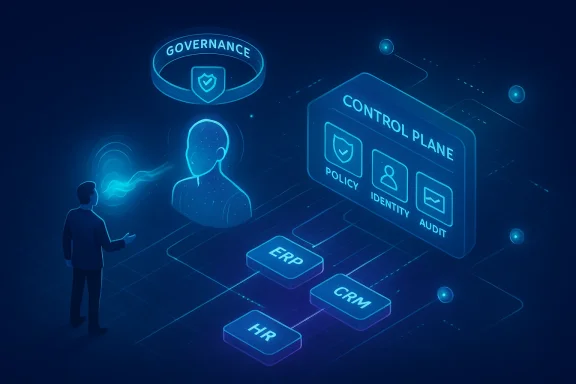
For decades, enterprise software optimized for human navigation: menus, pages, explicit workflows and form-driven processes. Improvements were incremental and mostly UX-driven. The Microsoft piece reframes this long-standing model by centering design on intent — the user’s goal — and putting an agentic reasoning layer between people and systems. The article, grounded in a conversation with Dion Hinchcliffe at Futurum and published on Microsoft’s Power Platform channel, lays out a conceptual stack where:- Agents become the primary interaction surface that accept and interpret intent.
- Applications become authoritative capability providers — systems of record, policy enforcement points, and trusted APIs the agent can call.
- A control plane provides governance, lifecycle management, observability, and security at scale.
Why “intent-first” — and why now?
The shift to intent-first design is driven by three simultaneous forces:- Large language models and reasoning systems are now capable of multi-step planning, tool invocation, and adaptive decision-making at a level that makes practical orchestration possible.
- Enterprise platform vendors are embedding agent-centric primitives into low-code platforms and cloud services so agents can invoke capabilities, access authenticated data, and update systems of record.
- A growing body of governance guidance and standards (most notably NIST’s AI Risk Management Framework) has made it clearer how to map policy, identity, and compliance controls onto AI systems — a prerequisite for safe, large-scale deployment.
Agents as the new interaction layer
From “open the app” to “express the outcome”
In an agent-first world, the cognitive work of knowing where to go inside the enterprise becomes the agent’s problem. Instead of training users to navigate 10 different systems, you let them express an outcome — “open a purchase order for Project Alpha” — and have an agent plan and execute the steps across procurement, finance, vendor systems, and approvals.This model flips the user experience:
- Users give intent and approve decisions.
- Agents do the how — orchestration, validation, and execution.
- Applications expose trusted capabilities (APIs, actions) and enforce permissions and audit trails.
What apps become
Apps are not erased; they are repurposed:- Systems of record and authority — the source where truth is authored and stored.
- Enforcement points — where policies and permissions are applied.
- Capability libraries — discrete, testable actions agents are allowed to call.
Rethinking enterprise complexity: orchestration over navigation
Consider a routine enterprise task: creating and approving a purchase order.Today, it might require opening procurement software, checking vendor records, filing a requisition, attaching budget codes, circulating approvals through email and ticketing queues, then updating ERP. The complexity is less about the PO itself and more about knowing the path to completion.
An agent-first approach inverts that complexity: the user states intent once; the agent identifies systems and policies to satisfy; it invokes vendor checks, routes approvals in the required order, posts records to the ERP, and notifies stakeholders. The user’s interaction surface becomes far smaller while the end-to-end orchestration is richer and auditable.
This pattern repeats across CRM, HR, IT operations, and support:
- Sales teams get a continuously updated customer-context agent that monitors calls, calendar entries, and case systems and then drives suggested next actions; the CRM stays the canonical store.
- IT operations rely on headless agents to detect incidents, open tickets, escalate based on policy, and post remediation actions — with humans stepping in only for exceptions.
Agents as the business logic and decision layer
Centralizing reasoning, distributing capabilities
Historically, business logic is embedded in every application as bespoke workflows and rules. That creates brittle systems where a policy change means rewriting logic in many places.An agentic architecture centralizes the reasoning layer: agents evaluate intent, context, constraints, and enterprise policies, then select and sequence actions across systems. Advantages include:
- Single source of decision logic — policies and exceptions are defined once and applied consistently.
- Faster adaptation — updates to decision rules propagate to all agent-driven processes without refactoring dozens of apps.
- Compound value — improvements in reasoning quality benefit many functions (HR, finance, ops) simultaneously.
What this demands technically
To make a shared reasoning layer credible, enterprises must invest in:- Machine-readable, enforceable policies (policy-as-code) that agents can evaluate at runtime.
- Provenance, audit logs, and attestations that answer “why was this decision made?” and “which policies were consulted?”
- Consistent identity and authorization across agent actions to ensure least-privilege invocation.
Headless agents: a new layer of digital labor
Not all agents need conversational UIs. Many of the highest-value agents are headless: event-driven, persistent, and autonomous. They monitor activity, synthesize information, update records, and only escalate to human handlers when exceptions arise.Together, conversational and headless agents form a new digital workforce layer:
- Routine work is automated end-to-end.
- Humans focus on oversight, judgment, and exception handling.
- Organizations can scale “work” capacity without linear headcount increases.
Note on claims and numbers: some vendor and analyst narratives offer aggressive adoption metrics or concrete counts of deployed agents inside individual vendors. Those numbers are useful for trend color but are often internal or survey-based and can be difficult to independently verify. Treat them as directional signals, not contractual facts.
Operating hundreds or thousands of agents: why a control plane is mandatory
Scaling from a single prototype agent to an enterprise fleet of agents radically increases operational complexity. The practical questions multiply:- How do you discover and catalog agents, their capabilities, and the data they access?
- How do you control identity, permissions, and delegation boundaries for each agent?
- How do you capture explainability and an auditable trail for each multi-step action?
- How do you budget and monitor the cost of agent activity, especially when model usage, API calls, and external integrations are involved?
- Agent registry and versioning (catalog of agent types, owners, and capabilities).
- Policy engine and policy-as-code for runtime enforcement and attestation.
- Identity, authentication, and delegation primitives that bind agent actions to authorized principals.
- Observability and auditing (action traces, decision explanations, cost telemetry).
- Lifecycle workflows (development, staging, canarying, production, retirement).
Practical architecture patterns for agentic systems
Below are common design patterns that are already maturing in production-grade agent architectures:- Separation of cognition and execution: agents reason in a typed, sandboxed reasoning layer and invoke typed tool interfaces for deterministic execution. This reduces hallucination risk by limiting what the agent can affect without explicit authorization.
- Policy-as-code + runtime policy enforcement: policies are machine-readable and applied at invocation time; enforcement is automatic and auditable.
- Context engineering (the agent’s operating system): curated, scoped, and provable context feeds the agent so decisions remain relevant and bounded.
- Agent registries and governance metadata: every agent carries metadata (owner, risk tier, required approvals, data access level).
- Human-on-the-loop control models: agents operate autonomously for low-risk tasks but escalate to human approval for high-risk decisions.
- Attestation and cryptographic audit trails: tamper-evident records that an action was authorized and that the agent consulted required policies.
From pilots to an enterprise operating model: a practical path
Many organizations start with proof-of-concept agents and stall when they attempt to scale. Successful transitions share predictable steps:- Define the target outcomes and risk profile for agentic work.
- Create a centralized policy catalog and assign ownership for policy decisions.
- Build or adopt a control plane that enforces policies, manages identity, and provides observability.
- Formalize operating procedures: agent registration, testing gates, production canaries, and incident response.
- Train and certify agent builders and owners; align IT, security, and business teams on SLAs and accountability.
- Monitor impact and iterate, using measurable KPIs (cycle time, exception rate, cost per transaction, and compliance audits).
Risks, failure modes, and mitigations
Agentic systems concentrate power — and therefore risk. Common failure modes include:- Permission explosions: agents granted broad rights that can be misused or exploited.
- Data leakage: agents aggregating and exfiltrating sensitive data across systems.
- Runaway automation: agents looping or performing destructive sequences without proper constraints.
- Undetected drift or model failure: decision logic degrades without timely detection.
- Regulatory noncompliance: actions that violate privacy, industry rules, or contractual obligations.
- Apply least privilege and ephemeral credentials for agent actions.
- Use machine-readable policies and runtime enforcement to prevent unauthorized operations.
- Implement rate limits, circuit breakers, and canary deployments for new agents.
- Establish continuous monitoring for drift, error rates, and unexpected data flows.
- Maintain human oversight for high-consequence decisions, with clear escalation paths.
Organizational implications: roles, ownership, and culture
Agentic transformation is as much an organizational change as a technical one. It creates new roles and changes old ones:- Agent product owners who understand both the business problem and the agent’s decision surface.
- Agent builders with expertise in prompt/context engineering and secure tool integration.
- AI governance teams responsible for policy definition, risk tiering, and auditability.
- IT security and identity teams enforcing least-privilege boundaries and attestations.
- Business operators focused on outcomes, KPIs, and exception management.
What leaders should do next
For executives thinking about intent-first development and agentic systems, practical first steps include:- Inventory current automation and identify candidate processes where intent-driven orchestration could reduce friction.
- Pilot agents in low-risk, high-signal areas (e.g., internal IT operations, non-sensitive procurement).
- Build or select a control plane early — don’t let governance be an afterthought.
- Align identity, policy, and audit teams before broad rollout.
- Invest in tooling for context engineering to ensure agents operate with relevant, provable data.
- Define clear ownership, KPIs, and human oversight requirements upfront.
Conclusion
Microsoft’s framing — to rearchitect enterprise work around intent and treat agents as the new interaction layer — captures a practical and accelerating shift in how organizations will compose work. Agents promise real productivity gains by reducing navigation overhead, centralizing decision logic, and standing up a new layer of digital labor. But they also force enterprises to confront operational realities that have been latent in previous waves of automation: identity, policy-enforced runtime behavior, lifecycle management, observability, and clear organizational ownership.The technical building blocks are arriving: reasoning-capable models, low-code agent tooling, and emerging control-plane patterns. The governance frameworks to constrain risk are maturing, too. What will separate successful adopters from costly experiments is not whether they can build a clever agent, but whether they can operate fleets of them with the same discipline, auditability, and controlled change management that modern IT demands.
In the agentic enterprise, apps don’t disappear — they become the accountable execution layer that agents invoke. The hard work is less about adding a conversational front end and more about building trustworthy, observable, and governable platforms that turn human intent into repeatable, auditable action. Organizations that treat the control plane as first-class infrastructure — and who pair that with clear ownership and continuous measurement — will turn intent-first development into a durable operational advantage rather than a fleeting experiment.
Source: Microsoft From apps to agents: Rearchitecting enterprise work around intent - Microsoft Power Platform Blog
