

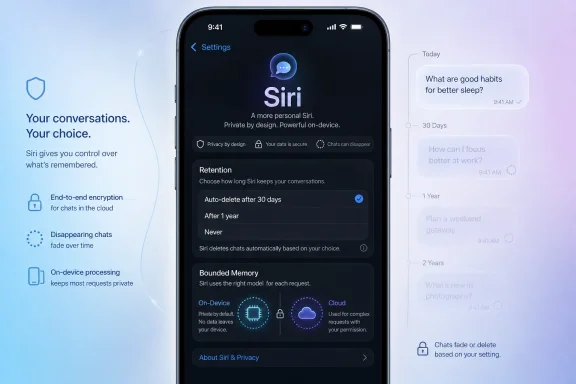
Apple is reportedly preparing a rebuilt Siri for iOS 27 with chat-style conversations and retention controls that let users auto-delete histories after 30 days, after one year, or never. The feature, reported by Bloomberg’s Mark Gurman and echoed by follow-on coverage, is small enough to fit inside a Settings pane but large enough to define Apple’s next AI argument. After losing the first round of the generative AI race on speed and spectacle, Apple appears ready to fight the second round on custody, memory, and trust.
That is a familiar Apple move, but not necessarily a cynical one. The company has often entered markets late, then tried to redraw the terms around integration, defaults, and user confidence. With the next Siri, the question is not whether Apple can suddenly out-chat ChatGPT, Gemini, or Copilot on raw capability. The question is whether Apple can convince hundreds of millions of users that an assistant worth using is also an assistant worth forgetting.
The modern chatbot has a memory problem, and not just in the technical sense. Users want assistants that remember preferences, projects, documents, relationships, itineraries, dietary restrictions, coding style, and half-finished plans. Users also increasingly understand that a machine that remembers everything may become a liability.
That tension sits at the center of the reported Siri redesign. A chat interface makes Siri more useful only if it can preserve continuity. But the moment Siri becomes a place where people discuss health worries, legal drafts, family disputes, work secrets, private photos, or half-formed business plans, conversation history stops being a convenience feature and becomes a governance problem.
Apple’s reported answer is not to eliminate history, but to make retention visible and bounded. Thirty days is the privacy-forward setting. One year is the pragmatic setting. Forever is the “I know what I’m doing” setting for users who want maximum continuity and are willing to accept the corresponding footprint.
That framing matters because most AI products have treated retention as plumbing. Chat history exists because it improves product stickiness, supports personalization, and feeds model-improvement pipelines unless a user turns that off. Apple, if the report proves accurate, is trying to turn the pipe into a lever.
The generative AI boom made that gap impossible to ignore. OpenAI made conversational AI feel immediate. Google moved Gemini across search, Android, Workspace, and developer tooling. Microsoft embedded Copilot into Windows, Edge, Office, GitHub, and the enterprise stack with a speed that sometimes seemed to outrun its own product coherence. Apple, meanwhile, introduced Apple Intelligence as a privacy-conscious framework but still had to answer the most embarrassing question: where was the actually transformed Siri?
That delay now gives Apple a narrative. The company can say, implicitly if not explicitly, that it did not rush a chatbot into the iPhone because a phone assistant is not the same thing as a website chatbot. A phone knows your messages, photos, location patterns, calendar, contacts, payment cards, health data, home devices, and work apps. If that assistant is going to become conversational, the privacy model has to be more than a disclaimer.
This is the argument Apple wants to own. It may not excuse years of Siri stagnation, and it will not magically make the new assistant good. But it reframes lateness as caution, and caution as a virtue.
But privacy is rarely decided by the existence of a feature. It is decided by defaults, discoverability, language, and the emotional contract a product forms with its users. A temporary mode is useful for people who remember to activate it before the sensitive conversation begins. An auto-delete policy is different because it applies to the ordinary flow of use.
That distinction is why the reported Siri setting is more interesting than it first appears. It does not merely ask, “Do you want this one chat to disappear?” It asks, “What kind of memory should this assistant have by default?” That is a more durable choice, and it is easier for normal people to reason about.
The setting also borrows from a familiar Apple pattern. Messages already has retention choices. Photos has recently deleted items. Safari has private browsing. The company’s best privacy features often succeed not because they are theoretically perfect, but because they are placed in categories users already understand. Chat history becomes less like an opaque AI training artifact and more like a household object: keep it, clear it, or set a timer.
Apple’s credibility will depend on how precisely it defines the boundary. Does a 30-day setting remove the chat from the interface only, or from Apple’s servers as well? Are deleted chats excluded from model training by design, policy, or both? If Siri routes a request to a third-party model, whose retention rules apply? If a conversation includes a file upload, image, or email thread, does retention follow the chat, the source document, or both?
Those are not pedantic questions. They are exactly the questions enterprise admins, lawyers, journalists, health workers, public-sector agencies, and regulated industries will ask before trusting a conversational assistant with real work. Apple’s consumer privacy brand helps, but it does not replace documentation.
Private Cloud Compute is relevant here because Apple has already laid the groundwork for a different kind of AI infrastructure story. The company says complex Apple Intelligence requests can be processed in a cloud environment designed so Apple cannot access the user’s personal data. That is a stronger architectural claim than a settings toggle, but the two must align. If Siri’s new memory layer sits awkwardly beside Apple’s cloud privacy architecture, the pitch will wobble.
That is why Siri’s reported evolution into a traditional chatbot changes the stakes. Today, a bad Siri answer is annoying. Tomorrow, a persistent Siri thread could contain a month of personal planning, private questions, copied documents, travel details, receipts, photos, health notes, and work context. The assistant becomes a diary with an API.
For WindowsForum readers, this should sound familiar. Microsoft’s Copilot ambitions have forced administrators to think about where organizational data goes when AI is allowed to reason across documents, email, meetings, chats, and local context. The more useful the assistant becomes, the more it begins to resemble a privileged user with an excellent memory and uncertain boundaries.
Apple’s advantage is vertical control. It controls the hardware, operating system, app review, many default apps, and the identity layer. That makes it easier to create a coherent retention model. It also makes failure more consequential, because users will reasonably assume that “Siri” means Apple is accountable for the whole experience, even when outside models or app extensions are involved.
That land grab created powerful products, but it also normalized a confusing user experience around data. Some chats are saved. Some are not. Some are used for training depending on account type or settings. Some temporary modes still retain data briefly for safety or operational purposes. Enterprise versions may differ sharply from consumer versions. Admin policies may override individual choices.
Apple’s reported Siri controls cut through that complexity by making the first-order choice simple. The assistant remembers for 30 days, one year, or indefinitely. That will not answer every back-end retention question, but it gives the user a human-scale model.
The danger for Apple is that simplicity can become oversimplification. AI systems are not just notebooks. They are pipelines of prompts, context windows, retrieved documents, model outputs, safety classifiers, logs, and sometimes third-party calls. If Apple’s interface suggests more certainty than the architecture can support, privacy marketing will become a liability.
AI assistants are not like calculator apps. They fail probabilistically, misunderstand context, invent answers, mishandle edge cases, and behave differently across languages, regions, accounts, and device classes. Pretending otherwise has damaged the credibility of several AI launches. A beta label can be a shield, but it can also be a useful warning.
For Apple, the beta question is especially delicate because Siri is not a niche feature tucked into a lab. It is a named assistant installed across iPhone, iPad, Mac, Apple Watch, HomePod, CarPlay, and more. If Apple presents the new Siri as both central and experimental, it has to give users a clear way to understand which parts are reliable and which parts are still being tested.
That is where retention controls again become part of the trust model. Users may be more willing to experiment with a new assistant if they know its memory is not permanent by default. Conversely, if Apple asks users to help improve Siri through extended interaction, it must be explicit about what is stored and why.
A personal iPhone can offer the user three retention choices and call that empowerment. A managed fleet cannot stop there. Organizations need administrative controls, auditability, data-loss-prevention hooks, app restrictions, legal hold compatibility, and clarity about whether corporate data can enter a personal Siri thread. The BYOD nightmare writes itself: an employee asks Siri to summarize a confidential spreadsheet, the chat persists for a year, and the organization has no practical visibility into what happened.
Apple has historically been strong in device management, but AI memory introduces a new administrative surface. Mobile device management policies will need to address whether the Siri app is enabled, whether third-party AI extensions can be used, whether uploads are allowed, and whether retention can be forced to a minimum or disabled for certain accounts.
This is where Microsoft and Google may retain an enterprise advantage. Their AI products are messy, but they are embedded in suites with compliance tooling, admin consoles, identity controls, and retention frameworks that large organizations already understand. Apple can win the consumer trust narrative and still face skeptical CIOs who want policy enforcement more than elegant defaults.
That requires memory, but not all memory is the same. There is conversation history, which is what the reported Siri setting addresses. There is preference memory, where the assistant remembers that you like vegetarian restaurants or concise answers. There is device context, where it can see your calendar, messages, files, and location. There is inferred memory, where the system builds a model of habits without storing a neat transcript of the chat that revealed them.
Apple’s challenge is to make those categories legible. A user may set Siri chats to delete after 30 days and assume Siri forgets everything after 30 days. But if the assistant keeps separate learned preferences, indexes local data, or maintains on-device context summaries, the practical meaning of deletion becomes more complicated.
That does not mean Apple should avoid memory. A forgetful assistant is a bad assistant. But Apple must avoid the trap of using one understandable retention setting to obscure a larger and less understandable system of personalization.
In the AI race, those constraints are magnified. The companies with the richest cloud histories and broadest user telemetry can improve assistants quickly. They can observe failures, tune responses, and personalize at scale. Apple must do more on device, explain more about cloud handoffs, and design features that preserve trust even when they need server-side compute.
The upside is that constraints can produce product clarity. If Apple cannot credibly promise the most aggressive AI memory, it can promise controlled memory. If it cannot beat every model benchmark, it can compete on the safety of putting AI next to your most personal data. That is not a small market. It may be the largest one.
But the strategy only works if Siri is good enough. Privacy cannot compensate for an assistant that fails basic tasks, misunderstands commands, or offers generic answers where competitors offer useful ones. Apple does not need to win every chatbot leaderboard. It does need to make Siri feel like a competent resident of the Apple ecosystem rather than a privacy brochure with a microphone.
Apple’s reported auto-deleting Siri chats are not revolutionary in isolation, but they point to a more mature AI market where memory is treated as a setting, a risk, and a promise. If Apple can pair that restraint with an assistant that finally deserves the Siri name, iOS 27 may mark the moment the AI race shifts from who can answer the most questions to who can be trusted with the ones users actually care about.
Source: The Tech Buzz https://www.techbuzz.ai/articles/revamped-siri-will-reportedly-offer-auto-deleting-chats/
That is a familiar Apple move, but not necessarily a cynical one. The company has often entered markets late, then tried to redraw the terms around integration, defaults, and user confidence. With the next Siri, the question is not whether Apple can suddenly out-chat ChatGPT, Gemini, or Copilot on raw capability. The question is whether Apple can convince hundreds of millions of users that an assistant worth using is also an assistant worth forgetting.
 Apple Turns AI Memory Into a Product Feature
The modern chatbot has a memory problem, and not just in the technical sense. Users want assistants that remember preferences, projects, documents, relationships, itineraries, dietary restrictions, coding style, and half-finished plans. Users also increasingly understand that a machine that remembers everything may become a liability.That tension sits at the center of the reported Siri redesign. A chat interface makes Siri more useful only if it can preserve continuity. But the moment Siri becomes a place where people discuss health worries, legal drafts, family disputes, work secrets, private photos, or half-formed business plans, conversation history stops being a convenience feature and becomes a governance problem.
Apple’s reported answer is not to eliminate history, but to make retention visible and bounded. Thirty days is the privacy-forward setting. One year is the pragmatic setting. Forever is the “I know what I’m doing” setting for users who want maximum continuity and are willing to accept the corresponding footprint.
That framing matters because most AI products have treated retention as plumbing. Chat history exists because it improves product stickiness, supports personalization, and feeds model-improvement pipelines unless a user turns that off. Apple, if the report proves accurate, is trying to turn the pipe into a lever.
Siri’s Delay Becomes Part of the Pitch
The irony is that Apple can make this privacy argument only because it is late. Siri launched in 2011 as a cultural event and then spent much of the next decade becoming shorthand for voice-assistant frustration. It could set timers, send messages, and answer simple queries, but it never became the ambient computing layer Apple once implied it would be.The generative AI boom made that gap impossible to ignore. OpenAI made conversational AI feel immediate. Google moved Gemini across search, Android, Workspace, and developer tooling. Microsoft embedded Copilot into Windows, Edge, Office, GitHub, and the enterprise stack with a speed that sometimes seemed to outrun its own product coherence. Apple, meanwhile, introduced Apple Intelligence as a privacy-conscious framework but still had to answer the most embarrassing question: where was the actually transformed Siri?
That delay now gives Apple a narrative. The company can say, implicitly if not explicitly, that it did not rush a chatbot into the iPhone because a phone assistant is not the same thing as a website chatbot. A phone knows your messages, photos, location patterns, calendar, contacts, payment cards, health data, home devices, and work apps. If that assistant is going to become conversational, the privacy model has to be more than a disclaimer.
This is the argument Apple wants to own. It may not excuse years of Siri stagnation, and it will not magically make the new assistant good. But it reframes lateness as caution, and caution as a virtue.
The Privacy War Is Really a Defaults War
The industry already has privacy features. OpenAI offers Temporary Chat. Google has introduced temporary-chat-style controls for Gemini. Microsoft provides ways to manage Copilot history, especially across consumer and enterprise contexts. These are not nothing, and Apple would be wrong to pretend competitors have ignored the issue entirely.But privacy is rarely decided by the existence of a feature. It is decided by defaults, discoverability, language, and the emotional contract a product forms with its users. A temporary mode is useful for people who remember to activate it before the sensitive conversation begins. An auto-delete policy is different because it applies to the ordinary flow of use.
That distinction is why the reported Siri setting is more interesting than it first appears. It does not merely ask, “Do you want this one chat to disappear?” It asks, “What kind of memory should this assistant have by default?” That is a more durable choice, and it is easier for normal people to reason about.
The setting also borrows from a familiar Apple pattern. Messages already has retention choices. Photos has recently deleted items. Safari has private browsing. The company’s best privacy features often succeed not because they are theoretically perfect, but because they are placed in categories users already understand. Chat history becomes less like an opaque AI training artifact and more like a household object: keep it, clear it, or set a timer.
Forgetting Is Useful, But It Is Not the Same as Privacy
There is a risk, however, in treating deletion as a privacy cure-all. Deleting a visible chat history does not automatically answer every question about logs, backups, abuse monitoring, analytics, crash reports, cloud processing, third-party integrations, or legal retention. Users have learned, sometimes painfully, that “delete” can mean different things in different systems.Apple’s credibility will depend on how precisely it defines the boundary. Does a 30-day setting remove the chat from the interface only, or from Apple’s servers as well? Are deleted chats excluded from model training by design, policy, or both? If Siri routes a request to a third-party model, whose retention rules apply? If a conversation includes a file upload, image, or email thread, does retention follow the chat, the source document, or both?
Those are not pedantic questions. They are exactly the questions enterprise admins, lawyers, journalists, health workers, public-sector agencies, and regulated industries will ask before trusting a conversational assistant with real work. Apple’s consumer privacy brand helps, but it does not replace documentation.
Private Cloud Compute is relevant here because Apple has already laid the groundwork for a different kind of AI infrastructure story. The company says complex Apple Intelligence requests can be processed in a cloud environment designed so Apple cannot access the user’s personal data. That is a stronger architectural claim than a settings toggle, but the two must align. If Siri’s new memory layer sits awkwardly beside Apple’s cloud privacy architecture, the pitch will wobble.
The iPhone Makes AI Retention More Dangerous
Chatbots on the open web are one thing. A conversational assistant built into the iPhone is another. The iPhone is not merely a device; for many users it is the primary archive of modern life.That is why Siri’s reported evolution into a traditional chatbot changes the stakes. Today, a bad Siri answer is annoying. Tomorrow, a persistent Siri thread could contain a month of personal planning, private questions, copied documents, travel details, receipts, photos, health notes, and work context. The assistant becomes a diary with an API.
For WindowsForum readers, this should sound familiar. Microsoft’s Copilot ambitions have forced administrators to think about where organizational data goes when AI is allowed to reason across documents, email, meetings, chats, and local context. The more useful the assistant becomes, the more it begins to resemble a privileged user with an excellent memory and uncertain boundaries.
Apple’s advantage is vertical control. It controls the hardware, operating system, app review, many default apps, and the identity layer. That makes it easier to create a coherent retention model. It also makes failure more consequential, because users will reasonably assume that “Siri” means Apple is accountable for the whole experience, even when outside models or app extensions are involved.
Competitors Have Been Optimizing for Capability First
The first stage of the AI race rewarded companies that moved quickly and visibly. OpenAI became the default synonym for consumer AI because ChatGPT was useful before most incumbents had finished their committee meetings. Google, initially rattled, used its distribution and model work to push Gemini into search, Android, and productivity surfaces. Microsoft turned Copilot into a brand umbrella spanning everything from Windows taskbars to enterprise compliance dashboards.That land grab created powerful products, but it also normalized a confusing user experience around data. Some chats are saved. Some are not. Some are used for training depending on account type or settings. Some temporary modes still retain data briefly for safety or operational purposes. Enterprise versions may differ sharply from consumer versions. Admin policies may override individual choices.
Apple’s reported Siri controls cut through that complexity by making the first-order choice simple. The assistant remembers for 30 days, one year, or indefinitely. That will not answer every back-end retention question, but it gives the user a human-scale model.
The danger for Apple is that simplicity can become oversimplification. AI systems are not just notebooks. They are pipelines of prompts, context windows, retrieved documents, model outputs, safety classifiers, logs, and sometimes third-party calls. If Apple’s interface suggests more certainty than the architecture can support, privacy marketing will become a liability.
A Beta Label Would Be More Honest Than Embarrassing
Reports also suggest Apple may treat the revamped Siri as a beta. For a company that prefers polished launches and controlled messaging, that would once have looked humiliating. In 2026, it may be the most honest label available.AI assistants are not like calculator apps. They fail probabilistically, misunderstand context, invent answers, mishandle edge cases, and behave differently across languages, regions, accounts, and device classes. Pretending otherwise has damaged the credibility of several AI launches. A beta label can be a shield, but it can also be a useful warning.
For Apple, the beta question is especially delicate because Siri is not a niche feature tucked into a lab. It is a named assistant installed across iPhone, iPad, Mac, Apple Watch, HomePod, CarPlay, and more. If Apple presents the new Siri as both central and experimental, it has to give users a clear way to understand which parts are reliable and which parts are still being tested.
That is where retention controls again become part of the trust model. Users may be more willing to experiment with a new assistant if they know its memory is not permanent by default. Conversely, if Apple asks users to help improve Siri through extended interaction, it must be explicit about what is stored and why.
Enterprise IT Will Read the Fine Print First
For consumers, the reported auto-delete settings will be marketed as peace of mind. For IT departments, they will be the beginning of a policy conversation. The difference matters.A personal iPhone can offer the user three retention choices and call that empowerment. A managed fleet cannot stop there. Organizations need administrative controls, auditability, data-loss-prevention hooks, app restrictions, legal hold compatibility, and clarity about whether corporate data can enter a personal Siri thread. The BYOD nightmare writes itself: an employee asks Siri to summarize a confidential spreadsheet, the chat persists for a year, and the organization has no practical visibility into what happened.
Apple has historically been strong in device management, but AI memory introduces a new administrative surface. Mobile device management policies will need to address whether the Siri app is enabled, whether third-party AI extensions can be used, whether uploads are allowed, and whether retention can be forced to a minimum or disabled for certain accounts.
This is where Microsoft and Google may retain an enterprise advantage. Their AI products are messy, but they are embedded in suites with compliance tooling, admin consoles, identity controls, and retention frameworks that large organizations already understand. Apple can win the consumer trust narrative and still face skeptical CIOs who want policy enforcement more than elegant defaults.
The Real Contest Is Personal Context
The broader fight is not over chat history. It is over personal context. Every major AI company wants to build an assistant that knows enough about you to be useful before you finish asking the question.That requires memory, but not all memory is the same. There is conversation history, which is what the reported Siri setting addresses. There is preference memory, where the assistant remembers that you like vegetarian restaurants or concise answers. There is device context, where it can see your calendar, messages, files, and location. There is inferred memory, where the system builds a model of habits without storing a neat transcript of the chat that revealed them.
Apple’s challenge is to make those categories legible. A user may set Siri chats to delete after 30 days and assume Siri forgets everything after 30 days. But if the assistant keeps separate learned preferences, indexes local data, or maintains on-device context summaries, the practical meaning of deletion becomes more complicated.
That does not mean Apple should avoid memory. A forgetful assistant is a bad assistant. But Apple must avoid the trap of using one understandable retention setting to obscure a larger and less understandable system of personalization.
Privacy Is Apple’s Best Weapon Because It Is Also Its Constraint
Apple’s privacy posture has always been both a marketing advantage and an engineering constraint. The company cannot easily do some things competitors do because it has promised not to centralize certain kinds of user data. That can slow product development, reduce training signals, and make cross-device intelligence harder.In the AI race, those constraints are magnified. The companies with the richest cloud histories and broadest user telemetry can improve assistants quickly. They can observe failures, tune responses, and personalize at scale. Apple must do more on device, explain more about cloud handoffs, and design features that preserve trust even when they need server-side compute.
The upside is that constraints can produce product clarity. If Apple cannot credibly promise the most aggressive AI memory, it can promise controlled memory. If it cannot beat every model benchmark, it can compete on the safety of putting AI next to your most personal data. That is not a small market. It may be the largest one.
But the strategy only works if Siri is good enough. Privacy cannot compensate for an assistant that fails basic tasks, misunderstands commands, or offers generic answers where competitors offer useful ones. Apple does not need to win every chatbot leaderboard. It does need to make Siri feel like a competent resident of the Apple ecosystem rather than a privacy brochure with a microphone.
Apple’s Siri Gamble Comes Down to Trust You Can Configure
The practical implications of the reported change are concrete, even before Apple confirms the feature publicly.- Users would gain a standing retention policy for Siri conversations rather than having to remember to start a special private session each time.
- A 30-day auto-delete option would make Siri more attractive for sensitive, everyday questions that users do not want preserved indefinitely.
- A one-year option would give users continuity without turning every AI conversation into a permanent archive.
- A “never delete” option would appeal to power users but would also create the largest long-term privacy and discovery risk.
- Enterprises will need administrative controls before treating a chat-style Siri as safe for confidential work.
- Apple’s privacy pitch will depend on whether deletion applies cleanly across local history, cloud processing, uploads, backups, and third-party AI extensions.
Apple’s reported auto-deleting Siri chats are not revolutionary in isolation, but they point to a more mature AI market where memory is treated as a setting, a risk, and a promise. If Apple can pair that restraint with an assistant that finally deserves the Siri name, iOS 27 may mark the moment the AI race shifts from who can answer the most questions to who can be trusted with the ones users actually care about.
Source: The Tech Buzz https://www.techbuzz.ai/articles/revamped-siri-will-reportedly-offer-auto-deleting-chats/
