

Thand Student Innovation Center’s new Artificial Intelligence Innovation Studio is more than a cluster of laptops and whiteboards — it’s a deliberate campus-scale push to make generative AI, agentic systems, AR/VR and model-driven workflows accessible to every Iowa State student, faculty member, and staffer, with dedicated hardware, pro-level subscriptions and hands-on mentorship to match.
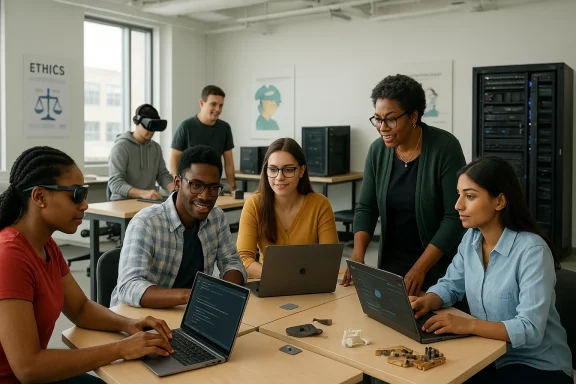
The AI Innovation Studio opened on the third floor of the Student Innovation Center as a purpose-built makerspace (room 3112) designed to give the entire campus low-barrier access to contemporary AI tools and peripherals, including AR/VR headsets and smart glasses, pro subscriptions such as ChatGPT Plus and Midjourney Pro, and a dedicated server and workstation for heavier experimentation. The Student Innovation Center describes the studio as part of its makerspace portfolio and lists the AI studio alongside other specialty shops and labs across the building. The studio was funded in part through private philanthropy and student technology fee allocations. A named gift — the AI Innovation Studio Support Fund — from Tony and Neera Talbert will support the space’s evolving needs: subscriptions, peripheral devices that attract undergraduate engagement, and replacement technology as the AI landscape advances. Inside Iowa State reported the new studio’s hours (Monday 10 a.m.–2 p.m.; Tuesday–Friday 10 a.m.–5 p.m. and framed the space as the Student Innovation Center’s ninth makerspace. This combination of institutional funding, donor support, and staff-backed programming reflects a broader trend on campuses to make AI tooling both equitable and supervised — enabling exploration while avoiding ad-hoc student-only use of consumer tools that may violate privacy or procurement policies.
The studio’s strengths are clear: equitable access, hands-on mentorship, and curriculum alignment. The risks are equally tangible: privacy exposure, vendor churn, uneven participation and academic integrity challenges. Thoughtful governance, predictable budgeting and an emphasis on reproducibility and ethics will be essential to convert early momentum into sustained impact. For universities building similar facilities, Iowa State’s model offers practical lessons — and a reminder that accessibility, oversight and pedagogy must move in step as AI becomes a core teaching and creative tool.
Source: inside.iastate.edu AI makerspace provides opportunities to all - Inside Iowa State
 Background
The AI Innovation Studio opened on the third floor of the Student Innovation Center as a purpose-built makerspace (room 3112) designed to give the entire campus low-barrier access to contemporary AI tools and peripherals, including AR/VR headsets and smart glasses, pro subscriptions such as ChatGPT Plus and Midjourney Pro, and a dedicated server and workstation for heavier experimentation. The Student Innovation Center describes the studio as part of its makerspace portfolio and lists the AI studio alongside other specialty shops and labs across the building. The studio was funded in part through private philanthropy and student technology fee allocations. A named gift — the AI Innovation Studio Support Fund — from Tony and Neera Talbert will support the space’s evolving needs: subscriptions, peripheral devices that attract undergraduate engagement, and replacement technology as the AI landscape advances. Inside Iowa State reported the new studio’s hours (Monday 10 a.m.–2 p.m.; Tuesday–Friday 10 a.m.–5 p.m. and framed the space as the Student Innovation Center’s ninth makerspace. This combination of institutional funding, donor support, and staff-backed programming reflects a broader trend on campuses to make AI tooling both equitable and supervised — enabling exploration while avoiding ad-hoc student-only use of consumer tools that may violate privacy or procurement policies.What the AI Innovation Studio offers
The Studio’s design splits tools and learning into three broad tiers so users can choose a path that matches their skills and goals:- No-code tools: Accessible interfaces like ChatGPT and Microsoft Copilot for rapid prototyping, idea-generation, summarization and first-pass scripting. These tools lower the barrier for students from non-technical majors.
- Low-code tools: Drag-and-drop automations and agent builders where students can assemble AI agents that reason, plan and act in looped workflows. These let students produce functioning prototypes without a full software-engineering background.
- Advanced tools: Compute-backed development using local or cloud-hosted models, ML toolkits, and VR/AR integrations for students who want to build custom models, domain-specific pipelines or immersive demonstrations. The studio includes a dedicated server and high-powered workstation to support this level of work.
- A dedicated server and high-performance workstation for training, inference and VR rendering.
- Laptops pre-configured with pro-tier generative AI subscriptions and image/video tools for immediate experimentation.
- AR/VR headsets, Ray-Ban Meta smart glasses and other peripherals that illustrate embodied AI interactions.
- Local tooling for private model hosting (LM Studio, Ollama) and industry-standard creative suites (Adobe, Blender, SketchUp).
Programming: workshops, tracks and the Applied AI Challenge
Programming is deliberately bite-sized and inclusive. Workshops planned for the spring semester cover prompting for text/image/video generation, building AI assistants with knowledge bases, converting sketches to 3D-printable models, and non-coder friendly “vibe-coding” approaches for prototyping software and portfolios. The studio’s workshop tracks feed directly into the second annual Applied AI Challenge — a short, sprint-style competition where student teams propose and develop solutions to real-world problems between April 3 and April 17. No coding experience is required to participate. Why this matters: converting workshops into competition tracks creates a low-friction progression from learning a tool to applying it under structured constraints. Students get both formative exposure (workshop) and summative practice (challenge), which accelerates skill acquisition and yields artifacts they can put in portfolios.Academic integration: support for the Applied AI minor
The AI Innovation Studio is explicitly positioned as a hands-on complement to Iowa State’s applied AI minor, an interdisciplinary undergraduate program available to students in any major that emphasizes practical, low-code/no-code AI literacy alongside ethics and social impact coursework. The applied AI minor (15 credits) includes core classes such as Introduction to Applied AI and Ethical Design, Use, and Impact of AI, and a menu of electives that span data science, image analysis and technology-and-society offerings. The minor is framed as a way for students to “drive a car” with AI tools rather than under-the-hood engineering — giving a workforce-ready skillset for diverse career paths. The Student Innovation Center’s faculty and staff — notably associate director Abram Anders, who has led AI curriculum initiatives — say the studio’s workshop curriculum is integrated into the minor’s offerings and provides direct, supervised practice for students taking core courses. This helps address concerns faculty have about unguided tool use by creating controlled, educational access points on campus.Strengths: what makes this approach effective
- Equitable access to paid tools and hardware. By centralizing licenses (ChatGPT Plus, Midjourney Pro, Runway Pro) and devices (headsets, smart glasses), the studio removes financial barriers for students who otherwise couldn't afford pro subscriptions or specialized peripherals. This levels the playing field across majors and socioeconomic backgrounds.
- Tiered learning pathway. The no-code → low-code → advanced progression is pedagogically sound: it reduces intimidation, lets students iterate quickly, and funnels motivated learners toward deeper technical training. This increases retention and produces more tangible outcomes (demos, prototypes, competition entries).
- On-site mentorship and safety. Graduate assistants with human–computer interaction and computer science backgrounds staff the studio, providing hands-on troubleshooting, ethical guidance and technical scaffolding. That human support is crucial when students are experimenting with tools that can hallucinate, misattribute content or mishandle data.
- Curriculum alignment. Integrating the studio with the applied AI minor and formal coursework helps faculty design assessments and incorporate AI into syllabi without leaving students to discover powerful tools informally. The combination of classroom instruction and supervised practice builds both skills and critical literacy.
- Short-cycle experimentation and events. Workshops feeding into the Applied AI Challenge create compact product cycles that motivate teams to deliver prototypes with concrete deadlines, mirroring real-world development rhythms and enhancing portfolio creation.
Risks and limitations — what requires careful attention
While the studio is a strong model, a campus makerspace for AI carries technical, ethical and operational risks that must be actively managed.- Data privacy and exposure risk. Generative AI tools and hosted model services can log prompts and uploaded data. If students or researchers upload sensitive datasets (e.g., health records, proprietary research), they risk leaking information to third-party providers unless the campus enforces clear policies and vetted enterprise contracts. The studio’s local model tools (LM Studio, Ollama) help mitigate this, but only if used and configured properly.
- Vendor dependency and licensing churn. Pro licenses (ChatGPT Plus, Midjourney Pro, Runway Pro, Adobe Firefly) give students access to fast-evolving features, but they also create budget and procurement burdens. The named fund and student tech fees can bridge early costs, but long-term sustainability requires predictable budgeting and procurement agreements to prevent sudden feature loss.
- Academic integrity and assessment design. As students learn to use generative tools, faculty must redesign assessments to evaluate process, reasoning and verification rather than only end products. Otherwise, course outcomes risk being undermined by tools that can produce superficially polished but unverified work. The studio’s workshops and faculty-facing resources can help, but institution-wide guidance is necessary.
- Skill gaps and uneven participation. No-code tools are accessible, but deeper understanding of bias, model limitations and evaluation requires structured curricula. Without equitable program outreach, students with prior exposure or domain privilege could dominate the best opportunities. The studio’s team-based workshops and competitions are a mitigation, but intentional outreach is required.
- Safety and misuse. Tools that enable deepfakes, automated persuasion or social engineering raise safety concerns. The studio must implement content policies, usage monitoring and human-in-the-loop checkpoints for high-risk projects. Institutional review boards or ethics review pathways might be necessary for certain research projects.
- Unverifiable or donor-related claims. Some background details such as donors’ specific corporate titles or employment histories are reported in the studio announcement but require independent corroboration. For example, the Inside Iowa State story reports Tony Talbert retired from IBM and Neera Talbert is a Microsoft executive; those personnel details appear only in the institutional announcement and could not be independently confirmed in public corporate filings at the time of reporting — this should be treated cautiously until verified through additional records or donor statements.
Governance, procurement and technical hygiene — practical recommendations
To translate enthusiasm into durable capability, the Student Innovation Center and similar campus units should consider the following implementation checklist:- Establish clear data-handling policies for generative AI use in the studio, differentiating between public, internal and sensitive data and enforcing tooling choices accordingly.
- Negotiate campus-level licensing and contractual terms that include data-use clauses (no training on customer data, retention limits, audit rights) and offer predictable renewal costs.
- Maintain a hybrid toolset: keep pro cloud services for rapid experimentation but prioritize local model hosting and isolated compute for sensitive or production-grade research.
- Provide mandatory workshops on AI ethics, hallucinations, model provenance and citation best practices for any user of pro services.
- Design assessment rubrics that reward process transparency (prompt logs, chain-of-thought annotations), reproducibility and human verification in instructor-graded coursework.
- Create an internal review pathway for projects with potential for misuse (deepfakes, deceptive automation, health data) including consults with campus counsel or IRB equivalents.
- Track outcomes: collect metrics on who uses the studio (majors, class-level, demographic mix), how many prototypes become start-up or research projects, and where students go on graduation to measure ROI.
Student and faculty impact: early evidence and stories
Initial reporting and studio documentation highlight rapid and diverse uses: undergraduates sketching product concepts and converting them to 3D-printable models, cross-disciplinary teams building knowledge-base agents for domain-specific tasks, and researchers using the server and tools to prototype vision and VR integrations. Graduate assistants emphasized that many undergraduates have high-level ideas but lack implementation pathways; the studio bridges that gap by making tools available and offering hands-on mentorship that turns concepts into demonstrable prototypes. The combination of open hours, structured workshops, and an applied competition is generating artifacts (portfolio pieces and proof-of-concept projects) that are immediately useful for internships and job interviews. For students from non-traditional computing backgrounds, the studio creates a safe environment to test how AI tools can augment disciplines ranging from agricultural communications to design.National context: why campus AI makerspaces matter
Universities are increasingly responding to pervasive generative AI adoption by creating campus-guided access points. The goals are consistent across institutions:- Demystify tools by embedding them in pedagogy rather than leaving students to adopt consumer services unsupervised.
- Address equity by providing paid resources and compute to students regardless of personal means.
- Protect privacy and compliance by concentrating tool use under vetted agreements and institutional governance.
- Drive workforce readiness by teaching prompt engineering, tool selection and verification practices that employers seek.
The long view: sustainability and scaling
Short-term excitement must be converted into sustainable capacity. Key levers for longevity include:- Institutional budget lines for recurring license renewals and hardware refresh cycles.
- Curricular anchors that send a steady stream of students through the studio (core classes, minors, capstones).
- Partnerships with campus IT to integrate identity, SSO and data governance into tool provisioning.
- Ongoing donor cultivation to support high-cost peripherals and occasional high-performance compute bursts.
Conclusion
The AI Innovation Studio at Iowa State exemplifies a pragmatic, inclusive model for bringing contemporary AI into undergraduate education and campus research. By offering tiered tooling (no-code, low-code, advanced), staffed mentorship, pro subscriptions and a linked curricular minor, the studio reduces friction for students and faculty who want to explore generative AI responsibly. That said, responsible stewardship — from procurement and data governance to assessment redesign and outreach — will determine whether the makerspace becomes a long-term institutional advantage or a short-lived experiment.The studio’s strengths are clear: equitable access, hands-on mentorship, and curriculum alignment. The risks are equally tangible: privacy exposure, vendor churn, uneven participation and academic integrity challenges. Thoughtful governance, predictable budgeting and an emphasis on reproducibility and ethics will be essential to convert early momentum into sustained impact. For universities building similar facilities, Iowa State’s model offers practical lessons — and a reminder that accessibility, oversight and pedagogy must move in step as AI becomes a core teaching and creative tool.
Source: inside.iastate.edu AI makerspace provides opportunities to all - Inside Iowa State
