

IP Fabric’s latest update promises to remove a long-standing blind spot for hybrid teams by deepening native visibility into Microsoft Azure and Google Cloud Platform (GCP) constructs—adding Azure Firewall, Private Link and Private Endpoint context, multi‑project GCP discovery, and improved hybrid pathing—features the vendor says will make network assurance truly multi‑cloud and easier to operationalize.
Enterprises have steadily moved to hybrid and multi‑cloud architectures, and the network layer has become the hardest place to keep a single, accurate source of truth. Traditional discovery and monitoring tools often treat cloud constructs as isolated objects, leaving network teams to stitch together application paths, peering, private connectivity and cloud security constructs manually. IP Fabric has built its reputation as an automated network assurance and modeling platform that creates continuously validated network snapshots and digital twins; the company’s new January release claims to extend that model deeper into Azure and GCP so the same assurance workflows cover cloud‑native constructs. This latest product move follows a steady cadence of enhancements from IP Fabric over the last 18 months—including the significant 7.0 platform refresh that added broader cloud and edge visibility, advanced BGP analytics and snapshot improvements—which established the company as a visible player in the network assurance and observability space. Independent trade coverage of prior releases explains how IP Fabric’s approach mixes digital‑twin snapshots with automated intent checks to reduce troubleshooting time and compliance risk.
IP Fabric’s update is an instructive example of how network assurance vendors are evolving to meet multi‑cloud realities: closing visibility gaps, making hybrid pathing accurate, and packaging analysis so that teams can act faster. Organizations that depend on private connectivity, cloud firewalls, and precise routing should evaluate the platform on live scenarios rather than marketing claims—but for many, the ability to see private endpoints and interconnects in the same model as routers and firewalls will be a material operational win.
Source: IT Brief New Zealand https://itbrief.co.nz/story/ip-fabric-boosts-azure-google-cloud-network-insight]
 Background
Enterprises have steadily moved to hybrid and multi‑cloud architectures, and the network layer has become the hardest place to keep a single, accurate source of truth. Traditional discovery and monitoring tools often treat cloud constructs as isolated objects, leaving network teams to stitch together application paths, peering, private connectivity and cloud security constructs manually. IP Fabric has built its reputation as an automated network assurance and modeling platform that creates continuously validated network snapshots and digital twins; the company’s new January release claims to extend that model deeper into Azure and GCP so the same assurance workflows cover cloud‑native constructs. This latest product move follows a steady cadence of enhancements from IP Fabric over the last 18 months—including the significant 7.0 platform refresh that added broader cloud and edge visibility, advanced BGP analytics and snapshot improvements—which established the company as a visible player in the network assurance and observability space. Independent trade coverage of prior releases explains how IP Fabric’s approach mixes digital‑twin snapshots with automated intent checks to reduce troubleshooting time and compliance risk. What IP Fabric announced (feature summary)
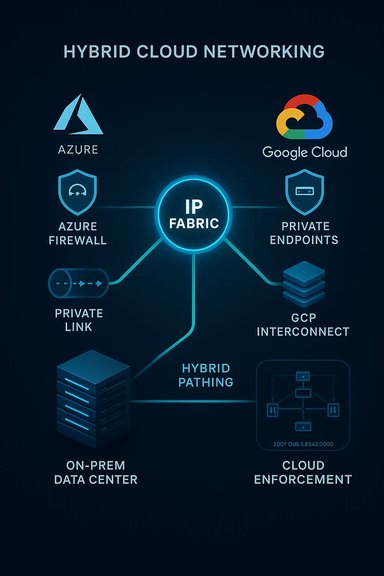
IP Fabric’s Jan. 14, 2026 announcement lists a set of concrete enhancements aimed at making cloud networking visible inside the platform’s end‑to‑end model. The most notable items are:- Expanded Azure visibility: Adds interpretation and modeling for Azure Firewall, Private Link and Private Endpoints so those elements appear in path diagrams and intent checks.
- Expanded GCP visibility: Multi‑project discovery and modeling plus support for GCP Interconnect, enabling correct hybrid path interpretation when on‑premises networks hang off Interconnect links.
- Improved hybrid pathing: Enriched cloud metadata and path simulation to produce accurate, user‑friendly diagrams of end‑to‑end flows across on‑prem and cloud.
- IPv6 support and vendor coverage: Improved IPv6 modeling across major vendors and general hybrid usability improvements (filtering, CSV attribute import/export, simplified filters).
Why this matters: operational and security implications
Cloud constructs are not just configuration knobs—they are often enforcement points for security and routing decisions. For example, Azure Private Endpoints and Private Link change how traffic reaches PaaS services; misinterpreting those paths can lead to silent bypasses of network or security controls. IP Fabric’s capability to show those constructs in a validated path model gives operations teams a way to test and document actual enforcement points rather than relying on fragmented consoles and ad‑hoc diagrams. This matters for:- Troubleshooting speed: Accurate paths reduce the “who owns this?” handoff between cloud, network and security teams.
- Compliance evidence: End‑to‑end diagrams and snapshots make it easier to demonstrate policy enforcement to auditors.
- Migration and M&A projects: Clear hybrid pathing reduces risk during rapid change windows.
- Security posture validation: Encoding cloud firewalls and private endpoints into automated checks helps detect misconfigurations that could expose data.
Technical analysis: what’s new under the hood (practical detail)
IP Fabric’s platform builds a logical model (a “snapshot”) of the environment by pulling configuration and state from network devices and cloud APIs, then synthesizing a normalized topology. The January update appears to focus on enriching that model with cloud provider metadata so the snapshot’s path engine can make correct decisions when a flow touches:- Cloud firewalls (e.g., Azure Firewall rules and zones),
- Private connectivity services (Private Link/Endpoints, GCP Interconnect),
- Multi‑project GCP resources (to correctly aggregate cross‑project routing and IAM),
- IPv6 addresses and vendor‑specific behaviors.
Strengths and practical advantages
- Unified source of truth: By modeling cloud constructs alongside on‑prem devices, platform users can depend on a single authoritative snapshot instead of ad‑hoc spreadsheets and slide decks. This reduces tribal knowledge risk and speeds incident response.
- Actionable diagrams and path interpretation: Plain diagrams with interpretive text reduce the need for deep platform expertise in every incident, enabling first responders to triage faster and hand off remediation tasks.
- Automated intent checks that include cloud controls: Extending automated verification into cloud-native enforcement areas means some classes of misconfiguration can be detected before they cause outages or compliance failures.
- Improved IPv6 and multi‑vendor coverage: As enterprises adopt IPv6 and mix vendor gear with cloud services, the ability to model IPv6 behavior consistently is a clear operational win.
- Faster project delivery: IP Fabric’s digital‑twin snapshots and CSV import/export features are aimed at reducing the friction of large change programs such as SD‑WAN rollouts and cloud migrations.
Risks, caveats and limitations
- Vendor claims vs. real‑world complexity: The features described come from a vendor press release and subsequent re‑publishing by news services. While the capabilities are plausible and consistent with prior product direction, organizations should validate real‑world fidelity in their own environments—especially for complex, cross‑project GCP setups or bespoke Private Link/PaaS topologies. Treat vendor claims as a starting point for validation, not final proof.
- API permissions and coverage gaps: Deep cloud visibility requires fairly broad read permissions against cloud accounts and projects. In some regulated environments, granting those permissions to a third‑party tool may be nontrivial and require careful design of least‑privilege roles and audit controls. Teams should evaluate what APIs are required and how access will be provisioned.
- Control plane blind spots: Private connectivity and managed services often have vendor control‑plane behavior that’s opaque (for example, proprietary routing within a cloud backbone). No external tool can perfectly simulate every vendor‑internal failure mode; IP Fabric will improve the surface‑level view but cannot guarantee to model every internal cloud control plane nuance. Verify critical assumptions with cloud provider documentation and run controlled tests.
- Scale and cost: Continuous snapshotting and high‑fidelity modeling at enterprise scale requires compute and storage budget. Teams should estimate the snapshot cadence and data retention needed to meet compliance and debugging goals and measure platform TCO against incident MTTR reductions.
- Integration and change management overhead: Introducing a new platform into mature workflows requires cross‑discipline buy‑in (network, cloud, security, compliance). Expect an initial investment to map runbooks and integrate outputs into ticketing and automation systems.
How to evaluate IP Fabric’s claims in your estate (practical checklist)
- Prepare test cases that cover common, real‑world failure modes you care about (Private Endpoint misconfigurations, cross‑project routes in GCP, IPv6 routing anomalies).
- Run a baseline snapshot and export the diagrams and path outputs for those test cases.
- Create the same test case in the actual environment and use synthetic traffic or application‑level tests (curl, application probes, or user experience tests) to verify the snapshot’s path vs. observed traffic flow.
- Check for cloud API permissions required and validate with your security/compliance team whether the read scopes are acceptable.
- Validate automated checks and intent rules by creating a controlled misconfiguration and ensuring the platform detects it and provides actionable remediation steps.
- Measure snapshot processing time, storage use and API rate limits to ensure operational cadence (for example, hourly snapshots vs. daily) matches needs.
- Integrate outputs into your incident response pipeline and run a tabletop exercise to ensure teams can action the diagrams under pressure.
Deployment patterns and recommended architecture
- Use a least‑privilege service account in Azure and GCP that exposes only the read APIs the tool needs. Document the roles and refresh token policies.
- Start with a pilot covering a single VNet/Project and a key on‑prem region to validate hybrid pathing fidelity before enterprise rollout.
- Integrate platform outputs into existing SIEM, ITSM and runbook automation so diagrams and intent checks become part of incident tickets, not separate artifacts.
- Configure snapshot cadence based on change windows: tighter cadence for dynamic, high‑change environments (dev/test) and longer for stable production. Measure cost vs. incremental value.
The market context: why vendors are racing to cloud‑native visibility
Hyperscalers and cloud‑centric tools have pressured observability vendors to interpret cloud constructs meaningfully rather than treat them as black boxes. Enterprises deploying AI, multi‑region databases and latency‑sensitive services demand predictable paths and proof of enforcement. IP Fabric’s move is one among several in the industry pushing observability into cloud control‑plane metadata and private connectivity (other vendors are also adding deep cloud inventory and interconnect modeling). This is consistent with a broader trend in which networking teams expect the same fidelity for cloud objects as for on‑prem routers and firewalls. The strategic value of accurate hybrid pathing has been underscored by recent hyperscaler network investments and partnerships that upgrade backbone and peering fabrics—those moves raise the bar for third‑party assurance tools to model multi‑terabit fabrics and complex interconnects correctly. Industry reporting on recent infrastructure upgrades shows hyperscalers and large vendors are moving to higher‑speed interconnects and richer software-defined networking toolsets to satisfy AI and global‑scale workloads.Bottom line for WindowsForum readers and IT decision‑makers
IP Fabric’s January release addresses a persistent operational gap by folding Azure and GCP native constructs into an automated, end‑to‑end model. For teams that run hybrid applications, use private connectivity, or must produce auditable evidence of network controls, the update is a meaningful step toward single‑pane hybrid assurance. However, the announcement is vendor‑driven and should be treated as a capability preview until validated within your specific cloud architecture and compliance constraints. Practical next steps for Windows and cloud operations teams:- Run a targeted pilot that includes a representative mix of Azure/GCP constructs (Private Endpoints, Private Link, Interconnect, multi‑project GCP) and a set of real application paths.
- Validate API access models with security and limit third‑party privileges to least privilege.
- Measure operational impact (MTTR, manual hours saved) and compare TCO to the risk reduction gained by automated intent checks and single‑source documentation.
- Include cloud platform teams in the onboarding plan—true hybrid assurance is an organizational problem as much as a technical one.
IP Fabric’s update is an instructive example of how network assurance vendors are evolving to meet multi‑cloud realities: closing visibility gaps, making hybrid pathing accurate, and packaging analysis so that teams can act faster. Organizations that depend on private connectivity, cloud firewalls, and precise routing should evaluate the platform on live scenarios rather than marketing claims—but for many, the ability to see private endpoints and interconnects in the same model as routers and firewalls will be a material operational win.
Source: IT Brief New Zealand https://itbrief.co.nz/story/ip-fabric-boosts-azure-google-cloud-network-insight]
