

The iQOO 15’s India arrival is shaping up to be as notable for its software promise as it is for raw horsepower: iQOO has signalled a substantial upgrade to its long-term support policy for the new flagship, promising five years of OS updates and seven years of security patches, while shipping the phone with OriginOS 6 (based on Android 16) and a spec sheet that reads like a high‑end play for endurance and photography.
iQOO’s 15 will make its India debut later this month; company teasers and retailer listings put the official launch in late November, with the brand confirming a November 26 India event in several announcements and media briefings. Why this matters: in a market where flagship buyers increasingly expect multi‑year platform support, iQOO’s claimed five‑year OS and seven‑year security window would be a major step up from the brand’s prior commitments and would put the company in closer alignment with a broader industry trend toward extended Android lifecycles. The move follows iQOO’s recent extension of the iQOO 12’s update policy and follows wider platform-level initiatives (notably Qualcomm/Google conversations around longer Android support for Snapdragon‑powered phones).
At the platform level, Qualcomm’s public advocacy for extended support windows for Snapdragon devices provides a backbone for vendors to execute multi‑year promises — but the work still falls to OEMs to fund, QA and deliver the update streams for years after a phone ships.
That said, the most important verification will arrive post‑launch: the official lifecycle wording, the first year’s cadence of monthly security updates, and clarity on whether the policy applies uniformly across Indian SKUs and carrier variants. Early reporting is consistent that the phone ships with OriginOS 6 on Android 16, the Snapdragon 8 Elite Gen 5 platform, a 7,000 mAh battery, and an ultra‑bright Samsung M14 OLED display — but the precise translation of the update promise into major Android versions remains ambiguous in outlets’ paraphrases and should be confirmed in the official policy text. Practical advice for interested buyers: treat the iQOO 15’s long‑term support pledge as a strong positive signal, verify the exact policy language at launch, and monitor the vendor’s update cadence closely in year one — that will be the clearest indicator of whether iQOO intends to make long‑term software support a durable differentiator.
Source: TechJuice iQOO 15 to Receive 5-Year of OS Updates and 7-Year Security Support
 Background / Overview
iQOO’s 15 will make its India debut later this month; company teasers and retailer listings put the official launch in late November, with the brand confirming a November 26 India event in several announcements and media briefings. Why this matters: in a market where flagship buyers increasingly expect multi‑year platform support, iQOO’s claimed five‑year OS and seven‑year security window would be a major step up from the brand’s prior commitments and would put the company in closer alignment with a broader industry trend toward extended Android lifecycles. The move follows iQOO’s recent extension of the iQOO 12’s update policy and follows wider platform-level initiatives (notably Qualcomm/Google conversations around longer Android support for Snapdragon‑powered phones). What iQOO is promising — the headline commitments
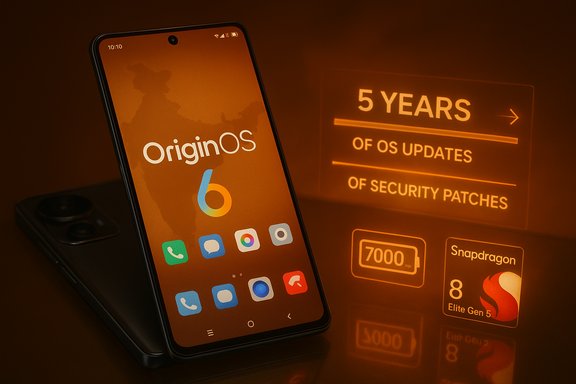
- Five years of OS updates: iQOO says the iQOO 15 will be eligible for major Android version updates for a five‑year span. Multiple outlets reporting on an iQOO/India briefing and an exclusive Smartprix item confirm the five‑year OS commitment.
- Seven years of security patches: the device is also being presented with a seven‑year security patch window, intended to keep the device protected from emergent vulnerabilities long after many typical upgrade cycles.
- OriginOS 6 on Android 16 out of the box: iQOO is shipping the 15 with OriginOS 6 (Vivo’s current flagship skin) based on Android 16, marking one of the first major Indian flagship launches to arrive with that base build.
The hardware headline: endurance, display, and flagship silicon
Beyond the update pledge, the iQOO 15’s hardware is intended to justify keeping the phone relevant for the long haul:- Snapdragon 8 Elite Gen 5 — the latest top‑tier Qualcomm mobile SoC is confirmed for India, delivering the peak CPU, GPU and NPU performance expected of 2025 flagships.
- 7,000 mAh battery — the phone carries a very large battery for a flagship device, which iQOO pairs with fast wired and wireless charging in teasers and third‑party reporting. Multiple media reports cite a 7,000 mAh battery figure for the India variant.
- Samsung M14 LEAD OLED (2K) with extreme peak brightness — iQOO and retailer listings reference a Samsung M14 OLED panel with a 2K resolution and a claimed high‑brightness mode in the 2,600‑nits range, positioning the screen as one of the brightest available on a phone.
- Triple‑camera system and wireless charging — teasers and early spec pages point to a 50MP‑class primary camera plus high‑quality supporting modules, along with wireless charging support — features that underline iQOO’s push beyond pure gaming‑centric claims.
What “five years of OS updates and seven years of security patches” actually means — and what it doesn’t
The marketing line reads cleanly, but translation to real‑world outcomes needs careful reading.1) OS updates vs. update years
“Five years of OS updates” is widely used in vendor messaging to mean major Android version upgrades (Android 17, 18, etc., but manufacturers can phrase this differently: some promise “X years of Android version updates,” others promise “X years of security updates” or a mix of version + security coverage.- If iQOO’s commitment means five major Android version upgrades, a phone shipping with Android 16 could theoretically receive updates through Android 21 (Android 17 through Android 21 inclusive). Several outlets paraphrase the claim as “updates up to Android 20,” while others say “Android 21” — the discrepancy demonstrates how vendors’ counting conventions (release‑year inclusive or exclusive) create real ambiguity. This divergence is visible in current reporting and should be treated as an open item until iQOO publishes the exact wording.
2) Regional and SKU differences
OEM update policies sometimes differ by market or by SKU (carrier locked vs unlocked). Historically, variants with different modems, carriers or region‑specific radios have been released on staggered update cadences. Buyers should expect possible regional caveats to the headline promise. There is no public guarantee yet that every India SKU will share identical timelines for all components or features.3) Delivery channels: over‑the‑air cadence and OEM responsibility
Long‑term support requires sustained engineering work: OS merges, driver backports, chipset firmware updates and compatibility testing. iQOO’s promise imposes a multi‑year commitment on its engineering resources; whether that commitment is met in practice will depend on company follow‑through, regional testing labs and partnerships with component vendors (Qualcomm, Samsung, camera sensor suppliers). OEMs have missed or delayed promised updates in the past; a policy itself is only as reliable as the company’s delivery track record.Why this matters to buyers — practical implications
- Improved longevity and resale value: phones that receive major OS upgrades and regular security fixes remain usable and compatible with new apps for longer, supporting a longer ownership cycle and better second‑hand value.
- Better privacy and security posture: seven years of security patches — if delivered consistently — reduces exposure to zero‑day and newly discovered issues compared with many three‑ or four‑year policies.
- Investment protection for power users: buyers who invest in a premium phone expect two or more years of flagship performance; longer software support aligns vendor incentives with buyers who plan to keep phones for four or five years.
- Environmental benefits: extending primary software support can curb premature replacement cycles and reduce e‑waste pressure, provided hardware remains physically serviceable.
Cross‑checking the claims — independent verification
Multiple independent outlets reported the same core points ahead of launch: India Today, Mint, Business Standard and Gadgets360 confirm the India launch and the Snapdragon 8 Elite Gen 5 platform, and specialist sites such as Smartprix, Gizmochina and Beebom reported the five‑year OS / seven‑year security claim. The TechJuice piece you shared mirrors these points. These are consistent, independently sourced signals that the company is positioning the iQOO 15 as a long‑support flagship. However, two kinds of caution are necessary:- Some details differ between reports (for example, whether the OS upgrades extend “up to Android 20” or “up to Android 21”), reflecting imprecise paraphrasing in early coverage and the standard ambiguity when vendors talk about “years” versus “major version upgrades.” Until iQOO publishes the formal lifecycle policy (wording that explicitly says “X major Android version upgrades” or “X years from release date”), that specific projection is not fully verifiable.
- Charger wattages, wireless charging speeds and precise camera sensor models are sometimes listed as “expected” or “rumoured” in retailer microsites and press copies; these should be validated against the official India product page or the launch event spec sheet for a definitive confirmation.
Competitive context — where iQOO’s promise sits in 2025
The iQOO 15’s software promise should be read against two industry trends:- OEMs extending support windows: Samsung, Google and some other vendors have already moved to multi‑year OS/security policies (Samsung and Google in particular have been publishing ever‑longer support windows), and Qualcomm has publicly encouraged extended vendor update programs for Snapdragon devices. An OEM offering five years of OS updates and seven years of security patches is therefore entering a broader competitive baseline, rather than inventing a new category.
- The cost of longer support: extended lifecycles can be expensive for vendors—engineering backlog, driver maintenance, and certification/testing cycles for successive Android releases add recurring cost. Some vendors mitigate this by committing to security patches only after a certain point, or by narrowing feature updates to a subset of models. Buyers should watch for the specific iQOO terms (major version upgrades vs. security‑only) and any small‑print regional exceptions.
Strengths of iQOO’s approach
- Stronger value proposition for long‑term ownership: committing to multiple years of OS and security coverage transforms a phone from a short‑term purchase into an investment that can stay secure and feature‑complete longer.
- Alignment with platform initiatives: iQOO’s policy dovetails with Qualcomm and Google’s push for extended Android support on modern Snapdragon silicon, which should reduce friction when vendors integrate new Android releases.
- Hardware choices that support longevity: the Snapdragon 8 Elite Gen 5’s modern drivers, the large 7,000 mAh battery and a high‑quality Samsung OLED panel suggest the hardware platform is chosen to remain usable and competitive over several Android cycles.
Risks, caveats and practical limitations
- Ambiguity in marketing language: without a formal iQOO policy page that reads “X major Android version upgrades” and “Y years of security patches,” buyers must accept a level of interpretive risk. Early reports already show conflicting statements (Android 20 vs Android 21 projections). Until the company publishes precise legal/marketing language, treat the headline numbers as conditional.
- Regional differences and carrier testing: some markets require extended carrier certification or regulatory checks that can delay or limit updates. Buyers in India should confirm the policy on iQOO India’s official support page after launch.
- UI and feature parity: long OS support does not guarantee parity in OEM features and app updates; OriginOS 6 changes and vendor‑specific services may not receive the same level of enhancement every year the way stock Android receives platform changes. Some features require new hardware (e.g., NPUs at a given TOPS threshold), so while the OS may update, feature experience may diverge.
- True security coverage vs. perceived coverage: “seven years of security patches” is meaningful only if the patches include kernel and vendor driver fixes, are delivered monthly (or at a predictable cadence), and are applied across all market SKUs. A vendor could theoretically narrow the scope of what is patched under the “security patch” umbrella. Independent verification over the 1st and 2nd years will be the best indicator of future reliability.
How to evaluate iQOO’s claim at launch — a checklist for buyers
- Read the official lifecycle statement on the iQOO India product/support page to confirm whether “five years” means five major Android version upgrades or five years from release date.
- Check the initial Android version shipped (OriginOS 6 on Android 16) and ask the vendor which Android version represents the final guaranteed update tier.
- Confirm whether carrier‑branded or India‑specific SKUs are covered identically to the global/unlocked SKUs.
- Monitor iQOO’s update cadence over the first 12 months — the frequency and scope of security updates are a practical proxy for long‑term reliability.
- Retain proof of purchase and register the device with iQOO for support eligibility to simplify future warranty and update queries.
Longer view — what this means for the Android ecosystem
iQOO’s commitment, if executed, reinforces a broader market trajectory toward longer device lifespans and reduces the incentive for frequent hardware churn. The move also pressures other OEMs to clarify their policies and raises buyer expectations that flagships should be supported for more than the traditional two‑to‑three years.At the platform level, Qualcomm’s public advocacy for extended support windows for Snapdragon devices provides a backbone for vendors to execute multi‑year promises — but the work still falls to OEMs to fund, QA and deliver the update streams for years after a phone ships.
Short technical note on the OS‑version math (why observers differ)
There are two common ways manufacturers and press outlets count updates:- By years (e.g., “5 years from release”) — this is chronological and straightforward but does not spell out how many major Android versions are included.
- By major Android version upgrades (e.g., “5 major Android updates”) — this is outcome‑driven but depends on how many Android releases ship during the five‑year window.
Conclusion
The iQOO 15 is not just another spec‑heavy flagship; it’s being positioned as a longer‑term investment with an unusually broad software and security promise for the brand. If iQOO follows through on five years of OS updates and seven years of security patches, the 15 will become a compelling option for buyers who prioritise long ownership horizons and sustained security.That said, the most important verification will arrive post‑launch: the official lifecycle wording, the first year’s cadence of monthly security updates, and clarity on whether the policy applies uniformly across Indian SKUs and carrier variants. Early reporting is consistent that the phone ships with OriginOS 6 on Android 16, the Snapdragon 8 Elite Gen 5 platform, a 7,000 mAh battery, and an ultra‑bright Samsung M14 OLED display — but the precise translation of the update promise into major Android versions remains ambiguous in outlets’ paraphrases and should be confirmed in the official policy text. Practical advice for interested buyers: treat the iQOO 15’s long‑term support pledge as a strong positive signal, verify the exact policy language at launch, and monitor the vendor’s update cadence closely in year one — that will be the clearest indicator of whether iQOO intends to make long‑term software support a durable differentiator.
Source: TechJuice iQOO 15 to Receive 5-Year of OS Updates and 7-Year Security Support
