

What if the long-promised “year of Linux on the desktop” quietly arrived — not with a headline-grabbing coup but as a creeping, measurable shift in how ordinary people use their computers — and almost nobody noticed? Over the last 12 months a series of small, connected signals has pushed Linux out of the server room and into everyday use: a tidal wave of curiosity and downloads for migration‑friendly distributions, measurable share gains in public telemetry, and a hardware- and policy-driven squeeze on Windows upgrades that left millions of devices stranded. Taken together, those signals amount to more than noise. They describe a moment — not a wholesale takeover, but a credible, sustained change in the desktop landscape that deserves careful scrutiny. Recent reporting and telemetry — including Zorin OS’s reported one‑million downloads, StatCounter’s rising Linux figures, the U.S. federal Digital Analytics Program’s Linux traffic numbers, and independent scans of millions of consumer PCs — all point to a trend that is small in percentage but large in consequence.
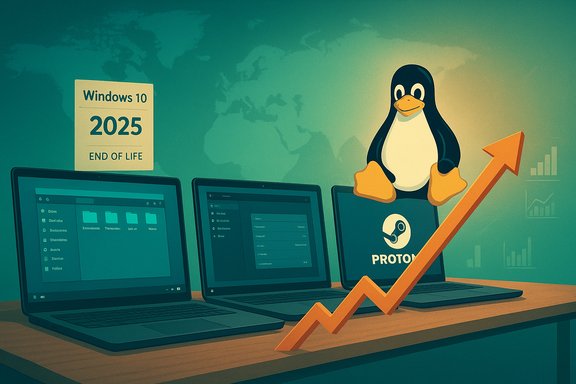
The most visible catalyst was calendar pressure: Microsoft ended mainstream support for Windows 10 on October 14, 2025. That formal deadline forced consumers and organisations to choose between upgrading to Windows 11 (when hardware allows), enrolling eligible devices in a limited Extended Security Updates (ESU) program, buying new hardware, or moving to an alternative such as ChromeOS Flex or a desktop Linux distribution. Microsoft’s own guidance and the ESU program are clear: Windows 10 will no longer receive routine feature or security updates after the cutoff, and ESU is explicitly framed as a short bridge, not a long‑term solution. Into that window stepped a range of Linux distributions explicitly pitched at Windows users. Most eye-catching among them was Zorin OS 18, which — according to multiple reports — hit roughly one million downloads within weeks of its release, with Zorin claiming about 78% of those downloads originated from Windows devices. That single figure is not proof of mass migration, but it acts like a visible flare: millions of Windows users were actively testing or trying alternatives in a compressed period. Those product-level signals sat beside independent telemetry: StatCounter showed desktop Linux moving past low single digits into the mid-single digits in recent months, and the U.S. Digital Analytics Program (DAP — analytics.usa.gov), which tracks billions of government website sessions, reported Linux accounting for roughly 5–6% of desktop sessions in its data set. Several industry analyses and scans — including a Lansweeper analysis of some 15 million consumer devices — reported Linux presence in the 5–6% range. Overlay ChromeOS and Android (both Linux‑kernel based), and the Linux family’s footprint in consumer devices balloons into the high tens of percent globally. Those numbers are uneven by methodology and sample, but they converge on a single conclusion: Linux is no longer a tiny niche on the desktop.
Caveat: some headline percentages you’ll see in discussion are aggregations or extrapolations (for example, adding ChromeOS and Android to “desktop Linux” or treating download counts as installs). Those are useful framing devices, but they should be treated as estimates rather than hard facts unless the original data source is transparent and reproducible. The most reliable route to judgement remains triangulation across sources: StatCounter, the Digital Analytics Program, inventory scans, vendor reports, and hard install/engagement metrics if and when vendors publish them. The quiet revolution is now visible enough to influence choices. For users on aging Windows 10 hardware, for educators and refurbishers, and for policy teams thinking about digital sovereignty and total cost of ownership, the pragmatic question is no longer “could we run Linux?” but “how do we do it safely, with minimal disruption, and with realistic expectations?” The answers will shape whether this year becomes an anecdote in the long history of missed Linux predictions, or the beginning of a durable pluralism on the desktop.
Source: Fudzilla.com What if we had a year of Linux on the desktop and no one realised?
 Background / Overview
The most visible catalyst was calendar pressure: Microsoft ended mainstream support for Windows 10 on October 14, 2025. That formal deadline forced consumers and organisations to choose between upgrading to Windows 11 (when hardware allows), enrolling eligible devices in a limited Extended Security Updates (ESU) program, buying new hardware, or moving to an alternative such as ChromeOS Flex or a desktop Linux distribution. Microsoft’s own guidance and the ESU program are clear: Windows 10 will no longer receive routine feature or security updates after the cutoff, and ESU is explicitly framed as a short bridge, not a long‑term solution. Into that window stepped a range of Linux distributions explicitly pitched at Windows users. Most eye-catching among them was Zorin OS 18, which — according to multiple reports — hit roughly one million downloads within weeks of its release, with Zorin claiming about 78% of those downloads originated from Windows devices. That single figure is not proof of mass migration, but it acts like a visible flare: millions of Windows users were actively testing or trying alternatives in a compressed period. Those product-level signals sat beside independent telemetry: StatCounter showed desktop Linux moving past low single digits into the mid-single digits in recent months, and the U.S. Digital Analytics Program (DAP — analytics.usa.gov), which tracks billions of government website sessions, reported Linux accounting for roughly 5–6% of desktop sessions in its data set. Several industry analyses and scans — including a Lansweeper analysis of some 15 million consumer devices — reported Linux presence in the 5–6% range. Overlay ChromeOS and Android (both Linux‑kernel based), and the Linux family’s footprint in consumer devices balloons into the high tens of percent globally. Those numbers are uneven by methodology and sample, but they converge on a single conclusion: Linux is no longer a tiny niche on the desktop. The data: what the numbers actually show
StatCounter: incremental gains, visible momentum
StatCounter’s public dashboards show global desktop Linux in the low single digits (roughly 3–4% worldwide in many months) and higher figures in specific markets such as the United States where it briefly crossed the 5% mark. StatCounter also reports a sizable “Unknown” category, which complicates direct comparisons; some observers suggest a portion of those “Unknown” entries are Linux variants that aren’t classified cleanly by user-agent strings. StatCounter’s month‑by‑month data documents steady growth since 2020 — not explosive takeover, but consistent upward movement.Digital Analytics Program (DAP): federal traffic as a lens
The U.S. government’s Digital Analytics Program aggregates analytics for thousands of federal websites and reports device and OS breakdowns for billions of sessions. DAP’s sample skews toward citizens interacting with public services, so its composition is not identical to the general consumer population; still, its scale and transparency make it a valuable signal. Recent DAP snapshots show Linux accounting for around 5–6% of desktop sessions; when ChromeOS and Android are included, Linux‑kernel‑based systems represent a much larger slice of traffic. This indicates the kernel’s ubiquity across device classes, even if “desktop Linux” in the strict sense remains a minority.Zorin OS: downloads, origin claims, and what downloads mean
Zorin Group’s announcement that Zorin OS 18 reached the million‑download threshold — with about 78% of downloads ‘from Windows’ according to the project — made headlines because it is a measurable, time‑bound event that coincided with Windows 10’s EOL. Multiple outlets reported the milestone and the Windows‑origin percentage. Downloads, however, are not the same as active installs or daily active users: expect many downloads to be trial boots (live‑USB tests), virtualization images for later installation, or ISOs downloaded for distribution. Still, the scale and the Windows‑origin signal suggest renewed, practical interest from everyday users.Lansweeper and other scans: inventory data
Industry scans that sample millions of endpoints — for example, Lansweeper’s analysis of roughly 15 million consumer PCs that showed Linux hovering just above 6% — provide complementary evidence. Those scans rely on device discovery and inventory telemetry and therefore capture installed endpoints rather than browser sessions. While methodologies and sampling frames differ, the Lansweeper figure lines up with DAP and StatCounter’s upward trend in a way that is hard to dismiss as coincidence. It’s still prudent to treat these as snapshots rather than comprehensive census data.Gaming telemetry: Steam and the gaming angle
Valve’s Steam Hardware & Software Survey is a gamer‑centric telemetry source and historically undercounts Linux relative to broader markets because it samples Steam players only. Nevertheless, Linux has grown within Steam’s sample — aided by Valve’s Proton and the Steam Deck ecosystem — and the gaming narrative is powerful: for some users, compatibility (running Windows games) was the primary blocker; Proton changed that for many titles, narrowing a major gap. Even small percentage gains in gaming telemetry translate into millions of active, engaged users.Why the shift is happening: practical drivers
1) The Windows upgrade trap and hardware gating
Windows 11’s stricter hardware requirements — TPM 2.0, Secure Boot, and specific CPU generation gates — mean a huge installed base of otherwise functional PCs cannot upgrade cleanly. The end of Windows 10 support made that reality urgent for many households and small organisations. Faced with paying for ESU or buying new hardware, a significant cohort opted to test low‑cost alternatives that could revive older machines. Which?’s UK survey directly captured consumer intent: among over 2,000 respondents, 26% said they planned to stay on Windows 10 after updates stopped and 6% were considering switching to an alternative such as Linux. Those are intent signals that align with observed download and inventory data.2) Gaming and compatibility improvements
The growth of Proton (Valve’s compatibility layer) and the rise of Steam Deck and SteamOS have shown mainstream users that gaming on Linux is no longer an academic exercise. Proton’s progress has closed the gap for many Windows games, and Valve’s investment has normalised Linux gaming workflows for a large audience of gamers who might previously have been Linux‑averse. That change reduces one of the strongest practical ties that previously bound many users to Windows.3) OEM and refurbisher economics
Refurbishers, charities, and budget OEMs have new destinations for older hardware: preloaded Linux images or simple reimages for resale. Linux’s lower hardware demands and absence of licensing costs make it an attractive choice for device life extension, which has both environmental and economic benefits. This secondary‑market channel amplifies migration beyond enthusiast communities.4) Privacy, sovereignty, and government procurement
Digital sovereignty concerns — especially in Europe — have pushed government entities to evaluate open‑source alternatives. Community efforts such as the EU OS proof‑of‑concept (a Fedora‑based KDE Plasma desktop tailored for public administration) illustrate institutional interest in an auditable Linux‑based stack for sensitive workloads. Procurement rules and policy pressures can catalyse durable shifts in specific sectors.5) UX improvements and migration‑focused distros
Distributions such as Zorin OS, Linux Mint, and Ubuntu have worked hard on UX polish, compatibility helpers (OneDrive integration, web‑app wrappers), and migration tooling that reduce retraining overhead for users moving from Windows. That design focus matters: a distribution that feels familiar and “just works” for basic workflows lowers the psychological barrier to switch.What these shifts mean in practice
For consumers
- Lower cost of ownership for older hardware: Linux can extend functional life by years.
- More options to avoid forced hardware upgrades when Windows 11 is not possible or desirable.
- A practical alternative for privacy‑minded users who dislike tighter Microsoft integrations and AI‑centric features.
For gamers
- Check ProtonDB and community compatibility lists for critical titles.
- Test locally (dual‑boot or live USB) before committing; some anti‑cheat and DRM features remain problematic for select games.
For small businesses and education
- Potential immediate savings through reimaging older devices.
- Need for pilot programs: not all line‑of‑business or legacy apps will run natively; virtualization or thin‑client strategies may be necessary.
For enterprises
- Windows remains dominant where certified apps, vendor support, and enterprise management stacks matter.
- Linux growth at the margins may influence procurement and support contracts; enterprises should evaluate hybrid strategies and pilot non‑Windows fleets only where TCO and compatibility analysis justify a change.
Strengths and risks: a critical appraisal
Notable strengths
- Device longevity and sustainability. Linux enables reuse and lowers the environmental cost of forced hardware refreshes.
- Gaming parity is improving. Proton and Valve’s investments have materially reduced a historic barrier for gamers.
- Diverse ecosystem. Multiple distros tailored to different user needs — from ultra‑light options for legacy machines to polished, Windows‑like experiences aimed at migrants — make Linux more approachable.
- Policy and procurement momentum. Public sector pilots and EU‑focused projects increase legit demand for supported, auditable desktop alternatives.
Principal risks and caveats
- Downloads ≠ installs ≠ retention. Zorin’s million downloads signal curiosity but do not guarantee long‑term adoption or daily active use. Many downloads are trials or images for later use; conversion rates are unknown. This is an important caveat for anyone reading headlines and assuming immediate mass migration.
- Sampling bias in telemetry. The DAP sample — while large — reflects government site visitors and may over‑ or under‑represent specific cohorts; StatCounter’s methodology has its own biases. Inventory scans like Lansweeper are valuable but may overrepresent certain channels (refurbishers, consumer PCs in specific regions). Use multiple data sources to triangulate, not to declare final truths.
- Application and support gaps. Some professional workflows, proprietary software, and DRM‑protected services still favor Windows. Wine, Proton, and virtualization close many gaps, but not all. Enterprise migration costs and vendor certification path dependencies remain meaningful friction.
- Security and update responsibility. Linux distributions receive rapid updates, but patch management responsibility often shifts to end users or in‑house teams. For non‑technical households, this operational change is material and must be managed through tooling or managed support.
- Data and measurement disputes. Some commentators have suggested combining ChromeOS, Android, and “Unknown” categories with desktop Linux to create an “all Linux” figure that looks much larger; that moves the goalposts and obscures meaningful comparisons. Such aggregation is useful to discuss kernel ubiquity, but it overstates desktop Linux adoption if treated as a single metric. Treat aggregated claims with caution.
Migration realities: practical paths and short checklist
If a user or small organisation decides to test or migrate to Linux, sensible steps reduce risk and frustration.- Backup everything: create image backups and cloud copies.
- Test with a Live USB: try hardware, display scaling, Wi‑Fi, and peripherals without installing.
- Inventory critical apps: identify Windows‑only apps and test via Wine/Proton, native replacements, or a Windows VM.
- Consider dual‑boot for a safe transition: retain Windows while learning the new OS.
- Prepare for peripherals: printers/scanners sometimes need vendor drivers or extra configuration.
- Plan support: community forums are helpful but different in tone and SLA from vendor support; consider paid support for critical deployments.
What to watch next
- Monthly StatCounter and DAP updates for persistent directionality versus short spikes.
- Zorin and other distro projects’ follow‑through: conversion stats, updates to migration tooling, and retention metrics (if and when those are published).
- OEM and refurbisher adoption — preloaded Linux machines at scale would be a structural game‑changer.
- Enterprise pilots and procurement decisions in the public sector; policy moves in Europe and large government migrations would materially increase Linux’s footprint.
- Valve and game‑publisher support for anti‑cheat and DRM on Linux — improvements here will accelerate gaming‑led adoption.
Final assessment: an incremental revolution, not a coup
The story is both simpler and stranger than the old chestnut about “this will be the year of Linux on the desktop.” It wasn’t a single year defined by one seismic moment; instead, 2025 produced a cluster of reinforcing events that together shifted the equilibrium. Windows 10’s formal end of support compressed decision timelines for hundreds of millions of devices, policy and privacy concerns nudged some public procurement toward open‑source alternatives, Valve and Proton improved the gaming experience, and distribution vendors such as Zorin engineered migration‑friendly offerings timed to the market moment. The result is measurable — downloads, inventory scans, and multiple telemetry sources all show Linux climbing from low single digits toward the mid‑single digits in consumer desktop contexts, and higher when you count ChromeOS and Android. This is not the end of Windows. Microsoft’s ecosystem and enterprise momentum remain dominant, and large organisations will not pivot overnight. But what has changed — and needs to be recognised — is that an ecosystem of viable, user‑friendly Linux desktops has arrived at scale. For many users the penguin is now a realistic destination, not a curiosity. That matters for sustainability, competition, and user choice.Caveat: some headline percentages you’ll see in discussion are aggregations or extrapolations (for example, adding ChromeOS and Android to “desktop Linux” or treating download counts as installs). Those are useful framing devices, but they should be treated as estimates rather than hard facts unless the original data source is transparent and reproducible. The most reliable route to judgement remains triangulation across sources: StatCounter, the Digital Analytics Program, inventory scans, vendor reports, and hard install/engagement metrics if and when vendors publish them. The quiet revolution is now visible enough to influence choices. For users on aging Windows 10 hardware, for educators and refurbishers, and for policy teams thinking about digital sovereignty and total cost of ownership, the pragmatic question is no longer “could we run Linux?” but “how do we do it safely, with minimal disruption, and with realistic expectations?” The answers will shape whether this year becomes an anecdote in the long history of missed Linux predictions, or the beginning of a durable pluralism on the desktop.
Source: Fudzilla.com What if we had a year of Linux on the desktop and no one realised?
