

IT Researches Ltd’s latest press release positions the company as a one‑stop Microsoft modernization partner — promising turnkey migrations to Microsoft 365 and Office 2024, Windows 11 and Windows Server 2025 rollouts, SQL Server 2022 data modernisation, and hybrid Azure integrations designed to make businesses more resilient, secure, and collaborative.
IT Researches Ltd — a UK‑based technology and consulting firm — frames its offering around a simple premise: modern business resilience depends on a cohesive Microsoft platform strategy rather than point solutions. Their announcement outlines services across client OS, server platforms, productivity software, security tooling, and hybrid cloud connectivity, with an explicit people‑first adoption model and ongoing managed support.
This feature unpacks those claims, verifies the most material technical assertions against authoritative Microsoft documentation and independent reporting, and offers a practical assessment for procurement teams and IT leaders considering a partner‑led Microsoft modernization program. Where vendor statements are purely marketing, those claims are flagged and pragmatic due‑diligence steps are recommended.
IT Researches’ positioning reflects a sensible engineering response to Microsoft’s recent product cadence: use hybrid‑enabled server features to reduce downtime, Azure‑enabled SQL Server capabilities to unlock real‑time analytics, and a people‑first adoption play to capture the productivity upside. Verified technical features and timelines exist in Microsoft documentation and independent coverage, but the ultimate value will come from delivery competence, transparent licensing, and measured adoption — not from the press release alone.
Source: FinancialContent https://markets.financialcontent.co...es-with-microsofts-next-generation-solutions/
 Background
IT Researches Ltd — a UK‑based technology and consulting firm — frames its offering around a simple premise: modern business resilience depends on a cohesive Microsoft platform strategy rather than point solutions. Their announcement outlines services across client OS, server platforms, productivity software, security tooling, and hybrid cloud connectivity, with an explicit people‑first adoption model and ongoing managed support.This feature unpacks those claims, verifies the most material technical assertions against authoritative Microsoft documentation and independent reporting, and offers a practical assessment for procurement teams and IT leaders considering a partner‑led Microsoft modernization program. Where vendor statements are purely marketing, those claims are flagged and pragmatic due‑diligence steps are recommended.
Overview of the offering
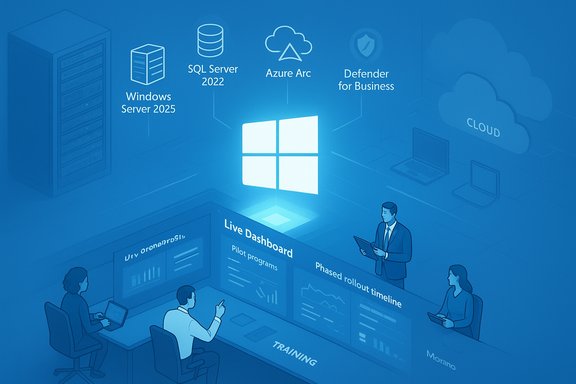
IT Researches’ public materials present a bundled services approach around these pillars:- Modern workplace: Microsoft 365 tenant design, Teams/SharePoint/OneDrive adoption, and Office 2024/LTSC deployments.
- Client OS lifecycle: Windows 11 assessment, image build, and staged rollout for Pro/Enterprise fleets.
- Server foundation: Windows Server 2025 migrations, Active Directory consolidation, Group Policy, and Remote Desktop Services.
- Data platform: SQL Server 2022 deployments, Azure Synapse Link integration, Power BI enablement.
- Hybrid cloud: Azure Arc onboarding, VM and backup planning, virtual desktop and DR options.
- Security and observability: Microsoft Entra ID (identity), Microsoft Defender for Business (endpoint) and Microsoft Sentinel (SIEM) aligned with Zero Trust.
- Adoption and managed services: training, pilots, and ongoing support to secure long‑term outcomes.
Why the timing makes sense
Microsoft’s platform cadence over the last 18–24 months created a natural window for partners to offer modernisation programs:- Office 2024 and Office LTSC 2024 provide a refreshed standalone productivity option and an LTSC path for disconnected or regulated environments; Microsoft published Office 2024 for consumers on October 1, 2024 and documented LTSC support and lifecycle guidance.
- Windows Server 2025 is positioned as a hybrid‑first LTSC server release with features such as SMB over QUIC and hotpatching for Azure Arc‑connected instances — capabilities that materially change operational trade‑offs for on‑premises workloads.
- SQL Server 2022 is the most Azure‑enabled on‑prem SQL Server release, with Azure Synapse Link, Ledger, and managed instance link features that simplify hybrid analytics and DR designs.
Product and platform verification: what’s factual
Office 2024 and Microsoft 365
Microsoft’s messaging confirms two distinct deployment models: Microsoft 365 (subscription, continuous updates and cloud integration) versus Office 2024/Office LTSC 2024 (standalone, fixed‑feature releases for offline or locked environments). Office 2024 for consumers was announced as available October 1, 2024, while Office LTSC 2024 is the supported on‑premises edition for enterprises that require a long‑term servicing channel. The Office documentation outlines system requirements and lifecycle windows. Practical implications:- Choose Microsoft 365 to obtain continuous cloud features and copilot/AI integrations.
- Choose Office LTSC 2024 if regulatory or isolation needs prohibit cloud‑connected updates, but expect a shorter five‑year support window for LTSC on‑prem releases.
Windows Server 2025
Microsoft’s product blog details Windows Server 2025 features including hotpatching (Azure Arc‑enabled hotpatching subscription model for reduced reboots), SMB over QUIC for secure internet file access, and hybrid management hooks via Azure Arc. Independent coverage and community explainers corroborate these capabilities and the operational trade‑offs (subscription and Azure dependency for some hotpatch features). Important operational notes:- Hotpatching for non‑Azure workloads typically requires Azure Arc and additional subscription considerations.
- SMB over QUIC introduces VPN‑less secure file access models that change perimeter assumptions and firewall design.
SQL Server 2022 and hybrid data integration
SQL Server 2022 documentation and Microsoft’s SQL blog describe deep Azure integration: Azure Synapse Link for near‑real‑time analytics, Ledger for tamper‑evident records, and managed DR links to Azure SQL Managed Instance. These features are real and change the economics of bringing analytics close to operational data while preserving performance.Identity and security building blocks
Azure AD’s rebrand to Microsoft Entra ID is documented and complete; the novel naming is organizational, not functional — capabilities and APIs remain the same. Microsoft’s security tools (Defender for Business for SMB‑focused endpoint protection and Microsoft Sentinel for cloud SIEM/XDR) are mature building blocks — but extracting value requires operational maturity (tuning, playbooks, data ingestion planning).What the press release gets right — key strengths
- Coherent platform story: Bundling Microsoft 365, Office 2024, Windows 11, Windows Server 2025, SQL Server and Azure into a single modernization program reduces vendor coordination overhead and simplifies procurement if the partner has demonstrable delivery capacity.
- Focus on hybrid reality: Modern enterprises rarely run strictly on‑prem or purely cloud. Windows Server 2025, Azure Arc, and SQL Server hybrid features give legitimate technical levers to lower operational friction during transitions.
- Security‑forward posture: Mapping Entra ID (formerly Azure AD), Defender for Business and Sentinel into a Zero Trust‑aligned program is consistent with best practice — if the partner shows operational evidence (playbooks, SOC integrations).
- Practical people focus: Emphasising training, adoption measurement and staged pilots addresses a common failure mode of modernization projects where technology is deployed but adoption lags.
Where claims need careful vetting — risks and gaps
- Syndicated PR vs. proven delivery: The public materials are marketing‑oriented. There is little in the press trace that substitutes for verifiable case studies with technical artifacts (architecture diagrams, runbooks, performance metrics). Procurement should treat press claims as a starting point, not proof of competence.
- Vendor coupling and licensing surprises: Hybrid features (hotpatching, Azure Arc, managed instance links) can require additional subscriptions or Azure‑centric licensing that increase ongoing TCO. Ensure licensing is modelled across a 3–5 year horizon before committing.
- Active Directory migration risk: Any change to AD schema, domain functional levels, or domain controllers carries operational risk and potential for application breakage. Detailed rollback and app compatibility testing are non‑negotiable.
- Security operations maturity: Tools such as Defender and Sentinel spotlight problems — but turning alerts into measurable risk reduction needs an operational program (playbooks, staffing, SOAR integration). Claims that “we’ll secure you” must be backed by named personnel, runbooks, and measurable SLAs.
- Corporate verification and continuity: Public records and registry traces for some small consultancies can show entity changes over time. Verify trading entity, insurance, and indemnity clauses during contracting.
Practical due‑diligence checklist (what procurement should ask for)
- Provide three technical references (project managers and architects) for comparable projects and permission to contact them.
- Deliver a defined, time‑boxed pilot with measurable KPIs (e.g., Teams active users, SQL query latency, RPO/RTO for DR tests).
- Supply named engineers and certifications (Partner Center/competencies) and evidence of role‑based certifications for Azure, Microsoft 365, Security and Data.
- Provide a full licensing and subscription TCO for the proposed hybrid features (Azure Arc, hotpatching subscription, managed instance links).
- Share security runbooks and Sentinel integration examples, including alert tuning and retention plans.
- Produce an exit plan for data portability, application migration, and timeframe to migrate away from managed services.
Deployment and architectural considerations
Windows 11 and Windows 10 EOL
Windows 10 reaches end of support on October 14, 2025. Organizations must inventory devices, assess hardware eligibility for Windows 11 (TPM 2.0, compatible CPU and firmware), and plan for Extended Security Updates (ESU) or device replacement for incompatible machines. These reality checks should shape the timing and scope of any PC modernization included in vendor proposals.Hybrid server strategy
Windows Server 2025’s hotpatching and SMB over QUIC reduce downtime and enable secure remote file access without VPNs, but they often depend on Azure Arc and specific licensing. For mission‑critical workloads, ensure the architecture includes:- Application compatibility testing with new SMB and storage features.
- AD backup/restore and staged domain functional level changes.
- Explicit costs and SLAs for Azure Arc onboarding and hotpatch subscriptions.
Data platform and analytics
SQL Server 2022’s Azure Synapse Link enables near‑real‑time OLAP use cases but introduces new data flows and governance requirements (Purview integration, data lake landing zones). A good partner will:- Baseline query performance and provide POC results for Synapse Link latency.
- Demonstrate a Purview classification and access governance plan.
- Define DR runbooks leveraging managed instance link where required.
Security posture: tools versus operations
Microsoft’s security stack (Microsoft Entra ID, Defender for Business, and Sentinel) provides powerful telemetry and guardrails — yet the difference between “having the tools” and “operational security” is large.- Entra ID (formerly Azure AD) renaming is cosmetic from an API/feature standpoint; the technical controls (conditional access, MFA, identity governance) remain the centerpiece of identity protection. Buyers should insist on an identity‑first architecture with least privilege and conditional access baselines.
- Defender for Business brings EDR, automated investigation, and remediation to SMBs; it is an appropriate baseline product for small and mid‑market customers but requires Intune/endpoint enrollment and policy tuning.
- Sentinel is a cloud SIEM/XDR that scales, but ingestion, retention and analytics need budget and playbook investment to provide real value. Newer Sentinel Data Lake and AI improvements signal that SIEM economics are improving — but an immature SOC will still struggle to operationalise alerts.
Cost and licensing realities
Hybrid features and managed services often bring hidden recurring costs:- Azure Arc, hotpatching subscriptions, and Synapse Link features may require monthly or per‑node billing beyond one‑time migration fees.
- Office LTSC removes subscription churn but commits organizations to fixed‑feature releases with shorter security windows compared to Microsoft 365’s continuous model.
Final assessment and recommendation
IT Researches Ltd’s messaging aligns with genuine Microsoft platform capabilities and a real market need: organisations want a single partner to simplify Microsoft‑centric modernization that spans desktop productivity, identity, server modernization and hybrid analytics. The product claims in the press materials map to documented Microsoft features (Office 2024, Windows Server 2025, SQL Server 2022, Entra ID, Defender for Business and Sentinel). However, syndicated press materials are a starting point, not a procurement decision. Before awarding a migration or managed services contract, organizations should require:- Verifiable customer references and technical artifacts.
- A time‑boxed pilot with measurable KPIs.
- A transparent, multi‑year licensing and TCO model that includes Azure‑dependent features.
- Detailed security runbooks, Sentinel onboarding plans, and an exit/data portability agreement.
IT Researches’ positioning reflects a sensible engineering response to Microsoft’s recent product cadence: use hybrid‑enabled server features to reduce downtime, Azure‑enabled SQL Server capabilities to unlock real‑time analytics, and a people‑first adoption play to capture the productivity upside. Verified technical features and timelines exist in Microsoft documentation and independent coverage, but the ultimate value will come from delivery competence, transparent licensing, and measured adoption — not from the press release alone.
Source: FinancialContent https://markets.financialcontent.co...es-with-microsofts-next-generation-solutions/
