Meta’s move to exclude rival generative AI chatbots from WhatsApp has been paused in Italy as the country’s competition watchdog steps in, raising the stakes in a cross‑border clash between platform control and open AI competition.
Since early 2025, WhatsApp has evolved from a pure messaging product into a battleground for generative AI services. In March, Meta began integrating its Meta AI assistant into WhatsApp, surfacing AI responses inside the app and promoting the feature as a built‑in convenience for millions of users. In October 2025 Meta updated the WhatsApp Business Solution Terms to treat third‑party AI Providers — defined broadly to include large language models, generative AI platforms and general‑purpose assistants — as prohibited from using the WhatsApp Business API when AI functionality is their primary offering. Those terms were written to take immediate effect for new entrants and to apply to existing providers from mid‑January 2026.
Italian competition authorities warned almost immediately that this contractual change could shut competing chatbots out of WhatsApp’s massive user base and amount to an unlawful tying or foreclosure of competition. In late November 2025 the Italian Competition Authority (AGCM) formally broadened an existing probe into Meta’s conduct and opened a procedure to consider interim measures under Italian competition law. European authorities followed: the European Commission launched a formal antitrust probe in early December 2025 into whether Meta’s policy unlawfully leverages WhatsApp’s dominance to privilege Meta AI.
On December 24, 2025, reporting from specialist legal press indicated the AGCM ordered a suspension — an interim freeze — of Meta’s policy in Italy, requiring Meta to halt enforcement of the October terms pending a full antitrust investigation. Meta reportedly said it would appeal and called the decision flawed.
This article synthesizes the available material, examines the legal and technical issues the dispute raises, and assesses the likely market, compliance and product implications for platforms, AI providers and businesses that rely on WhatsApp.
For regulators, the challenge is to preserve competition and consumer choice without undermining legitimate safety or operational needs. For platforms, the lesson is that product‑design choices with exclusionary effects attract intense scrutiny and that technical necessity must be demonstrable and narrowly drawn. For AI providers, the immediate imperative is diversification: dependence on a single privileged distribution channel is now a strategic vulnerability.
The short term will be messy: companies must scramble to adapt, legal proceedings will play out, and users may face inconsistent availability of popular assistants. The longer term will be formative — regulatory doctrine around platform control of AI distribution will be shaped by the outcome, influencing product roadmaps, partnerships and the structure of the AI market for years to come.
Source: MLex WhatsApp ordered to suspend policy on AI chatbots in Italy | MLex | Specialist news and analysis on legal risk and regulation
 Background
Since early 2025, WhatsApp has evolved from a pure messaging product into a battleground for generative AI services. In March, Meta began integrating its Meta AI assistant into WhatsApp, surfacing AI responses inside the app and promoting the feature as a built‑in convenience for millions of users. In October 2025 Meta updated the WhatsApp Business Solution Terms to treat third‑party AI Providers — defined broadly to include large language models, generative AI platforms and general‑purpose assistants — as prohibited from using the WhatsApp Business API when AI functionality is their primary offering. Those terms were written to take immediate effect for new entrants and to apply to existing providers from mid‑January 2026.Italian competition authorities warned almost immediately that this contractual change could shut competing chatbots out of WhatsApp’s massive user base and amount to an unlawful tying or foreclosure of competition. In late November 2025 the Italian Competition Authority (AGCM) formally broadened an existing probe into Meta’s conduct and opened a procedure to consider interim measures under Italian competition law. European authorities followed: the European Commission launched a formal antitrust probe in early December 2025 into whether Meta’s policy unlawfully leverages WhatsApp’s dominance to privilege Meta AI.
On December 24, 2025, reporting from specialist legal press indicated the AGCM ordered a suspension — an interim freeze — of Meta’s policy in Italy, requiring Meta to halt enforcement of the October terms pending a full antitrust investigation. Meta reportedly said it would appeal and called the decision flawed.
This article synthesizes the available material, examines the legal and technical issues the dispute raises, and assesses the likely market, compliance and product implications for platforms, AI providers and businesses that rely on WhatsApp.
What the AGCM action — and the underlying policy — actually do
The contractual change at issue
- The October 2025 update to the WhatsApp Business Solution Terms introduces a new, broadly worded ban on “AI Providers” using the WhatsApp Business Solution when their core proposition is a general‑purpose AI assistant or chatbot.
- The terms distinguish between incidental/ancillary AI usage (permitted) and primary AI functionality (prohibited), with Meta reserving wide discretion to determine which providers fall into the banned category.
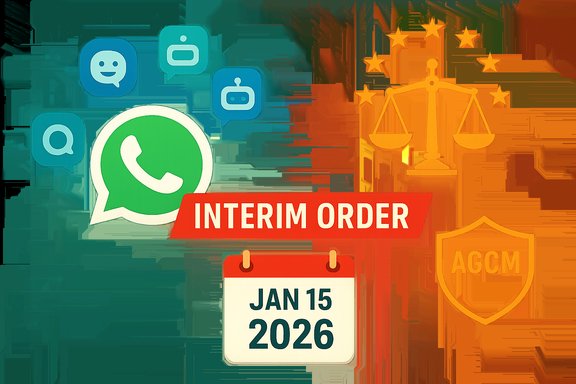
- For newcomers, the ban was immediate after the October change; for existing integrations Meta gave a grace period to January 15, 2026.
What the AGCM interim measures seek to prevent
- The Italian authority’s stated concern is that excluding third‑party chatbots from WhatsApp could produce serious and irreparable harm by foreclosing a rapidly developing market: AI chatbot services delivered at scale via messaging apps.
- Interim measures of the type the AGCM can adopt are specifically designed to preserve market structure and competition during the pendency of a full probe. Practically, a suspension prevents Meta from enforcing the new ban in Italy while investigators analyze whether the measure amounts to an abuse of dominance.
Legal framework and competition theory
The legal hooks: national and EU competition law
- The case is being assessed under longstanding competition principles that prohibit an undertaking holding a dominant position from abusing that position to exclude rivals or distort competition.
- At the EU level, Article 102 of the Treaty on the Functioning of the European Union prohibits abuse of a dominant position; national authorities like the AGCM can act in parallel to impose interim measures under domestic law while the Commission may open a formal EU‑wide investigation.
- Interim measures are an extraordinary remedy reserved where irreparable harm or a serious risk to contestability can be shown — a standard the AGCM signalled it believes is met here.
Theories of harm in play
- Tying and leveraging: The central allegation is effectively a tying/leveraging theory — that Meta is leveraging its dominance in messaging to push users to its own AI, thereby raising rivals’ costs of access to the user base and reducing competitive pressure on Meta AI.
- Foreclosure and market access: By removing a distribution channel used by competing chatbots, WhatsApp’s terms may materially impede rival providers’ ability to reach end users, slowing their adoption and innovation cycles.
- Lock‑in and switching costs: Messaging platforms are characterized by strong network effects and user inertia; losing presence on WhatsApp can be a near‑fatal blow to an AI chatbot’s growth prospects in many markets.
Why regulators are treating AI + messaging as high‑risk
Two structural features make this dispute legally fraught and commercially consequential.- Networked distribution: WhatsApp is a gateway to tens of millions of users in many countries. Controlling distribution channels in markets with high user density confers more than just convenience — it confers strategic power over which services flourish.
- Rapid nascent market dynamics: Generative AI chatbots and assistants are fast‑moving, with early leader dynamics and strong complementarities between data access, usage scale and model quality. An incumbent platform that can limit competitors’ access at a formative stage can frustrate competition in ways that are very hard to reverse.
The practical technical arguments Meta has advanced — and their limits
Meta’s public defenses focus on two related points: operational constraints and API design intent.- WhatsApp has consistently described the Business Solution / API as designed for human‑to‑business messaging (order confirmations, support, notifications), not as a general LLM hosting or streaming channel. Allowing arbitrary AI providers to run large‑scale LLM interactions over the API could, Meta says, place severe strain on systems and introduce safety and moderation risks.
- Meta also asserts that a uniform set of technical and safety standards is necessary to keep conversational quality and user safety high across the ecosystem.
- The constraints are technical necessities or self‑imposed design choices.
- Less restrictive alternatives exist (rate limits, credentialing, certified providers, differentiated endpoints).
- Meta’s approach is proportionate — i.e., whether it restricts competition more than necessary to achieve legitimate operational goals.
Commercial and market implications
For AI providers and startups
- Companies that integrated with WhatsApp as a distribution channel — including large players that made WhatsApp bots available — face sudden commercial disruption if the ban is enforced.
- Startups that used WhatsApp to reach customers risk losing market momentum; those with limited distribution substitutes may face existential risk.
- The suspension order (where enforced) buys time for rivals but does not resolve long‑term access or commercial terms.
For businesses using WhatsApp for customer service
- Many enterprises that embed AI assistants into WhatsApp workflows may face contractual disruption or be forced to redesign customer journeys, migrating to alternative channels or on‑premises solutions.
- Businesses should inventory critical workflows that rely on third‑party AI, and evaluate contingency plans for channel migration, as well as contractual protections with AI vendors.
For Meta and the platform economy
- A regulatory requirement to allow third‑party AI on WhatsApp — or to adopt narrowly tailored access rules — would limit Meta’s ability to monetize and differentiate Meta AI via preferential distribution.
- Conversely, a full legal victory for Meta would reinforce platform control over an adjacent market (AI), with broad strategic consequences for competition across the tech stack.
Precedents and enforcement mechanics: what might happen next
- Interim remedies and hearings: The AGCM’s interim step — whether labeled a suspension, injunction or freeze — is reversible on appeal but can persist long enough to affect market dynamics while the investigation proceeds.
- Full antitrust probe outcomes: Investigations can conclude with a range of remedies:
- Behavioral remedies (e.g., non‑discriminatory access, certification regimes, technical standards).
- Structural remedies (rare in EU competition law, but possible in extreme tying cases).
- Fines for breaches of competition law — penalties under EU enforcement can reach double‑digit percentages of global turnover for serious infringements.
- Cross‑jurisdictional follow‑through: With the European Commission also investigating, final outcomes could be coordinated EU‑wide, or national authorities might seek country‑level measures that lead to fragmentation across markets.
- Litigation and appeal: Expect Meta to appeal any interim measures in domestic courts and to litigate final conclusions vigorously. Appeals can delay final resolution and create prolonged uncertainty.
Technical and product design lessons for platforms and AI providers
- Avoid overbroad, categorical bans that can be read as exclusionary; prefer narrowly tailored technical or safety standards that are transparent, objective and equally applicable to all providers.
- Implement certified‑provider regimes: independent certification or accreditation for trusted AI providers would balance safety and access.
- Build portability and multi‑channel architectures: AI service vendors should design integrations that can be ported rapidly between platforms (WhatsApp, Telegram, web widgets, SMS, in‑app channels).
- Document operational constraints: if platforms claim capacity or safety limits, document the causality and show why less restrictive measures wouldn’t work.
Practical checklist for business and product teams (short‑term actions)
- Inventory: Map all internal systems and customer journeys that rely on third‑party chatbots on WhatsApp.
- Contract review: Check termination and force‑majeure clauses with AI vendors and WhatsApp Business providers.
- Technical fallback: Design fallbacks (email, SMS, in‑app chat, web chat) and test failover.
- Regulatory watch: Monitor legal developments closely; regulatory timelines and rulings can change implementation dates and obligations.
- Consumer communication: Prepare templates to notify users of service changes without creating alarm or GDPR/privacy breaches.
Risks that regulators and the market must weigh
- Over‑enforcement could stifle competition and innovation: overly prescriptive remedies might slow the emergence of better AI assistants and reduce consumer choice.
- Under‑enforcement risks platform entrenchment: letting dominant platforms bundle adjacent services tightly risks creating integrated monopolies that are hard to displace.
- Fragmentation and user experience harm: patchwork national remedies could fragment the messaging and AI landscape, making it harder for global services to provide consistent experiences.
- Security and safety trade‑offs: unregulated third‑party AI access can increase abusive content, data leakage, or spam; regulators must balance competition goals with legitimate safety concerns.
Strategic scenarios and likely timelines
- Minimal intervention scenario: Regulators require a narrow, technical fix (e.g., clarify the definition of “primary functionality,” adopt certification), allowing Meta to keep broad control but under oversight. Market impact modest; players adapt.
- Behavioral remedy scenario: Authorities require nondiscriminatory access conditions or an open certification program. This preserves competition but forces Meta to operate a neutral gatekeeping mechanism.
- Structural or punitive scenario: Regulators find abuse of dominance, impose heavy fines and structural constraints (rare but not impossible). This could reshape Meta’s incentives to vertically integrate AI across its products.
- Prolonged litigation: Appeals and cross‑jurisdictional coordination could extend uncertainty for months or years; in this scenario businesses must prepare for an extended period of ambiguity.
What this means for the broader AI ecosystem
This dispute is a high‑stakes test of how competition law will govern the intersection of platforms and generative AI. Key implications:- Access to distribution channels matters as much as model quality. An AI provider’s growth path depends critically on being present where users are.
- Regulators are treating early platform conduct in AI as strategically important; enforcement outcomes here will set precedent for future platform‑level decisions.
- Technical gatekeeping and safety concerns will not, on their own, absolve platforms from competition scrutiny; proportionality and nondiscrimination are the tests that matter.
- Companies and regulators need better cooperative frameworks for safe, competitive AI deployment (standardized safety APIs, certification, interoperable protocols).
Final assessment
The Italian authority’s intervention — whether labeled a suspension or an interim freeze — is a decisive regulatory escalation that underscores how competition law is adapting to the realities of generative AI’s rapid rollout inside consumer platforms. Meta’s business decision to limit third‑party chatbots via WhatsApp terms sits at the collision point of operational design, product strategy and competition policy.For regulators, the challenge is to preserve competition and consumer choice without undermining legitimate safety or operational needs. For platforms, the lesson is that product‑design choices with exclusionary effects attract intense scrutiny and that technical necessity must be demonstrable and narrowly drawn. For AI providers, the immediate imperative is diversification: dependence on a single privileged distribution channel is now a strategic vulnerability.
The short term will be messy: companies must scramble to adapt, legal proceedings will play out, and users may face inconsistent availability of popular assistants. The longer term will be formative — regulatory doctrine around platform control of AI distribution will be shaped by the outcome, influencing product roadmaps, partnerships and the structure of the AI market for years to come.
Source: MLex WhatsApp ordered to suspend policy on AI chatbots in Italy | MLex | Specialist news and analysis on legal risk and regulation