

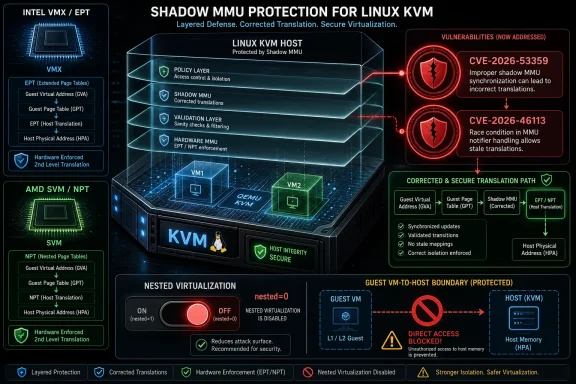
Januscape, publicly disclosed on July 6, 2026, is a Linux KVM guest-to-host escape class issue in the x86 shadow MMU that affects both Intel VMX/EPT and AMD SVM/NPT hosts. The immediate action is simple: patch both CVE-2026-53359 and CVE-2026-46113, verify that the running kernel or livepatch feed actually contains both fixes, and disable nested virtualization wherever guests or workloads do not explicitly need it. Treat this as more than a one-CVE cleanup: the source facts tie full remediation to both identifiers, and partial patching can leave related shadow-paging logic exposed.
The simplest version of Januscape is the one administrators should act on first: a malicious guest with root inside its own VM can trigger a KVM x86 shadow-MMU bug that corrupts host kernel memory. Public reporting describes a denial-of-service path through released proof-of-concept code and a controlled root-level exploit claimed by the researcher but not publicly released. That distinction matters. This should not be described as a publicly available host-root exploit, but it is still serious because the vulnerable path crosses the guest-to-host boundary.
The bug affects x86 KVM on both major x86 hardware virtualization paths: Intel VMX/EPT and AMD SVM/NPT. ARM64 hosts are not affected by Januscape itself. Hyunwoo Kim’s earlier ITScape disclosure in June 2026 is a separate KVM/arm64 issue, not the same bug. The practical reading is narrow but important: Januscape is an x86 KVM issue, and exposure depends on whether the affected KVM path is reachable.
Nested virtualization changes that bargain. When a guest VM is allowed to run a hypervisor and launch its own sub-guests, the host cannot treat the translation problem the same way. KVM has to emulate pieces of the second-level translation machinery for the first-level guest, and that can push execution back through shadow MMU code.
That shadow-paging path is complex and security-sensitive. It exists because compatibility and nested virtualization require it, not because most operators spend their days thinking about shadow page-table reuse. Januscape is a reminder that code outside the common simple-guest path can still define the isolation boundary when a feature such as nested virtualization is enabled.
The vulnerable function is
That role is not decorative metadata. It records what kind of shadow page KVM is dealing with. For Januscape’s purposes, the crucial distinction is whether KVM is dealing with a direct mapping or an indirect shadow of a guest page table. If the guest frame number matches but the role does not, KVM can reuse the wrong shadow page structure. That wrong reuse can leave stale reverse-map state behind and lead KVM toward a use-after-free condition.
That is the use-after-free at the heart of CVE-2026-53359. The fix authored by KVM maintainer Paolo Bonzini and merged into mainline on June 19, 2026, adds a
CVE-2026-46113, fixed in May 2026, addressed a related case where the modified page-directory entry pointed to a leaf shadow page. CVE-2026-53359 is the non-leaf case, where the guest frame number can still appear to match while the role is wrong. Both bugs sit in related shadow-paging reuse logic, but they are not duplicates.
The practical consequence is that administrators should not reduce this to a single advisory checkbox. CVE-2026-53359 corresponds to commit
KernelCare users have a direct verification path:
Both CVEs need to appear. A livepatch feed that contains only the headline Januscape CVE but not the companion fix would leave one related path unresolved.
For vulnerability management teams, the search terms matter. Do not search only for the Januscape name. Search for both CVE identifiers, both upstream commits, and vendor advisory language involving shadow paging, use-after-free, unexpected role, guest frame number, or KVM MMU reuse.
Debian issued DSA-6381-1 on July 5, 2026, covering testing, also known as trixie, and unstable, also known as sid. As of July 8, 2026, the source material said patches for stable Bookworm and oldstable Bullseye remained pending. That is the kind of downstream lag that makes source-level confidence insufficient.
SUSE and openSUSE rated the issue Important, with patches in QA across most SUSE Linux Enterprise 15 SP7 and Leap product lines. For enterprise fleets, “in QA” is a planning signal, not a completed control.
CloudLinux’s advisory translated the vulnerability into hosting-provider terms. CloudLinux shipped patched kernels for CL7h and CL8 in the beta/testing channel, while AlmaLinux kernels for CL9 and CL10 were in the AlmaLinux testing repository. TuxCare Extended Lifecycle Support customers on CloudLinux 8 LTS and 9 LTS were slated to receive the fix through the ELS
KernelCare livepatch availability also matters because hypervisor reboot windows are expensive. As of July 7, 2026, the main feed covered AlmaLinux 10, RHEL 10, Oracle Linux 10, Rocky Linux 10, and Ubuntu 22.04 Jammy. Ubuntu 24.04 Noble was in the testing feed, with EL8, EL9, and others in preparation.
The lesson is not that one distribution is fast and another is slow. The lesson is that kernel vulnerability response is a chain of custody: upstream stable, vendor backport, package repository, livepatch feed, maintenance window, reboot or livepatch application, and verification on the host. Januscape is serious enough that every link in that chain needs to be checked rather than assumed.
June 19, 2026 — Paolo Bonzini’s fix for CVE-2026-53359 was merged into mainline.
July 4, 2026 — Patches landed in all major maintained kernel branches.
July 5, 2026 — Debian issued DSA-6381-1 for testing trixie and unstable sid.
July 6, 2026 — Januscape was publicly disclosed.
July 7, 2026 — KernelCare main-feed coverage included AlmaLinux 10, RHEL 10, Oracle Linux 10, Rocky Linux 10, and Ubuntu 22.04 Jammy.
July 8, 2026 — Debian stable Bookworm and oldstable Bullseye remained pending according to the source material.
The
Most VM escape stories naturally focus on cloud providers, and Januscape deserves that framing. If an untrusted tenant can crash a host or reach a controlled guest-to-host exploit path, other workloads sharing that physical server can be affected by the host-level failure. But Januscape also has a local exposure angle that broadens the risk beyond conventional “malicious cloud customer” scenarios.
On Red Hat Enterprise Linux and downstream rebuilds, including EL8, EL9, and EL10 families and CloudLinux 8, 9, and 10, the KVM device node
This changes the exposure model for shared Linux machines. A shell user on a shared host, a compromised web application that can reach local execution, or a post-compromise foothold from some unrelated bug may be enough to interact with
That is why mitigation should split guest-to-host escape from local hardening. Disabling nested virtualization can reduce the tenant escape path, but it does not automatically fix world-accessible
A headline about KVM guest-to-host escape sounds like a cloud-only fire. In practice, the KVM device node can make this a hardening issue for multi-user Linux systems, hosting platforms, build machines, lab infrastructure, and server images that carry KVM access by default.
Januscape shows why that convenience has to be treated as a security decision. Enabling nested virtualization is not merely granting a CPU capability to the guest; it can expose host KVM code paths that are otherwise less relevant to ordinary guest operation. That should move nested virtualization out of the “nice feature” bucket and into the “documented exception” bucket.
For cloud providers, the right question is not whether some customers need nested virtualization. Some do. The right question is whether those customers should share physical hosts with tenants who do not need it, and whether nested-capable flavors should be isolated into dedicated pools with tighter patch windows and clearer admission policies.
For enterprises, the question is often simpler: who asked for nested virtualization, and is it still needed? Lab clusters and CI runners can become permanent infrastructure after the project that justified them ends. Januscape is a good reason to inventory those hosts and remove nested virtualization where it is not required.
The mitigation commands are straightforward, though they are not a substitute for patching. On Intel hosts:
On AMD hosts:
Those settings still need operational follow-through: module reload or reboot planning, configuration management, drift detection, and validation that guests no longer see nested capability. A one-line mitigation is reliable only if the fleet keeps it applied.
That pattern does not prove KVM is uniquely unsafe. KVM is a large, high-value, kernel-resident hypervisor used across clouds, hosting providers, enterprise virtualization, developer tooling, and lab infrastructure. Serious researchers go where the blast radius is large.
The pattern does suggest that older KVM internals deserve systematic security work. Shadow paging, reverse maps, nested virtualization, and architecture-specific emulation paths are exactly the kinds of subsystems where subtle invariants accumulate. A missing
For operators, the key point is narrower and more actionable: public proof-of-concept material demonstrates the crash path, while the claimed root-level exploit has not been publicly released. That is not a reason to wait. Once a bug class is explained, patched, and demonstrated in part, other researchers and attackers can study the same area.
That is why even the public denial-of-service path matters. If one tenant can crash a physical host, the provider has an availability incident, a placement problem, and a trust problem. If a controlled exploit can reach host root, the concern expands from availability to confidentiality and integrity. The public record should be described carefully: the root-level path is claimed in a controlled setting, not released as a turnkey public exploit.
Januscape is also notable because it lives in the in-kernel KVM subsystem rather than being framed primarily as a userspace device-emulation bug. If the vulnerable KVM path is reachable, changing the userspace management layer does not by itself make the kernel bug disappear.
That point should resonate with WindowsForum readers who run Proxmox, OpenStack, libvirt clusters, lab hypervisors, or Linux-backed virtualization underneath Windows-heavy estates. The guests may be Windows Server, Windows 11 development VMs, Linux containers inside VMs, or nested lab domains; the host isolation still depends on Linux KVM doing the right thing in kernel space.
The same logic applies to CI providers and internal build farms. Build runners are often treated as disposable, but the hosts beneath them are not always isolated with the same discipline as production cloud nodes. If a runner can access nested virtualization, and if untrusted pull requests or third-party code can reach that runner, the Januscape model becomes relevant outside the public-cloud marketplace.
There is also a documentation burden. Teams need to know which instance types, flavors, host aggregates, templates, and kernel module configurations expose nested virtualization. They need to know whether
Security teams should also treat Januscape as a tabletop scenario. What happens if a tenant VM panics a host? Can the provider identify co-resident workloads? Are crash logs collected before automated remediation wipes evidence? Can administrators distinguish hardware instability from a malicious guest-triggered kernel panic? Those are not questions to answer during an outage.
The absence of a public root exploit should not lull anyone into treating this as routine. The claimed controlled exploit, the public crash proof of concept, the two-CVE remediation requirement, and the x86 reach across Intel and AMD together justify an urgent response.
 Januscape Turns Nested Virtualization Into the Blast Radius
The simplest version of Januscape is the one administrators should act on first: a malicious guest with root inside its own VM can trigger a KVM x86 shadow-MMU bug that corrupts host kernel memory. Public reporting describes a denial-of-service path through released proof-of-concept code and a controlled root-level exploit claimed by the researcher but not publicly released. That distinction matters. This should not be described as a publicly available host-root exploit, but it is still serious because the vulnerable path crosses the guest-to-host boundary.Direct action summary
- Patch CVE-2026-53359 and CVE-2026-46113; do not treat Januscape as fixed if only one identifier is covered.
- Verify the running kernel, vendor backport, or livepatch status rather than relying on upstream version numbers alone.
- For KernelCare systems, confirm both CVEs appear in patch information:
kcarectl --patch-info | grep -E 'CVE-2026-53359|CVE-2026-46113'- Disable nested virtualization on Intel and AMD hosts where it is not required.
- Audit
/dev/kvmexposure on shared Linux systems, especially where local users or compromised workloads could open KVM directly. - Prioritize hypervisors, CI runners, lab hosts, hosting platforms, and any shared machine that exposes nested virtualization or KVM access.
The bug affects x86 KVM on both major x86 hardware virtualization paths: Intel VMX/EPT and AMD SVM/NPT. ARM64 hosts are not affected by Januscape itself. Hyunwoo Kim’s earlier ITScape disclosure in June 2026 is a separate KVM/arm64 issue, not the same bug. The practical reading is narrow but important: Januscape is an x86 KVM issue, and exposure depends on whether the affected KVM path is reachable.
The Old Shadow MMU Became the New Cloud Problem
To understand why Januscape is more than an ordinary kernel CVE, look at the part of KVM it inhabits. Modern x86 virtualization normally relies on hardware-assisted second-level address translation: Intel Extended Page Tables and AMD Nested Page Tables. For a straightforward guest on a straightforward host, the CPU handles much of the address-translation work that older hypervisors once had to emulate.Nested virtualization changes that bargain. When a guest VM is allowed to run a hypervisor and launch its own sub-guests, the host cannot treat the translation problem the same way. KVM has to emulate pieces of the second-level translation machinery for the first-level guest, and that can push execution back through shadow MMU code.
That shadow-paging path is complex and security-sensitive. It exists because compatibility and nested virtualization require it, not because most operators spend their days thinking about shadow page-table reuse. Januscape is a reminder that code outside the common simple-guest path can still define the isolation boundary when a feature such as nested virtualization is enabled.
The vulnerable function is
kvm_mmu_get_child_sp(). Its job is to find or reuse a shadow page-table structure when KVM needs to track guest memory. The mistake, as summarized in the source material, was a reuse check that compared the guest frame number but did not also compare the page’s role.That role is not decorative metadata. It records what kind of shadow page KVM is dealing with. For Januscape’s purposes, the crucial distinction is whether KVM is dealing with a direct mapping or an indirect shadow of a guest page table. If the guest frame number matches but the role does not, KVM can reuse the wrong shadow page structure. That wrong reuse can leave stale reverse-map state behind and lead KVM toward a use-after-free condition.
That is the use-after-free at the heart of CVE-2026-53359. The fix authored by KVM maintainer Paolo Bonzini and merged into mainline on June 19, 2026, adds a
role.word comparison alongside the guest-frame-number check. The lesson for operators is practical: a small invariant in hypervisor memory-management code can become a large isolation failure when nested virtualization makes the path reachable.Two CVEs Close One Class of Mistake
The most dangerous administrative misunderstanding around Januscape is the assumption that patching CVE-2026-53359 alone is enough. The source facts tie full remediation to both CVE-2026-53359 and CVE-2026-46113.CVE-2026-46113, fixed in May 2026, addressed a related case where the modified page-directory entry pointed to a leaf shadow page. CVE-2026-53359 is the non-leaf case, where the guest frame number can still appear to match while the role is wrong. Both bugs sit in related shadow-paging reuse logic, but they are not duplicates.
The practical consequence is that administrators should not reduce this to a single advisory checkbox. CVE-2026-53359 corresponds to commit
81ccda30b4e8; CVE-2026-46113 corresponds to commit 0cb2af2ea66a. Distribution backports may carry these fixes under different package versions and release names, so uname -r is only a starting point.KernelCare users have a direct verification path:
kcarectl --patch-info | grep -E 'CVE-2026-53359|CVE-2026-46113'Both CVEs need to appear. A livepatch feed that contains only the headline Januscape CVE but not the companion fix would leave one related path unresolved.
For vulnerability management teams, the search terms matter. Do not search only for the Januscape name. Search for both CVE identifiers, both upstream commits, and vendor advisory language involving shadow paging, use-after-free, unexpected role, guest frame number, or KVM MMU reuse.
The Patch Matrix Is Clear Upstream, Messier Downstream
Patches landed in all major maintained kernel branches on July 4, 2026, according to the source facts. Upstream, the fixed-version story is relatively clean; downstream, administrators still need to follow the vendor that actually ships their running kernel.| Kernel branch | Fixed version |
|---|---|
| 7.x stable | 7.1.3 |
| 6.18.x | 6.18.38 |
| 6.12.x LTS | 6.12.95 |
| 6.6.x LTS | 6.6.144 |
| 6.1.x LTS | 6.1.177 |
| 5.15.x LTS | 5.15.211 |
| 5.10.x LTS | 5.10.260 |
SUSE and openSUSE rated the issue Important, with patches in QA across most SUSE Linux Enterprise 15 SP7 and Leap product lines. For enterprise fleets, “in QA” is a planning signal, not a completed control.
CloudLinux’s advisory translated the vulnerability into hosting-provider terms. CloudLinux shipped patched kernels for CL7h and CL8 in the beta/testing channel, while AlmaLinux kernels for CL9 and CL10 were in the AlmaLinux testing repository. TuxCare Extended Lifecycle Support customers on CloudLinux 8 LTS and 9 LTS were slated to receive the fix through the ELS
kernel-lts package.KernelCare livepatch availability also matters because hypervisor reboot windows are expensive. As of July 7, 2026, the main feed covered AlmaLinux 10, RHEL 10, Oracle Linux 10, Rocky Linux 10, and Ubuntu 22.04 Jammy. Ubuntu 24.04 Noble was in the testing feed, with EL8, EL9, and others in preparation.
The lesson is not that one distribution is fast and another is slow. The lesson is that kernel vulnerability response is a chain of custody: upstream stable, vendor backport, package repository, livepatch feed, maintenance window, reboot or livepatch application, and verification on the host. Januscape is serious enough that every link in that chain needs to be checked rather than assumed.
Timeline
May 2026 — CVE-2026-46113 was fixed, closing the companion leaf-case shadow-paging path.June 19, 2026 — Paolo Bonzini’s fix for CVE-2026-53359 was merged into mainline.
July 4, 2026 — Patches landed in all major maintained kernel branches.
July 5, 2026 — Debian issued DSA-6381-1 for testing trixie and unstable sid.
July 6, 2026 — Januscape was publicly disclosed.
July 7, 2026 — KernelCare main-feed coverage included AlmaLinux 10, RHEL 10, Oracle Linux 10, Rocky Linux 10, and Ubuntu 22.04 Jammy.
July 8, 2026 — Debian stable Bookworm and oldstable Bullseye remained pending according to the source material.
The /dev/kvm Detail Makes This Broader Than Cloud Tenants
Most VM escape stories naturally focus on cloud providers, and Januscape deserves that framing. If an untrusted tenant can crash a host or reach a controlled guest-to-host exploit path, other workloads sharing that physical server can be affected by the host-level failure. But Januscape also has a local exposure angle that broadens the risk beyond conventional “malicious cloud customer” scenarios.On Red Hat Enterprise Linux and downstream rebuilds, including EL8, EL9, and EL10 families and CloudLinux 8, 9, and 10, the KVM device node
/dev/kvm ships world-accessible by default with mode 0666, according to the source material. That means an unprivileged local user can open KVM directly and create a VM. If the vulnerable KVM path is reachable, the system does not need to be a public cloud hypervisor for the device node to matter.This changes the exposure model for shared Linux machines. A shell user on a shared host, a compromised web application that can reach local execution, or a post-compromise foothold from some unrelated bug may be enough to interact with
/dev/kvm. From there, the administrator’s question becomes whether the host kernel is fixed and whether KVM access should have been exposed to that local context in the first place.That is why mitigation should split guest-to-host escape from local hardening. Disabling nested virtualization can reduce the tenant escape path, but it does not automatically fix world-accessible
/dev/kvm exposure. Tightening /dev/kvm permissions can reduce local abuse, but it does not substitute for the kernel fix on hosts that intentionally expose nested virtualization to guests.A headline about KVM guest-to-host escape sounds like a cloud-only fire. In practice, the KVM device node can make this a hardening issue for multi-user Linux systems, hosting platforms, build machines, lab infrastructure, and server images that carry KVM access by default.
Nested Virtualization Is No Longer Just a Product Feature
Nested virtualization is useful. Developers use it for virtualization labs and test environments. CI systems may use it to spin up disposable environments inside runners. Cloud providers expose it so customers can run hypervisors, emulators, sandboxes, lab networks, and enterprise virtualization stacks inside rented instances.Januscape shows why that convenience has to be treated as a security decision. Enabling nested virtualization is not merely granting a CPU capability to the guest; it can expose host KVM code paths that are otherwise less relevant to ordinary guest operation. That should move nested virtualization out of the “nice feature” bucket and into the “documented exception” bucket.
For cloud providers, the right question is not whether some customers need nested virtualization. Some do. The right question is whether those customers should share physical hosts with tenants who do not need it, and whether nested-capable flavors should be isolated into dedicated pools with tighter patch windows and clearer admission policies.
For enterprises, the question is often simpler: who asked for nested virtualization, and is it still needed? Lab clusters and CI runners can become permanent infrastructure after the project that justified them ends. Januscape is a good reason to inventory those hosts and remove nested virtualization where it is not required.
The mitigation commands are straightforward, though they are not a substitute for patching. On Intel hosts:
echo "options kvm_intel nested=0" > /etc/modprobe.d/kvm_intel.confOn AMD hosts:
echo "options kvm_amd nested=0" > /etc/modprobe.d/kvm_amd.confThose settings still need operational follow-through: module reload or reboot planning, configuration management, drift detection, and validation that guests no longer see nested capability. A one-line mitigation is reliable only if the fleet keeps it applied.
Action checklist for admins
- Patch the running kernel as a priority, using your distribution’s security advisory rather than upstream version numbers alone.
- Confirm both CVE-2026-53359 and CVE-2026-46113 are present; the required commits are
81ccda30b4e8and0cb2af2ea66a. - For KernelCare systems, verify both CVEs with:
kcarectl --patch-info | grep -E 'CVE-2026-53359|CVE-2026-46113'- Disable nested virtualization on Intel or AMD hosts where tenants or workloads do not explicitly require it.
- Audit
/dev/kvmpermissions, especially on shared Linux servers that are not intended to expose guest execution to local users. - Track vendor advisories for the kernel you actually run, including backported fixes and livepatch feed status.
- Reboot or livepatch according to vendor guidance, then verify the running state after maintenance.
- Do not wait for a scoring label before acting; the public crash path and claimed controlled root-level path are enough to justify urgent remediation.
Kim’s Run of KVM Bugs Is the Warning After the Patch
Januscape is not an isolated moment in Hyunwoo Kim’s 2026 research. In June 2026, he disclosed ITScape, tracked as CVE-2026-46316, a separate KVM/arm64 guest-to-host escape involving the virtual interrupt controller. Januscape then brought attention back to the x86 side, with source material describing reach across both Intel and AMD paths.That pattern does not prove KVM is uniquely unsafe. KVM is a large, high-value, kernel-resident hypervisor used across clouds, hosting providers, enterprise virtualization, developer tooling, and lab infrastructure. Serious researchers go where the blast radius is large.
The pattern does suggest that older KVM internals deserve systematic security work. Shadow paging, reverse maps, nested virtualization, and architecture-specific emulation paths are exactly the kinds of subsystems where subtle invariants accumulate. A missing
role.word comparison is easy to understand after the patch; finding it before exploitation requires targeted review, fuzzing, and adversarial modeling.For operators, the key point is narrower and more actionable: public proof-of-concept material demonstrates the crash path, while the claimed root-level exploit has not been publicly released. That is not a reason to wait. Once a bug class is explained, patched, and demonstrated in part, other researchers and attackers can study the same area.
VM Isolation Is a Business Promise, Not Just a Kernel Property
Hypervisor bugs are different from ordinary guest kernel bugs because they attack the abstraction that sells cloud computing and virtualization in the first place. Customers agree to share hardware with strangers because the provider promises that the hypervisor boundary makes those strangers irrelevant. A guest-to-host escape path is the failure mode that promise is built to prevent.That is why even the public denial-of-service path matters. If one tenant can crash a physical host, the provider has an availability incident, a placement problem, and a trust problem. If a controlled exploit can reach host root, the concern expands from availability to confidentiality and integrity. The public record should be described carefully: the root-level path is claimed in a controlled setting, not released as a turnkey public exploit.
Januscape is also notable because it lives in the in-kernel KVM subsystem rather than being framed primarily as a userspace device-emulation bug. If the vulnerable KVM path is reachable, changing the userspace management layer does not by itself make the kernel bug disappear.
That point should resonate with WindowsForum readers who run Proxmox, OpenStack, libvirt clusters, lab hypervisors, or Linux-backed virtualization underneath Windows-heavy estates. The guests may be Windows Server, Windows 11 development VMs, Linux containers inside VMs, or nested lab domains; the host isolation still depends on Linux KVM doing the right thing in kernel space.
The same logic applies to CI providers and internal build farms. Build runners are often treated as disposable, but the hosts beneath them are not always isolated with the same discipline as production cloud nodes. If a runner can access nested virtualization, and if untrusted pull requests or third-party code can reach that runner, the Januscape model becomes relevant outside the public-cloud marketplace.
What Matters After the Emergency Window
The immediate work is patching, verification, and mitigation. The longer-term work is deciding whether nested virtualization should be available by default anywhere untrusted code runs. Januscape should push that default toward “no” unless there is a documented reason.There is also a documentation burden. Teams need to know which instance types, flavors, host aggregates, templates, and kernel module configurations expose nested virtualization. They need to know whether
/dev/kvm is world-accessible on shared systems. They need to know whether livepatch verification proves both CVEs, not merely the named headline issue.Security teams should also treat Januscape as a tabletop scenario. What happens if a tenant VM panics a host? Can the provider identify co-resident workloads? Are crash logs collected before automated remediation wipes evidence? Can administrators distinguish hardware instability from a malicious guest-triggered kernel panic? Those are not questions to answer during an outage.
The absence of a public root exploit should not lull anyone into treating this as routine. The claimed controlled exploit, the public crash proof of concept, the two-CVE remediation requirement, and the x86 reach across Intel and AMD together justify an urgent response.
The Signals Worth Carrying Forward
Januscape’s details are technical, but the operating lessons are concrete. The patch is small, the affected surface is consequential, and the dependency on nested virtualization makes exposure uneven across fleets.- CVE-2026-53359 is not fully remediated unless CVE-2026-46113 is also present.
- Intel VMX/EPT and AMD SVM/NPT hosts are in scope.
- ARM64 hosts are not affected by Januscape itself; ITScape is a separate KVM/arm64 issue.
- Nested virtualization is the core guest-to-host exposure path and should be disabled where unnecessary.
- World-accessible
/dev/kvmmode0666can create a local exposure concern even on systems not intended to host tenant VMs. - Upstream fixed versions are available, but downstream advisories, backports, and livepatch status must be checked per distribution.
- The public exploit path demonstrates host crash behavior; the claimed root path is not public.
/dev/kvm, and which kernel fixes are actually running before the next variant arrives.”