

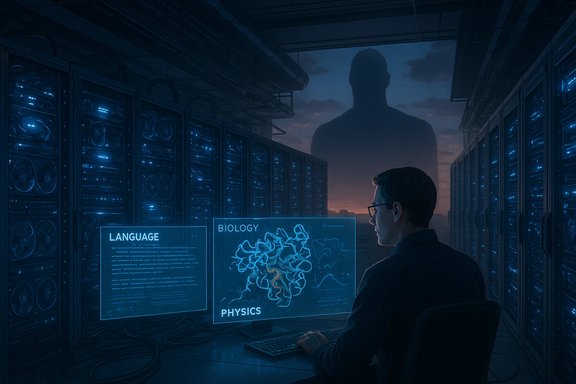
NVIDIA’s Jensen Huang told a long-form podcast audience that a single, all-knowing “God AI” might exist someday — but not within any practical horizon we should plan around — and his remarks have reopened a familiar industry debate about timelines, risk, and the right policy posture for AI today. Huang framed “God AI” as a hypothetical system that would master human language, molecular and genomic languages, physics, and more in one monolithic intelligence, and he called that vision “biblical” or even “galactic” in scale. His point was less to predict an exact calendar date and more to argue for decoupling doomsday neurology from the business of integrating capable, domain-specific AI into products and infrastructure now. This article takes the conversation beyond headlines: it summarizes the core remarks, places them against other prominent views from Demis Hassabis and Sam Altman, verifies the technical and economic claims that matter to Windows users and IT buyers, and evaluates the practical risks and corporate incentives at stake. It draws on the original No Priors interview, major press coverage, canonical technical achievements (notably AlphaFold’s breakthrough in protein structure prediction), and energy-and-infrastructure analyses to test whether Huang’s dismissal of a near-term monolithic “God AI” is persuasive — and what it means for companies that must deploy AI responsibly over the next decade.
That practical posture sits beside legitimate alarms from figures like Demis Hassabis and Bill Gates. Those voices raise real and specific risks — from loss of human oversight in critical systems to dual-use biological threats — which require governance, cross-disciplinary collaboration, and new public goods (detection, surveillance, and global coordination) that go beyond corporate roadmaps.
For IT decision-makers and Windows-centric organizations, the right strategy is dual-track: accelerate adoption of proven, domain-specific AI where it delivers ROI, while simultaneously supporting the policy, safety research, and infrastructure investment needed to keep long-term risks manageable. The industry should treat Huang’s timeline skepticism as a useful corrective to hysteria — but not as a reason to postpone the hard governance work that experts and policymakers rightly demand.
Source: Windows Central NVIDIA CEO says "God AI" could exist someday — but not in the next decade
 Background
What Jensen Huang actually said — and what he meant
Jensen Huang’s comments came in a wide-ranging No Priors interview where he covered stack-level AI engineering, robotics, open source, and industry narratives. When asked whether we will ever have a single system that “knows everything,” Huang responded:- “I guess someday we will have God AI… but that someday is probably on biblical scales. I think galactic scales.”
- He emphasized that no company or researcher is practically close to building such a system, and that the industry should instead focus on integrating practical AI into business operations now.
Why this matters right now
The debate over whether AGI or “God AI” is near is not only philosophical. It shapes:- Regulatory urgency and the political appetite for guardrails.
- Corporate R&D and capex planning (chip orders, datacenter construction, energy contracts).
- Public risk narratives that influence hiring, venture flows, and research priorities.
Overview: competing narratives from the industry
The “far-off God AI” position — Jensen Huang
Huang’s view is built on three pillars:- A single monolithic model that truly masters language, biological systems, and physics is qualitatively different from today's ensembles of specialized models.
- The engineering and scientific gaps to a unified system are enormous; we should not confuse fast progress in one domain (e.g., large language models) with general mastery.
- Meanwhile, the immediate business problem is scale, energy, and integration — getting domain-specific AI into products, data centers, and workflows.
The “society-is-unready” alarm — Demis Hassabis
DeepMind’s Demis Hassabis has taken the opposite tack on urgency. While acknowledging AI’s benefits, Hassabis has warned that AGI — or models approaching human-level cognitive generality — could arrive within a timeframe that requires active societal preparation. His public interviews stress governance, controllability, and international cooperation. That view elevates the need for policy frameworks and proactive safety research.The “whoosh-by” hypothesis — Sam Altman
OpenAI’s Sam Altman has said the AGI concept may be losing utility as modern models blur the boundary between narrow systems and general capabilities. At times, he has suggested that AGI-like behavior could “whoosh by” without obvious, immediate catastrophe — a characterization that emphasizes continuity over dramatic rupture. That framing has been interpreted in various ways: as reassurance, as minimizing downside, and — by critics — as underestimating non-linear risks. These three positions — Huang’s caution about monoliths, Hassabis’s readiness warnings, and Altman’s continuity framing — capture the spectrum of executive-level sentiment today. Each view carries different policy and procurement implications for Windows enthusiasts, enterprises, and regulators.Technical reality check: how close are we to a single, universal intelligence?
The state of the art across domains
AI progress has been rapid but domain-specific:- Language: Large language models (LLMs) like recent iterations of mainstream products show advanced reasoning, coding, summarization, and multimodal abilities.
- Biology: DeepMind’s AlphaFold dramatically changed protein structure prediction — a breakthrough recognized with the Nobel Prize in Chemistry — but AlphaFold is a specialized system optimized for one class of biological problems. It does not, by itself, confer general cognitive understanding of biology, therapeutic design, or wet-lab experimentation.
- Physics: Machine learning aids simulation and material discovery, but physics problems still require domain-specific modeling, simulation fidelity, and experimental validation.
- Integrated reasoning across domains: No publicly known system reliably bridges natural language, molecular design, and advanced physical simulation at production-grade scale.
Why a unified “God AI” is hard — three technical barriers
- Data heterogeneity and grounding — Language tokens are not the same as physical experiment traces or molecular conformational ensembles; models trained on one distribution do not automatically generalize to others.
- Computation and energy — Training and running the largest models demand enormous compute and power; the infrastructure scaling problem is non-trivial and includes cooling, grid access, and capex constraints. OECD and energy analysts highlight that AI-driven data center demand is a central near-term bottleneck.
- Evaluation and safety — We lack robust, universal evaluation metrics that certify a system is “generally intelligent” in ways that map to controllability and alignment.
Economics and infrastructure: Huang’s “AI factory” thesis verified
GPUs, datacenters, and energy are the limiting story now
Huang repeatedly frames the current moment as an infrastructure phase: chips, racks, networking, and power. Independent analyses show data centers’ power needs are growing fast, driven in significant part by AI workloads. Projections from energy and economic organizations warn that AI-related data center electricity use will be a major planning challenge for utilities and governments. These engineering constraints support Huang’s pragmatic point that the immediate task is to build sustainable infrastructure for the AI we have today. Key, verifiable numbers (representative, not exhaustive):- Data center electricity consumption rose materially in recent years and is projected to increase further as AI inference and training workloads scale.
- Analysts estimate that AI adoption and hyperscale GPU deployments will require thousands of megawatts of new power capacity in short order, with implications for grid planning and industrial gas/nuclear capacity in some geographies.
“Tokenomics” and falling inference costs — an important but double-edged claim
Huang and other industry leaders have pointed out that per-query costs for inference have dropped substantially over time, enabling broad productization. That decline in marginal cost fuels rapid adoption. But lower per-query cost also means overall system energy and supply chain demand can still increase dramatically once scale multiplies. In other words, efficiency gains often enable larger overall consumption rather than reduce it. This pattern has appeared across computing history and is visible again in AI infrastructure forecasts.Safety and policy: why Bill Gates, Hassabis, and others are sounding alarms
Bill Gates’s specific warning: dual-use biological risk
Bill Gates recently warned that AI could be used to design biological agents and that non-state actors using open tools may present a bioterrorism risk comparable to or greater than COVID-era threats. This is a concrete, domain-specific concern: computational biology tools lower technical barriers for design and hypothesis generation. Gates stresses the need for governance, detection, and international coordination to manage these dual-use capabilities. Those remarks have been made publicly in his Year Ahead letters and widely reported. Two important verifications:- AlphaFold and comparable tools demonstrate AI’s capacity to accelerate biological discovery — which is a benefit — but the same techniques can be misused in the wrong hands.
- AI labs including OpenAI have acknowledged dual-use potential and are engaging biosecurity experts; policymakers have begun to treat biosecurity from AI-driven tools as a governance priority.
The spectrum of safety responses: immediate, medium, and long-term
- Immediate: tighten access control, operational monitoring, and biosecurity collaborations for dual-use workflows.
- Medium: invest in detection, diagnostics, and resilient public-health infrastructure (the same fix Gates advocated after COVID).
- Long-term: global accords, standards for explainability, validation pipelines for high-stakes model outputs.
Practical takeaways for IT buyers, Windows users, and enterprise leaders
Short-term (now → 2 years)
- Prioritize domain-specific AI pilots that have measurable ROI rather than chasing “general intelligence.”
- Plan for compute and power constraints: negotiate long-term energy contracts, build redundancies, and evaluate cloud vs. on-prem costs with energy considerations factored in.
- Apply rigorous risk assessments for any model used in high-stakes domains (healthcare, identity, finance), including adversarial threat models and red-team exercises.
Medium-term (2 → 5 years)
- Build modular AI governance that covers data provenance, model certifiability, and post-deployment monitoring.
- Prepare teams for hybrid workflows where human experts validate and augment AI outputs; don’t assume fully autonomous substitution without robust validation.
Long-term (5+ years)
- Support public policy that couples capability oversight with innovation incentives: standards for traceability, testing, and cross-border audits.
- Invest in strategic energy resilience to avoid being dependent on volatile supply for critical AI workloads.
Critical analysis: strengths, weaknesses, and the honest bets
Strengths in Huang’s position
- Grounded engineering realism: emphasizing infrastructure, energy, and domain specialization aligns with verifiable technical constraints.
- Operational focus: his push for open source and practical productization addresses where most value will flow in the near term.
- Counterweight to fear: by rejecting melodrama, he helps prevent regulatory overreach that could cripple useful, safety-enhancing investments.
Potential blind spots and risks
- Underestimating non-linear risk: dismissing an existential or near-term AGI risk narrative does not obviate dual-use dangers in biology or rapid emergent behaviors in powerful models.
- Commercial incentive bias: as the CEO of a company selling GPUs and data-center hardware, Huang’s emphasis on infrastructure and practical deployment is partly aligned with NVIDIA’s commercial interests. Readers should account for that incentive structure when weighing his timeline claims.
- Public-policy mismatch: the policy community increasingly interprets some technical signals as reasons to accelerate guardrails; industry emphasis on productivity can conflict with the pace policymakers deem prudent.
Where the honest bets lie
- Bet on specialized, high-value AI in the next decade — drug discovery primitives, coding assistants, legal-research agents, and imaging tools will continue to deliver measurable value.
- Expect energy and infrastructure friction — supply-chain and grid constraints are the most immediate bottlenecks to scaling AI operations.
- Prepare for regulatory tightening in bio- and cybersecurity domains — given the dual-use nature of many advances, expect governments to impose stricter controls over certain model classes and datasets.
Unverifiable claims and necessary caution
- “God AI” timelines are intrinsically speculative: metaphors like “biblical” or “galactic” are rhetorical, not scientific forecasts. Treat them as corporate framing rather than falsifiable predictions.
- Claims that “we’re not anywhere near God AI” are a defensible working hypothesis today, but they do not preclude sudden breakthroughs or combinatorial advances. Therefore, both engineering resilience and policy frameworks deserve simultaneous investment.
- Projections about exact electricity usage or timeline-to-AGI from single analysts vary widely; rely on cross-validated studies (IEA, OECD, academic literature) rather than single-source extrapolations.
Conclusion
Jensen Huang’s “God AI” soundbite did more than provoke social-media takes: it clarified an important industry stance. Huang argues that an all-powerful, monolithic intelligence is not the urgent technical problem companies should be building around today. His emphasis on infrastructure, domain specialization, and open-source innovation is consistent with measurable constraints — especially energy and data-center scaling — and resonates with how most enterprises will capture value from AI in the coming years.That practical posture sits beside legitimate alarms from figures like Demis Hassabis and Bill Gates. Those voices raise real and specific risks — from loss of human oversight in critical systems to dual-use biological threats — which require governance, cross-disciplinary collaboration, and new public goods (detection, surveillance, and global coordination) that go beyond corporate roadmaps.
For IT decision-makers and Windows-centric organizations, the right strategy is dual-track: accelerate adoption of proven, domain-specific AI where it delivers ROI, while simultaneously supporting the policy, safety research, and infrastructure investment needed to keep long-term risks manageable. The industry should treat Huang’s timeline skepticism as a useful corrective to hysteria — but not as a reason to postpone the hard governance work that experts and policymakers rightly demand.
Source: Windows Central NVIDIA CEO says "God AI" could exist someday — but not in the next decade
