

Nearly a decade after its launch, Just Cause 3 has quietly been nudged back into the news cycle — not with a new expansion or sequel tease, but with a stealth PC update that appears to remove the game’s long‑criticized Denuvo anti‑tamper layer, a change that is already reshaping mod compatibility, executable size, and community sentiment.
Just Cause 3, Avalanche Studios’ explosive open‑world sandbox released in December 2015, has remained a vocal presence on PC thanks to its wingsuit traversal, chaotic physics, and an enduring mod scene. For many players and modders the game carried an old grievance: the inclusion of Denuvo, a commercial anti‑tamper system that has been blamed — rightly or wrongly — for performance overhead, compatibility hurdles, and headaches for community modding efforts.
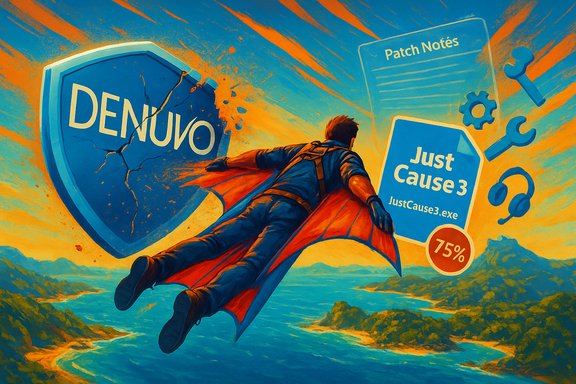
On 17 December 2025 the Steam build for Just Cause 3 changed (build 20206564), and community watchers quickly noticed two things: the store page and metadata no longer referenced Denuvo, and the main Windows executable saw a meaningful size reduction. The change appeared in SteamDB’s patch listing for the game and left the community piecing together what had happened. This article breaks down what changed, why it matters for players and modders, how the community has reacted, practical recovery steps, and the broader industry context — including what this move may signal about the economics and technical trade‑offs of modern DRM.
Source: Windows Central https://www.windowscentral.com/gami...aotic-sandbox-still-has-tricks-up-its-sleeve/
 Background / Overview
Just Cause 3, Avalanche Studios’ explosive open‑world sandbox released in December 2015, has remained a vocal presence on PC thanks to its wingsuit traversal, chaotic physics, and an enduring mod scene. For many players and modders the game carried an old grievance: the inclusion of Denuvo, a commercial anti‑tamper system that has been blamed — rightly or wrongly — for performance overhead, compatibility hurdles, and headaches for community modding efforts.On 17 December 2025 the Steam build for Just Cause 3 changed (build 20206564), and community watchers quickly noticed two things: the store page and metadata no longer referenced Denuvo, and the main Windows executable saw a meaningful size reduction. The change appeared in SteamDB’s patch listing for the game and left the community piecing together what had happened. This article breaks down what changed, why it matters for players and modders, how the community has reacted, practical recovery steps, and the broader industry context — including what this move may signal about the economics and technical trade‑offs of modern DRM.
What actually changed — the evidence
- SteamDB recorded a new public build for Just Cause 3 on 17 December 2025: Build 20206564. SteamDB’s patch listing shows the update was applied to the public branch and that one depot (the Windows executable depot) changed. The entry contains no developer patch notes beyond the list of changed files.
- Multiple outlets and hands‑on users reported the result: the main executable (JustCause3.exe) dropped in size by roughly 73 MB, a reduction consistent with the removal of embedded anti‑tamper code. Reporting outlets that examined the build and community technical observations flagged the same size delta.
- The game’s Steam metadata and store presence no longer list Denuvo or other Denuvo product strings, which — combined with the executable change — strongly indicates the anti‑tamper layer was removed in the update. Community postings captured screenshots and user reports verifying the disappearance of Denuvo from store text and local metadata.
- There has been no formal public announcement from Square Enix or Avalanche Studios explaining the change; instead the evidence is community‑driven (SteamDB, Reddit, modder posts, and tech press writeups). Treat the lack of an official statement as a relevant caveat: the removal is verifiable through third‑party telemetry and file changes, but publisher motives and long‑term plans have not been published.
Why Denuvo matters (brief refresher)
Denuvo is an anti‑tamper and anti‑piracy technology that integrates into a game executable and related binaries. Its design is to make unauthorized cracking and redistribution harder, particularly in the crucial release window. Over the last decade it has become controversial for several reasons:- Performance claims: Some players and reviewers associate Denuvo with longer load times and microstutters in certain titles. While impact varies between games and hardware, the perception that Denuvo increases overhead is widespread. Performance debates around Denuvo have persisted in PC communities for years.
- Modding friction: Because Denuvo hooks into executables and memory, it historically made reverse engineering and modding harder; modders often need to work around anti‑tamper protections or wait for official changes. This has led to delayed or more complex mod compatibility for older titles.
- Licensing economics: Denuvo is an ongoing commercial product and maintaining it in a title can entail subscription or license costs. Publishers sometimes choose to remove it after the early piracy risk window has passed, balancing cost versus perceived benefit. Community discussions around those economics frequently surface when older games are patched to drop the tech.
Immediate community impact: mods, multiplayer tools, and broken workflows
The Just Cause 3 community reacted fast — as communities do — and the initial practical consequences are predictable and already visible.- Several major mods and community tools — including multiplayer frameworks, script patches, and exe‑patch dependent mods — reported breakages immediately after the update. Mod authors explained that the changes to the executable’s identity and internal layout meant existing binary‑patching approaches and ASI/third‑party hooks no longer match. One modder advised downgrading to the previous executable until mod updates follow.
- Players reported a range of end‑user symptoms after updating: some saw the game fail to initialize or report Steam initialization errors; others found the update fixed existing Denuvo‑related microfreezes. The mixed experiences reflect how removal can both break tools that expect the old binary and restore performance for owners who suffered from in‑game anti‑tamper overhead.
- The update’s practical effect for modders is twofold: (1) a short‑term disruption to tools that rely on the old exe; and (2) a longer‑term win for modding freedom once community mods are updated to target the new executable layout. Several modders have already published or shared workarounds and archived older executables to help users who want compatibility while the ecosystem catches up.
How to handle the update now — practical steps for players and modders
If you own Just Cause 3 on PC, here are practical, ordered steps to protect your install and stay in control of mods and online features.- Backup first.
- Before doing any file verification or Steam updates, make a copy of your current JustCause3.exe and any modded files. Place them outside the Steam directory so they’re preserved. This lets you roll back if you need to.
- Don’t verify game files if you want the old exe preserved.
- Steam’s “Verify integrity of game files” will re‑download the latest depot (the Denuvo‑free exe). If you rely on an older mod that needs the previous exe, skip verification until mod updates are available.
- If a mod breaks, look for an updated release or an archived exe.
- Many mod authors are already posting patched mod releases or providing the previous exe as a convenience. Use trusted community channels (official mod pages, reputable Reddit threads) and avoid downloading executables from unknown mirrors.
- If you want the new build for performance reasons, accept that some mods will need time to catch up.
- The Denuvo removal may reduce background processes and microfreezes for some configurations. If you prioritize stability over old‑exe mod compatibility, update and then expect to reinstall or update mods as new versions arrive.
- For multiplayer and server‑side mod frameworks: check community announcements.
- Framework authors (e.g., JC3 multiplayer projects) will coordinate compatibility patches. If a multiplayer tool is required to play with friends, don’t switch build versions unilaterally — coordinate to ensure everyone uses the same executable.
- Keep an eye on SteamDB branches.
- SteamDB shows branch history and sometimes preserves a “lastrelease” branch or private branches. Advanced users can reference SteamDB to understand which build ID corresponds to the older executable if they need to restore it. Using branch management tools requires caution and is not officially supported by Steam.
Publisher intent and industry context — what might be behind this move?
There are three plausible and not mutually exclusive reasons publishers remove Denuvo from older titles:- Financial: Denuvo licensing and maintenance costs can be meaningful, and publishers may decide ongoing protection is not worth the license fees for a ten‑year old title. Community commentary has often pointed to the recurring cost as a driver for removal.
- Technical/UX: Ongoing complaints about performance and compatibility can push a publisher to remove heavy anti‑tamper tech once the initial piracy window has closed. For many single‑player titles, the early sales window is the main period where DRM provides perceived value. After that, the technical downside can outweigh benefits. Industry examples of later removal exist: other developers have publicly removed Denuvo for stability reasons.
- Strategic: Removing Denuvo can be a goodwill gesture to long‑term players and modding communities, signalling that a legacy title is being maintained in a lighter, more community‑friendly form. That said, publishers rarely accompany such removals with public fanfare, so community detection of file changes is often how these moves become known.
Risks, unknowns, and things to watch
- Server and leaderboard implications: Some community comments raised the possibility that removing Denuvo might be associated with shutting down legacy leaderboard or online services. There is no evidence that Square Enix is simultaneously discontinuing online features, but the concern is worth noting because prior updates involving DRM swaps have sometimes coincided with server changes. Until Square Enix confirms otherwise, treat any predictions about leaderboards or online service shutdowns as speculative.
- Security and anti‑cheat trade‑offs: Removing Denuvo does not necessarily mean a game becomes unprotected forever. Publishers can and do replace one anti‑tamper solution with another system or rely on platform DRM (e.g., Steam) and server‑side checks. Community chatter hinted at the possibility that Steam’s built‑in protections or other measures are being relied on in the new build; this is plausible but not formally documented by the publisher.
- Mod ecosystem fragmentation: In the immediate term expect fragmentation — some players will run the new exe to enjoy performance gains; others will stick with the old exe for critical mods. That split can complicate multiplayer and modded community events until a clear migration path emerges.
- Unverified motives: Without a publisher statement, motives like “cost‑saving” or “practical stability improvement” are plausible but not confirmed. Treat these interpretations as reasoned inference rather than declared fact.
Broader takeaways for Windows PC gaming and modders
- Old games still matter.
- Even titles more than a decade old maintain active communities and daily player counts. That active playerbase is enough to merit occasional maintenance releases, especially when third‑party ecosystems (mods, multiplayer frameworks) continue to add value. The Just Cause 3 case underscores that a legacy title can still generate technical work and community attention.
- DRM decisions are both technical and economic.
- Choices about embedded anti‑tamper systems are not purely technical; licensing costs, community relations, and long‑tail sales dynamics influence whether a publisher keeps or removes systems like Denuvo. Observers should expect more such removals as licensing windows close and community pressure continues.
- Modding communities remain resilient.
- The initial disruption to mods is painful but temporary. Modders have repeatedly shown they can adapt to binary changes, release new patches, and coordinate restored compatibility — albeit sometimes after a short period of fragmentation. If you rely on mods, approach updates with backups and patience.
Conclusion
The stealth update to Just Cause 3 is a textbook example of how legacy games can still ripple across the PC ecosystem. The evidence — a SteamDB build change on 17 December 2025, the disappearance of Denuvo references, and a ~73 MB shrink in the Windows executable — strongly supports the conclusion that Denuvo was removed from the PC build. That removal brings both immediate friction and potential long‑term upside: mod compatibility was disrupted, but owners may see cleaner performance and easier modding once the community stabilizes. Without an official statement from Square Enix or Avalanche Studios, the publisher’s intent and any downstream server decisions remain unconfirmed; the most reliable evidence is currently the file and store changes captured by SteamDB and the modding community. For players and modders, the sensible approach is conservative: back up current executables, follow trusted modder channels for patched releases, and monitor SteamDB/official channels for any formal publisher communication. Over time this change is likely to be net positive for the modding ecosystem and for players who experienced Denuvo‑related issues — but it’s also a reminder that the technical and economic lifecycle of DRM affects more than just piracy metrics; it affects performance, mod culture, and how older games are preserved on modern Windows PCs.Source: Windows Central https://www.windowscentral.com/gami...aotic-sandbox-still-has-tricks-up-its-sleeve/
