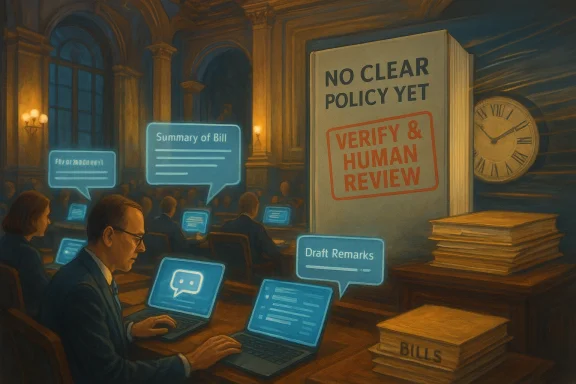
Kansas lawmakers are already using AI chatbots in the Statehouse, but the institution they serve has not yet built a clear rulebook for responsible use. That gap matters because the tools are no longer novelty gadgets; they are becoming part of the day-to-day machinery of drafting remarks, summarizing bills and finding background information at breakneck speed. The result is a distinctly 2026 problem: legislators are adopting powerful generative AI faster than the Legislature can define where convenience ends and governance begins. In a chamber where one missing word can change the meaning of law, that lag is not just procedural — it is structural.
The Kansas Statehouse has reached a familiar inflection point for public institutions: technology moved first, policy arrived later. According to the Kansas News Service reporting republished by The Lawrence Times, lawmakers from both parties have been experimenting with tools such as ChatGPT, Claude and Microsoft Copilot to summarize bills, draft remarks and quickly gather context before hearings or votes. The striking part is not that legislators are using AI; it is that they are doing so without formal statewide guidance on what counts as acceptable, prudent or prohibited use.
That absence of rules is not occurring in a vacuum. The 2026 Kansas legislative session has been moving at a punishing pace, and lawmakers themselves say the volume of bill activity makes quick research tools tempting. When the House voted on 113 bills in two days in February, the Statehouse was essentially creating the perfect environment for productivity shortcuts. In that atmosphere, AI becomes less of a futuristic experiment and more of a coping mechanism for overload.
At the same time, Kansas is not approaching AI in isolation. The Legislature has already entertained separate bills targeting AI-generated child sexual abuse material, chatbot harms and broader AI study groups. Those efforts show an institution trying to regulate the technology externally while still improvising internally. That tension — regulate the public use of AI while leaving lawmakers’ own use largely ungoverned — is the central paradox of the moment.
There is also a deeper administrative story here. The Legislature is still waiting on a major modernization of its bill tracking infrastructure, and the state’s chief information technology officer has said AI may eventually have a role, but not yet. That cautious institutional posture contrasts sharply with the individual behavior of lawmakers who are already using chatbots as informal assistants. The mismatch is classic government tech adoption: staff and members move at the speed of necessity, while the system moves at the speed of procurement, hearings and risk review.
Kansas is now experiencing the consequences of that broader shift. The state’s lawmakers are not unique in turning to AI, but the Statehouse is unique in the stakes attached to those outputs. In most office settings, an AI-generated mistake can be embarrassing or costly. In a legislative chamber, a mistake can misstate existing law, distort the effect of an amendment or shape a vote on incomplete information. That means the tolerance for hallucinations should be far lower than in ordinary office work.
What makes the Kansas case especially interesting is the overlap between individual experimentation and institutional delay. The Legislature has been pursuing a bill tracking overhaul for years, but modernization has lagged. Meanwhile, legislators are improvising with consumer-grade AI tools to compensate for that delay. That creates a system where the frontend has advanced faster than the backend, a recipe for uneven usage and inconsistent judgment.
The article’s reporting also fits into a broader Kansas AI policy landscape that has accelerated in the last two sessions. Lawmakers have already considered restrictions on certain AI platforms, study groups, age-related chatbot rules and child-safety provisions. That legislative activity shows real awareness of AI risks. Yet awareness is not the same thing as internal governance. It is one thing to regulate what AI does to Kansans; it is another to decide how elected officials should use it while drafting, summarizing and communicating.
Rep. Nick Hoheisel presents another version of the same trend: pragmatic, curious and somewhat guarded. He described using chatbots to compare bill language across states, which is exactly the sort of task generative AI can do well when used as a research accelerator rather than a final authority. But he also acknowledged that chatbots have produced hallucinations, especially when dealing with case law, underscoring the obvious but easily forgotten truth that speed does not equal reliability.
But legislative leverage can be deceptive. An AI summary may be fast, fluent and wrong all at once. If the chamber normalizes the tool without normalizing verification, then the Legislature risks building a workflow that rewards confidence rather than comprehension.
That skepticism is not merely philosophical. Sawyer Clayton also points out that legislative staff already exist to handle some of the tasks lawmakers are increasingly pushing onto AI. In her view, if summaries and data points are needed, the Legislature should rely on staff expertise rather than probabilistic chatbots. That argument matters because it frames AI not as a replacement for labor, but as a possible substitute for institutional memory and expertise.
That principle should matter even more for public-facing work. Constituent emails, press releases and talking points may seem low stakes, but they still shape public understanding of policy. If AI starts drafting the language that frames legislation, then the risk is not just factual inaccuracy — it is a gradual flattening of human voice, judgment and accountability.
The article notes that during one especially intense week in February, the House voted on 113 bills in two days. That number is more than a workload statistic; it is a signal that lawmakers are operating inside a high-throughput system. When the volume is that high, people naturally reach for shortcuts, and AI is the most seductive shortcut available because it feels like synthesis rather than skipping.
That is why the session pace matters so much. It is not just creating demand for AI; it is making the consequences of AI mistakes harder to notice in time. The faster the process, the more the Legislature needs deliberate guardrails.
Altaf Uddin, the chief information technology officer for the Kansas Legislature, said there is room for AI in the future but that the Legislature has not arrived there yet. His caution is telling. He appears comfortable with AI as a research aid but unwilling to trust it with core drafting functions. That distinction is smart. A tool that can summarize or retrieve may be useful; a tool that rewrites legal text without supervision is a different proposition entirely.
That split matters. It suggests Kansas is willing to legislate AI as a social and criminal issue before it has built the governance norms needed to manage AI inside the Capitol. In other words, the state is more comfortable regulating what AI does to the public than defining what AI should do for legislators.
Kansas should be careful not to let the task force become a substitute for simple, practical internal standards. Lawmakers do not need a yearlong study to know that AI-generated legal text should be checked, sensitive constituent data should be protected and public communications should not be treated as machine-authored facts without review.
This is where enterprise considerations diverge from consumer convenience. A legislator using AI on a personal account is not just using a tool; they are potentially creating a record, a privacy risk and a chain-of-accountability problem. Governments are not startups, and their tolerance for ambiguity should be much lower than a private worker’s.
That means transparency matters. Not every use of AI requires a ceremonial announcement, but the Legislature should consider norms that distinguish assistance from authorship. The public can tolerate tools. What it will not tolerate for long is the sense that elected officials are hiding behind them.
Several developments will be worth watching in the coming months. They will show whether Kansas is moving toward a coherent model or simply living with improvisation.
In the end, the real test is not whether Kansas lawmakers use AI. It is whether they can use it without letting it quietly redefine what responsible legislative work looks like.
Source: The Lawrence Times Some Kansas lawmakers use AI chatbots in the Statehouse — with no guidelines on responsible use
 Overview
The Kansas Statehouse has reached a familiar inflection point for public institutions: technology moved first, policy arrived later. According to the Kansas News Service reporting republished by The Lawrence Times, lawmakers from both parties have been experimenting with tools such as ChatGPT, Claude and Microsoft Copilot to summarize bills, draft remarks and quickly gather context before hearings or votes. The striking part is not that legislators are using AI; it is that they are doing so without formal statewide guidance on what counts as acceptable, prudent or prohibited use.That absence of rules is not occurring in a vacuum. The 2026 Kansas legislative session has been moving at a punishing pace, and lawmakers themselves say the volume of bill activity makes quick research tools tempting. When the House voted on 113 bills in two days in February, the Statehouse was essentially creating the perfect environment for productivity shortcuts. In that atmosphere, AI becomes less of a futuristic experiment and more of a coping mechanism for overload.
At the same time, Kansas is not approaching AI in isolation. The Legislature has already entertained separate bills targeting AI-generated child sexual abuse material, chatbot harms and broader AI study groups. Those efforts show an institution trying to regulate the technology externally while still improvising internally. That tension — regulate the public use of AI while leaving lawmakers’ own use largely ungoverned — is the central paradox of the moment.
There is also a deeper administrative story here. The Legislature is still waiting on a major modernization of its bill tracking infrastructure, and the state’s chief information technology officer has said AI may eventually have a role, but not yet. That cautious institutional posture contrasts sharply with the individual behavior of lawmakers who are already using chatbots as informal assistants. The mismatch is classic government tech adoption: staff and members move at the speed of necessity, while the system moves at the speed of procurement, hearings and risk review.
What the reporting reveals
The reporting points to several important realities. First, AI use is already normalized enough that at least one lawmaker, Rep. Sean Willcott, openly described using AI to help write parts of his remarks during a committee hearing about AI itself. Second, lawmakers do not agree on whether this is wise, with some seeing AI as an efficiency tool and others treating it with deep suspicion. Third, the Legislature has no explicit restrictions on using chatbots for constituent emails, press releases or legislative prep.- AI is already embedded in legislative work.
- No formal use policy currently governs lawmakers.
- Bill tracking modernization is still incomplete.
- Human judgment remains essential, especially where legal text is concerned.
- The pace of session is pushing members toward automation.
Background
AI chatbots entered public consciousness as novelty tools, then quickly escaped into the workflow of professionals who needed speed, summaries and drafts. In legislatures, that transition happened with remarkable speed because the work is text-heavy, deadline-driven and often repetitive. A bill analysis, a constituent response and a floor speech all require quick synthesis of documents, precedent and political nuance — exactly the kind of task that tempts users to ask a chatbot for a first draft.Kansas is now experiencing the consequences of that broader shift. The state’s lawmakers are not unique in turning to AI, but the Statehouse is unique in the stakes attached to those outputs. In most office settings, an AI-generated mistake can be embarrassing or costly. In a legislative chamber, a mistake can misstate existing law, distort the effect of an amendment or shape a vote on incomplete information. That means the tolerance for hallucinations should be far lower than in ordinary office work.
What makes the Kansas case especially interesting is the overlap between individual experimentation and institutional delay. The Legislature has been pursuing a bill tracking overhaul for years, but modernization has lagged. Meanwhile, legislators are improvising with consumer-grade AI tools to compensate for that delay. That creates a system where the frontend has advanced faster than the backend, a recipe for uneven usage and inconsistent judgment.
The article’s reporting also fits into a broader Kansas AI policy landscape that has accelerated in the last two sessions. Lawmakers have already considered restrictions on certain AI platforms, study groups, age-related chatbot rules and child-safety provisions. That legislative activity shows real awareness of AI risks. Yet awareness is not the same thing as internal governance. It is one thing to regulate what AI does to Kansans; it is another to decide how elected officials should use it while drafting, summarizing and communicating.
Why this moment matters
This is not just a story about tools. It is a story about institutional confidence, procedural integrity and public trust. If lawmakers increasingly rely on AI for background work, then they also need norms about verification, disclosure and acceptable boundaries.- Productivity gains are real, especially during compressed sessions.
- Accuracy risks are also real, particularly with legal text.
- Transparency expectations will likely rise as public awareness grows.
- Staff roles may shift if members lean on AI for routine work.
- Policy lag can create a credibility gap between public regulation and private use.
The Lawmakers Embracing AI
One of the clearest signals in the reporting is that AI use has become ordinary enough to be discussed openly in public hearings. Rep. Sean Willcott’s willingness to say he used AI to help write portions of his remarks is notable not because it is shocking, but because it reflects a new kind of legislative candor. When lawmakers begin admitting that AI helped shape the words they deliver to committees, the technology has crossed from private experimentation into public process.Rep. Nick Hoheisel presents another version of the same trend: pragmatic, curious and somewhat guarded. He described using chatbots to compare bill language across states, which is exactly the sort of task generative AI can do well when used as a research accelerator rather than a final authority. But he also acknowledged that chatbots have produced hallucinations, especially when dealing with case law, underscoring the obvious but easily forgotten truth that speed does not equal reliability.
Practical uses in the chamber
The range of uses described by lawmakers is revealing. Some are using AI for summary work, others for quick background, and still others for drafting assistance. That diversity suggests there is no single “AI use case” in the Statehouse; there are many, each with different risk profiles.- Bill summaries help lawmakers digest large volumes of text.
- Background research can speed up issue onboarding.
- Drafted remarks can save time before committee hearings.
- Comparison across states can surface policy models quickly.
- Constituent communication may become more efficient, but also less personal.
The appeal of speed
Lawmakers are under constant time pressure, and that pressure creates openings for automation. Legislative work often requires scanning dense language quickly, understanding technical topics on the fly and reacting in real time during hearings. AI fits that environment because it turns waiting into instant response, which feels like leverage.But legislative leverage can be deceptive. An AI summary may be fast, fluent and wrong all at once. If the chamber normalizes the tool without normalizing verification, then the Legislature risks building a workflow that rewards confidence rather than comprehension.
Skepticism and the Human Element
Not every lawmaker is enchanted by chatbots. Democratic Rep. Stephanie Sawyer Clayton’s response is a sharp reminder that one of the oldest values in democratic lawmaking is still relevant: read the thing yourself. Her “legislative purist” stance is not anti-technology so much as pro-accountability. She is arguing that the core work of interpreting testimony and asking questions should remain human, because political judgment cannot be outsourced without consequence.That skepticism is not merely philosophical. Sawyer Clayton also points out that legislative staff already exist to handle some of the tasks lawmakers are increasingly pushing onto AI. In her view, if summaries and data points are needed, the Legislature should rely on staff expertise rather than probabilistic chatbots. That argument matters because it frames AI not as a replacement for labor, but as a possible substitute for institutional memory and expertise.
Purism versus pragmatism
The political divide on AI in Kansas is not neatly partisan. The article makes clear that the split is more cultural than ideological. Some lawmakers prioritize efficiency and experimentation; others prioritize deliberation and direct reading. That makes the debate especially interesting because it mirrors a larger national argument about whether AI should assist judgment or become part of it.- Purists want human review to remain central.
- Pragmatists see AI as a force multiplier.
- Staff capacity influences how much AI temptation exists.
- Transparency becomes harder if outputs are blended into human work.
- Bias and errors can hide inside polished prose.
Why skepticism matters
In a legislature, skepticism is not a flaw. It is a feature. A system that depends on argument, amendment and oversight should be slow to trust tools that can confidently fabricate information. When lawmakers say they are “double and triple checking” outputs, they are acknowledging the essential truth that the machine cannot be the authority.That principle should matter even more for public-facing work. Constituent emails, press releases and talking points may seem low stakes, but they still shape public understanding of policy. If AI starts drafting the language that frames legislation, then the risk is not just factual inaccuracy — it is a gradual flattening of human voice, judgment and accountability.
Why the Session Pace Is Driving Adoption
The most practical explanation for AI uptake in Kansas is time pressure. The Legislature is moving quickly, and members have described the session as unusually compressed. In that kind of environment, every tool that promises a faster read on a bill or amendment looks useful, even if it comes with caveats.The article notes that during one especially intense week in February, the House voted on 113 bills in two days. That number is more than a workload statistic; it is a signal that lawmakers are operating inside a high-throughput system. When the volume is that high, people naturally reach for shortcuts, and AI is the most seductive shortcut available because it feels like synthesis rather than skipping.
Speed changes behavior
When institutions move too fast, they change what counts as normal. In a calmer process, a lawmaker might ask staff for a memo, read the bill text and cross-check sources manually. In a compressed process, a chatbot can seem like a reasonable first pass because it returns something usable immediately.- Fast sessions encourage rapid summarization.
- Dense agendas reward instant background.
- Limited time makes manual review harder.
- AI outputs can feel like relief.
- Bad workflows can become normalized quickly.
The hidden cost of convenience
Convenience is not free. Every time a lawmaker uses AI to compress complex text into a digestible form, there is a tradeoff between speed and confidence. If the tool gets it right, the gain is obvious. If it gets it wrong, the cost may surface much later, when the bill has already advanced or the public conversation has already hardened.That is why the session pace matters so much. It is not just creating demand for AI; it is making the consequences of AI mistakes harder to notice in time. The faster the process, the more the Legislature needs deliberate guardrails.
The Technology Infrastructure Gap
Kansas’ AI conversation cannot be separated from the state’s broader information technology modernization efforts. The Legislature has been waiting on an overhaul of its digital bill-tracking system, and the delays have frustrated members across party lines. That matters because institutions usually adopt AI best when the underlying systems are already clean, structured and integrated. If the basic workflow is fragmented, AI becomes a patch rather than a platform.Altaf Uddin, the chief information technology officer for the Kansas Legislature, said there is room for AI in the future but that the Legislature has not arrived there yet. His caution is telling. He appears comfortable with AI as a research aid but unwilling to trust it with core drafting functions. That distinction is smart. A tool that can summarize or retrieve may be useful; a tool that rewrites legal text without supervision is a different proposition entirely.
Why bill systems matter
AI can only be as useful as the data and process around it. If bill tracking is slow, opaque or incomplete, lawmakers will look elsewhere for answers. That is one reason consumer AI tools become so attractive: they are immediately available, even when institutional systems are not.- Modern bill tracking reduces pressure to improvise.
- Structured data improves research quality.
- Workflow integration matters more than flashy features.
- AI without infrastructure becomes ad hoc and inconsistent.
- Precision requirements are much higher for statutes than for summaries.
Precision versus probability
Uddin’s warning about “probabilistic” models is the key technical insight in the piece. Chatbots do not know things the way statutes know things; they predict likely text based on patterns. That makes them exceptionally fluent and, at times, deeply misleading. In a bill, “not” can reverse meaning. In governance, that is not a minor error. It is the difference between clarity and litigation.Kansas AI Policy Is Moving, But Not Fast Enough
Kansas lawmakers are not ignoring AI risks. In fact, they have already moved on several AI-related measures, including criminal penalties for AI-generated child sexual abuse materials and a bill to establish a task force on artificial intelligence and emerging technologies. That activity shows a Legislature that recognizes the public policy stakes of AI. The irony is that these external policy efforts are moving faster than internal guidance for lawmakers themselves.That split matters. It suggests Kansas is willing to legislate AI as a social and criminal issue before it has built the governance norms needed to manage AI inside the Capitol. In other words, the state is more comfortable regulating what AI does to the public than defining what AI should do for legislators.
What the bills signal
HB 2592, the task force bill, is especially relevant because it frames AI as a subject requiring study, not just regulation. The bill would create a Kansas task force on artificial intelligence and emerging technologies to evaluate risks, workforce implications and regulatory needs. That is sensible as a starting point, but it also underlines how early Kansas still is in institutional AI governance.- HB 2592 reflects a study-first approach.
- Other AI bills focus on harms and restrictions.
- Regulatory energy is real, but fragmented.
- Internal use policies have lagged behind public-facing rules.
- Governance maturity is still developing.
The role of task forces
Task forces can be useful when a technology is moving quickly and the policy landscape is uncertain. They bring together expertise, create a record and help lawmakers avoid rushing into bad rules. But task forces can also become a way to defer difficult decisions.Kansas should be careful not to let the task force become a substitute for simple, practical internal standards. Lawmakers do not need a yearlong study to know that AI-generated legal text should be checked, sensitive constituent data should be protected and public communications should not be treated as machine-authored facts without review.
The Enterprise Question: Staff, Data and Public Trust
The article’s most important institutional question is not whether lawmakers use AI, but how the Legislature protects itself when they do. That includes staff workflows, data handling and public confidence. If a member pastes constituent information into a public chatbot, that may expose sensitive data. If a chatbot drafts a press release, it may spread inaccuracies. If AI summaries are treated as authoritative, the Legislature’s own deliberative standards may erode.This is where enterprise considerations diverge from consumer convenience. A legislator using AI on a personal account is not just using a tool; they are potentially creating a record, a privacy risk and a chain-of-accountability problem. Governments are not startups, and their tolerance for ambiguity should be much lower than a private worker’s.
What responsible use would require
A serious internal AI policy would need to address more than whether chatbots are “allowed.” It would need to define contexts, boundaries and review requirements. The Legislature may not have such a policy today, but the need for one is obvious from the use cases lawmakers have already described.- No sensitive data should be entered into consumer chatbots.
- AI-generated text should be reviewed before public use.
- Legal and amendment drafting should remain human-controlled.
- Disclosure norms may be needed for public-facing materials.
- Staff guidance should be aligned with member behavior.
Why public trust is fragile
The public is already skeptical about politics, and AI can deepen that skepticism if it appears to replace authentic legislative voice with generated content. People expect lawmakers to think, read and decide for themselves. If the public starts believing that AI is writing speeches, summarizing bills and answering constituent mail, then trust may erode even if the underlying work is benign.That means transparency matters. Not every use of AI requires a ceremonial announcement, but the Legislature should consider norms that distinguish assistance from authorship. The public can tolerate tools. What it will not tolerate for long is the sense that elected officials are hiding behind them.
Strengths and Opportunities
Kansas has a chance to shape a smarter, more deliberate model of AI use in a state legislature that is already confronting the technology in public. If lawmakers take the current moment seriously, they can preserve the speed benefits of AI while building safeguards that fit democratic work. That is the opportunity hidden inside the controversy.- Faster research can help lawmakers keep up with dense hearings.
- Better summaries may improve comprehension across the aisle.
- Cross-state comparisons can broaden policy options.
- Task force work can create a shared factual baseline.
- Modern bill systems could reduce dependence on consumer tools.
- Responsible norms could make AI use more transparent.
- Staff augmentation may free humans for higher-value analysis.
Risks and Concerns
The risks are serious because the Legislature is not using AI in a vacuum; it is using it in a high-stakes environment where precision matters and public trust is always on the line. The absence of clear guidelines means the current system depends heavily on individual discretion, which is a weak foundation for public governance.- Hallucinations can distort legal or factual analysis.
- Sensitive data exposure is a real privacy concern.
- Overreliance may erode legislative expertise.
- Public distrust could grow if AI use feels hidden.
- Inconsistent practices can create unequal standards.
- Bias in outputs may shape policy framing subtly.
- Drafting errors can have legal consequences.
Looking Ahead
The next phase will likely depend on whether Kansas lawmakers decide that internal AI governance deserves the same seriousness as external AI regulation. If the Legislature continues to rely on ad hoc personal judgment, AI use will probably keep spreading quietly, shaped more by convenience than policy. If it creates a framework, Kansas could become an example of how to adopt AI without surrendering legislative discipline.Several developments will be worth watching in the coming months. They will show whether Kansas is moving toward a coherent model or simply living with improvisation.
- Whether HB 2592 advances or stalls after committee review.
- Whether internal AI guidance is proposed for lawmakers or staff.
- Whether bill-tracking modernization picks up momentum.
- Whether public disclosure norms emerge for AI-assisted communications.
- Whether more lawmakers openly discuss AI use in hearings.
- Whether privacy concerns trigger stricter boundaries.
In the end, the real test is not whether Kansas lawmakers use AI. It is whether they can use it without letting it quietly redefine what responsible legislative work looks like.
Source: The Lawrence Times Some Kansas lawmakers use AI chatbots in the Statehouse — with no guidelines on responsible use
Last edited: