

Katy Independent School District is preparing to put a formal artificial intelligence framework into practice for the 2026–27 school year, establishing a deliberately cautious, grade-based model for AI in the classroom rather than treating generative tools as an unrestricted new default.
The Katy ISD AI framework arrives as school systems confront a simple reality: artificial intelligence is already embedded in the technology students use outside school, in the software that shapes modern workplaces, and in the tools teachers increasingly encounter. The district’s response is notable because it positions AI as a matter of instructional design, digital citizenship, and student readiness—not merely an IT policy or a device-management issue.
At a July 20 Board Work Study meeting, district leaders connected the forthcoming framework to the ongoing implementation of the Texas Essential Knowledge and Skills for Technology Applications, commonly called Technology TEKS. That connection matters. Katy ISD is not presenting AI as a stand-alone elective, a chatbot access policy, or a temporary reaction to popular generative AI platforms. It is integrating the topic into a broader K–8 progression of technology skills and extending structured expectations into high school.
The stated goal is ambitious but sensible: create consistent, intentional AI use across campuses while ensuring technology does not displace teaching, human judgment, hands-on learning, or the relationships at the center of a functioning classroom.
That framing should be reassuring to Windows users, educators, and families who have watched AI adoption accelerate faster than school policies. It also sets a high bar. A framework only succeeds if the rules are clear, the approved tools are genuinely safe and useful, staff have adequate training, and students understand that an AI-generated response is not equivalent to learning.
The standards span more than basic computer familiarity. They support a progression of skills involving:
By fifth grade, the planned allocation reaches about 85 minutes per week, with students building practical skills such as keyboarding, digital file organization, and selecting suitable tools for specific tasks.
These figures are important because they counter a common assumption that an AI framework inevitably means substantially more passive screen time. Katy ISD’s model is presented as a measured progression in digital competency, not as an effort to put every child in front of an AI assistant all day.
Technology remains available to teachers as a way to enrich lessons, support differentiation, and meet individual learning needs. But the district’s public position is that digital tools should support instruction rather than replace high-quality teaching.
That flexibility is both necessary and potentially difficult. AI products change rapidly. Capabilities, vendor policies, privacy terms, and safety features can shift in a matter of months. A policy designed to remain static would become outdated quickly. At the same time, an evolving framework needs disciplined governance so that changes do not create inconsistent expectations between schools or leave families uncertain about what is permitted.
The district has made one principle especially clear: AI is a tool, not a teacher.
Educators will remain responsible for:
That organization suggests Katy ISD is treating AI literacy as a durable competency rather than a short-term lesson on how to write prompts for a chatbot. Proper AI literacy should include the ability to explain, at an age-appropriate level, what an AI system does and does not do.
Students need to understand that generative AI can create fluent responses without guaranteeing accuracy. It can omit context, reproduce bias, invent information, or confidently state something false. It also cannot determine whether a student understands a subject, whether an assignment reflects authentic work, or whether a particular recommendation fits a student’s real-world circumstances.
A productive K–12 AI literacy program therefore has to teach skepticism, verification, attribution, privacy, and judgment. Those skills will remain valuable even as today’s AI platforms are replaced by new ones.
This is a far more defensible approach than a binary policy in which every student either has open access to generative AI or is simply banned from using it.
However, younger students will not be allowed to use general-purpose generative AI chat tools such as Microsoft Copilot or Google Gemini.
This boundary is one of the framework’s strongest features. The district is distinguishing between narrowly designed instructional software, which can operate within teacher-led activities, and open-ended AI chat systems that can generate broad answers, writing, advice, and potentially unsuitable content.
For elementary students, that distinction is particularly important. Younger learners are still developing the reading, writing, research, social, and self-regulation skills needed to recognize when an AI response is mistaken or inappropriate. A chatbot may write in a confident tone that makes unreliable content look authoritative.
Teacher-guided, district-approved software does not eliminate every risk. But it creates a more manageable environment for introducing adaptive features, feedback tools, and digital learning systems without handing younger students a general-purpose content generator.
This is a sensible intermediate stage. Students at this level are more capable of discussing AI limitations, source evaluation, bias, privacy, and academic integrity. Yet they still benefit from a defined toolset and adult oversight.
The policy also avoids an easy loophole that has undermined many school AI rules: allowing use in principle while failing to specify which products are approved, what settings must be used, where student data goes, or how assignments should disclose AI assistance.
A supervised seventh-grade model gives teachers an opportunity to teach practical AI habits before students reach a stage where they have broader permission to use generative systems for academic work.
This is the part of the framework that most closely reflects the environment students will encounter in college, technical training, and the workplace. In many careers, responsible AI use will increasingly be expected. Students who have never learned to work with these tools may be at a disadvantage. Students who learn to rely on them uncritically may be at an even greater disadvantage.
Teacher authorization is the key phrase. It preserves the educator’s ability to decide when AI supports a learning objective and when it defeats it.
For example, generative AI could be appropriate when students are:
The framework’s requirement that students cite AI use when appropriate is an important start. But teachers will need practical, consistent examples. A vague citation rule can become difficult to enforce if a student used AI for brainstorming, grammar suggestions, translation, outline generation, code completion, image generation, or a full first draft.
A generative model can produce a worksheet, summarize an article, rewrite a passage at a different reading level, or suggest a lesson activity in seconds. But speed is not the same as educational quality.
Teachers understand classroom context. They know when a student’s sudden fluency signals genuine growth and when it may signal outside assistance. They recognize the difference between a student who needs a new explanation and one who needs more time, a worked example, a conversation, or encouragement.
AI cannot reliably replace that judgment.
Learning often requires students to encounter difficulty, organize their thoughts, make mistakes, receive feedback, revise, and try again. If an AI tool completes the difficult cognitive work too early, the student may submit a polished result without gaining the underlying skill.
Katy ISD’s insistence that AI should enhance, rather than replace, teaching and learning is therefore more than a slogan. It must become the standard used to evaluate every classroom use case.
A useful test is straightforward: Does the AI activity require students to think more deeply, or does it let them avoid thinking?
If the answer is avoidance, the technology may produce an impressive-looking assignment but weak learning.
This recognizes that age-appropriate AI education is not simply a matter of lowering the reading level of a policy document. It requires different expectations, safeguards, and learning objectives at different developmental stages.
Students need keyboarding, digital organization, communication, computational reasoning, online safety, and source evaluation. AI competence grows out of those foundations.
That distinction should make policy enforcement easier and help families better understand what their children are actually using.
Schools cannot control every tool a student sees, but they can teach students how to recognize AI, question it, and use it responsibly.
Families need clarity about which tools are approved, what student information those tools process, whether data can be used for model training, how parents can raise concerns, and what academic expectations apply at home.
For Windows-based school environments, this is especially relevant because AI features are increasingly integrated into productivity suites, browsers, search tools, device management platforms, and collaboration software. The line between a dedicated AI app and an ordinary education tool will continue to blur.
A practical framework might identify categories such as:
Teachers need continuing support that is practical rather than promotional. They need examples of classroom activities, model assignment language, sample disclosures, guidance for responding to suspected misuse, and clear procedures for reporting unsafe AI behavior or problematic vendor output.
Professional development must also respect teacher workload. Educators should not be expected to become AI safety specialists, policy attorneys, cybersecurity analysts, and content moderators on top of their existing responsibilities.
A strong districtwide model can reduce those gaps by ensuring every student receives structured instruction in school. But schools must also ensure that AI-supported activities do not punish students who lack access at home or require families to purchase subscriptions.
Accessibility must be built in as well. AI tools may support students with disabilities through text-to-speech, language assistance, drafting support, or adaptive feedback. But poorly configured systems can also create barriers, misinterpret student work, or offer support that conflicts with individualized learning plans.
Success would mean students can explain what AI is, what it cannot reliably do, and how to verify its outputs. It would mean teachers can authorize AI use with confidence because expectations are clear. It would mean parents can identify which tools are approved and understand how the district protects student data.
It would also mean classroom work remains recognizably human.
Students should still read complete texts, write independently, solve problems without automated answers, discuss ideas face to face, conduct experiments, build projects, collaborate with peers, and learn through revision. AI should make some learning experiences more engaging or more accessible, but it should not flatten every assignment into a generated response.
The real test begins with implementation in the 2026–27 school year. Clear privacy standards, sustained teacher training, consistent academic-integrity expectations, transparent communication with families, and rigorous oversight of approved tools will decide whether the framework becomes a useful model or merely a well-intentioned policy document.
For now, Katy ISD is taking the more responsible path: treating AI as a powerful but imperfect tool that students must learn to question, use transparently, and place within the larger discipline of human learning.
 Overview
The Katy ISD AI framework arrives as school systems confront a simple reality: artificial intelligence is already embedded in the technology students use outside school, in the software that shapes modern workplaces, and in the tools teachers increasingly encounter. The district’s response is notable because it positions AI as a matter of instructional design, digital citizenship, and student readiness—not merely an IT policy or a device-management issue.At a July 20 Board Work Study meeting, district leaders connected the forthcoming framework to the ongoing implementation of the Texas Essential Knowledge and Skills for Technology Applications, commonly called Technology TEKS. That connection matters. Katy ISD is not presenting AI as a stand-alone elective, a chatbot access policy, or a temporary reaction to popular generative AI platforms. It is integrating the topic into a broader K–8 progression of technology skills and extending structured expectations into high school.
The stated goal is ambitious but sensible: create consistent, intentional AI use across campuses while ensuring technology does not displace teaching, human judgment, hands-on learning, or the relationships at the center of a functioning classroom.
That framing should be reassuring to Windows users, educators, and families who have watched AI adoption accelerate faster than school policies. It also sets a high bar. A framework only succeeds if the rules are clear, the approved tools are genuinely safe and useful, staff have adequate training, and students understand that an AI-generated response is not equivalent to learning.
Background: Technology TEKS Are the Foundation
Texas revised its K–8 Technology Applications TEKS in 2022, with implementation beginning in the 2024–25 school year. These state standards establish what students should know and be able to do with technology at each grade level.The standards span more than basic computer familiarity. They support a progression of skills involving:
- Computer fundamentals
- Keyboarding and productivity software
- Digital citizenship
- Digital literacy
- Computational thinking
- Responsible technology use
- Cybersecurity and privacy awareness
- Communication and collaboration using digital tools
A paced approach to screen time and technology use
The district’s presentation also emphasized that classroom technology will be introduced gradually and purposefully. At the kindergarten level, students are expected to spend roughly 35 minutes per week on foundational technology skills connected to the curriculum. That rises to approximately one hour each week in first and second grade.By fifth grade, the planned allocation reaches about 85 minutes per week, with students building practical skills such as keyboarding, digital file organization, and selecting suitable tools for specific tasks.
These figures are important because they counter a common assumption that an AI framework inevitably means substantially more passive screen time. Katy ISD’s model is presented as a measured progression in digital competency, not as an effort to put every child in front of an AI assistant all day.
Technology remains available to teachers as a way to enrich lessons, support differentiation, and meet individual learning needs. But the district’s public position is that digital tools should support instruction rather than replace high-quality teaching.
What the Katy ISD AI Framework Establishes
Katy ISD describes its AI framework as a guide for the ethical, safe, and purposeful integration of artificial intelligence across district classrooms. The framework is intended to be a living resource, with continued updates informed by educators, campus leaders, students, and families.That flexibility is both necessary and potentially difficult. AI products change rapidly. Capabilities, vendor policies, privacy terms, and safety features can shift in a matter of months. A policy designed to remain static would become outdated quickly. At the same time, an evolving framework needs disciplined governance so that changes do not create inconsistent expectations between schools or leave families uncertain about what is permitted.
The district has made one principle especially clear: AI is a tool, not a teacher.
Educators will remain responsible for:
- Designing instruction
- Selecting learning activities
- Evaluating student understanding
- Providing feedback
- Building relationships
- Making professional decisions about student needs
- Maintaining accountability for classroom learning
AI literacy sits alongside core technology skills
The framework’s public-facing structure places AI literacy alongside computer fundamentals, digital citizenship, digital literacy and computational thinking, productivity tools, and keyboarding.That organization suggests Katy ISD is treating AI literacy as a durable competency rather than a short-term lesson on how to write prompts for a chatbot. Proper AI literacy should include the ability to explain, at an age-appropriate level, what an AI system does and does not do.
Students need to understand that generative AI can create fluent responses without guaranteeing accuracy. It can omit context, reproduce bias, invent information, or confidently state something false. It also cannot determine whether a student understands a subject, whether an assignment reflects authentic work, or whether a particular recommendation fits a student’s real-world circumstances.
A productive K–12 AI literacy program therefore has to teach skepticism, verification, attribution, privacy, and judgment. Those skills will remain valuable even as today’s AI platforms are replaced by new ones.
The Grade-Level Rules: A Scaffolded Access Model
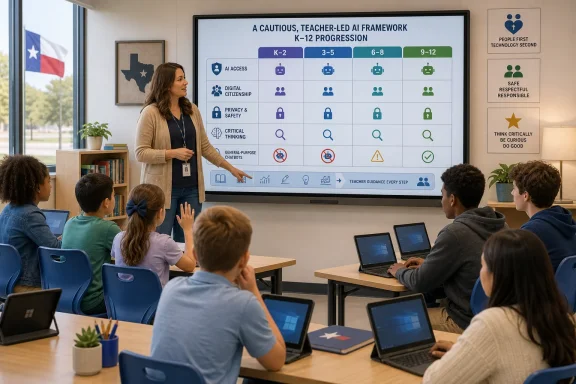
The most concrete part of Katy ISD’s plan is its scaffolded access system. Rather than offering the same AI permissions to every student, the district will progressively expand access according to grade level and instructional context.This is a far more defensible approach than a binary policy in which every student either has open access to generative AI or is simply banned from using it.
Kindergarten through sixth grade: guided platforms, no generative chatbots
Students in kindergarten through sixth grade may use district-approved AI-enabled learning platforms under teacher guidance. The district has identified tools such as Amira Learning and Writable as examples of platforms that can be used in this structured setting.However, younger students will not be allowed to use general-purpose generative AI chat tools such as Microsoft Copilot or Google Gemini.
This boundary is one of the framework’s strongest features. The district is distinguishing between narrowly designed instructional software, which can operate within teacher-led activities, and open-ended AI chat systems that can generate broad answers, writing, advice, and potentially unsuitable content.
For elementary students, that distinction is particularly important. Younger learners are still developing the reading, writing, research, social, and self-regulation skills needed to recognize when an AI response is mistaken or inappropriate. A chatbot may write in a confident tone that makes unreliable content look authoritative.
Teacher-guided, district-approved software does not eliminate every risk. But it creates a more manageable environment for introducing adaptive features, feedback tools, and digital learning systems without handing younger students a general-purpose content generator.
Seventh grade: approved AI under supervision
Seventh grade represents a transition point. Students may use district-approved AI tools while under teacher supervision, but they may not use non-approved generative AI products on school devices or district networks.This is a sensible intermediate stage. Students at this level are more capable of discussing AI limitations, source evaluation, bias, privacy, and academic integrity. Yet they still benefit from a defined toolset and adult oversight.
The policy also avoids an easy loophole that has undermined many school AI rules: allowing use in principle while failing to specify which products are approved, what settings must be used, where student data goes, or how assignments should disclose AI assistance.
A supervised seventh-grade model gives teachers an opportunity to teach practical AI habits before students reach a stage where they have broader permission to use generative systems for academic work.
Eighth through 12th grade: authorized educational use
Students in eighth through twelfth grade will be permitted to use generative AI tools for specified educational purposes with teacher authorization. They will still be expected to follow district policy and cite AI use when appropriate.This is the part of the framework that most closely reflects the environment students will encounter in college, technical training, and the workplace. In many careers, responsible AI use will increasingly be expected. Students who have never learned to work with these tools may be at a disadvantage. Students who learn to rely on them uncritically may be at an even greater disadvantage.
Teacher authorization is the key phrase. It preserves the educator’s ability to decide when AI supports a learning objective and when it defeats it.
For example, generative AI could be appropriate when students are:
- Comparing multiple explanations of a difficult concept
- Analyzing the strengths and errors in AI-generated writing
- Brainstorming research terms before beginning a source-based project
- Creating practice questions after independently studying material
- Revising a draft while documenting which suggestions were accepted or rejected
- Exploring how prompt phrasing changes an AI response
- Testing the accuracy of an AI answer against reliable classroom materials
The framework’s requirement that students cite AI use when appropriate is an important start. But teachers will need practical, consistent examples. A vague citation rule can become difficult to enforce if a student used AI for brainstorming, grammar suggestions, translation, outline generation, code completion, image generation, or a full first draft.
Why the Teacher-Centered Design Matters
The strongest message in Katy ISD’s AI framework is not that the district is embracing AI. Many districts have already done that in one form or another. The meaningful message is that teachers remain the center of instructional decision-making.A generative model can produce a worksheet, summarize an article, rewrite a passage at a different reading level, or suggest a lesson activity in seconds. But speed is not the same as educational quality.
Teachers understand classroom context. They know when a student’s sudden fluency signals genuine growth and when it may signal outside assistance. They recognize the difference between a student who needs a new explanation and one who needs more time, a worked example, a conversation, or encouragement.
AI cannot reliably replace that judgment.
The danger of “frictionless” learning
The core risk of generative AI in schools is not merely cheating. It is the erosion of productive struggle.Learning often requires students to encounter difficulty, organize their thoughts, make mistakes, receive feedback, revise, and try again. If an AI tool completes the difficult cognitive work too early, the student may submit a polished result without gaining the underlying skill.
Katy ISD’s insistence that AI should enhance, rather than replace, teaching and learning is therefore more than a slogan. It must become the standard used to evaluate every classroom use case.
A useful test is straightforward: Does the AI activity require students to think more deeply, or does it let them avoid thinking?
If the answer is avoidance, the technology may produce an impressive-looking assignment but weak learning.
Key Strengths of the Framework
Katy ISD’s plan has several notable strengths that other districts should watch closely.1. It begins with a clear developmental progression
The framework does not assume all students are ready for the same AI access. Limiting open generative chatbot use in elementary grades, allowing supervised approved use in seventh grade, and authorizing more targeted high-school use creates a logical pathway.This recognizes that age-appropriate AI education is not simply a matter of lowering the reading level of a policy document. It requires different expectations, safeguards, and learning objectives at different developmental stages.
2. It places AI inside a broader technology curriculum
AI literacy has been connected to the Technology TEKS implementation rather than treated as an isolated new initiative. This helps prevent the common mistake of reducing AI education to “prompt engineering.”Students need keyboarding, digital organization, communication, computational reasoning, online safety, and source evaluation. AI competence grows out of those foundations.
3. It distinguishes approved platforms from open-ended chat tools
The district’s approach recognizes that not all software labeled “AI” carries the same risks. A teacher-guided, district-approved literacy or writing platform is not equivalent to unrestricted access to a broad generative chatbot.That distinction should make policy enforcement easier and help families better understand what their children are actually using.
4. It acknowledges AI use beyond school walls
Katy ISD’s framework addresses how students encounter AI both in and outside school. That is realistic. A school network ban does not erase AI from smartphones, home computers, gaming platforms, search engines, social media, word processors, and consumer apps.Schools cannot control every tool a student sees, but they can teach students how to recognize AI, question it, and use it responsibly.
5. It invites family involvement
The district plans to publish the framework and approved tool list and has opened an avenue for parents to participate in an AI advisory committee. This is essential. AI policy cannot be credible if it is developed only behind administrative doors.Families need clarity about which tools are approved, what student information those tools process, whether data can be used for model training, how parents can raise concerns, and what academic expectations apply at home.
The Questions Katy ISD Still Must Answer
The framework is promising, but public descriptions leave several operational details unresolved. Those details will determine whether the policy works consistently across a large district.Privacy, student data, and vendor accountability
The public framework emphasizes safe AI use, but “safe” needs a precise definition. Every approved AI platform should be evaluated for:- Student data collection and retention
- Data-sharing practices
- Whether submitted content may train external models
- Age-appropriate account controls
- Authentication and identity protection
- Content moderation standards
- Accessibility and multilingual support
- Security incident reporting
- Procedures for deleting student information
For Windows-based school environments, this is especially relevant because AI features are increasingly integrated into productivity suites, browsers, search tools, device management platforms, and collaboration software. The line between a dedicated AI app and an ordinary education tool will continue to blur.
Assessment and academic integrity
The district’s requirement to cite AI when appropriate is valuable, but it needs assignment-level guidance. Students and teachers require a common vocabulary for what constitutes acceptable assistance.A practical framework might identify categories such as:
- No AI permitted: independent work used to measure individual mastery.
- AI permitted for limited support: brainstorming, language feedback, or technical help, with disclosure.
- AI permitted as an object of analysis: students critique, fact-check, revise, or compare AI output.
- AI permitted for collaborative creation: students use AI transparently in a project where tool use is part of the learning objective.
Teacher preparation and workload
Katy ISD indicated that an AI literacy course will launch as teachers return from summer break. That is an encouraging first step, but a single training session will not be enough.Teachers need continuing support that is practical rather than promotional. They need examples of classroom activities, model assignment language, sample disclosures, guidance for responding to suspected misuse, and clear procedures for reporting unsafe AI behavior or problematic vendor output.
Professional development must also respect teacher workload. Educators should not be expected to become AI safety specialists, policy attorneys, cybersecurity analysts, and content moderators on top of their existing responsibilities.
Equity and accessibility
The framework must ensure AI literacy does not become another source of uneven access. Students arrive with very different levels of home internet access, device availability, parental familiarity with technology, language support, and prior experience using AI.A strong districtwide model can reduce those gaps by ensuring every student receives structured instruction in school. But schools must also ensure that AI-supported activities do not punish students who lack access at home or require families to purchase subscriptions.
Accessibility must be built in as well. AI tools may support students with disabilities through text-to-speech, language assistance, drafting support, or adaptive feedback. But poorly configured systems can also create barriers, misinterpret student work, or offer support that conflicts with individualized learning plans.
What Success Should Look Like in 2026–27
The framework should not be judged by how many AI products enter Katy ISD classrooms. The more meaningful measures are educational.Success would mean students can explain what AI is, what it cannot reliably do, and how to verify its outputs. It would mean teachers can authorize AI use with confidence because expectations are clear. It would mean parents can identify which tools are approved and understand how the district protects student data.
It would also mean classroom work remains recognizably human.
Students should still read complete texts, write independently, solve problems without automated answers, discuss ideas face to face, conduct experiments, build projects, collaborate with peers, and learn through revision. AI should make some learning experiences more engaging or more accessible, but it should not flatten every assignment into a generated response.
A practical standard for classroom AI
The district’s future decisions should follow several durable principles:- Human accountability must remain visible.
- Student learning objectives must come before convenience.
- AI output must be treated as draft material, not authority.
- Privacy and security reviews must precede broad deployment.
- Teacher authorization must carry real weight.
- Students must disclose meaningful AI assistance.
- Access rules must be understandable to families.
- Policies must be reviewed frequently as tools change.
Conclusion
Katy ISD’s artificial intelligence framework is a measured attempt to bring order to a technology shift that schools can no longer ignore. Its grade-based access model, emphasis on approved tools, connection to Technology TEKS, and insistence that AI remains subordinate to teacher expertise are all substantial strengths.The real test begins with implementation in the 2026–27 school year. Clear privacy standards, sustained teacher training, consistent academic-integrity expectations, transparent communication with families, and rigorous oversight of approved tools will decide whether the framework becomes a useful model or merely a well-intentioned policy document.
For now, Katy ISD is taking the more responsible path: treating AI as a powerful but imperfect tool that students must learn to question, use transparently, and place within the larger discipline of human learning.
References
- Primary source: Community Impact
Published: 2026-07-24T17:27:00+00:00
Katy ISD launches artificial intelligence framework for 2026-27 school year | Katy - Fulshear | Community Impact
Katy ISD is adapting its curriculum to handle the rise in technology and artificial intelligence.communityimpact.com - Related coverage: katyisd.org
Katy ISD Strikes a Balance with Technology and AI in the Classroom | Contact Us
As technology continues to reshape education and the future workforce, Katy ISD is taking a thoughtful, balanced approach to preparing students for success. At its July Board Work Study meeting, District leaders unveiled a comprehensive vision for classroom technology that emphasizes purposeful... www.katyisd.org