

Microsoft and G42’s proposed $1 billion-plus geothermal-powered data centre in Olkaria, Kenya, announced in May 2024 as the anchor for a new East Africa Azure cloud region, has stalled amid concerns over electricity supply, public guarantees, and the scale of hyperscale AI infrastructure. The lesson is not that Africa should think smaller because its ambitions are smaller. It is that the continent’s AI build-out cannot be copy-pasted from Northern Virginia, Dublin, or Phoenix. If African AI sovereignty is going to mean anything more than renting someone else’s GPUs at a markup, the infrastructure will have to be local, distributed, power-aware, and politically defensible.
The Kenya project had all the ingredients of a modern infrastructure success story: Microsoft’s cloud brand, G42’s capital and AI ambitions, Kenya’s geothermal resources, and a regional market hungry for lower-latency cloud services. Olkaria, with its Rift Valley geothermal fields, looked like precisely the sort of place where the AI boom could be reconciled with cleaner energy. The pitch was elegant: build green compute where green power already exists.
But elegance on a slide deck is not the same as resilience on a national grid. According to remarks from Sandy Okoth of Invest Kenya at GITEX Kenya, the initial phase was expected to start around 100 megawatts and potentially scale toward one gigawatt. In a country producing roughly 3,000 megawatts, with peak consumption around 2,400 megawatts, the arithmetic quickly becomes political.
A 100MW data centre is already a major industrial load. A 1GW campus is no longer merely a data centre; it is a national energy-planning event. At that scale, a private cloud facility competes not just with other investors, but with households, factories, hospitals, electrified transport, irrigation, and every other claim on the grid.
That is why the reported dispute over guarantees matters. If a government is asked to underwrite the power assumptions behind a private cloud project, the investment stops being a simple foreign direct investment win. It becomes a question of who absorbs the downside if demand projections, grid upgrades, currency movements, or political priorities shift.
The deeper issue is that hyperscale AI infrastructure increasingly arrives as a lumpy demand shock. It does not ask for power in increments that most emerging grids can comfortably digest. It asks for enormous blocks of energy, long-term certainty, preferential connection arrangements, and often public-sector coordination that can blur into public-sector exposure.
For governments, that creates an awkward asymmetry. The political upside is easy to announce: jobs, cloud services, sovereign data hosting, AI innovation, and prestige. The liabilities are harder to explain: capacity payments, grid balancing, tariff distortions, transmission constraints, and the possibility that citizens will see their electricity system bent around the needs of a foreign-backed compute campus.
That is why Okoth’s reported comments about time-of-use tariffs and open-access power arrangements are more than technocratic footnotes. They point to a more mature model: let heavy compute users consume power when the system can support them, and let private buyers contract directly with generators where possible. The public grid can enable the market without becoming the silent guarantor of every megawatt.
Training and serving large models require dense clusters of accelerators, and those accelerators demand power, cooling, water management, sophisticated networking, and high reliability. The result is that cloud infrastructure now lands in public debate as energy policy, industrial policy, and sometimes foreign policy. A GPU cluster is no longer just a procurement line item; it is a demand forecast with diplomatic implications.
This is not uniquely African. Ireland has wrestled with data centre loads. Parts of the United States are seeing grid planning reshaped by AI campuses. Utilities from Europe to Asia are being asked whether their systems can support power-hungry compute without crowding out electrification elsewhere. The difference in Africa is that the margin for error is thinner.
Where grids are still expanding to meet basic industrial and household needs, a single hyperscale project can loom disproportionately large. The issue is not whether data centres are “good” or “bad.” It is whether they are sequenced, priced, and governed in a way that strengthens the surrounding system rather than extracting its scarcest resource.
A local cloud region can also deepen the developer ecosystem. Startups build differently when compute, storage, identity, and analytics services are nearby and priced for regional realities. Universities and research institutions benefit when they are not forced to route every experiment through infrastructure an ocean away.
But the Kenya episode suggests that the region-versus-grid tradeoff has to be brought into the open. A cloud region is not automatically a public good simply because it is local. Its value depends on who can afford to use it, whether it meaningfully reduces dependency, whether it creates durable skills, and whether the infrastructure burden is shared fairly.
Microsoft’s broader cloud strategy in Africa has long been about positioning Azure as a platform for enterprise modernization, government digitization, and AI adoption. That is a rational commercial strategy. The question for Kenya and its neighbors is whether the infrastructure terms serve the region’s technology base or merely import a hyperscale template whose economics were designed elsewhere.
That deficit has consequences. African users often depend on servers thousands of kilometres away, increasing latency and complicating data governance. Businesses pay more for services whose underlying infrastructure is not optimized for local markets. Developers building AI systems in African languages or for African public-sector use cases face compute costs that can be prohibitive.
Yet the answer to an infrastructure deficit is not automatically the biggest possible data centre. The temptation is understandable: if Africa has less than 1% of global capacity, why not attract enormous campuses and leapfrog into the AI era? But capacity that overwhelms the grid, depends on sovereign guarantees, or prices out local users is not sovereignty. It is dependency with better branding.
The more useful question is what kind of capacity Africa needs first. For many workloads, especially inference, content delivery, financial transactions, public-sector applications, and locally tuned AI services, proximity and efficiency can matter more than sheer scale. A network of smaller, well-connected facilities may do more for African digital resilience than a handful of trophy campuses.
This is not a retreat from ambition. It is a different engineering philosophy. Instead of assuming that the grid must bend around the data centre, the data centre is designed around the grid.
Edge data centres can reduce transmission losses, shorten deployment timelines, and support local services where latency and sovereignty matter. They can also create a more plural market, allowing regional operators, universities, telecoms, banks, and public agencies to participate without depending entirely on a global hyperscaler’s capital cycle.
There are tradeoffs. Smaller facilities may struggle to match the economies of scale, physical security, redundancy, and procurement leverage of hyperscale campuses. AI training at frontier-model scale still concentrates in massive clusters because the networking and accelerator density requirements are unforgiving. But most African AI use over the next several years will not involve training trillion-parameter foundation models from scratch.
The near-term opportunity is inference, fine-tuning, data curation, retrieval systems, local-language applications, and sector-specific models for agriculture, logistics, health, education, and public administration. Those workloads need reliable, affordable, nearby compute. They do not all need a gigawatt campus.
Sarah Qian’s point about foundational layers of the AI stack goes to the heart of the matter. Africa needs datasets in local languages, domain-specific corpora, annotated public-interest data, and legal frameworks that allow research and innovation without turning citizens into raw material for extraction. A local data centre that hosts imported models trained on imported data may reduce latency, but it does not automatically produce local intelligence.
The comparison with M-PESA is instructive because mobile money succeeded by solving African problems under African constraints. It did not wait for a perfect imitation of Western banking infrastructure. It used mobile networks, agent networks, regulation, trust, and unmet demand to create a system that became globally influential.
AI could follow a similar path if infrastructure choices are tied to local use cases. Agricultural advisory tools that understand regional crops and languages, public-health triage systems designed for local clinics, education assistants tuned to national curricula, legal and administrative tools that reflect domestic institutions — these are not merely apps. They are the basis of a different AI economy.
But they require control over data pipelines, model adaptation, deployment environments, and cost structures. If every experiment must rent scarce GPUs at a premium from distant regions, the innovation base narrows. The winners become those with foreign grants, multinational partnerships, or hard-currency revenue, not necessarily those solving the most urgent local problems.
High GPU costs do not just slow AI startups. They shape what gets built. Developers avoid experimentation, universities limit training runs, researchers simplify models, and companies defer AI adoption or rely on foreign-hosted services that may not meet local compliance or performance needs.
The distinction between training and inference is therefore not academic. Training large models is energy-intensive and capital-intensive. Inference, especially when optimized with smaller models and efficient accelerators, can deliver real-world AI services at far lower power draw. For African markets, this suggests a pragmatic sequencing: build the infrastructure for useful AI first, then expand into heavier training capacity where energy, capital, and skills align.
This is also where Microsoft, G42, and other major players could still play a constructive role. Instead of seeing Africa only as the next hyperscale frontier, they could help build regional inference capacity, model optimization pipelines, developer credits, local-language tooling, and partnerships with universities and public agencies. That would not generate the same headline as a gigawatt data centre, but it might produce more durable adoption.
Sovereign guarantees are not inherently illegitimate. Governments routinely back strategic infrastructure when the public benefits are clear and the terms are transparent. But AI data centres complicate that logic because the benefits can be diffuse and the costs can be immediate.
If a government guarantees power offtake, transmission upgrades, or minimum payments for a private cloud campus, citizens will reasonably ask what they receive in return. Are public hospitals getting better digital services? Are local startups getting affordable compute? Are universities getting access? Are jobs meaningful and technical, or mostly temporary construction and facilities roles? Are tariffs protected for ordinary consumers?
Those questions are not anti-investment. They are the conditions under which investment remains politically sustainable. The era when governments could announce a giant technology deal and assume applause is fading. AI has made the physical costs of digital infrastructure too visible.
Kenya’s push toward time-of-use tariffs and open-access arrangements is therefore a sign of institutional learning. It shifts the discussion from “Will the government make this happen?” to “Can the market procure power in ways that do not distort the system?” That is a healthier basis for the next deal.
But even renewable electricity has opportunity costs. A megawatt used by a data centre is a megawatt not used elsewhere unless new generation is added and deliverable. The fact that power is clean does not mean it is abundant, cheap, or politically frictionless.
In Kenya, geothermal is a national advantage. It supports grid stability and provides a platform for industrial growth. That makes it valuable precisely because many sectors want it. Data centres can be part of that industrial strategy, but they cannot be allowed to monopolize the logic of renewable development.
This is where smaller facilities again look more compelling. A modular data centre near a geothermal plant or solar project can grow alongside generation. It can be matched to available capacity rather than premised on future abundance. It can also be replicated across regions, distributing both economic benefits and grid pressure.
The goal should not be to keep AI away from African power systems. The goal should be to make AI infrastructure a customer that helps finance better power systems rather than a privileged load that destabilizes them.
The next wave of deals will probably be more sophisticated. Investors will arrive with modular designs, dedicated power purchase agreements, battery storage, on-site generation, and more careful language about phases. Governments will ask sharper questions about guarantees, local access, tax treatment, water use, employment, and data sovereignty.
That maturation is welcome. Africa does not need to reject hyperscale investment. It needs to negotiate from a clearer understanding of what hyperscale actually demands. The continent’s leverage lies not only in market growth, but in renewable resources, young talent, underdigitized sectors, and the chance to build infrastructure patterns without being locked into legacy mistakes.
For Microsoft, the strategic logic of an East Africa cloud region remains strong. For G42, Africa remains a significant arena for AI infrastructure and geopolitical positioning. For Kenya, the opportunity remains real. But the version of the project that survives, if it does, will have to look less like a trophy and more like a contract the public can understand.
But it would give African countries more negotiating room. Instead of betting on one giant facility whose failure becomes a national embarrassment, governments and operators could build portfolios of capacity. Some sites could serve enterprise cloud and public-sector workloads. Others could specialize in AI inference, content delivery, disaster recovery, research, or regulated data hosting.
This approach also fits Africa’s geography. The continent is not a single market with a single grid. It is a patchwork of power systems, languages, regulations, subsea cable routes, inland connectivity gaps, and regional trade blocs. Smaller, strategically placed data centres can map onto that reality better than a few mega-campuses.
There is also a security argument. Distributed infrastructure is harder to monopolize and potentially more resilient. A continent dependent on a small number of hyperscale nodes remains vulnerable to outages, pricing power, political pressure, and supply bottlenecks. A broader mesh of local facilities, if properly interconnected, creates redundancy and competition.
That does not mean every country needs its own full-stack AI cloud. Some regional specialization is inevitable and sensible. But the default should be capacity that serves local needs first, not capacity whose primary purpose is to satisfy a global hyperscaler’s expansion map.
Africa’s AI future will not be won by rejecting big infrastructure, nor by accepting every grand data-centre proposal as proof of arrival. It will be won by countries and companies that understand compute as part of a broader civic stack: power, connectivity, data, skills, governance, and trust. The next successful African AI build-out may still include hyperscale campuses, but it will be anchored by smaller, local, power-aware systems that make the continent more capable rather than merely more connected.
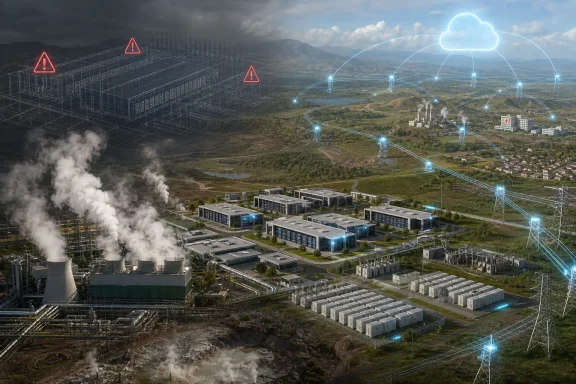 The Hyperscale Dream Hit the Grid Before It Hit the Ground
The Kenya project had all the ingredients of a modern infrastructure success story: Microsoft’s cloud brand, G42’s capital and AI ambitions, Kenya’s geothermal resources, and a regional market hungry for lower-latency cloud services. Olkaria, with its Rift Valley geothermal fields, looked like precisely the sort of place where the AI boom could be reconciled with cleaner energy. The pitch was elegant: build green compute where green power already exists.But elegance on a slide deck is not the same as resilience on a national grid. According to remarks from Sandy Okoth of Invest Kenya at GITEX Kenya, the initial phase was expected to start around 100 megawatts and potentially scale toward one gigawatt. In a country producing roughly 3,000 megawatts, with peak consumption around 2,400 megawatts, the arithmetic quickly becomes political.
A 100MW data centre is already a major industrial load. A 1GW campus is no longer merely a data centre; it is a national energy-planning event. At that scale, a private cloud facility competes not just with other investors, but with households, factories, hospitals, electrified transport, irrigation, and every other claim on the grid.
That is why the reported dispute over guarantees matters. If a government is asked to underwrite the power assumptions behind a private cloud project, the investment stops being a simple foreign direct investment win. It becomes a question of who absorbs the downside if demand projections, grid upgrades, currency movements, or political priorities shift.
Kenya’s Problem Was Not Ambition, but the Shape of the Bet
It would be easy, and wrong, to frame the stalled Microsoft-G42 plan as evidence that Kenya overreached. Kenya is one of Africa’s strongest candidates for data infrastructure precisely because it has meaningful renewable generation, a growing digital economy, subsea connectivity, a maturing startup scene, and a government that has actively courted technology investment. If a cloud region in East Africa is to be built anywhere, Kenya belongs in the conversation.The deeper issue is that hyperscale AI infrastructure increasingly arrives as a lumpy demand shock. It does not ask for power in increments that most emerging grids can comfortably digest. It asks for enormous blocks of energy, long-term certainty, preferential connection arrangements, and often public-sector coordination that can blur into public-sector exposure.
For governments, that creates an awkward asymmetry. The political upside is easy to announce: jobs, cloud services, sovereign data hosting, AI innovation, and prestige. The liabilities are harder to explain: capacity payments, grid balancing, tariff distortions, transmission constraints, and the possibility that citizens will see their electricity system bent around the needs of a foreign-backed compute campus.
That is why Okoth’s reported comments about time-of-use tariffs and open-access power arrangements are more than technocratic footnotes. They point to a more mature model: let heavy compute users consume power when the system can support them, and let private buyers contract directly with generators where possible. The public grid can enable the market without becoming the silent guarantor of every megawatt.
AI Infrastructure Is Becoming Energy Policy by Another Name
For years, cloud computing was sold as an abstraction. Enterprises moved workloads to “the cloud,” developers spun up instances, and consumers streamed, synced, searched, and backed up without much thought about the buildings behind the metaphor. AI has ended that innocence.Training and serving large models require dense clusters of accelerators, and those accelerators demand power, cooling, water management, sophisticated networking, and high reliability. The result is that cloud infrastructure now lands in public debate as energy policy, industrial policy, and sometimes foreign policy. A GPU cluster is no longer just a procurement line item; it is a demand forecast with diplomatic implications.
This is not uniquely African. Ireland has wrestled with data centre loads. Parts of the United States are seeing grid planning reshaped by AI campuses. Utilities from Europe to Asia are being asked whether their systems can support power-hungry compute without crowding out electrification elsewhere. The difference in Africa is that the margin for error is thinner.
Where grids are still expanding to meet basic industrial and household needs, a single hyperscale project can loom disproportionately large. The issue is not whether data centres are “good” or “bad.” It is whether they are sequenced, priced, and governed in a way that strengthens the surrounding system rather than extracting its scarcest resource.
The Azure Region That Was Promised Is Still the Right Kind of Prize
For East African businesses, the attraction of a local Azure region is real. Lower latency matters for financial services, e-commerce, health applications, education platforms, public-sector systems, and AI inference. Data residency matters for regulated sectors and for governments trying to keep sensitive information within national or regional boundaries.A local cloud region can also deepen the developer ecosystem. Startups build differently when compute, storage, identity, and analytics services are nearby and priced for regional realities. Universities and research institutions benefit when they are not forced to route every experiment through infrastructure an ocean away.
But the Kenya episode suggests that the region-versus-grid tradeoff has to be brought into the open. A cloud region is not automatically a public good simply because it is local. Its value depends on who can afford to use it, whether it meaningfully reduces dependency, whether it creates durable skills, and whether the infrastructure burden is shared fairly.
Microsoft’s broader cloud strategy in Africa has long been about positioning Azure as a platform for enterprise modernization, government digitization, and AI adoption. That is a rational commercial strategy. The question for Kenya and its neighbors is whether the infrastructure terms serve the region’s technology base or merely import a hyperscale template whose economics were designed elsewhere.
Africa’s Data Centre Deficit Is Real, but It Is Often Misread
Africa’s share of global data centre capacity remains tiny, and East Africa’s live capacity is especially limited. Reports cited in the GITEX Kenya discussion put East Africa’s live data centre load at around 30MW, a figure that would barely register in major global hubs. Kenya may lead the region by facility count, but the continent remains structurally underbuilt.That deficit has consequences. African users often depend on servers thousands of kilometres away, increasing latency and complicating data governance. Businesses pay more for services whose underlying infrastructure is not optimized for local markets. Developers building AI systems in African languages or for African public-sector use cases face compute costs that can be prohibitive.
Yet the answer to an infrastructure deficit is not automatically the biggest possible data centre. The temptation is understandable: if Africa has less than 1% of global capacity, why not attract enormous campuses and leapfrog into the AI era? But capacity that overwhelms the grid, depends on sovereign guarantees, or prices out local users is not sovereignty. It is dependency with better branding.
The more useful question is what kind of capacity Africa needs first. For many workloads, especially inference, content delivery, financial transactions, public-sector applications, and locally tuned AI services, proximity and efficiency can matter more than sheer scale. A network of smaller, well-connected facilities may do more for African digital resilience than a handful of trophy campuses.
The Edge Is Not a Consolation Prize
Stanislav Kazanov’s argument for smaller, modular data centres near energy sources deserves attention because it challenges the prestige economy around hyperscale infrastructure. In that model, a country does not wait a decade for grid upgrades before it participates in AI. It places compute closer to geothermal, solar, hydro, or other available generation, then scales in increments the system can absorb.This is not a retreat from ambition. It is a different engineering philosophy. Instead of assuming that the grid must bend around the data centre, the data centre is designed around the grid.
Edge data centres can reduce transmission losses, shorten deployment timelines, and support local services where latency and sovereignty matter. They can also create a more plural market, allowing regional operators, universities, telecoms, banks, and public agencies to participate without depending entirely on a global hyperscaler’s capital cycle.
There are tradeoffs. Smaller facilities may struggle to match the economies of scale, physical security, redundancy, and procurement leverage of hyperscale campuses. AI training at frontier-model scale still concentrates in massive clusters because the networking and accelerator density requirements are unforgiving. But most African AI use over the next several years will not involve training trillion-parameter foundation models from scratch.
The near-term opportunity is inference, fine-tuning, data curation, retrieval systems, local-language applications, and sector-specific models for agriculture, logistics, health, education, and public administration. Those workloads need reliable, affordable, nearby compute. They do not all need a gigawatt campus.
Local Data Is the Other Half of Local Compute
The GITEX Kenya discussion rightly widened the frame beyond electricity. AI sovereignty is not achieved by placing servers inside national borders if the datasets, models, tools, and applications still reflect someone else’s assumptions. Compute is necessary, but it is not sufficient.Sarah Qian’s point about foundational layers of the AI stack goes to the heart of the matter. Africa needs datasets in local languages, domain-specific corpora, annotated public-interest data, and legal frameworks that allow research and innovation without turning citizens into raw material for extraction. A local data centre that hosts imported models trained on imported data may reduce latency, but it does not automatically produce local intelligence.
The comparison with M-PESA is instructive because mobile money succeeded by solving African problems under African constraints. It did not wait for a perfect imitation of Western banking infrastructure. It used mobile networks, agent networks, regulation, trust, and unmet demand to create a system that became globally influential.
AI could follow a similar path if infrastructure choices are tied to local use cases. Agricultural advisory tools that understand regional crops and languages, public-health triage systems designed for local clinics, education assistants tuned to national curricula, legal and administrative tools that reflect domestic institutions — these are not merely apps. They are the basis of a different AI economy.
But they require control over data pipelines, model adaptation, deployment environments, and cost structures. If every experiment must rent scarce GPUs at a premium from distant regions, the innovation base narrows. The winners become those with foreign grants, multinational partnerships, or hard-currency revenue, not necessarily those solving the most urgent local problems.
The GPU Price Gap Is a Warning Light
The reported May 2026 pricing gap for NVIDIA H100 rentals in Africa — around $13.55 per hour compared with a global average of roughly $7.32 — captures the problem in one painful number. When compute is scarce and energy is expensive, African developers pay more to build in markets where customers often have less ability to pay. That is a brutal inversion.High GPU costs do not just slow AI startups. They shape what gets built. Developers avoid experimentation, universities limit training runs, researchers simplify models, and companies defer AI adoption or rely on foreign-hosted services that may not meet local compliance or performance needs.
The distinction between training and inference is therefore not academic. Training large models is energy-intensive and capital-intensive. Inference, especially when optimized with smaller models and efficient accelerators, can deliver real-world AI services at far lower power draw. For African markets, this suggests a pragmatic sequencing: build the infrastructure for useful AI first, then expand into heavier training capacity where energy, capital, and skills align.
This is also where Microsoft, G42, and other major players could still play a constructive role. Instead of seeing Africa only as the next hyperscale frontier, they could help build regional inference capacity, model optimization pipelines, developer credits, local-language tooling, and partnerships with universities and public agencies. That would not generate the same headline as a gigawatt data centre, but it might produce more durable adoption.
The Politics of Public Guarantees Will Define the Next Wave
The most important phrase in the Kenya dispute may be risk allocation. Infrastructure projects fail or stall not only because the engineering is hard, but because the risks are placed where politics cannot tolerate them. A government can support data infrastructure without promising to socialize private downside.Sovereign guarantees are not inherently illegitimate. Governments routinely back strategic infrastructure when the public benefits are clear and the terms are transparent. But AI data centres complicate that logic because the benefits can be diffuse and the costs can be immediate.
If a government guarantees power offtake, transmission upgrades, or minimum payments for a private cloud campus, citizens will reasonably ask what they receive in return. Are public hospitals getting better digital services? Are local startups getting affordable compute? Are universities getting access? Are jobs meaningful and technical, or mostly temporary construction and facilities roles? Are tariffs protected for ordinary consumers?
Those questions are not anti-investment. They are the conditions under which investment remains politically sustainable. The era when governments could announce a giant technology deal and assume applause is fading. AI has made the physical costs of digital infrastructure too visible.
Kenya’s push toward time-of-use tariffs and open-access arrangements is therefore a sign of institutional learning. It shifts the discussion from “Will the government make this happen?” to “Can the market procure power in ways that do not distort the system?” That is a healthier basis for the next deal.
Renewable Power Is Necessary, Not Magical
The Olkaria story also shows how easily “green data centre” can become a misleading simplification. Geothermal power is one of the best possible resources for data infrastructure because it can provide stable, low-carbon baseload generation. Unlike solar and wind, it is not dependent on daily weather cycles in the same way.But even renewable electricity has opportunity costs. A megawatt used by a data centre is a megawatt not used elsewhere unless new generation is added and deliverable. The fact that power is clean does not mean it is abundant, cheap, or politically frictionless.
In Kenya, geothermal is a national advantage. It supports grid stability and provides a platform for industrial growth. That makes it valuable precisely because many sectors want it. Data centres can be part of that industrial strategy, but they cannot be allowed to monopolize the logic of renewable development.
This is where smaller facilities again look more compelling. A modular data centre near a geothermal plant or solar project can grow alongside generation. It can be matched to available capacity rather than premised on future abundance. It can also be replicated across regions, distributing both economic benefits and grid pressure.
The goal should not be to keep AI away from African power systems. The goal should be to make AI infrastructure a customer that helps finance better power systems rather than a privileged load that destabilizes them.
The Microsoft-G42 Deal Is a Preview, Not an Exception
It is tempting to treat the Microsoft-G42 Kenya saga as a one-off: a big promise, a hard negotiation, a project that ran into the messy reality of national infrastructure. That would miss the broader signal. Similar conflicts are likely wherever AI infrastructure ambitions meet constrained grids and governments eager for digital investment.The next wave of deals will probably be more sophisticated. Investors will arrive with modular designs, dedicated power purchase agreements, battery storage, on-site generation, and more careful language about phases. Governments will ask sharper questions about guarantees, local access, tax treatment, water use, employment, and data sovereignty.
That maturation is welcome. Africa does not need to reject hyperscale investment. It needs to negotiate from a clearer understanding of what hyperscale actually demands. The continent’s leverage lies not only in market growth, but in renewable resources, young talent, underdigitized sectors, and the chance to build infrastructure patterns without being locked into legacy mistakes.
For Microsoft, the strategic logic of an East Africa cloud region remains strong. For G42, Africa remains a significant arena for AI infrastructure and geopolitical positioning. For Kenya, the opportunity remains real. But the version of the project that survives, if it does, will have to look less like a trophy and more like a contract the public can understand.
The Smaller-Centre Strategy Gives Africa More Room to Move
A distributed infrastructure strategy would not solve every problem. It would still require capital, skilled operators, cybersecurity standards, cooling expertise, reliable connectivity, and clear regulation. It would still face hard economics in markets where cloud demand is growing but not yet deep enough to support every facility.But it would give African countries more negotiating room. Instead of betting on one giant facility whose failure becomes a national embarrassment, governments and operators could build portfolios of capacity. Some sites could serve enterprise cloud and public-sector workloads. Others could specialize in AI inference, content delivery, disaster recovery, research, or regulated data hosting.
This approach also fits Africa’s geography. The continent is not a single market with a single grid. It is a patchwork of power systems, languages, regulations, subsea cable routes, inland connectivity gaps, and regional trade blocs. Smaller, strategically placed data centres can map onto that reality better than a few mega-campuses.
There is also a security argument. Distributed infrastructure is harder to monopolize and potentially more resilient. A continent dependent on a small number of hyperscale nodes remains vulnerable to outages, pricing power, political pressure, and supply bottlenecks. A broader mesh of local facilities, if properly interconnected, creates redundancy and competition.
That does not mean every country needs its own full-stack AI cloud. Some regional specialization is inevitable and sensible. But the default should be capacity that serves local needs first, not capacity whose primary purpose is to satisfy a global hyperscaler’s expansion map.
The Olkaria Lesson Is Now Written Into the Next Deal
The Kenya episode gives policymakers, operators, and cloud buyers a sharper checklist than they had before. The issue is no longer whether Africa needs data centres; it plainly does. The question is whether the next projects are designed to strengthen the systems around them.- A data centre that requires extraordinary public guarantees should be treated as national infrastructure policy, not just foreign direct investment.
- A cloud region has more public value when it includes affordable local access, skills development, university partnerships, and services tailored to regional compliance needs.
- Renewable power claims should be judged against deliverable capacity, grid impact, and opportunity cost, not just the energy source named in the announcement.
- African AI strategies should prioritize inference, smaller models, local-language datasets, and sector-specific applications before chasing frontier-scale training.
- Modular and edge data centres can let countries add compute in increments that match real power availability rather than speculative future capacity.
- Hyperscale investors will remain important, but African governments need procurement and tariff structures that prevent private AI demand from becoming public energy risk.
Africa’s AI future will not be won by rejecting big infrastructure, nor by accepting every grand data-centre proposal as proof of arrival. It will be won by countries and companies that understand compute as part of a broader civic stack: power, connectivity, data, skills, governance, and trust. The next successful African AI build-out may still include hyperscale campuses, but it will be anchored by smaller, local, power-aware systems that make the continent more capable rather than merely more connected.
References
- Primary source: allafrica.com
Published: 2026-06-02T10:30:10.224809

Africa's AI Future Hinges On Smaller, Local Data Centres - Experts
Microsoft and G42's planned digital investment in Kenya has become a case study in how large infrastructure deals can run into challenges tied to power availability, policy direction, and public interest.allafrica.com
- Related coverage: techradar.com
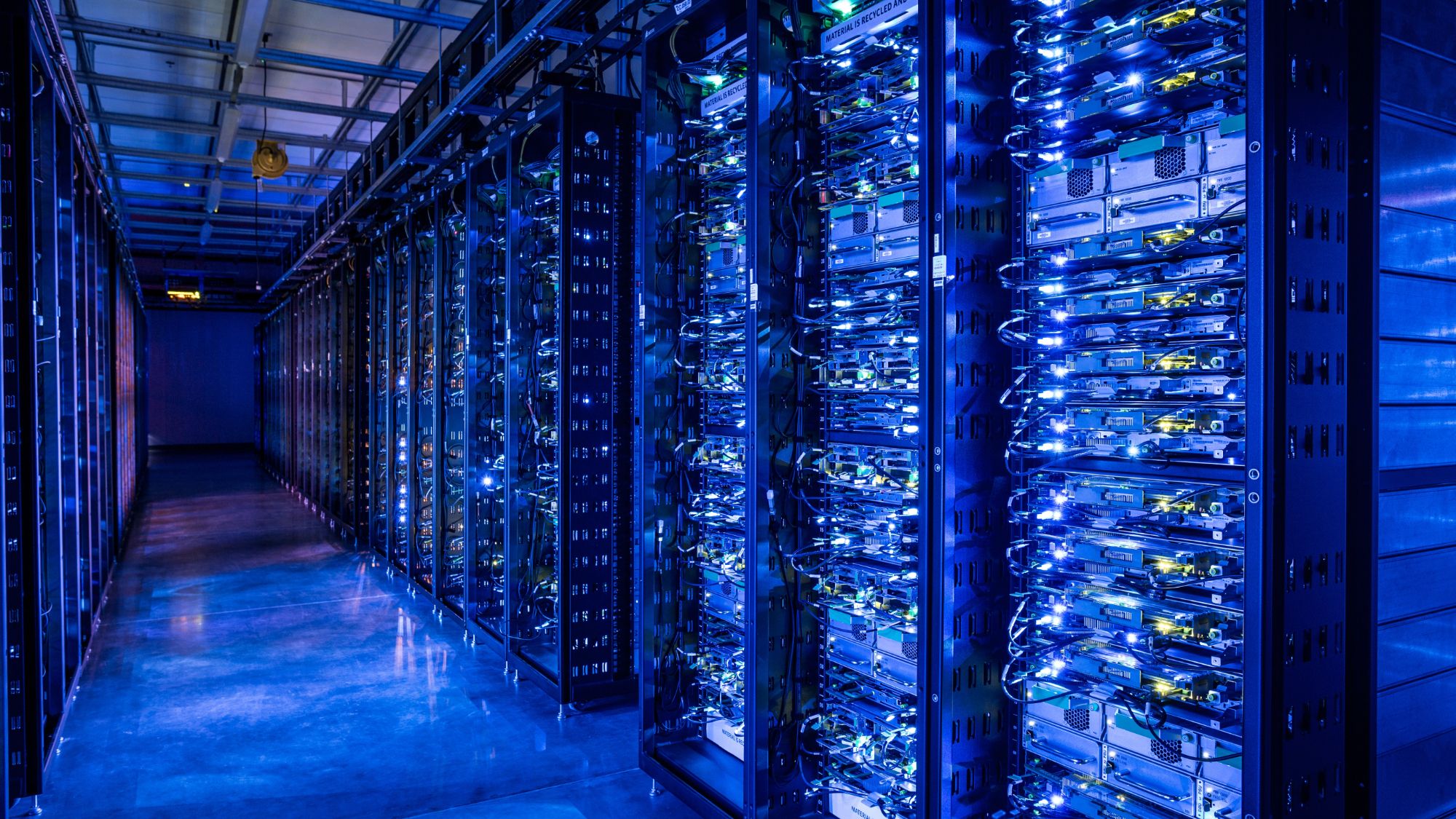
Microsoft and G42 are building a $1 billion data center in Africa powered by geothermal energy
Kenya is set for a major digital revolutionwww.techradar.com
- Related coverage: datacenterknowledge.com

Microsoft, G42 Announce $1B Geothermal Data Center in Kenya
Microsoft will use the initial cloud-computing power to create an East African region for its Azure products. www.datacenterknowledge.com
- Related coverage: datacenterdynamics.com

Microsoft and G42 to build geothermal-powered data center in Kenya
Part of $1 billion investment in East African country www.datacenterdynamics.com
- Related coverage: kengen.co.ke
- Related coverage: aidatacenterindex.com
Microsoft & G42's Olkaria Geothermal Data Center (Kenya) — 100 MW — Planned
Microsoft & G42's Olkaria Geothermal Data Center (Kenya) in Naivasha, Eastern Africa, Kenya is planned. 100 MW IT capacity. Ranked #226 of 335 globally. Powe…aidatacenterindex.com
- Related coverage: tomshardware.com
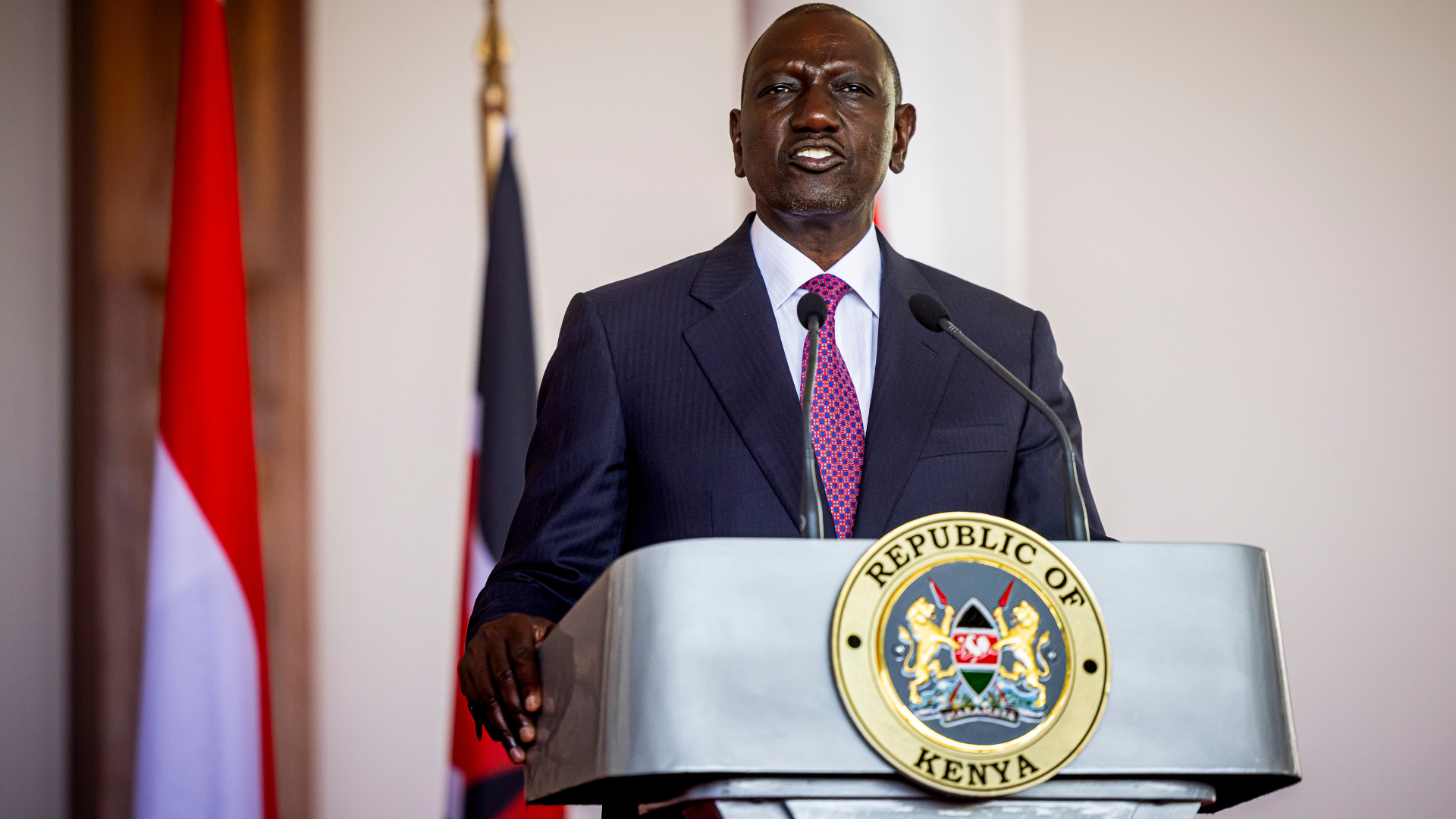
Microsoft's massive Kenya AI data center would require switching off 'half the country' to meet power requirements, government says — $1 billion project stalls over capacity disagreements and lack of infrastructure
“We would need to switch off half the country for the data center to be powered."www.tomshardware.com
- Related coverage: windowscentral.com
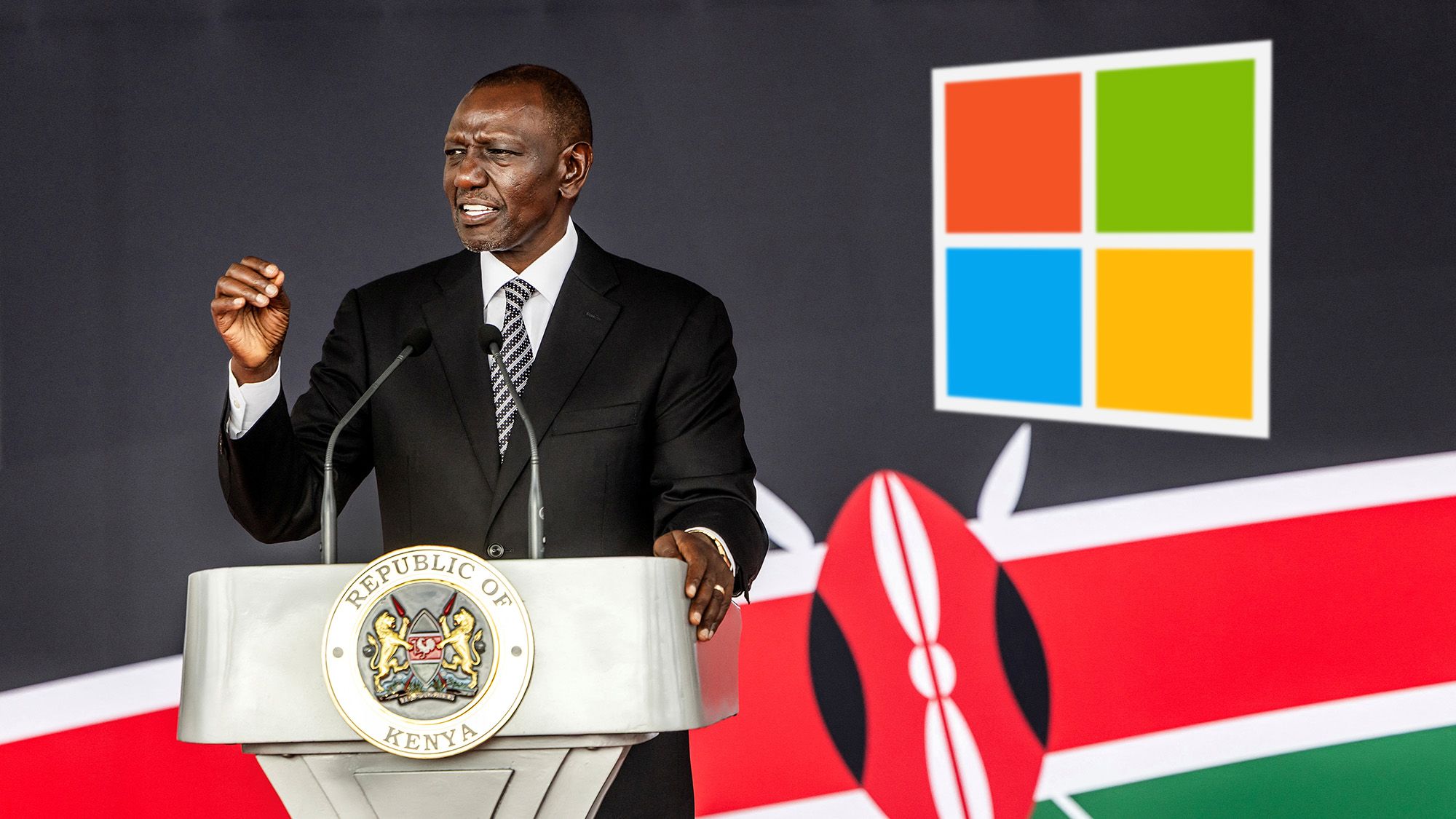
Kenya already struggles to keep the lights on, and Microsoft’s $1 billion AI data center will cripple our national power grid
President William Ruto says says Microsoft’s massive $1 billion AI data center could “switch off half the country.” www.windowscentral.com
- Related coverage: interface.media

Microsoft pivots in East-Africa with $1 billion Kenyan data centre run on geothermal power
The major infrastructure project points to a new direction for Microsoft’s data centre ambitions in Africa. interface.media
- Related coverage: dcide.co.uk
Microsoft and G42 Announce $1 Billion Digital Investment Initiative in Kenya, Including Construction of a "Green" Data Center
DCIDE is a next-gen market analytics platform serving the data centre value chain. We sell opportunity. Providing actionable insights and solutions. www.dcide.co.uk
- Related coverage: techpoint.africa

Kenya gets $1 billion from Microsoft and UAE's G42 for geothermal data centre
Microsoft and G42, an artificial intelligence (AI) firm from the United Arab Emirates, have announced $1 billion in digital investments in Kenya. techpoint.africa
- Related coverage: africa-energy-portal.org

Microsoft and G42 invest $1bn in geothermal-powered data in Kenya
US IT giant Microsoft and artificial intelligence company G42 are to build an "eco-friendly" data centre in Kenya. Costing $1 billion, the project is being developed on the Olkaria geothermal site and is backed by the United Arab Emirates (UAE).africa-energy-portal.org
- Related coverage: pcgamer.com
Microsoft's $1 billion data center project in Kenya stalls amid row over payment and power
'Future generations will be overburdened by the current decisions.'www.pcgamer.com
- Related coverage: mobileworldlive.com

Microsoft, G42 partner on $1B green data centre in Kenya
Microsoft and United Arab Emirates-based G42 teamed up on a $1 billion investment to build a geothermal data centre in Kenya.www.mobileworldlive.com
- Related coverage: tomshw.it
- Related coverage: as.com

Microsoft paraliza su ambicioso megaproyecto en África: su centro de datos de 1.000 millones se atasca por un problema inesperado
Descubre cuáles son los motivos por los que Microsoft paraliza su ambicioso megaproyecto en África: su centro de datos de 1.000 millones se atasca.as.com
- Related coverage: content.knightfrank.com
- Related coverage: cdn.twimbit.com
