

On May 5, 2026, the US Commerce Department’s Center for AI Standards and Innovation, housed at NIST, expanded pre-release AI testing agreements with Google DeepMind, Microsoft, and xAI, giving government evaluators access to frontier models before public launch. The announcement, reported by Bloomberg and later covered by outlets including Cybersecurity Dive, Axios, and Tom’s Hardware, looks at first like a Washington story about American national security. It is not only that. For Kenya, it is a reminder that the AI systems being woven into classrooms, businesses, cloud platforms, and public debate are increasingly governed elsewhere before they are experienced locally.
The Eastleigh Voice framed the issue through a Kenyan lens, asking why local users should care if US government scientists are stress-testing models from companies whose products already sit inside Gmail, Microsoft 365, Google Workspace, Azure, Google Cloud, search, productivity software, and marketing platforms. That is the right question, but the deeper answer is not simply that “AI is global.” The deeper answer is that Kenya is becoming a downstream jurisdiction in a technology stack whose safety thresholds, release schedules, acceptable risks, and disclosure norms may be decided in Washington, Brussels, London, and Silicon Valley long before Nairobi gets a vote.
The US programme is built around a practical fear: the most powerful AI models may be capable of helping users find software vulnerabilities, automate cyber operations, generate persuasive misinformation, or assist with dangerous scientific misuse before vendors or regulators fully understand the risk. That is why CAISI, the renamed successor to the US AI Safety Institute, is focused on pre-deployment evaluation rather than merely post-release cleanup.
NIST’s public description of earlier agreements with OpenAI and Anthropic in 2024 said the institute would receive access to major new models before and after release for safety research, testing, and evaluation. The 2026 expansion brought Google DeepMind, Microsoft, and xAI into the same broad orbit, with Commerce Department officials describing the goal as frontier AI measurement tied to national security and public safety.
That matters because pre-release testing changes the regulatory calendar. Instead of governments reacting to harms after millions of people have used a model, the state gets a look while the system is still behind the curtain. For users in Kenya, that may sound remote, but it affects the version of the technology that eventually appears in a browser tab, a workplace assistant, a coding tool, or a school assignment workflow.
Microsoft’s involvement is especially relevant to WindowsForum readers because Microsoft is not merely an AI lab. It is an operating-system company, a cloud provider, a productivity-suite vendor, a cybersecurity supplier, and a default presence in many organizations’ identity and collaboration systems. When Microsoft submits frontier AI systems for government testing, the implications run through Copilot, Azure-hosted services, developer tooling, and the broader enterprise software environment.
Google’s role is similarly expansive. Gemini is only one visible face of a deeper AI integration strategy that touches Search, Gmail, Docs, advertising, analytics, Android, cloud infrastructure, and developer platforms. xAI, meanwhile, represents the newer class of frontier-model company whose systems can become influential through consumer access, social platforms, APIs, and enterprise integrations.
The Eastleigh Voice quoted ESG research analyst Timothy Ivusah arguing that Kenya should not “turn a blind eye” while powerful technology companies and foreign governments shape the rules around systems that collect data, influence communication, and affect individual rights. His comments mix corporate-governance concerns, data-protection worries, and a broader anxiety about who benefits when emerging markets become high-volume users of imported digital infrastructure.
There is a fair amount to unpack there. The most defensible version of the argument is not that the US government literally directs every commercial decision made by Google or Microsoft, nor that every safety test is a disguised market intervention. It is that frontier AI is now important enough that governments see access to unreleased models as a matter of national interest — and once governments do that, smaller markets must ask what kind of access, transparency, and recourse they have.
Kenya’s exposure is practical rather than theoretical. A university student using Gemini or Copilot for research, a small business using Google Ads automation, a county office using Microsoft 365, and a bank experimenting with AI-assisted support all depend on systems whose behavior can shift through model updates. If those updates are shaped by US security priorities, Western legal exposure, or vendor risk calculations, Kenyan users inherit the result without necessarily seeing the negotiation.
That does not mean the US testing programme is bad for Kenya. In many cases, it may be beneficial. If pre-release testing catches a model that can too easily help automate phishing, exploit discovery, or malware development, Kenyan users are safer too. But indirect benefit is not the same as democratic participation.
Frontier models do not need to invent cybercrime to change the threat landscape. They can lower the skill barrier for social engineering, code analysis, vulnerability research, reconnaissance, and translation of technical instructions into usable attack plans. A poorly safeguarded model can become a force multiplier for actors who already know what they want but lack the expertise to execute it efficiently.
That is why the US focus on model manipulation, unsafe outputs, and cyber misuse is not an American-only concern. Kenyan businesses already face phishing, SIM-swap fraud, account takeover, ransomware attempts, and payment-system abuse. If more capable models make those attacks easier to scale, the blast radius includes Nairobi as surely as New York.
Microsoft’s presence in this programme also intersects with the enterprise security market. Many organizations rely on Microsoft Defender, Entra ID, Windows endpoints, Azure, Teams, Outlook, and Office documents as part of their daily security perimeter. AI features inside those products may improve defense, but they also introduce new dependency on model behavior, telemetry handling, prompt injection resistance, and vendor-managed safety updates.
For IT administrators, the lesson is simple: AI risk is becoming part of ordinary vendor risk. It belongs in procurement reviews, security questionnaires, data-protection impact assessments, acceptable-use policies, and incident-response planning. Treating it as a novelty feature bolted onto software is already obsolete.
Kenya has a data-protection regime, including the Data Protection Act and the Office of the Data Protection Commissioner, but enforcement capacity and technical visibility remain persistent challenges for many jurisdictions. The difficulty is not writing principles such as consent, purpose limitation, minimization, and accountability. The difficulty is applying them to AI systems that change rapidly, operate through complex cloud supply chains, and may process data across borders.
When a Kenyan business enables an AI assistant in a productivity suite, it may not fully understand which data is used for grounding, which is retained, which is logged, which is excluded from training, and which subprocessors are involved. Vendors publish documentation, but the practical burden often falls on administrators who must interpret fast-changing settings across tenants, licenses, and regions.
That is where US pre-release testing reveals both progress and limitation. Safety evaluations may test dangerous capabilities, but they do not automatically answer every local privacy question. A model can be safer from a national-security perspective while still raising unresolved concerns about workplace surveillance, student data, customer profiling, or cross-border processing.
Ivusah’s broader warning about individual rights therefore lands on firmer ground when framed around governance rather than conspiracy. The issue is not simply whether American officials see unreleased models. The issue is whether Kenyan institutions have enough leverage and expertise to demand intelligible terms for systems that increasingly mediate education, commerce, communication, and public life.
Investors usually react more sharply when regulation creates obvious costs, blocks product launches, imposes liability, or threatens business models. A cooperative testing arrangement can even be read positively, because it suggests that companies are close enough to government to shape emerging rules rather than merely suffer them. For Microsoft and Google, regulatory engagement is part of the cost of being infrastructure.
But the long-term market signal is more interesting. If pre-release testing becomes expected for frontier models, then AI development begins to look less like pure software shipping and more like a regulated high-risk industry. Release velocity, compliance staffing, documentation, red-teaming, secure model handling, and government relations all become competitive factors.
That favors large incumbents. Microsoft and Google can absorb governance overhead more easily than smaller labs or startups. xAI, backed by Elon Musk’s capital networks and public profile, is not a tiny player either. If frontier AI becomes a game where only the biggest firms can afford the safety, lobbying, compute, and compliance bill, emerging-market developers may find themselves pushed further from the center.
For Kenya, that could widen an already visible gap. Local developers may build applications, integrations, and services, but the base-model layer remains concentrated abroad. The money, standards, and safety definitions accrue to the platform owners, while local firms compete in thinner margins above them.
In other words, the absence of a company from one headline does not necessarily mean exemption. It may reflect earlier agreements, renegotiated terms, phased participation, or separate disclosure timelines. Tom’s Hardware, citing Bloomberg and Commerce Department statements, reported that OpenAI and Anthropic had already been part of the evaluation ecosystem and that their arrangements were updated to align with the current administration’s AI priorities.
The more important point is that Washington is trying to bring the major US frontier labs into a common evaluation channel. That is a structural shift. The debate is moving from voluntary corporate safety blog posts toward government-access arrangements, national-security framing, and institutional testing.
That does not eliminate the need for independent researchers, civil society, or international oversight. Government testing can be narrow, classified, politically shaped, or focused on national interests that do not fully map onto consumer rights in other countries. A model may be evaluated for cyber risk without being fully assessed for labor displacement, local-language bias, educational integrity, or misinformation in Kenyan political contexts.
This is where Kenya’s concerns should be specific. The question is not whether US testing is secretly illegitimate. The question is whether it is sufficient for countries whose citizens use the tools but whose regulators are not in the testing room.
That quiet distribution model makes governance harder. Users may adopt AI because it is bundled, not because an organization made a deliberate strategic choice. A school may discover students are using generative tools before it has an assessment policy. A small business may connect customer data to an AI service before it has reviewed retention settings. A public office may use cloud productivity features before its data-classification rules catch up.
The platform companies understand this. Microsoft’s Copilot strategy is built around embedding AI into the productivity and developer environments where work already happens. Google’s Gemini strategy is similarly tied to search, workspace tools, Android, and cloud services. The AI revolution is less a separate app category than a rewrite of existing interfaces.
That means Kenyan policymakers should not treat AI regulation as a niche science-and-technology file. It belongs in education, finance, labor, competition policy, cybersecurity, procurement, consumer protection, and data protection. The same model that helps a student revise an essay may help a fraudster craft a better scam or a business automate decisions that affect customers.
The practical governance challenge is to make the invisible visible. Organizations need inventories of where AI is enabled, what data it can access, who can turn it on, whether outputs are logged, and how errors are challenged. Without that, “AI adoption” becomes a slogan rather than a managed risk.
The better strategy is leverage. Kenya can insist that public-sector deployments meet clear standards for data residency where appropriate, auditability, procurement transparency, human oversight, and incident reporting. Regulators can require meaningful disclosure when AI systems are used in sensitive decisions. Universities can set assessment rules that distinguish learning support from academic fraud. Businesses can demand contract terms that clarify data use and model behavior.
Regional coordination would help. A single market may struggle to pressure trillion-dollar technology companies, but coordinated African positions on AI safety, data protection, competition, and cloud procurement would be harder to ignore. The African Union’s AI policy efforts and national strategies across the continent are early steps, but they need operational teeth.
Kenya also has a domestic innovation stake. If local firms are forever downstream consumers of foreign foundation models, they will build useful products but rarely control the deepest layer of value. Supporting local AI research, public datasets with safeguards, Kiswahili and local-language evaluation, university-industry collaboration, and compute access is not protectionism; it is infrastructure policy.
The point is not to replicate Silicon Valley. It is to ensure that Kenyan contexts are not always afterthoughts in systems trained, tested, and governed elsewhere.
For Kenyan users and institutions, the immediate task is not panic. It is literacy, procurement discipline, and regulatory seriousness. The country does not need to reject AI to demand better answers about safety, privacy, accountability, and local impact.
The Eastleigh Voice framed the issue through a Kenyan lens, asking why local users should care if US government scientists are stress-testing models from companies whose products already sit inside Gmail, Microsoft 365, Google Workspace, Azure, Google Cloud, search, productivity software, and marketing platforms. That is the right question, but the deeper answer is not simply that “AI is global.” The deeper answer is that Kenya is becoming a downstream jurisdiction in a technology stack whose safety thresholds, release schedules, acceptable risks, and disclosure norms may be decided in Washington, Brussels, London, and Silicon Valley long before Nairobi gets a vote.
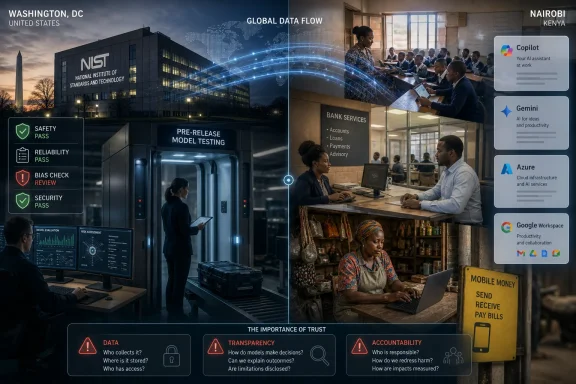 Washington Is Turning AI Safety Into Pre-Flight Inspection
The US programme is built around a practical fear: the most powerful AI models may be capable of helping users find software vulnerabilities, automate cyber operations, generate persuasive misinformation, or assist with dangerous scientific misuse before vendors or regulators fully understand the risk. That is why CAISI, the renamed successor to the US AI Safety Institute, is focused on pre-deployment evaluation rather than merely post-release cleanup.NIST’s public description of earlier agreements with OpenAI and Anthropic in 2024 said the institute would receive access to major new models before and after release for safety research, testing, and evaluation. The 2026 expansion brought Google DeepMind, Microsoft, and xAI into the same broad orbit, with Commerce Department officials describing the goal as frontier AI measurement tied to national security and public safety.
That matters because pre-release testing changes the regulatory calendar. Instead of governments reacting to harms after millions of people have used a model, the state gets a look while the system is still behind the curtain. For users in Kenya, that may sound remote, but it affects the version of the technology that eventually appears in a browser tab, a workplace assistant, a coding tool, or a school assignment workflow.
Microsoft’s involvement is especially relevant to WindowsForum readers because Microsoft is not merely an AI lab. It is an operating-system company, a cloud provider, a productivity-suite vendor, a cybersecurity supplier, and a default presence in many organizations’ identity and collaboration systems. When Microsoft submits frontier AI systems for government testing, the implications run through Copilot, Azure-hosted services, developer tooling, and the broader enterprise software environment.
Google’s role is similarly expansive. Gemini is only one visible face of a deeper AI integration strategy that touches Search, Gmail, Docs, advertising, analytics, Android, cloud infrastructure, and developer platforms. xAI, meanwhile, represents the newer class of frontier-model company whose systems can become influential through consumer access, social platforms, APIs, and enterprise integrations.
Kenya Is Not a Spectator When the Stack Is Imported
The uncomfortable reality is that Kenya does not need to host an AI frontier lab to be affected by frontier AI governance. Kenyan schools, universities, banks, small businesses, newsrooms, software teams, digital marketers, and government contractors already rely on AI-powered tools built abroad. The market may feel local at the point of use, but the control plane is international.The Eastleigh Voice quoted ESG research analyst Timothy Ivusah arguing that Kenya should not “turn a blind eye” while powerful technology companies and foreign governments shape the rules around systems that collect data, influence communication, and affect individual rights. His comments mix corporate-governance concerns, data-protection worries, and a broader anxiety about who benefits when emerging markets become high-volume users of imported digital infrastructure.
There is a fair amount to unpack there. The most defensible version of the argument is not that the US government literally directs every commercial decision made by Google or Microsoft, nor that every safety test is a disguised market intervention. It is that frontier AI is now important enough that governments see access to unreleased models as a matter of national interest — and once governments do that, smaller markets must ask what kind of access, transparency, and recourse they have.
Kenya’s exposure is practical rather than theoretical. A university student using Gemini or Copilot for research, a small business using Google Ads automation, a county office using Microsoft 365, and a bank experimenting with AI-assisted support all depend on systems whose behavior can shift through model updates. If those updates are shaped by US security priorities, Western legal exposure, or vendor risk calculations, Kenyan users inherit the result without necessarily seeing the negotiation.
That does not mean the US testing programme is bad for Kenya. In many cases, it may be beneficial. If pre-release testing catches a model that can too easily help automate phishing, exploit discovery, or malware development, Kenyan users are safer too. But indirect benefit is not the same as democratic participation.
The Cybersecurity Argument Travels Well
The strongest case for CAISI-style testing is cybersecurity. Kenya’s digital economy depends on mobile money, banking APIs, identity systems, cloud-hosted business software, government portals, telecom networks, and a growing layer of online services. These are precisely the kinds of systems that can be harmed if advanced AI makes offensive capability cheaper and more widely available.Frontier models do not need to invent cybercrime to change the threat landscape. They can lower the skill barrier for social engineering, code analysis, vulnerability research, reconnaissance, and translation of technical instructions into usable attack plans. A poorly safeguarded model can become a force multiplier for actors who already know what they want but lack the expertise to execute it efficiently.
That is why the US focus on model manipulation, unsafe outputs, and cyber misuse is not an American-only concern. Kenyan businesses already face phishing, SIM-swap fraud, account takeover, ransomware attempts, and payment-system abuse. If more capable models make those attacks easier to scale, the blast radius includes Nairobi as surely as New York.
Microsoft’s presence in this programme also intersects with the enterprise security market. Many organizations rely on Microsoft Defender, Entra ID, Windows endpoints, Azure, Teams, Outlook, and Office documents as part of their daily security perimeter. AI features inside those products may improve defense, but they also introduce new dependency on model behavior, telemetry handling, prompt injection resistance, and vendor-managed safety updates.
For IT administrators, the lesson is simple: AI risk is becoming part of ordinary vendor risk. It belongs in procurement reviews, security questionnaires, data-protection impact assessments, acceptable-use policies, and incident-response planning. Treating it as a novelty feature bolted onto software is already obsolete.
The Data Question Is Bigger Than Chatbots
Kenyan concern should not stop at whether an AI model gives a dangerous answer. The more enduring issue is data. AI systems sit inside work documents, inboxes, searches, analytics dashboards, cloud logs, student workflows, and customer-service interactions. That makes them both productivity tools and observation layers.Kenya has a data-protection regime, including the Data Protection Act and the Office of the Data Protection Commissioner, but enforcement capacity and technical visibility remain persistent challenges for many jurisdictions. The difficulty is not writing principles such as consent, purpose limitation, minimization, and accountability. The difficulty is applying them to AI systems that change rapidly, operate through complex cloud supply chains, and may process data across borders.
When a Kenyan business enables an AI assistant in a productivity suite, it may not fully understand which data is used for grounding, which is retained, which is logged, which is excluded from training, and which subprocessors are involved. Vendors publish documentation, but the practical burden often falls on administrators who must interpret fast-changing settings across tenants, licenses, and regions.
That is where US pre-release testing reveals both progress and limitation. Safety evaluations may test dangerous capabilities, but they do not automatically answer every local privacy question. A model can be safer from a national-security perspective while still raising unresolved concerns about workplace surveillance, student data, customer profiling, or cross-border processing.
Ivusah’s broader warning about individual rights therefore lands on firmer ground when framed around governance rather than conspiracy. The issue is not simply whether American officials see unreleased models. The issue is whether Kenyan institutions have enough leverage and expertise to demand intelligible terms for systems that increasingly mediate education, commerce, communication, and public life.
Markets May Shrug First, Then Reprice the Rules
The Eastleigh Voice also quoted business reporter Alfred Onyango arguing that the market impact of the US testing move is likely to be limited in the short term and mostly sentiment-driven. That is plausible. Voluntary testing agreements do not automatically change revenue forecasts, product demand, or cloud margins overnight.Investors usually react more sharply when regulation creates obvious costs, blocks product launches, imposes liability, or threatens business models. A cooperative testing arrangement can even be read positively, because it suggests that companies are close enough to government to shape emerging rules rather than merely suffer them. For Microsoft and Google, regulatory engagement is part of the cost of being infrastructure.
But the long-term market signal is more interesting. If pre-release testing becomes expected for frontier models, then AI development begins to look less like pure software shipping and more like a regulated high-risk industry. Release velocity, compliance staffing, documentation, red-teaming, secure model handling, and government relations all become competitive factors.
That favors large incumbents. Microsoft and Google can absorb governance overhead more easily than smaller labs or startups. xAI, backed by Elon Musk’s capital networks and public profile, is not a tiny player either. If frontier AI becomes a game where only the biggest firms can afford the safety, lobbying, compute, and compliance bill, emerging-market developers may find themselves pushed further from the center.
For Kenya, that could widen an already visible gap. Local developers may build applications, integrations, and services, but the base-model layer remains concentrated abroad. The money, standards, and safety definitions accrue to the platform owners, while local firms compete in thinner margins above them.
The OpenAI Omission Was Never the Main Story
Some online commentary has asked why certain companies are named in one announcement while others are not. That kind of question is understandable, but it can be misleading if it ignores chronology. NIST announced agreements with OpenAI and Anthropic in August 2024, while the 2026 reporting focused on Google DeepMind, Microsoft, and xAI joining or expanding the pre-release testing framework.In other words, the absence of a company from one headline does not necessarily mean exemption. It may reflect earlier agreements, renegotiated terms, phased participation, or separate disclosure timelines. Tom’s Hardware, citing Bloomberg and Commerce Department statements, reported that OpenAI and Anthropic had already been part of the evaluation ecosystem and that their arrangements were updated to align with the current administration’s AI priorities.
The more important point is that Washington is trying to bring the major US frontier labs into a common evaluation channel. That is a structural shift. The debate is moving from voluntary corporate safety blog posts toward government-access arrangements, national-security framing, and institutional testing.
That does not eliminate the need for independent researchers, civil society, or international oversight. Government testing can be narrow, classified, politically shaped, or focused on national interests that do not fully map onto consumer rights in other countries. A model may be evaluated for cyber risk without being fully assessed for labor displacement, local-language bias, educational integrity, or misinformation in Kenyan political contexts.
This is where Kenya’s concerns should be specific. The question is not whether US testing is secretly illegitimate. The question is whether it is sufficient for countries whose citizens use the tools but whose regulators are not in the testing room.
Local Impact Will Arrive Through Ordinary Software
The most important AI deployments in Kenya may not arrive as dramatic new products called “AI.” They will arrive as feature updates in software people already use. A writing assistant appears in Word. A meeting summary appears in Teams. A search result becomes an answer. A customer-service dashboard suggests replies. A spreadsheet proposes analysis. A developer tool writes code.That quiet distribution model makes governance harder. Users may adopt AI because it is bundled, not because an organization made a deliberate strategic choice. A school may discover students are using generative tools before it has an assessment policy. A small business may connect customer data to an AI service before it has reviewed retention settings. A public office may use cloud productivity features before its data-classification rules catch up.
The platform companies understand this. Microsoft’s Copilot strategy is built around embedding AI into the productivity and developer environments where work already happens. Google’s Gemini strategy is similarly tied to search, workspace tools, Android, and cloud services. The AI revolution is less a separate app category than a rewrite of existing interfaces.
That means Kenyan policymakers should not treat AI regulation as a niche science-and-technology file. It belongs in education, finance, labor, competition policy, cybersecurity, procurement, consumer protection, and data protection. The same model that helps a student revise an essay may help a fraudster craft a better scam or a business automate decisions that affect customers.
The practical governance challenge is to make the invisible visible. Organizations need inventories of where AI is enabled, what data it can access, who can turn it on, whether outputs are logged, and how errors are challenged. Without that, “AI adoption” becomes a slogan rather than a managed risk.
Kenya Needs Leverage, Not Just Alarm
There is a temptation in debates like this to reduce the issue to digital sovereignty rhetoric. That would be a mistake. Kenya cannot simply wish away Microsoft, Google, OpenAI, Anthropic, xAI, or the cloud platforms that underpin modern business. Nor would cutting off foreign AI tools serve students, entrepreneurs, developers, or public agencies trying to improve productivity.The better strategy is leverage. Kenya can insist that public-sector deployments meet clear standards for data residency where appropriate, auditability, procurement transparency, human oversight, and incident reporting. Regulators can require meaningful disclosure when AI systems are used in sensitive decisions. Universities can set assessment rules that distinguish learning support from academic fraud. Businesses can demand contract terms that clarify data use and model behavior.
Regional coordination would help. A single market may struggle to pressure trillion-dollar technology companies, but coordinated African positions on AI safety, data protection, competition, and cloud procurement would be harder to ignore. The African Union’s AI policy efforts and national strategies across the continent are early steps, but they need operational teeth.
Kenya also has a domestic innovation stake. If local firms are forever downstream consumers of foreign foundation models, they will build useful products but rarely control the deepest layer of value. Supporting local AI research, public datasets with safeguards, Kiswahili and local-language evaluation, university-industry collaboration, and compute access is not protectionism; it is infrastructure policy.
The point is not to replicate Silicon Valley. It is to ensure that Kenyan contexts are not always afterthoughts in systems trained, tested, and governed elsewhere.
The Kenyan AI Debate Has Moved From Access to Authority
The US testing agreements with Google DeepMind, Microsoft, and xAI should be read as a sign that frontier AI is entering a more formal governance era. The companies still build the models, own the platforms, and set commercial strategy. But governments increasingly want early visibility into the systems before they become public infrastructure by default.For Kenyan users and institutions, the immediate task is not panic. It is literacy, procurement discipline, and regulatory seriousness. The country does not need to reject AI to demand better answers about safety, privacy, accountability, and local impact.
- Kenya should treat AI features inside Microsoft, Google, and cloud platforms as infrastructure decisions, not mere software conveniences.
- Regulators should ask how pre-release safety findings abroad translate into product behavior, disclosures, and safeguards for Kenyan users.
- Schools and universities should create clear AI-use policies before generative tools become an informal shadow curriculum.
- Businesses should include AI risk, data handling, and model-update practices in vendor due diligence.
- Policymakers should push for regional African coordination so that AI governance is not negotiated country by country from a position of weakness.
- Local developers and researchers should be supported to test AI systems against Kenyan languages, institutions, risks, and social contexts.
References
- Primary source: The Eastleigh Voice
Published: 2026-07-04T02:50:12.250839
Why Kenyans should care as the US tests AI tools from Google, Microsoft and xAI | The Eastleigh Voice
The US government, coordinated through NIST, has asked major tech companies including Google, Microsoft and xAI to share access to unreleased AI models.eastleighvoice.co.ke - Related coverage: techfastforward.com
NIST Erased Its AI Safety Pact With Google and xAI | TechFastForward
NIST silently deleted its pre-deployment AI testing deal with Google, Microsoft, and xAI, offering no public explanation for the reversal.techfastforward.com - Related coverage: krasa.ai
NIST Now Tests AI Models Before Launch: Google, Microsoft, xAI Sign On | Krasa.ai
Google DeepMind, Microsoft, and xAI joined OpenAI and Anthropic in letting NIST's CAISI evaluate their AI models for safety and security risks before public release. www.krasa.ai
- Related coverage: tomshardware.com
Google, Microsoft, and xAI agree to let US government test AI models before public release — OpenAI and Anthropic also on board after renegotiating deals with Washington | Tom's Hardware
All five major frontier labs now give the Commerce Department early access to unreleased AI systems.www.tomshardware.com - Related coverage: aigovernance.com
Microsoft, Google DeepMind, and xAI Grant U.S. Government Pre-Release Access to Frontier AI Models | AI Governance Institute
Microsoft, Google DeepMind, and xAI have each signed formal agreements with CAISI—the Center for AI Standards and Innovation at NIST—granting the U.S.…aigovernance.com - Related coverage: cybersecuritydive.com
NIST will test three major tech firms’ frontier AI models for cybersecurity risks | Cybersecurity Dive
After Anthropic’s announcement of Claude Mythos, agencies across the government are racing to get ahead of new AI models’ potential dangers.www.cybersecuritydive.com
- Related coverage: siliconangle.com
Google, Microsoft and xAI agree to allow government safety checks of their AI models prior to release - SiliconANGLE
Google, Microsoft and xAI agree to allow government safety checks of their AI models prior to release - SiliconANGLE siliconangle.com
- Related coverage: itpro.com
Microsoft joins competitors in handing over AI models for advanced testing | IT Pro
US and UK government agencies will evaluate the firm's frontier models, along with those from Google and xAIwww.itpro.com
