

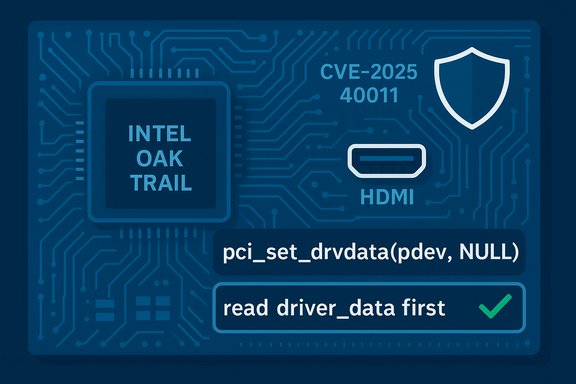
A small, tightly scoped kernel fix published in October 2025 removes a fragile null‑pointer dereference in the Intel gma500 DRM driver that could provoke a kernel oops during HDMI teardown on Oak Trail platforms; the correction is a simple reorder of calls in the driver’s HDMI teardown path, and distributions are rolling the upstream patch into stable kernels and backports for affected releases.
Background
The Linux kernel’s DRM/gma500 driver supports Intel’s older Oak Trail (gma500) graphics and associated HDMI handling. In this case the vulnerable pattern came from an ordering mistake: the kernel call that clears a PCI device’s driver data (pci_set_drvdata) ran before the driver code extracted the driver_data from the same pdev, which made it possible for the teardown path to dereference a now‑NULL pointer. The upstream fix swaps those two operations so that extraction occurs before the pci_set_drvdata clears the pointer, eliminating the null dereference. The defect was reported by the Linux Verification Center using Svacer and was recorded as CVE‑2025‑40011 with public entries appearing in the usual vulnerability trackers on 20–21 October 2025. Upstream maintainers merged a small, surgical patch into the stable kernel trees rather than a large behavioral change—typical for defensive fixes that remove a single unsafe dereference while preserving runtime behavior for correct inputs. Why this matters (technical overview)
The kernel context: null dereferences are more severe than userland faults
A null pointer dereference in user space normally terminates a single process. In kernel space it is a privileged execution fault that frequently produces an oops or a panic, destabilizing services or the entire host. For a DRM driver used during device teardown, the symptom is usually an oops in the graphics/audio subsystem or a crashed driver that can disrupt display, audio and HDMI attach/detach flows until a reboot or driver reload. That makes even a tiny code mistake operationally significant for multi‑user systems, embedded devices and single‑board computers still running Oak Trail stacks.The root cause (what happened)
- The teardown sequence called
pci_set_drvdata(pdev, NULL)to clear the device’s driver data. - Shortly after, the code attempted to read
pdev->driver_data(the previously set value) to retrieve ani2c_devpointer inoaktrail_hdmi_i2c_exit. - Because the clearing happened first, the subsequent read could be NULL and the code would dereference it, producing a kernel fault.
- The fix simply swaps the two operations: read/extract the
driver_datafirst, then clear it withpci_set_drvdata. This ensures the code never dereferences the now‑cleared pointer.
Scope and affected platforms
What code is affected
The flaw lives in the DRMgma500 driver code path relating to Oak Trail HDMI teardown (the oaktrail_hdmi_i2c_exit path and the PCI driver data management around it). The vulnerability is present in upstream kernel commits prior to the stable commits that contain the patch; vendor and distribution packaging determine whether a given system is vulnerable. Who is likely impacted
- Systems running kernels that include the
gma500driver without the patch are potentially vulnerable. This primarily includes older Intel Oak Trail platforms and embedded variants that still run these drivers. - Desktop and server distributions that ship kernels containing the vulnerable commit prior to the stable patch need to apply updated kernel packages or backports from their maintainers. Distribution trackers (Debian/Ubuntu, etc. list package status and fixed package versions as they roll updates.
- Embedded devices and vendor kernels pose the biggest practical risk: Android devices, legacy tablets, IoT appliances and specialized appliances that use vendor‑forked kernels may not receive timely patches unless the vendor backports the upstream change. Those platforms often lag behind mainline and must be inventoried and validated separately.
Attack surface and exploitability
- Attack vector: Local. The code path is exercised during device teardown; an attacker would generally need local access or some mechanism that triggers HDMI/I²C teardown on the host.
- Privileges required: Low in some configurations—public trackers indicate the code can be exercised by unprivileged local users in certain conditions, though this depends on how the device is exposed and what device nodes are accessible.
- Typical impact: Availability (kernel oops / crash) rather than confidentiality or integrity compromise. There is no public evidence that this vulnerability enables remote code execution or privilege escalation.
The upstream fix and how distributions are handling it
What the patch does
Upstream maintainers implemented a minimal change: reorder thepci_set_drvdata and the code that extracts driver_data so the latter runs first. There are multiple stable branch commits that carry the same fix into different kernel stable branches, and distribution package maintainers are working to incorporate those commits into their kernel packages. The patch is deliberately focused and avoids behavioral changes to healthy paths—this makes it easy to backport. Where to look for the fix in your environment
- Check your distribution’s CVE / security tracker and kernel package changelogs to confirm whether the kernel package includes the stable commit that fixes CVE‑2025‑40011. Major distributions have entries that list package status and fixed versions.
- If you build kernels from source, verify whether your kernel tree contains the upstream stable commit(s) that implement the swap in
oaktrail_hdmi_i2c_exit. Kernel.org stable commit IDs are listed in public trackers and CVE aggregators.
Recommended remediation and operational steps
Apply the upstream guidance and standard kernel remediation playbook. The single most effective action is to install a kernel that contains the upstream fix and then reboot.- Inventory: discover hosts running kernels with gma500/Oak Trail support.
- uname -r to identify your kernel version.
- Inspect kernel config or module presence for
gma500oroaktrailcomponents.
- Confirm vendor/distribution status:
- Consult your distribution’s security tracker or advisory for CVE‑2025‑40011 and the targeted fixed package versions.
- For vendor devices or embedded images, open a support ticket or check the vendor’s firmware/kernel advisory.
- Deploy patched kernels:
- Install the distribution kernel package that includes the stable commit.
- For source‑built kernels, merge the stable commit from kernel.org into your branch and rebuild.
- Reboot to the updated kernel:
- Kernel fixes require reboot; plan maintenance windows or staged rollouts for critical fleets.
- Compensating controls if patching is delayed:
- Limit local untrusted code execution and remove unnecessary local access to devices that expose HDMI/I²C teardown paths.
- Isolate sensitive hosts and restrict USB/PCI device attachment controls in virtualized or multi‑tenant environments.
Detection, hunting and validation
Kernel logs and forensic signals
A kernel null dereference in this driver will typically generate:- An oops trace referencing the DRM/gma500 driver or
oaktrail_hdmi_i2c_exit. - Messages in dmesg or journalctl showing a “NULL pointer dereference” with a stack trace that names the relevant teardown functions.
- Repeated DRM or HDMI subsystem errors correlated to device detach events.
- “NULL pointer dereference” occurrences in kernel logs.
- Stack traces that include
oaktrail_hdmi_i2c_exitor othergma500symbols. - Repeated DRM driver reloads or crashes.
Test validation steps
After installing a patched kernel, validate on representative hardware:- Attach and detach HDMI devices and observe kernel logs for any WARN/BUG traces.
- Run device enumeration/teardown cycles that previously reproduced symptoms.
- For embedded images, use vendor test cases that exercise the display and audio stacks.
Practical risk analysis and enterprise impact
Why this is mostly a DoS/robustness fix
The code flaw is a classic null pointer dereference arising from an ordering issue rather than memory corruption or an exploitable code‑execution primitive. As such:- The primary operational risk is availability: kernel oops, driver crash, or host instability.
- There is little evidence this bug facilitates privilege escalation or remote compromise on its own.
- From a triage perspective, it is a medium‑priority kernel robustness issue in many enterprise scoring systems because the required attack vector is local, and the consequence is availability impact.
Where to prioritize remediation
Prioritize patching based on exposure and criticality:- Hosts that run shared or multi‑tenant services, or that process critical display/audio functionality (e.g., digital kiosks, broadcast capture appliances), should be patched early.
- Embedded fleets and vendor devices with slow patch cycles deserve focused tracking and vendor escalation: these often have the highest real‑world exposure.
Vendor and distribution behavior to expect
- Upstream kernel: Small defensive patches merged into the stable branches; these are now available as commits on kernel.org and will be included in subsequent stable kernels and point releases.
- Distributions: Debian and Ubuntu (and others) have CVE entries and are evaluating or packaging fixes; status will move from “needs evaluation” to fixed package versions as maintainers backport and release updates. Administrators should monitor distribution advisories and apply the fixed kernel packages when available.
- Vendors: For OEMs with vendor kernels or Android derivatives, expect staggered availability. If you operate devices from such vendors, request an update path and timeline and apply controls to limit local untrusted interactions until a fix is provided.
What the patch teaches us (developer and security takeaways)
- Defensive coding matters: even in mature kernel subsystems, a single ordering mistake can produce a host‑impacting failure. The fix—checking ordering and avoiding use of cleared pointers—is a straightforward defensive programming principle that belongs in driver teardown logic.
- Small patches are often the right answer: surgical fixes that preserve behavior for correct hardware reduce the risk of regressions and speed vendor adoption.
- Inventory and vendor visibility are critical: the largest exposure will come from embedded and vendor‑supplied kernels that lag upstream. Robust device inventories that include kernel versions and driver footprints materially reduce blind spots.
Checklist for administrators (quick reference)
- Inventory: identify hosts using
gma500/ Oak Trail stacks. - Patch: install the kernel package that includes the CVE fix or merge the stable commit and rebuild.
- Reboot: schedule reboots after kernel upgrades.
- Validate: reproduce attach/detach scenarios on representative hardware and check kernel logs.
- Compensate: restrict local untrusted execution on hosts where immediate patching is infeasible.
- Escalate: contact vendors for embedded devices that do not provide timely kernel updates.
Caveats and unverifiable claims
Public trackers consistently describe CVE‑2025‑40011 as a null pointer dereference fixed by swapping two calls in the HDMI teardown path; the research attribution (Linux Verification Center with Svacer) is indicated in the public advisories. While community scoring and commentary vary slightly, claims that this bug permits remote code execution or privilege escalation are unsupported by public records and should be treated as unverified until either a credible exploit or technical write‑up demonstrates a memory‑corruption primitive beyond the null dereference.Timeline (concise)
- Vulnerability recorded and publicized: 20–21 October 2025.
- Upstream patch: merged into kernel.org stable branches as a minimal ordering fix.
- Distribution tracking: Debian, Ubuntu and other trackers list the CVE and are managing backports into distro kernels; affected package statuses vary by release.
Conclusion
CVE‑2025‑40011 is a textbook kernel robustness fix: a small, easily explained ordering error that could cause a kernel null dereference during Oak Trail HDMI teardown. The remediation is straightforward—apply upstream or distribution kernel updates and reboot—but the operational reality for many organizations will depend on vendor responsiveness for embedded devices and the thoroughness of kernel inventory. Because the fix is minimal and non‑disruptive for correct inputs, there is no technical reason to delay applying vendor or distribution patches once they become available, and doing so removes a local Denial‑of‑Service risk that can otherwise cause instability in multimedia and embedded deployments.Source: MSRC Security Update Guide - Microsoft Security Response Center
