

The Linux kernel has received a small but important patch closing a buffer‑underflow defect in the Realtek RTL8187 USB wireless driver: the rx callback in rtl8187 could compute an RX descriptor header address by subtracting the header size from skb tail pointer without first confirming the packet was large enough to contain that header, which can result in a read before the start of the skb data area and a kernel panic; the upstream fix adds explicit length checks for both rtl8187 and rtl8187b descriptor headers and drops truncated packets cleanly.
The rtl8187 driver family (drivers/net/wireless/realtek/rtl818x/rtl8187) supports a class of USB Wi‑Fi adapters based on Realtek RTL8187 chips. These drivers handle inbound and outbound packets delivered via USB URBs; the kernel code must therefore map USB URB payloads into sk_buffs (skb structures) and parse descriptor headers and radio metadata that are appended by the device in the RX path.
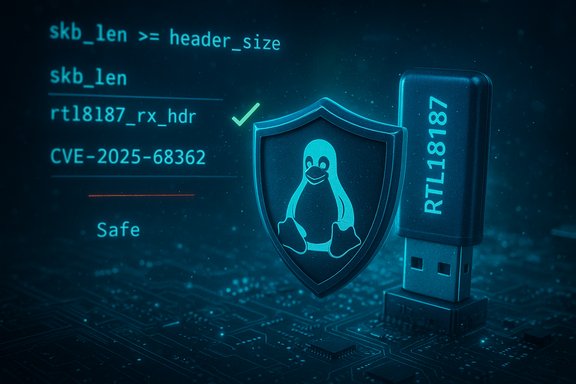
The recently published CVE, CVE‑2025‑68362, documents a defect in the rtl8187 RX callback where the code calculated the address of a receive descriptor header by subtracting its size from the skb tail pointer without first ensuring the packet length (skb->len, derived from urb->actual_length) actually contained that header. If the USB device or transport produced a truncated URB, that subtraction could point before the data area in the skb, causing the kernel to read memory it should not and provoking a panic. The upstream kernel team added defensive length checks and a clean packet drop on truncated inputs. Why this matters: kernel memory‑safety mistakes in device drivers are high‑impact because they run in privileged context; even a small arithmetic or bounds‑checking omission can crash a host, destabilize services, or — in complex chains — contribute to higher impact exploitation scenarios. The rtl8187 change is small and targeted, but the operational consequences of an unhandled kernel panic are large in production infrastructure, embedded gateways, or shared host environments.
Administrators should prioritize inventory, apply vendor kernel updates as soon as they are available, and document mitigations for long‑lived, embedded, or OEM devices where upstream patches may lag. Monitor kernel logs for rtl8187 signatures and enforce host USB device policies to reduce exposure while updates are rolled out. The fix is a textbook example of small, defensive kernel engineering: validate untrusted lengths before pointer arithmetic and fail cleanly when the input is malformed.
Source: MSRC Security Update Guide - Microsoft Security Response Center
 Background / Overview
The rtl8187 driver family (drivers/net/wireless/realtek/rtl818x/rtl8187) supports a class of USB Wi‑Fi adapters based on Realtek RTL8187 chips. These drivers handle inbound and outbound packets delivered via USB URBs; the kernel code must therefore map USB URB payloads into sk_buffs (skb structures) and parse descriptor headers and radio metadata that are appended by the device in the RX path.The recently published CVE, CVE‑2025‑68362, documents a defect in the rtl8187 RX callback where the code calculated the address of a receive descriptor header by subtracting its size from the skb tail pointer without first ensuring the packet length (skb->len, derived from urb->actual_length) actually contained that header. If the USB device or transport produced a truncated URB, that subtraction could point before the data area in the skb, causing the kernel to read memory it should not and provoking a panic. The upstream kernel team added defensive length checks and a clean packet drop on truncated inputs. Why this matters: kernel memory‑safety mistakes in device drivers are high‑impact because they run in privileged context; even a small arithmetic or bounds‑checking omission can crash a host, destabilize services, or — in complex chains — contribute to higher impact exploitation scenarios. The rtl8187 change is small and targeted, but the operational consequences of an unhandled kernel panic are large in production infrastructure, embedded gateways, or shared host environments.
The technical problem — exactly what went wrong
How the RX callback computes the descriptor pointer
In the RTL8187 RX path the driver needs to access an RX descriptor header that the device appends to the received frame. The code computes the header address by subtracting the header size from the skb tail pointer (skb_tail_pointer(skb) - sizeof(hdr). That arithmetic assumes the packet buffer contains at least sizeof(hdr) bytes at the tail. If the URB indicates a truncated payload (urb->actual_length smaller than expected), skb->len will be smaller, and the subtraction can underflow the valid skb data pointer.The consequence of trusting the length implicitly
A pointer computed before the start of the skb data area produces a read of kernel memory outside the intended buffer. In practice that manifested as kernel oopses and panics under tests that delivered truncated URBs. The behaviour is deterministic: malformed or truncated USB transfers can drive the code path toward the unsafe read. The upshot is availability impact (kernel panic), and in worst cases an underflow‑driven read or corrupted stack state could aid more complex exploitation chains — though no public exploit chain was published at disclosure.The upstream fix (what changed in the code)
The patch adds explicit length checks before attempting to locate the descriptor header. Concretely, the fixed code verifies that skb->len is at least the size of the rtl8187_rx_hdr or rtl8187b_rx_hdr as applicable; if the check fails the driver frees the skb in IRQ context and returns early, avoiding any pointer arithmetic that could underflow. The change is a small defensive guard that cleanly drops malformed or truncated packets and preserves normal behaviour for well‑formed frames.A closer look at exploitability and attack surface
Attack vector and prerequisites
- Local / device vector: The defect is in a USB Wi‑Fi driver. Exploitation requires a way to cause the kernel to receive a truncated URB containing RX metadata shorter than expected. Realistic threat models include:
- A malicious or compromised USB Wi‑Fi adapter (firmware controlling URB contents).
- A host that accepts untrusted USB devices (e.g., public kiosks, shared workstations).
- Virtualized environments where guests or untrusted VMs are granted USB passthrough.
- Network/remote vector: There is no straightforward over‑the‑Internet path to exploit this bug unless combined with other factors that let an attacker control the USB device/firmware or the host’s USB subsystem remotely. Public records characterize the vector as local.
Complexity and likelihood of exploitation
This is a classic bounds‑check omission, not a logic bug that immediately yields remote code execution. Public vulnerability trackers and early scoring characterize the attack complexity as moderate to high because exploitation typically requires ability to control USB URB content or firmware. EPSS and exploit telemetry are very low as of disclosure, indicating no widespread exploitation in the wild at publication time. That said, the underlying class of bugs (kernel memory underflow) is serious and must be treated with priority because kernel crashes and memory corruption can be impactful operationally.Who should worry — affected systems and typical deployments
- Devices running kernels that include the in‑tree rtl8187 driver and that accept USB Wi‑Fi adapters without firmware verification are in scope.
- Typical at‑risk platforms:
- Desktop or laptop systems that use RTL8187 USB Wi‑Fi dongles.
- Embedded appliances and single‑board computers that include the rtl8187 driver in their kernel builds.
- Development systems and virtualization hosts that allow untrusted USB device passthrough to guests.
- Not directly affected:
- Native Windows installations are not affected by a Linux kernel driver CVE. However, Windows hosts that run Linux guests (Hyper‑V/Linux VMs) or WSL instances may need to consider whether a Linux kernel they use contains the vulnerable code.
Operational guidance — detection, mitigation and remediation
Immediate detection and short‑term mitigations
- Watch kernel logs for oops/panic text referencing rtl8187, rtl8187_rx_cb, or stack traces that include the rtl8187 module name. These are the most direct operational indicators of a trigger attempt.
- If possible, restrict USB access:
- Disable automatic mounting/acceptance of untrusted USB devices.
- Use USBGuard or similar host‑side policies to restrict which USB devices may be used.
- For virtual environments, disable or restrict USB passthrough to guests until patched.
- Temporary driver mitigation:
- If the rtl8187 driver is not needed, unload or blacklist the module as a stopgap:
- Unload: sudo modprobe -r rtl8187 (test the effect — removing the module will disrupt Wi‑Fi functionality).
- Blacklist in modprobe.d if you require a persistent block until the patch is applied.
- For managed fleets, automate module removal through configuration management where loss of that device is acceptable.
The recommended remediation path
- Inventory: identify systems with the rtl8187 module loaded.
- Commands:
- uname -r (kernel version)
- lsmod | grep -i rtl8187
- modinfo rtl8187 (module details)
- Update: apply the vendor or distribution kernel packages that include the upstream patch. Vendors will typically backport the small patch into their stable kernels; install the updated kernel package and reboot to activate it.
- Verify: after reboot, confirm the running kernel or module package includes the fix (package changelog, distribution advisory, or kernel commit presence).
- Test: in lab environments, validate that previously observed kernel oops conditions no longer occur by replaying the test conditions (do not perform this on production without controls).
- Containment for unmanaged devices: if you cannot immediately patch, isolate affected hosts from untrusted USB devices or require physical device inspection until firmware/vendor updates are available.
Hunting rules and post‑patch telemetry
- Raise alerts for kernel log entries matching rtl8187 module oops patterns.
- Correlate any unexpected host reboots or kernel panics with wifi driver stack traces in logs (journalctl -k, dmesg).
- For environments that run sanitizer‑enabled kernels (KASAN/KMSAN) in staging, reproduce the receive path under instrumentation to confirm the fix prevents underflow reports.
Why the fix is straightforward — and why that matters
The patch is intentionally surgical: it clamps a needed precondition (packet length) before performing pointer arithmetic. That pattern is preferred for kernel fixes because it is easy to audit, low risk for regressions, and straightforward to backport to stable kernel branches and vendor kernels. Small, defensive checks like this are exactly the right approach to harden parsing and descriptor handling logic without altering driver semantics for normal frames.Risk assessment — strengths and residual concerns
Strengths
- The correction is minimal and low‑risk, so vendors can backport and distribute patched kernel packages quickly.
- The change directly addresses the root cause (missing length check) and eliminates the underflow without large refactors.
- Multiple trusted aggregators and the stable kernel tree reflect the fix quickly, enabling distribution vendors to incorporate the change.
Residual risks and caveats
- Long tail in embedded and OEM devices: devices with long firmware lifecycles, custom kernels, or vendor forks may take longer to receive the fix. This is the largest operational concern for IoT gateways, OEM routers, and embedded appliances that include the rtl8187 driver.
- Chaining possibilities: while this CVE alone is a bounds‑check fix causing availability impact, kernel memory‑safety defects can sometimes be combined with other vulnerabilities to raise impact. Treat memory‑safety bugs as high‑priority even when initial scoring centers on DoS.
- Mis‑mappings in vendor branches: vendors occasionally backport fixes under different commit IDs or bundle them with other changes; always validate package changelogs or vendor advisories to ensure the intended upstream commit is present.
Exploit availability status (as of disclosure)
There were no widely published exploit PoCs at the time the CVE was recorded and urgency scoring/EPSS indicators remain low; public trackers flag the attack vector as local and note the practical difficulty of causing the truncated URB without control over the device or its firmware. That lowers immediate exploitation risk for most centrally managed datacenter hosts, but does not eliminate the operational need to patch.Practical mitigation checklist for administrators (ranked steps)
- Inventory affected endpoints and classify risk by exposure (public kiosks, lab machines, VMs with USB passthrough).
- Apply vendor/distribution kernel updates that include the upstream patch; schedule reboots as needed.
- If patching is delayed, disable or blacklist the rtl8187 module on endpoints where the hardware is not required.
- Enforce host policies to prevent untrusted USB devices (USBGuard) and limit USB passthrough for virtual guests.
- Monitor kernel logs and set alerts for rtl8187‑related oops/panic signatures.
- For embedded vendors: coordinate with OEMs to obtain firmware/kernel updates and prepare a supported remediation timeline.
For WindowsForum readers: what to check in mixed environments
- Windows users running Linux guests (Hyper‑V/WSL2/other VMs): update Linux guest kernels via your distribution package system. WSL’s managed kernel updates come from Microsoft or the chosen WSL distro — verify the distro kernel includes the patch if the kernel is supplied by the distro. The Windows host itself is not directly vulnerable; the risk lives in the Linux kernel image running on the host/VM.
- Enterprises with mixed fleets: track vendor advisories for desktop Linux images, embedded appliances, and cloud images. If you manage cloud images, verify marketplace images or custom images do not contain vulnerable kernels.
Final assessment and takeaway
CVE‑2025‑68362 is an important, straightforward memory‑safety fix in the rtl8187 Linux wireless driver that prevents a buffer underflow and consequent kernel panic by adding simple length checks before descriptor header access. The technical fix is small and low‑risk, so vendors can — and should — backport and ship updates quickly. The practical threat model is local: exploitation requires control or manipulation of USB URB contents (compromised/malicious device firmware, untrusted USB devices, or uncontrolled USB passthrough). As usual with kernel memory issues, the operational impact is primarily availability and stability, and the correct remediation path is prompt patching, coupled with short‑term mitigations (module unload, USB access restrictions) where patch windows are constrained.Administrators should prioritize inventory, apply vendor kernel updates as soon as they are available, and document mitigations for long‑lived, embedded, or OEM devices where upstream patches may lag. Monitor kernel logs for rtl8187 signatures and enforce host USB device policies to reduce exposure while updates are rolled out. The fix is a textbook example of small, defensive kernel engineering: validate untrusted lengths before pointer arithmetic and fail cleanly when the input is malformed.
Source: MSRC Security Update Guide - Microsoft Security Response Center
