

A small but consequential fix landed in the stable Linux kernel this week to resolve CVE-2025-40306, an OrangeFS xattr-related bug that could lead to kernel oopses, hung processes and an accumulating kernel memory leak under repeated module activity — operators should treat this as a prioritized maintenance item if their systems load the OrangeFS module.
OrangeFS is a parallel filesystem historically used in high-performance computing and some appliance contexts; the recent CVE addresses how OrangeFS handles extended attributes (xattrs) in its kernel module. The vulnerability description shows two related failures: a loop condition bug in the xattr helper that can iterate past valid C string boundaries and an xattr-cache insertion mistake that caused repeated, uncaught allocations to be placed into the wrong hash bucket — generating an effective kernel memory leak under repeated triggers. This is fundamentally an availability problem rather than a secrecy or integrity break: the immediate, realistic impacts are kernel oopses, hung user-space operations that interact with xattrs (for example, setfattr/getfattr), and resource exhaustion when automated tests or repeated module operations repeatedly exercise the faulty paths. The upstream changes are small and surgical — intended to correct loop logic, fix cache insertion behavior, and ensure proper cleanup — which makes them suitable for stable backports.
Immediate (0–24 hours)
Source: MSRC Security Update Guide - Microsoft Security Response Center
 Background / Overview
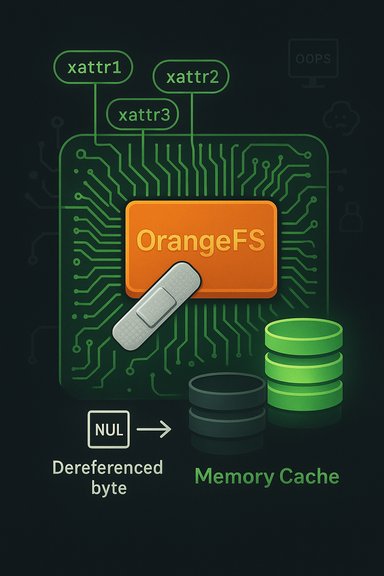
OrangeFS is a parallel filesystem historically used in high-performance computing and some appliance contexts; the recent CVE addresses how OrangeFS handles extended attributes (xattrs) in its kernel module. The vulnerability description shows two related failures: a loop condition bug in the xattr helper that can iterate past valid C string boundaries and an xattr-cache insertion mistake that caused repeated, uncaught allocations to be placed into the wrong hash bucket — generating an effective kernel memory leak under repeated triggers. This is fundamentally an availability problem rather than a secrecy or integrity break: the immediate, realistic impacts are kernel oopses, hung user-space operations that interact with xattrs (for example, setfattr/getfattr), and resource exhaustion when automated tests or repeated module operations repeatedly exercise the faulty paths. The upstream changes are small and surgical — intended to correct loop logic, fix cache insertion behavior, and ensure proper cleanup — which makes them suitable for stable backports. What exactly went wrong (technical anatomy)
The buggy helper: xattr_key loop condition
At the heart of the initial failure is the helper function that walks xattr key strings. The implementation mistakenly used the pointer variable itself as the loop condition instead of dereferencing it; as the pointer is incremented, it remains non-NULL and the loop can read into unmapped memory, producing a hang, kernel oops, or corrupted state when triggered by user operations such as setfattr/getfattr. This defect is classic C string handling gone wrong: tests that rely on stopping at a NUL terminator instead walk until a fatal fault occurs.The cache insertion mistake that produced a leak
Fixing the loop revealed a second problem during downstream testing (xfstests generic/069): OrangeFS returned a hashed key and then used the kernel macro hash_add to insert an entry into its xattr cache. Because hash_add itself performs hashing (via hash_log) the code unintentionally double-hashed or used the wrong bucketing logic, so cached negative entries (which include a kmalloc) never ended up in the expected bucket and later were never freed. Under repeated gets for the same attribute (for example, "security.capability"), the system would allocate repeatedly and never release memory — a kernel memory leak that, when exercised in automated test environments or repeated module loads/unloads, can climb into OOM territory. The upstream remedy replaced hash_add uses with hlist_add_head in the affected insertion paths and corrected cleanup flows.Why kmemleak and xfstests matter in discovery
This CVE is a textbook example of how defensive kernel testing and instrumentation find layered issues: an initial reported logic bug in xattr_key was validated via manual reproduction (setfattr/getfattr), then automated test suites (xfstests generic/069) and kmemleak surfaced a persistent allocation pattern that only appeared after the first fix. The maintainers’ approach — fix the string loop first, then re-run tests to discover secondary effects — is the correct triage sequence for kernel subsystems where small changes can expose related latent defects.Scope: what is affected and who should care
- Systems that load the OrangeFS kernel module (built-in or modular) are in scope; check for orangefs in running modules or kernel configuration.
- Multi-tenant hosts, CI systems, test farms, and appliances that repeatedly load/unload modules or that mount and exercise OrangeFS features are highest priority because the exploit primitive is local and its operational cost scales with repeated triggering.
- Typical desktops that never load the orangefs module are not affected in practice, but distributions and appliances that vendor the module still should review package changelogs for the fix.
Verified facts and proof points
- CVE assignment and publication: CVE-2025-40306 was published in early December 2025; public trackers (NVD/OSV/CVEdetails) contain the canonical description.
- Upstream kernel commits and stable-tree merges: the fix series was merged into the stable kernel trees (multiple stable patch messages and stable commit references were posted to the Linux stable update lists). The public digest and stable-patch emails describe the exact changes and reasoning.
- Nature of impact: the bug manifests as kernel oops/hangs and a memory leak that can escalate to OOM under repeated triggers; vendors classify the primary impact as availability.
Practical impact and risk model
- Primary outcome: Denial-of-service — hung processes, kernel oopses, or even OOM-induced reboots in the most heavily exercised hosts.
- Exploitability: Local-only; an attacker needs the ability to trigger module initialization or to cause the OrangeFS xattr code to run. That makes hypervisor hosts, CI runners, and image‑ingestion services higher risk because untrusted inputs may reach privileged parsing code.
- Confidentiality/Integrity: No direct evidence that this bug enables data disclosure or privilege escalation on its own; it’s a leak and correctness bug rather than an immediate memory-corruption write primitive. However, availability issues in multi-tenant infrastructure can have severe downstream operational consequences. If you see claims of weaponization or remote compromise tied to this CVE, treat them as unverified until accompanied by public PoC or telemetry.
Detection and hunting guidance
These diagnostics are actionable and relatively high-signal for a problem that manifests at kernel level.- Inventory hosts likely to load OrangeFS:
- lsmod | grep orangefs
- grep -R "orangefs" /lib/modules/$(uname -r) /etc/modprobe.d
- Check package lists for orangefs modules and kernel config options.
- Look for symptomatic kernel logs:
- journalctl -k or dmesg for messages indicating "unreferenced object", kmemleak traces, or backtraces rooted in orangefs_sysfs_init.
- Search specifically for kmalloc_trace frames that reference orangefs_sysfs_init or similar call chains reported in upstream diagnostics.
- Reproduce in a controlled test host:
- Load the orangefs module (insmod/modprobe) in a non-production VM.
- Run xfstests generic/069 (or the relevant xfstests subset) to try to reproduce the behavior reported by upstream test runs.
- Enable kmemleak if available and examine its reports for unreferenced kobjects linked to orangefs.
- Telemetry rules to add to SIEM:
- Alert on repeated insmod/rmmod frequency per host combined with increasing kernel slab usage.
- Alert on kernel kmemleak messages that include lines referencing orangefs or xattr helpers.
- Monitor for repeated getfattr/setfattr failures or unusually frequent "security.capability" lookups on orangefs-mounted files.
Remediation and mitigation playbook (prioritized)
Applying vendor kernel updates that include the upstream patches is the definitive remediation. The kernel-level nature of the fix requires a reboot to load the updated kernel modules.Immediate (0–24 hours)
- Inventory:
- Identify hosts that may load OrangeFS: lsmod | grep orangefs; check /proc/modules and /lib/modules.
- Prioritize multi-tenant, CI/test-farm, and image‑ingestion hosts that accept untrusted inputs.
- Confirm vendor mapping:
- Consult your distribution's security tracker or package changelog to confirm that the kernel package includes the CVE or the upstream commit IDs. Do not rely solely on generic kernel version numbers.
- If you cannot patch immediately:
- Restrict the ability to insert/remove kernel modules to trusted operators.
- For virtualization hosts or services that mount untrusted images, move image processing to sandboxed/isolated hosts that do not run OrangeFS, or disable mounting of untrusted images on the host.
- Increase monitoring of kernel logs and slab usage and escalate if kmemleak traces appear.
- Deploy the vendor-supplied kernel update that includes the stable patch and schedule reboots in a controlled maintenance window.
- Validate remediation by:
- Confirming package changelog mentions the CVE or upstream commit IDs.
- Rebooted hosts show no kmemleak entries or repeated getfattr/setfattr-induced oopses under a defined test workload.
- Run a smoke test that exercises xattr ops (setfattr/getfattr) on OrangeFS-mounted test files and re-run xfstests generic/069 if your organization uses that test suite. Ensure kmemleak produces no new unreferenced allocations associated with orangefs_sysfs_init.
Why this patch is important despite the “low” exploit surface
Three practical points justify swift patching even where direct remote exploitability is not observed:- Operational cost: a persistent leak can silently degrade nodes in test farms or shared infrastructure until an OOM event occurs. The operational burden of tracking down an intermittent kernel leak can be high.
- Amplification in multi-tenant contexts: an attacker or a buggy tenant process that can repeatedly trigger the offending path can affect all co-located tenants by driving the host into memory pressure and instability.
- Precedent for chaining: while this defect is not itself a remote RCE, stability and correctness bugs increase the available surface area for multi-stage exploitation; in complex attack scenarios an initial local instability can be used as a stepping stone by a capable adversary. Treat such chaining as speculative but operationally relevant in high-value environments.
What maintainers changed (brief, concrete summary)
- Corrected the loop condition in xattr_key so it checks the byte at the pointer (dereference) rather than the pointer value itself; this prevents walking past the NUL terminator.
- Replaced uses of hash_add with hlist_add_head in the xattr cache insertion paths to avoid unintended rehashing and placement into incorrect buckets.
- Tightened cleanup paths so that kmalloc'd negative-cache entries are freed correctly on error/exit paths, eliminating the repeated unfreed allocations that raised slab growth and OOM risk in tests.
Limitations, open questions, and cautionary notes
- No authoritative public PoC for remote, unauthenticated exploitation has been published at the time of disclosure; the threat model remains local and availability-centered. However, exploit absence is not the same as exploit impossibility; keep monitoring vendor advisories and threat intel feeds. Treat claims of weaponization as unverified unless corroborated by reliable telemetry or published exploit code.
- Vendor backport timelines vary: embedded OEM kernels and appliance images are often the long tail that remain vulnerable the longest because vendors delay or skip stable backports. Verify package changelogs rather than assuming parity with upstream.
- Some operational detection methods require enabling kmemleak or running destructive test suites; those should be executed in controlled, non-production environments only. Preserve logs and vmcores for vendor triage if you encounter the issue in production.
Quick checklist for busy admins
- Inventory hosts that may load orangefs: lsmod | grep orangefs; check packages and kernel config.
- If orangefs is present, consult your distribution security tracker and map the CVE→package→kernel version; do not rely only on kernel release numbers.
- Schedule and apply the vendor kernel update containing the stable patch; reboot hosts to complete remediation.
- If immediate patching is impossible, restrict module load privileges, isolate image-processing workloads, and increase kernel-level telemetry for kmemleak and slab growth.
Conclusion
CVE-2025-40306 is a telling example of how a small logic error in string handling can cascade into a larger operational issue when combined with subtle cache-management mistakes. The bug’s practical impact is availability-focused — kernel hangs, oopses and an accumulating memory leak — and the upstream response is appropriately narrow and defensive, making it straightforward for maintainers and distributors to backport the fix. Operators should treat this as a real, actionable maintenance item for any host that loads the OrangeFS module: inventory, patch, reboot, and validate with the provided detection guidance to ensure the leak no longer shows up in kmemleak or xfstests.Source: MSRC Security Update Guide - Microsoft Security Response Center
