

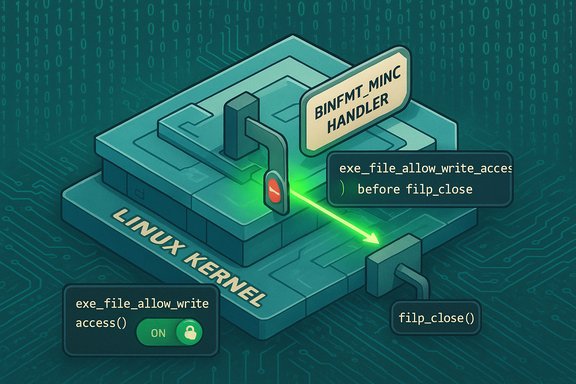
A subtle correctness bug in the Linux kernel’s binfmt_misc handler has been assigned CVE-2025-68239 and quietly fixed upstream: when bm_register_write opens an executable via open_exec, the kernel denies write access while the file is treated as executable, but under certain error paths the code closed the file without restoring write permission — a logic gap fixed by calling exe_file_allow_write_access before filp_close.
The binfmt_misc facility lets the kernel dispatch file execution to handler modules when the binary format is not a native ELF — common for language runtimes, interpreters, and compatibility shims. The handler that registers writable “magic” patterns (bm_register_write must open candidate files with execution semantics while carefully managing write permission during the open/execute transition so the binary can’t be modified while being prepared to run.
In this instance, the kernel helper open_exec (implemented via do_open_execat opens the target and temporarily denies write access to prevent modification during the exec-like open. If the subsequent code hits an error path, bm_register_write historically closed the file descriptor with filp_close without re-enabling writes. The omitted call to exe_file_allow_write_access meant the file could be left in a state where subsequent attempts to write to it failed unexpectedly. The NVD entry and upstream patch summary capture this exact sequence and the corrective change. This is a correctness/regression class fix rather than a direct memory-corruption or privilege-escalation vulnerability. Upstream maintainers authored a short patch to explicitly restore write access before closing the file, and that change has been merged into the stable trees referenced in vulnerability feeds and OSV.
The patch was proposed and discussed on multiple kernel mailing lists (patch email posted by the author), and the stable commit IDs cited by public sources mark the change as applied to the kernel stable branch. The patch is intentionally minimal and targeted: it restores a symmetry (deny-on-open → re-allow-on-close) that was missing in the error path.
Restoring write access before closing files opened by open_exec is a small but necessary correctness fix: it preserves expected file semantics after register-time errors and prevents surprising write failures that can break builds and developer tooling. The patch is small and low-risk, but administrators should still verify vendor packages and apply kernel updates promptly to eliminate the failure mode in production environments.
Source: MSRC Security Update Guide - Microsoft Security Response Center
 Background / Overview
The binfmt_misc facility lets the kernel dispatch file execution to handler modules when the binary format is not a native ELF — common for language runtimes, interpreters, and compatibility shims. The handler that registers writable “magic” patterns (bm_register_write must open candidate files with execution semantics while carefully managing write permission during the open/execute transition so the binary can’t be modified while being prepared to run.In this instance, the kernel helper open_exec (implemented via do_open_execat opens the target and temporarily denies write access to prevent modification during the exec-like open. If the subsequent code hits an error path, bm_register_write historically closed the file descriptor with filp_close without re-enabling writes. The omitted call to exe_file_allow_write_access meant the file could be left in a state where subsequent attempts to write to it failed unexpectedly. The NVD entry and upstream patch summary capture this exact sequence and the corrective change. This is a correctness/regression class fix rather than a direct memory-corruption or privilege-escalation vulnerability. Upstream maintainers authored a short patch to explicitly restore write access before closing the file, and that change has been merged into the stable trees referenced in vulnerability feeds and OSV.
Technical analysis
What went wrong (concise)
- bm_register_write needs to open a file that may be executed; it calls open_exec, which internally denies write access so the file can't be changed during the open/exec transition.
- If bm_register_write encounters an error after open_exec, it used filp_close to close the file. That direct close does not automatically re-enable the previously disabled write access.
- The result: the inode's write permission state could remain altered, causing later writes to the same file to fail even though no logical reason remained for the write to be blocked.
The fix (what the patch does)
The upstream patch inserts a call to exe_file_allow_write_access prior to filp_close on the error path, ensuring the temporary denial of writes is undone before the file is closed. This restores inode state hygiene and prevents spurious failures for future write operations.The patch was proposed and discussed on multiple kernel mailing lists (patch email posted by the author), and the stable commit IDs cited by public sources mark the change as applied to the kernel stable branch. The patch is intentionally minimal and targeted: it restores a symmetry (deny-on-open → re-allow-on-close) that was missing in the error path.
Why this is not an RCE or memory-corruption bug
The bug is a race/state-correction/permissions oversight, not a memory-safety defect. It does not create an attacker-controlled write or code execution primitive. At disclosure, public trackers and the upstream description characterize the issue as causing write failures on files, not as enabling arbitrary code execution or privilege escalation. The practical consequence is broken behavior or application errors that rely on being able to write a file after a failed registration attempt.Affected code and versions
- The change and the CVE were published to public vulnerability feeds on December 16, 2025, and tracking pages list kernel commits that implement the fix. The OSV/NVD entries include the upstream stable-branch commit references tied to the correction.
- OSV’s vulnerability record maps the regression into kernel Git ranges and lists the fix commits; the conversion metadata indicates the issue was introduced in earlier kernel lines and fixed in the stable series (referenced commits and trees are included in public databases). Administrators should treat kernels before the stable backport as potentially impacted until their vendor/kernel package explicitly includes the fix.
- Vendor and scanner feeds (SUSE, Tenable/Nessus, CVE aggregators) have added entries and detection signatures referencing CVE-2025-68239; some scanner plugins initially mark unpatched kernels as vulnerable even where vendors have not yet produced binary updates. Use vendor advisories/changelogs to confirm whether your distribution package includes the upstream commit or an equivalent backport.
Operational impact and exploitability
Practical impact
- Symptom: subsequent write operations to a file that went through the bm_register_write path may fail after an error path leaves the file’s write access disabled. This can break installations, updates, packaging tools, or language runtimes that rely on binfmt_misc registration and then attempt to modify the handler files. The result is application failures or surprising permission errors.
- Exploitability: remote exploitation is not applicable. The vector is local and deterministic under the right code path. Aggregators that index the fix list this as a functional correctness/availability issue rather than a code-execution vulnerability. There is no public proof-of-concept demonstrating elevated privileges or remote compromise tied to this CVE at disclosure.
Who should care most
- Developers and administrators who run systems that register non-native binary handlers via binfmt_misc (for example interpreters, cross-compilers, runtime shims) should be alert. Automated packaging systems, container image builders, developer workstations and CI runners that perform repeated binfmt_misc operations could trigger the code path and observe write-failures.
- Distribution maintainers and kernel packagers should ensure the stable backport is included in their kernel packages. System integrators using custom kernels or long-tail embedded kernels should check for the specific fix.
Detection, telemetry and validation
What to look for in logs and failures
- Application-level errors complaining about inability to write files immediately after binfmt_misc registration attempts or executable-handler installs.
- Reproducible sequences: if a machine running binfmt_misc handlers shows writes failing only after registration attempts, the bug is a candidate. Reproduce in a test environment where a failing bm_register_write path is exercised and then attempt a write to the same file. If the write fails with permission-like errors, the behavior matches the described defect.
- Kernel and package changelogs: the authoritative validation is to confirm your kernel package’s changelog or vendor advisory references the upstream commit or the CVE explicitly. Scanners may flag a kernel as vulnerable based on heuristics; vendor changelogs and package metadata are the true verification points.
How to validate a patch is present
- Check your distribution’s kernel package changelog for references to CVE-2025-68239 or the upstream commit hashes supplied in public advisories.
- If you build kernels from source, confirm the stable branch contains the commit that adds exe_file_allow_write_access before filp_close in the bm_register_write error path. Public OSV/NVD metadata lists the fix commits for cross-checking.
Mitigation and remediation guidance
Recommended immediate actions
- Inventory: Identify systems that use binfmt_misc or that host language runtimes and tools that register handlers (for example, developer machines, CI runners, container build hosts).
- Patch: Apply vendor-supplied kernel updates that explicitly mention CVE-2025-68239 or include the upstream backport. Reboot into the updated kernel — kernel fixes require a reboot.
- Verify: After upgrade, confirm the kernel package changelog or vendor advisory references the CVE or upstream commit; test the previously failing registration-and-write sequence in a staging environment.
Short-term mitigations (if you cannot patch immediately)
- Avoid running untrusted scripts that register binfmt_misc handlers on critical hosts. Isolate image-build or interpreter-install tasks to dedicated ephemeral VMs or containers where kernel updates can be controlled.
- Limit who can perform binfmt_misc registration operations. Restrict the administrative scope for registering binary handlers to trusted administrators only.
- Add a post-failure remediation step in automation that runs exe_file_allow_write_access-equivalent operations before closing or cleaning up when an error path occurs — only if you control the code path (that is, in custom wrappers or management tooling). Do not modify kernel behavior in production aside from installing the vendor patch.
Rollout checklist (practical)
- Map hosts that need updating (developer machines, build servers, container hosts).
- Stage kernel updates in a test ring and run representative binfmt_misc and packaging workflows.
- Schedule rolling reboots and monitor post-upgrade logs for regressions.
- Confirm remediation by reproducing the prior failure scenario and verifying writes now succeed.
Broader risk assessment and context for WindowsForum readers
- Many Windows-oriented developers will encounter affected kernels indirectly: via Linux VMs, WSL/WSL2 kernels, Azure Linux images, or cross-platform CI runners. If you run WSL2 or Linux VMs on Windows hosts, check the kernel versions and vendor advisories that map the CVE to specific kernel builds. Do not assume WSL builds are unaffected — verify the kernel revision and whether the distribution or product-specific kernel contains the fix.
- Operational priority: treat this as a functional correctness and reliability issue with potential to break automation or developer workflows. It’s not a high-severity remote-exploitation emergency, but in production build systems or critical automation its impact can be disruptive and should be corrected on the normal kernel-update cadence rather than ignored.
- Vendor variability: distributions may backport the patch differently or merge it into different package versions. Embedded, vendor-forked, or long-tail kernels can lag upstream and need explicit attention. When in doubt, contact your vendor or check the distribution security tracker for the mapping between upstream commits and packaged kernels.
For kernel developers and packagers — technical notes
- The fix is intentionally minimal: restoring write access before filp_close on the error path. That makes the change easy to review and backport. Kernel maintainers favor such surgical fixes because they minimize regression risk. The patch was discussed on maintainer mailing lists and applied to stable trees; maintainers also ensured the same fix pattern applies across relevant code paths.
- When auditing other exec/open helpers, search for similar patterns where open_exec or do_open_execat is used: verify that every path that can return an error afterwards either re-enables write access or otherwise normalizes the inode state before returning/closing.
Conclusion — what to do now
- Confirm whether your Linux kernel package includes the CVE-2025-68239 fix by checking vendor advisories or the kernel package changelog. If the package is not yet updated, plan to install the vendor-supplied kernel update and reboot into it as part of your routine kernel patching process.
- Prioritize patching for systems that host CI/build runners, image builders, or developer workstations that use binfmt_misc. For other systems, schedule the fix in your regular kernel maintenance window after validating that the vendor’s package maps the upstream stable commit into the binary kernel package.
- This CVE is a reminder that small, correctness-oriented fixes in the kernel can produce surprising operational effects. Maintain a test ring for kernel updates, confirm vendor mappings of upstream commits, and keep automation idempotent so that transient kernel state bugs cannot produce lasting failures.
Restoring write access before closing files opened by open_exec is a small but necessary correctness fix: it preserves expected file semantics after register-time errors and prevents surprising write failures that can break builds and developer tooling. The patch is small and low-risk, but administrators should still verify vendor packages and apply kernel updates promptly to eliminate the failure mode in production environments.
Source: MSRC Security Update Guide - Microsoft Security Response Center
