

The Linux kernel patch for CVE-2025-38350 fixes a subtle but recurring logic gap in the traffic‑control (net/sched) classful qdisc handling that can lead to a use‑after‑free when a child qdisc unexpectedly goes empty during an enqueue operation, and operators should treat multi‑tenant and network‑facing hosts as high priority for remediation.
Classful queueing disciplines (qdiscs) in the Linux network scheduler let administrators build hierarchical traffic‑control trees that shape, prioritize, and drop packets. Those qdiscs and their classes communicate backlog and state changes to parent qdiscs through a small API surface: counters, notifications (qlen_notify), and dequeue/enqueue handlers. A subtle interaction in that lifecycle — when a child qdisc becomes empty as the result of an internal dequeue triggered during an enqueue flow — created a race that could leave parent code operating on stale class pointers. The bug was assigned CVE‑2025‑38350. The kernel community took a pragmatic route: rather than changing complex backlog accounting across many classful qdiscs, the upstream fix makes sure notifications are always passed to the parent when the child class becomes empty (qdisc_tree_reduce_backlog will call qlen_notify in those cases). That change closes the lifecycle gap across a broad set of classful qdiscs and avoids the re‑activation path that could otherwise produce a use‑after‑free.
Source: MSRC Security Update Guide - Microsoft Security Response Center
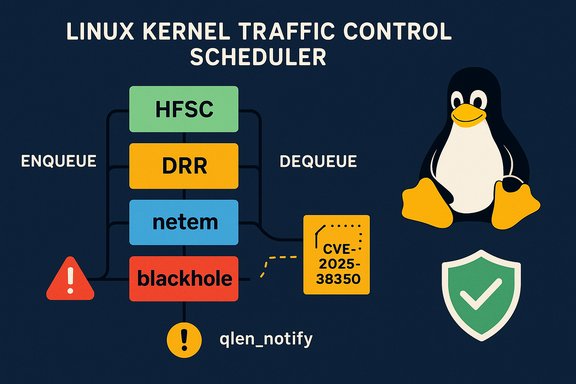 Background / Overview
Classful queueing disciplines (qdiscs) in the Linux network scheduler let administrators build hierarchical traffic‑control trees that shape, prioritize, and drop packets. Those qdiscs and their classes communicate backlog and state changes to parent qdiscs through a small API surface: counters, notifications (qlen_notify), and dequeue/enqueue handlers. A subtle interaction in that lifecycle — when a child qdisc becomes empty as the result of an internal dequeue triggered during an enqueue flow — created a race that could leave parent code operating on stale class pointers. The bug was assigned CVE‑2025‑38350. The kernel community took a pragmatic route: rather than changing complex backlog accounting across many classful qdiscs, the upstream fix makes sure notifications are always passed to the parent when the child class becomes empty (qdisc_tree_reduce_backlog will call qlen_notify in those cases). That change closes the lifecycle gap across a broad set of classful qdiscs and avoids the re‑activation path that could otherwise produce a use‑after‑free. What exactly went wrong
Technical anatomy in plain language
- Certain classful qdiscs can call their classes' dequeue handler during what appears to be an enqueue operation. That is: an enqueue can trigger downstream dequeues as part of qdisc internals (for example, to maintain fairness or perform shapers).
- If a child qdisc is emptied by that dequeue, the kernel marks the class as passive via qlen_notify. Most qdiscs expect such notifications only in particular sequences; when notifications happen at this earlier point, some qdiscs may later re-activate the class.
- That re‑activation sequence can cause the parent to use a class pointer that has already been freed, producing a classic use‑after‑free (UAF) inside net/sched — a dangerous condition for kernel memory safety.
Reproducer (safe to read, do not run on production)
Upstream advisories published a compact reproducer showing the fault on the loopback device (this is kept here for discussion — do not run on production hosts):- Add a DRR root qdisc and a basic filter, create nested classful qdiscs (HFSC, netem, blackhole).
- Send a small UDP packet with socat to exercise the enqueue/dequeue paths.
- Delete a parent class, then send another packet to trigger the use‑after‑free.
The upstream fix — what changed and why it matters
The minimal, robust approach
Instead of chasing every possible accounting path that could result in stale backlog counters, the patch ensures that when a child qdisc becomes empty, the scheduler always notifies the parent via qlen_notify. This guarantees parent qdiscs observe the child’s emptied state consistently — even if the child is emptied as a side effect of an enqueue. Because a recent patch series made classful qdisc qlen_notify handlers idempotent, calling qlen_notify more than once is harmless and safe to backport into stable kernels. Key implementation notes:- The change centers on qdisc_tree_reduce_backlog and the qlen_notify pathway in net/sched.
- The patch was intentionally small and conservative to ease backporting into stable kernel branches.
- Multiple stable branches, including those used by popular distributions, received the change as part of routine stable updates.
Commit and version details (verification)
Upstream tracing shows the issue was introduced in a prior commit and fixed in a follow‑up stable commit series. The kernel CVE announcement references the regression and the fix; maintainers identify the faulty and remediating commits and mapped the fix into 5.4/5.15 and other stable lines for vendor backports. Operators should cross‑check their vendor changelogs for the specific stable commit hashes cited by kernel maintainers.Who is affected — scope and exposure model
- Affected component: Linux kernel networking scheduler (net/sched) — specifically classful qdiscs and their parent/child notification paths.
- Likely exposed hosts: any Linux build that includes classful qdiscs (HFSC, DRR, netem, etc. and compiles the scheduler code paths in question. That includes general-purpose distributions, embedded appliances, network gateways, and cloud VM images that include full net/sched support.
- An attacker must be able to run code on the target machine (for example, an unprivileged user, a container tenant, CI runners, or a scripted process).
- In multi‑tenant or shared infrastructures, a tenant or untrusted workload that can exercise tc/netlink operations is the realistic threat model.
- The risk to a single‑user hardened desktop with no untrusted local execution is comparatively lower, but still non‑zero if the host exposes management interfaces to untrusted processes.
Severity and exploitability — practical assessment
- Immediate technical impact: use‑after‑free inside kernel net/sched — a memory‑safety defect that can cause kernel crashes, stability issues, and in the worst case be leveraged (with other primitives) to escalate to code execution.
- Attack vector: local/adjacent; an attacker requires the ability to perform netlink/tc operations or to trigger the specific qdisc sequences via packet flows in a locally controlled context.
- At public disclosure there was no widespread public proof‑of‑concept demonstrating trivial remote exploitation. The issue requires local access and specific tc/class sequences; public advisories do not document active, large‑scale exploitation campaigns tied to this CVE at publication. Operators should treat the absence of a public PoC as temporary: once patches are published, attackers often analyze diffs and may craft PoCs quickly.
Detection, triage, and forensic guidance
What to look for
- Kernel oops or WARN traces that include net/sched functions or stack frames referencing class handling, qdisc tree operations, qlen_notify, or qdisc_tree_reduce_backlog.
- Unexplained kernel instability or unexpected OOPS around networking operations shortly after tc/qdisc changes.
- Unexpected behavior in traffic‑control (tc) statistics, or changes in qdisc state after routine enqueue/dequeue operations.
Concrete triage steps
- Search kernel logs: dmesg and journalctl -k for traces mentioning qdisc, sch_api, qlen_notify, or qdisc_tree_reduce_backlog.
- Correlate with recent tc operations: check orchestration or automation logs for tc/qdisc/class operations near the time of any kernel OOPS.
- Preserve evidence: capture vmcore/kernel crash dumps (kdump) and collect uname -a, loaded modules, and kernel build IDs for triage. Avoid rebooting until relevant artifacts are saved where practical.
Safe reproduction (lab-only)
Reproduce only in an isolated test lab. Use the short reproducer sequence published by the kernel team to validate that a test kernel is vulnerable or that a patched kernel is not. Do not run reproducer sequences on production hosts.Remediation and mitigation
Primary remediation — patch and reboot
- Apply vendor/distribution kernel updates that include the upstream stable commit(s) fixing CVE‑2025‑38350.
- Reboot hosts into the patched kernel after validating the vendor package mapping.
- Verify the kernel changelog or package changelog explicitly maps the upstream commit hash or CVE to the package. Kernel version numbers alone are not sufficient — distributors often backport patches into custom kernels.
Vendor mapping and patch availability
Popular distributions and vendors released updates and advisories mapping the upstream fix into their kernels (Ubuntu, Debian, Red Hat/Oracle, SUSE and others). Administrators should consult their vendor’s security tracker for the exact fixed package version and SRU/SRC records for stable‑release backports.Short‑term compensating controls (if you cannot patch immediately)
- Restrict local access to tc/netlink interfaces: limit who may run tc, and use sudoers or RBAC to restrict netlink‑manipulating utilities to trusted administrators.
- Harden multi‑tenant platforms: reduce the ability of untrusted tenants to run privileged network configuration actions; tighten container runtime capabilities so unprivileged containers cannot manipulate host qdiscs.
- Isolate vulnerable hosts: move critical workloads off possibly vulnerable infrastructure until the patch can be applied.
These are temporary mitigations — the definitive fix is a patched kernel.
Operational checklist (recommended actions for admins)
- Inventory: Identify Linux hosts that expose net/sched functionality — routers, gateways, cloud VMs, network appliances, CI runners, and developer workstations. Use configuration management tooling to query kernel package versions and installed kernels.
- Vendor advisory check: Consult your distribution’s security advisory for CVE‑2025‑38350 and map fixed package versions to your release channels.
- Test: Validate the patched kernel in a staging environment using the published reproducer to ensure the issue is resolved and that there are no regressions in qdisc behavior for your workload.
- Patch: Deploy updated kernel packages in prioritized waves: test → pilot → broad rollout; reboot into patched kernels.
- Monitor: After rolling out fixes, monitor kernel logs for residual OOPS warnings and confirm no further qdisc-related traces are occurring.
Risk analysis and critical appraisal
Notable strengths of the upstream fix
- The change is small and defensive: always calling qlen_notify when the child becomes empty is conceptually simple, low‑risk, and easy to backport into stable kernels.
- Fixing notification semantics solves the root lifecycle mismatch rather than repeatedly patching accounting code paths, which reduces future regressions.
- Because idempotency for qlen_notify handlers was already applied upstream, the approach safely tolerates multiple notifications.
Potential residual risks and caveats
- Vendor backports vary. Some appliance or OEM kernels, marketplace images, or vendor-modified kernels may not receive the fix on the same schedule as mainstream distributions. Operators must verify their specific kernel packages include the fixing commit rather than assume safety by kernel version alone.
- While the patch closes this particular class of UAF, the net/sched area has historically seen several related timing/accounting bugs. Administrators should maintain vigilance — a future, different lifecycle bug could appear if other qdisc implementations deviate from expected semantics.
- Although no widely publicized PoC or exploitation campaign was reported at disclosure, the existence of a UAF in a privileged kernel path makes the vulnerability a valuable piece in a multi‑stage exploit chain. Local information gained from kernel behavior and leaks combined with other primitives can still escalate risk. Flag any claims of trivial remote exploitation as unverified absent concrete PoCs.
Practical recommendations for Windows‑centric operators and mixed estates
Many Windows administrators run Linux guests, containers, or appliances in hybrid environments. The presence of Linux kernels with this scheduler code in mixed estates means Windows‑centered ops teams should:- Inventory virtual machines, Azure images, Marketplace items, and WSL2 kernels to identify Linux kernel versions and vendor advisories that may affect hosted Linux artifacts.
- Prioritize patching for infrastructure nodes that host many tenants or run network services (CI runners, shared build hosts, and edge networking appliances).
- Subscribe to vendor advisories and kernel stable branch announcements to avoid lag between upstream fixes and vendor backports.
Conclusion
CVE‑2025‑38350 is a textbook example of how notification and lifecycle mismatches — not just arithmetic bugs — produce kernel memory‑safety issues. The upstream response is sensible: a small, well‑scoped, and backportable change that standardizes notification semantics across classful qdiscs and prevents the re‑activation scenario that produced a use‑after‑free. For defenders, the takeaway is straightforward:- Treat multi‑tenant and network‑facing hosts as high priority for remediation.
- Verify vendor advisories and kernel package mappings to ensure your specific kernel carries the stable commit.
- Apply updates and reboot in a controlled manner; use short‑term access controls where the patch cannot be immediately installed.
Source: MSRC Security Update Guide - Microsoft Security Response Center
