

Keychron’s decision to publish hardware design assets alongside firmware marks one of the most aggressive openness plays the keyboard market has seen in years, and it could reshape how enthusiasts, modders, and small accessory makers think about premium boards. The move goes well beyond the usual QMK or VIA firmware support: Keychron’s GitHub now surfaces industrial design files in STEP format, plus documentation for case geometry, keycap profiles, and control knobs across a wide range of its lineup, including the K, L, P, Q, and V families (github.com). In practical terms, that means the company is not just letting owners remap keys or flash new firmware; it is handing them the bones of the product itself. For a brand already known for courting keyboard hobbyists, that is a meaningful escalation.
For much of the mechanical-keyboard era, manufacturers treated the physical design of a board as closely guarded property. Firmware might be shared through QMK or a vendor tool, and keymaps could be customized, but the case dimensions, mounting points, knob geometry, and part tolerances usually stayed locked inside the factory. That kept the aftermarket dependent on reverse engineering, hobbyist measurement, and guesswork. It also made premium boards feel like finished artifacts rather than platforms.
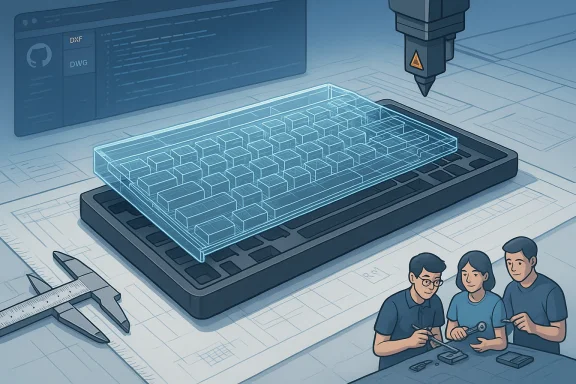
Keychron has been trending in the opposite direction for some time. Its GitHub presence already includes open-source firmware work, and the company’s public repository page shows a broad ecosystem of firmware and hardware projects, including qmk_firmware, zmk, vial-qmk, and, most importantly, a new Keychron-Keyboards-Hardware-Design repository described as containing industrial design files for keyboards and mice with CAD assets in STEP, DXF, DWG, and PDF formats (github.com). That is a strong signal that the current release did not appear out of nowhere; it is part of a sustained strategy.
The timing matters, too. Keychron’s official site already maintains separate firmware and JSON pages for multiple product lines, including the K QMK / K Pro / K Max series, the QMK V series, the S and C Pro series, and Lemokey keyboards. In other words, the company had already normalized software-level openness and configurability. Publishing the mechanical assets is the next logical step in that playbook, not a random marketing stunt.
What makes this moment especially notable is that the files are not merely marketing renders or simple reference diagrams. The GitHub listing describes the repository as containing more than 100 models with CAD assets, and the repository is marked as active with updates as recently as April 11, 2026 (github.com). That suggests an ongoing rollout rather than a one-time archival dump. For a hardware enthusiast community, active publication often matters as much as the files themselves, because it implies future models, revisions, and corrections may continue to arrive.
The most important competitive nuance is that this is not the same as a casual “download our plate” gesture. The repository description indicates a full design ecosystem that includes support for multiple series and more than one board category (github.com). That broad coverage matters because it suggests Keychron is trying to make openness an identity across product tiers, not a one-off perk for a flagship model. If the source files are consistent and well documented, they can become a foundation for community-driven customization that is far richer than standard firmware remapping.
The public wording also indicates commercial boundaries. The material is described as source-available, not a carte blanche for cloning, and the company says commercial use is allowed for original compatible accessories within the license terms (github.com). That distinction is crucial. It preserves room for an accessory ecosystem while preventing straightforward knockoffs of finished keyboards. In other words, Keychron appears to be encouraging derivative innovation without surrendering brand control.
The result is a more complete modding toolkit.
It also changes the economics of iteration. Previously, if someone wanted a different look or feel, they often had to buy a whole new keyboard. Now, they may only need a compatible PCB, switches, and some printer time. That shifts spending away from full replacement and toward incremental upgrades, which is better for consumers who care about tinkering but want to control costs. It also gives the enthusiast a way to experiment more freely, because a failed prototype is less painful when the underlying board stays intact.
The files can also accelerate learning. Beginner-friendly documentation means this is not just for engineers fluent in STEP exports or CAD workflows. Students, hobbyists, and DIY keyboard builders can study real production geometry and gain a better understanding of why premium keyboards feel and sound the way they do. That educational value is easy to underestimate, but it may be one of the most durable benefits of the release.
This limitation is actually part of the business logic. If everything could be fully reproduced with commodity parts, Keychron would have handed away too much of the product identity. By keeping the PCB and, in some cases, the switch ecosystem anchored to the brand, the company preserves a revenue floor while still enabling creative freedom. That is the sweet spot many hardware firms would like to reach but rarely articulate so openly.
From a consumer standpoint, the tradeoff is reasonable. The value of the release is not that it turns a premium keyboard into a free lunch. It is that it reduces the cost and complexity of meaningful customization. That is enough to matter, especially for users who already own compatible boards and are more interested in design than in replacing electronics.
The move also supports the accessory economy. If users create new cases, knobs, and custom parts, they are still operating within the Keychron orbit. That means the company can sell switches, keycaps, and compatible add-ons to a broader audience than just original-device buyers. It is a classic platform strategy: let the community do the creative work, then capture value through the surrounding ecosystem.
There is also a defensive angle. When a brand opens up design files, it can become the default platform for modding rather than the victim of informal clones. That does not eliminate imitation, but it gives the company a better narrative. Instead of fighting the maker community, it can position itself as the company that empowered it. In a competitive category where many products start to look alike, that narrative can be a differentiator.
The competitive impact may be strongest in the mid-to-premium range. In that segment, buyers increasingly evaluate more than specs; they want a platform they can live with and evolve over time. If Keychron becomes the default recommendation for people who want to mod, other brands will need a response. That response could come through their own open design programs, better documentation, or more aggressive aftermarket partnerships.
There is also a broader market effect on small builders. Boutique keyboard makers often rely on the scarcity of design knowledge to justify premium pricing. If a mainstream brand begins publishing high-quality physical design assets, it may compress some of that scarcity premium. That does not eliminate boutique demand, but it changes the baseline expectation for what a modern enthusiast product should provide.
Enterprise buyers, by contrast, will care less about 3D-printable cases and more about supportability, compatibility, and fleet consistency. Still, there is a subtle corporate advantage here. A keyboard platform that is well documented and easy to service can reduce frustration for IT teams, especially in departments where users have specialized input needs. The openness itself is less important than the maintainability it implies.
The enterprise angle should not be oversold, though. Most offices do not want staff printing bespoke keyboard shells at home and then bringing them into the workplace. What enterprises do want is predictable firmware, repair options, and a vendor that looks less likely to strand a product line. On that front, the release may improve procurement confidence even if no one in IT ever opens the CAD files.
That distinction also helps explain why the company can move this far without undermining its core business. A permissive accessory policy invites innovation from modders, makers, and small shops, but the anti-cloning language keeps the company’s completed products protected. This is the same basic logic that underpins many successful platform businesses: let others build around you, but do not let them become you.
For the community, the exact wording will matter in practice. The most useful open hardware projects are the ones where the license is clear enough that creators know where the boundaries are. If the rules are ambiguous, people hesitate to build. If the rules are clear, a healthy aftermarket can form quickly. That is why the legal framing here is not a footnote; it is part of the product.
The strategy is especially sensible because the keyboard market is maturing. Buyers have more choices, and many competing products offer similar switch types, polling claims, or RGB effects. In that environment, openness can be a stronger differentiator than another marginal spec bump. If a brand becomes synonymous with hackability and support, it can retain customers even when competitors chase short-term feature parity.
Keychron is also, in a sense, future-proofing its relationship with the maker community. Once a brand becomes the default source for reference geometry, it becomes easier for third parties to build compatible parts, tutorials, and community tools. That creates momentum the company does not have to manufacture itself. And because the files are tied to real shipped products, the ecosystem grows around hardware users can actually buy.
The other major question is whether competitors respond. If a rival brand starts publishing its own hardware assets or launches a more ambitious open-design initiative, the market could move toward a new baseline where premium keyboards are expected to be mod-friendly by default. If no one follows, Keychron will have carved out a valuable niche that is both hard to replicate and easy to market.
Source: games.gg Keychron Makes Top Keyboards Open Source and 3D-printable | GAMES.GG
 Background
For much of the mechanical-keyboard era, manufacturers treated the physical design of a board as closely guarded property. Firmware might be shared through QMK or a vendor tool, and keymaps could be customized, but the case dimensions, mounting points, knob geometry, and part tolerances usually stayed locked inside the factory. That kept the aftermarket dependent on reverse engineering, hobbyist measurement, and guesswork. It also made premium boards feel like finished artifacts rather than platforms.Keychron has been trending in the opposite direction for some time. Its GitHub presence already includes open-source firmware work, and the company’s public repository page shows a broad ecosystem of firmware and hardware projects, including qmk_firmware, zmk, vial-qmk, and, most importantly, a new Keychron-Keyboards-Hardware-Design repository described as containing industrial design files for keyboards and mice with CAD assets in STEP, DXF, DWG, and PDF formats (github.com). That is a strong signal that the current release did not appear out of nowhere; it is part of a sustained strategy.
The timing matters, too. Keychron’s official site already maintains separate firmware and JSON pages for multiple product lines, including the K QMK / K Pro / K Max series, the QMK V series, the S and C Pro series, and Lemokey keyboards. In other words, the company had already normalized software-level openness and configurability. Publishing the mechanical assets is the next logical step in that playbook, not a random marketing stunt.
What makes this moment especially notable is that the files are not merely marketing renders or simple reference diagrams. The GitHub listing describes the repository as containing more than 100 models with CAD assets, and the repository is marked as active with updates as recently as April 11, 2026 (github.com). That suggests an ongoing rollout rather than a one-time archival dump. For a hardware enthusiast community, active publication often matters as much as the files themselves, because it implies future models, revisions, and corrections may continue to arrive.
Why hardware openness matters
A firmware repository lets users change behavior. A geometry repository lets them change the object. That distinction is the real story here.- Firmware openness affects layout, lighting, latency tuning, and macro behavior.
- Hardware openness affects ergonomics, acoustics, repairability, and aesthetics.
- Together, they turn a keyboard from a sealed product into a platform.
- For modders, that platform lowers the barrier to experimentation.
- For the manufacturer, it creates a community that can extend the product’s life.
What Keychron Actually Released
The headline feature is not just “open source” in the abstract. It is the combination of firmware source material and printable or editable design assets that cover cases, caps, and knobs. The public repository page describes industrial design files with STEP, DXF, DWG, and PDF assets, which is exactly the kind of package that lets hobbyists move from theory into practical prototyping (github.com). STEP is particularly important because it is a standard 3D CAD exchange format, meaning the model can be imported into widely used design tools for modification or measurement.The most important competitive nuance is that this is not the same as a casual “download our plate” gesture. The repository description indicates a full design ecosystem that includes support for multiple series and more than one board category (github.com). That broad coverage matters because it suggests Keychron is trying to make openness an identity across product tiers, not a one-off perk for a flagship model. If the source files are consistent and well documented, they can become a foundation for community-driven customization that is far richer than standard firmware remapping.
The public wording also indicates commercial boundaries. The material is described as source-available, not a carte blanche for cloning, and the company says commercial use is allowed for original compatible accessories within the license terms (github.com). That distinction is crucial. It preserves room for an accessory ecosystem while preventing straightforward knockoffs of finished keyboards. In other words, Keychron appears to be encouraging derivative innovation without surrendering brand control.
What is especially rare
Most keyboard vendors that engage with enthusiasts stop at one of three levels: firmware support, layout configurators, or user guides. Keychron is pairing those with physical design files, which is a stronger and rarer commitment. That matters because physical design files are the part most manufacturers are reluctant to expose, precisely because they can reveal engineering decisions, tolerances, and revision history.The result is a more complete modding toolkit.
- Firmware source helps users tune behavior.
- CAD files help users reimagine the shell.
- Documentation helps less technical users start safely.
- Access to multiple formats broadens software compatibility.
- The repository becomes useful to beginners and power users alike.
The Modding Opportunity
For keyboard enthusiasts, the obvious prize is freedom. A user with a 3D printer can now explore new case shapes, custom bezels, alternate materials, and more experimental mounting strategies without starting from scratch. That opens the door to a level of personalization previously reserved for boutique builders or people willing to commission custom cases at significant cost. In that sense, Keychron is democratizing what used to be an artisanal market.It also changes the economics of iteration. Previously, if someone wanted a different look or feel, they often had to buy a whole new keyboard. Now, they may only need a compatible PCB, switches, and some printer time. That shifts spending away from full replacement and toward incremental upgrades, which is better for consumers who care about tinkering but want to control costs. It also gives the enthusiast a way to experiment more freely, because a failed prototype is less painful when the underlying board stays intact.
The files can also accelerate learning. Beginner-friendly documentation means this is not just for engineers fluent in STEP exports or CAD workflows. Students, hobbyists, and DIY keyboard builders can study real production geometry and gain a better understanding of why premium keyboards feel and sound the way they do. That educational value is easy to underestimate, but it may be one of the most durable benefits of the release.
What modders can realistically do
There is a difference between fantasy and practical customization, and Keychron’s release sits somewhere in the middle. Users should not expect to print an entire finished keyboard and call it a day, but they can absolutely produce meaningful changes.- Build custom cases around existing PCBs.
- Design alternate top shells and bezel treatments.
- Create new knob shapes and caps.
- Experiment with colorways and finishes.
- Prototype ergonomic tweaks before committing to a final build.
What You Still Have to Buy
The open files do not eliminate the need for core hardware. Users still need to source a PCB and switches separately, and that means the project is open in spirit but not literally free in practice. Standard mechanical switches can be bought from third-party vendors, but Hall effect models remain tied to Keychron’s own magnetic switch ecosystem and are not interchangeable with generic options, according to the user-provided report and the broader structure of Keychron’s product line. That constraint preserves the company’s control over its most specialized products.This limitation is actually part of the business logic. If everything could be fully reproduced with commodity parts, Keychron would have handed away too much of the product identity. By keeping the PCB and, in some cases, the switch ecosystem anchored to the brand, the company preserves a revenue floor while still enabling creative freedom. That is the sweet spot many hardware firms would like to reach but rarely articulate so openly.
From a consumer standpoint, the tradeoff is reasonable. The value of the release is not that it turns a premium keyboard into a free lunch. It is that it reduces the cost and complexity of meaningful customization. That is enough to matter, especially for users who already own compatible boards and are more interested in design than in replacing electronics.
The practical boundary lines
The distinction between openness and cloning is doing a lot of work here.- You can personalize and prototype.
- You cannot lawfully mass-produce a lookalike complete keyboard.
- You can sell original accessories built from the files.
- You still need to source the electronic core separately.
- Hall effect models remain more ecosystem-specific than standard mechanical boards.
Why Keychron Would Do This
The business case is more sophisticated than simple generosity. Keychron has spent years building a reputation in enthusiast circles, where openness and mod-ability are signals of authenticity. Publishing hardware assets reinforces that identity and makes the brand more valuable to the very users who influence online buying decisions. In a market where word of mouth matters, that kind of goodwill has real commercial weight.The move also supports the accessory economy. If users create new cases, knobs, and custom parts, they are still operating within the Keychron orbit. That means the company can sell switches, keycaps, and compatible add-ons to a broader audience than just original-device buyers. It is a classic platform strategy: let the community do the creative work, then capture value through the surrounding ecosystem.
There is also a defensive angle. When a brand opens up design files, it can become the default platform for modding rather than the victim of informal clones. That does not eliminate imitation, but it gives the company a better narrative. Instead of fighting the maker community, it can position itself as the company that empowered it. In a competitive category where many products start to look alike, that narrative can be a differentiator.
A smart brand moat
The key strategic insight is that openness can itself become a moat.- It attracts enthusiasts who want to customize.
- It encourages third-party accessory development.
- It extends product lifespan and brand visibility.
- It lowers barriers for educational and hobbyist use.
- It makes Keychron harder to dismiss as a commodity brand.
Competitive Implications
Keychron’s decision raises the bar for competitors that market themselves to keyboard enthusiasts. Brands that merely advertise hot-swap sockets, QMK support, or VIA compatibility now look comparatively conservative. Those features are table stakes in the custom-keyboard conversation; what Keychron has done is move the discussion to enclosure design and end-user fabrication. That is a much deeper level of openness.The competitive impact may be strongest in the mid-to-premium range. In that segment, buyers increasingly evaluate more than specs; they want a platform they can live with and evolve over time. If Keychron becomes the default recommendation for people who want to mod, other brands will need a response. That response could come through their own open design programs, better documentation, or more aggressive aftermarket partnerships.
There is also a broader market effect on small builders. Boutique keyboard makers often rely on the scarcity of design knowledge to justify premium pricing. If a mainstream brand begins publishing high-quality physical design assets, it may compress some of that scarcity premium. That does not eliminate boutique demand, but it changes the baseline expectation for what a modern enthusiast product should provide.
How rivals may react
Competitors have a few choices, none of them especially comfortable.- Match the openness and publish their own assets.
- Double down on proprietary design language and premium materials.
- Compete on acoustics, feel, and aesthetics rather than modability.
- Build tighter accessory ecosystems to keep users inside the brand.
- Emphasize warranty and support for consumers who prefer turnkey products.
Consumer and Enterprise Impact
For consumers, the value is obvious and immediate. Owners gain more control over the look and feel of their keyboards, and prospective buyers get a stronger reason to choose Keychron over a closed competitor. The most likely beneficiaries are PC gamers, hobbyists, and power users who already treat their desk setup as a project rather than a purchase. This is especially relevant in enthusiast gaming communities, where customization is part of the identity.Enterprise buyers, by contrast, will care less about 3D-printable cases and more about supportability, compatibility, and fleet consistency. Still, there is a subtle corporate advantage here. A keyboard platform that is well documented and easy to service can reduce frustration for IT teams, especially in departments where users have specialized input needs. The openness itself is less important than the maintainability it implies.
The enterprise angle should not be oversold, though. Most offices do not want staff printing bespoke keyboard shells at home and then bringing them into the workplace. What enterprises do want is predictable firmware, repair options, and a vendor that looks less likely to strand a product line. On that front, the release may improve procurement confidence even if no one in IT ever opens the CAD files.
Separate priorities
The same release means different things to different buyers.- Consumers want expression and ownership.
- Gamers want fit, feel, and performance tuning.
- Makers want editable geometry and printable parts.
- Enterprises want stability, documentation, and lifecycle clarity.
- Resellers want a story that can justify premium pricing.
The Licensing Question
The licensing language matters nearly as much as the files themselves. Keychron’s public GitHub page describes the repository as source-available and says commercial use is allowed for original compatible accessories within the license terms (github.com). That wording is deliberate. It signals openness while still reserving the right to police direct product cloning and trademark misuse. For a consumer brand, that balance is often the difference between a useful open ecosystem and a legal free-for-all.That distinction also helps explain why the company can move this far without undermining its core business. A permissive accessory policy invites innovation from modders, makers, and small shops, but the anti-cloning language keeps the company’s completed products protected. This is the same basic logic that underpins many successful platform businesses: let others build around you, but do not let them become you.
For the community, the exact wording will matter in practice. The most useful open hardware projects are the ones where the license is clear enough that creators know where the boundaries are. If the rules are ambiguous, people hesitate to build. If the rules are clear, a healthy aftermarket can form quickly. That is why the legal framing here is not a footnote; it is part of the product.
What the license needs to accomplish
A successful hardware license has to do several jobs at once.- Protect trademarks and finished-product identity.
- Permit compatible accessories and derivative creativity.
- Discourage outright cloning and counterfeit sales.
- Give small makers confidence to participate.
- Keep the ecosystem economically worthwhile for Keychron.
How This Fits Keychron’s Larger Strategy
Keychron has been quietly assembling a broad open-source posture for years. Its repository ecosystem includes firmware work, VIA-related tooling, ZMK, and now a dedicated hardware-design hub with active updates (github.com). That pattern suggests a company that understands where enthusiast hardware is heading: toward transparency, interoperability, and user-driven modification. The keyboard is no longer just a shipping box with switches; it is a software-and-hardware canvas.The strategy is especially sensible because the keyboard market is maturing. Buyers have more choices, and many competing products offer similar switch types, polling claims, or RGB effects. In that environment, openness can be a stronger differentiator than another marginal spec bump. If a brand becomes synonymous with hackability and support, it can retain customers even when competitors chase short-term feature parity.
Keychron is also, in a sense, future-proofing its relationship with the maker community. Once a brand becomes the default source for reference geometry, it becomes easier for third parties to build compatible parts, tutorials, and community tools. That creates momentum the company does not have to manufacture itself. And because the files are tied to real shipped products, the ecosystem grows around hardware users can actually buy.
The ecosystem flywheel
The dynamic here is self-reinforcing.- Better files attract more builders.
- More builders create more accessories.
- More accessories deepen brand relevance.
- Deeper brand relevance drives more sales.
- More sales justify further openness.
Strengths and Opportunities
The release is strong precisely because it combines cultural relevance with practical utility. It speaks to makers without alienating casual buyers, and it gives Keychron a platform story that is easy to understand and hard for rivals to copy quickly. The upside is not just new sales; it is a richer ecosystem around every compatible board.- Deeper customization for cases, knobs, and caps.
- Lower-cost experimentation for hobbyists and students.
- Longer product life through repair and redesign.
- Stronger enthusiast loyalty around an open platform.
- Accessory-market growth for small shops and makers.
- Better educational value for people learning CAD and hardware design.
- Clearer differentiation versus closed competitors.
Risks and Concerns
The same openness that makes the move exciting also introduces complexity. If documentation is incomplete or files are inconsistent, the community may become frustrated quickly. There is also the chance that counterfeiters or low-quality sellers attempt to exploit the designs despite licensing restrictions, which could create confusion around what is legitimate and what is not.- IP enforcement challenges against clone sellers.
- Potential license confusion among small makers.
- Support burden if users expect official help for modified builds.
- Quality-control risk from third-party printed parts.
- Community fragmentation if files differ across revisions.
- Overpromising if users think every part is fully printable.
- Hall effect constraints that limit universal reuse.
Looking Ahead
The next few months will tell us whether this becomes a genuinely influential platform shift or just a well-received enthusiast headline. The most important signal will be whether third-party creators start releasing practical accessories, alternate cases, and printable mods that people can actually use. If that happens, Keychron may have created the kind of community flywheel that keeps products relevant long after their retail launch window closes.The other major question is whether competitors respond. If a rival brand starts publishing its own hardware assets or launches a more ambitious open-design initiative, the market could move toward a new baseline where premium keyboards are expected to be mod-friendly by default. If no one follows, Keychron will have carved out a valuable niche that is both hard to replicate and easy to market.
What to watch
- New community-designed cases and bezels.
- Third-party accessory shops using the files.
- Whether Keychron expands the repository to more models.
- The clarity and stability of the licensing terms.
- Competitor reactions in the enthusiast keyboard segment.
Source: games.gg Keychron Makes Top Keyboards Open Source and 3D-printable | GAMES.GG
Last edited:
