

Kia’s 2025 refresh of the Seltos is not a reinvention so much as a careful upgrade — a targeted package of design tweaks, software and cabin upgrades, and safety technology that pushes the Seltos closer to the premium compact-SUV norm while preserving the sporty identity that made the nameplate a market mainstay.
Kia introduced the 2025 Seltos update with a clear objective: broaden appeal and close the feature gap with rivals without moving the model upmarket so far that it loses value-for-money credibility. Rather than launching a full new-generation model, Kia expanded the model’s variant ladder, reworked trim content, and added higher-tech options — most notably Level‑2 ADAS on upper trims and a larger, more integrated digital cockpit in some markets. The result is a vehicle that reads as noticeably fresher and more connected but remains recognizably the Seltos purchasers know.
This article dissects what changed, what genuinely matters to buyers, and where the refreshed Seltos could run into trouble against heavyweights such as the Hyundai Creta and Maruti Suzuki Grand Vitara. The analysis focuses on design, interiors, infotainment, powertrains, ADAS/safety, pricing strategy, and competitive positioning — and flags claims or specs that vary by market or remain inconsistent across public reports.
This approach is deliberate: a complete stylistic reset can alienate existing customers in this segment; small, confident tweaks preserve resale friendliness while signaling progress to new buyers.
The practical takeaway: the Seltos now offers a tech stack expected in the segment’s top trims — navigation, smartphone integration and OTA connectivity — making it more attractive to buyers who treat in‑car software as a purchase factor.
Buyers who prioritize outright performance should opt for the turbo petrol with a DCT; those after low running costs will lean to the diesel or turbo depending on duty cycle.
Against the Hyundai Creta, the Seltos remains a strong, sportier alternative; against the Maruti Grand Vitara, it competes on tech and driving dynamics but concedes the fuel‑efficiency advantage to hybrids. For buyers who value modern connectivity, solid ADAS, and engaging driving dynamics packaged at competitive prices, the refreshed Seltos is an enticing proposition — provided that shoppers confirm the exact features for their target trim and market and weigh hybrid rivals if fuel economy is a primary concern.
Ultimately, Kia’s 2025 Seltos underscores a broader market truth: the compact‑SUV battlefield is now won by credible tech and safety packaging as much as by design and mechanical competence. The updated Seltos meets that standard and will keep Kia competitive — so long as buyers and fleet managers pay attention to variant details and real‑world ADAS performance when they sign the dotted line.
Source: Trak.in New Kia Seltos 2025 Will Challenge Hyundai Creta, Maruti Grand Vitara - Trak.in - Indian Business of Tech, Mobile & Startups
 Background / Overview
Kia introduced the 2025 Seltos update with a clear objective: broaden appeal and close the feature gap with rivals without moving the model upmarket so far that it loses value-for-money credibility. Rather than launching a full new-generation model, Kia expanded the model’s variant ladder, reworked trim content, and added higher-tech options — most notably Level‑2 ADAS on upper trims and a larger, more integrated digital cockpit in some markets. The result is a vehicle that reads as noticeably fresher and more connected but remains recognizably the Seltos purchasers know.This article dissects what changed, what genuinely matters to buyers, and where the refreshed Seltos could run into trouble against heavyweights such as the Hyundai Creta and Maruti Suzuki Grand Vitara. The analysis focuses on design, interiors, infotainment, powertrains, ADAS/safety, pricing strategy, and competitive positioning — and flags claims or specs that vary by market or remain inconsistent across public reports.
What’s new: highlights at a glance
- Variant expansion — Kia widened the Seltos lineup with additional trims at the entry and mid-levels to improve choice and sharpen value positioning.
- Cockpit and display upgrades — higher trims offer a panoramic twin‑screen arrangement that visually integrates the instrument cluster and infotainment.
- ADAS Level‑2 availability — adaptive cruise, lane‑keeping/ lane‑following assist, collision avoidance and blind‑spot interventions are now on offer for upper trims.
- Refined interior materials and comfort kit — ventilated seats, improved upholstery and more premium trim materials in selected variants.
- Powertrain continuity, minor tuning — the Seltos retains the 1.5‑litre family of engines (naturally aspirated petrol, turbo‑petrol, and diesel) with established outputs and gearbox pairings.
- Strategic pricing — Kia priced the refresh to keep the Seltos competitive against the Creta and the Grand Vitara, while stretching into higher-feature territory with GTX+/X-Line variants.
Design: bolder, not radical
Exterior updates
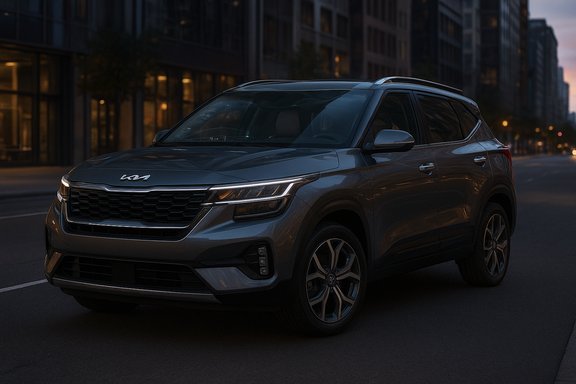
The refreshed Seltos presents a bolder front face and crisper lighting signatures while retaining the familiar silhouette that buyers recognize. Key visual changes include reshaped LED headlamps with sharper internal graphics and a revised grille treatment that gives the car a more mature road presence. Side and rear changes are more subtle — new wheel designs, small bumper treatments and updated lamp clusters that collectively modernize the look without losing identity.This approach is deliberate: a complete stylistic reset can alienate existing customers in this segment; small, confident tweaks preserve resale friendliness while signaling progress to new buyers.
Market-specific notes
Exterior features such as wheel sizes and grille finishes are often market- and trim-dependent. Buyers should expect sportier X-Line or GTX trims to carry darker accents and larger alloy wheels, while entry trims stick to simpler alloys or steel wheels.Interior & infotainment: the driver‑centric upgrade
Digital cockpit and displays
One of the most visible upgrades is the cabin’s digital presentation. Kia has moved to a panoramic display concept for many markets — a layout that pairs the digital instrument cluster with a large infotainment touchscreen into a single, sweeping visual plane. On higher trims this is executed with twin 10.25‑inch (or similarly sized) screens mounted under a continuous glass shroud, creating the appearance of a single integrated panel.- Benefit: The integrated look modernizes the dash and improves perceived quality.
- Caveat: Not every market or trim uses the same screen sizing; base and mid trims can retain smaller, conventional displays (for example, 8‑inch infotainment plus a smaller cluster on entry-level configurations).
Infotainment, connectivity and audio
Kia elevated the infotainment experience with a more responsive UI, wireless smartphone mirroring, voice controls and connected‑car features including over‑the‑air capability in some markets. Top trims can be equipped with premium audio systems, wireless charging, multiple USB‑C ports and ambient lighting.The practical takeaway: the Seltos now offers a tech stack expected in the segment’s top trims — navigation, smartphone integration and OTA connectivity — making it more attractive to buyers who treat in‑car software as a purchase factor.
Comfort & materials
Interior finishes have been upgraded in selected trims: higher‑grade soft touch surfaces, improved seat upholstery, and comfort features such as ventilated front seats and powered driver memory seats in premium variants. Kia aimed to make the cabin feel more upscale and driver oriented, prioritizing ergonomics (switch placements, steering controls) for everyday use and long highway drives.Powertrains and performance: familiar, refined
Kia retains the tried‑and‑tested 1.5‑litre engine family to serve different buyer needs:- 1.5‑litre naturally aspirated petrol — tuned for efficiency and smooth city driving; commonly paired with a 6‑speed manual or CVT in many markets.
- 1.5‑litre turbo‑petrol — the performance option, delivering a significant step up in power and torque and typically mated to a 7‑speed DCT or clutchless manual options where offered.
- 1.5‑litre diesel — intended for buyers prioritizing long‑distance economy, paired with manual or torque‑converter autoboxes.
Buyers who prioritize outright performance should opt for the turbo petrol with a DCT; those after low running costs will lean to the diesel or turbo depending on duty cycle.
Ride, handling and NVH: tuned for real roads
Kia has refined the Seltos’ suspension calibration to strike a balance between urban comfort and highway composure. The Seltos retains a bias toward a confident, planted feel — front MacPherson strut and a rear torsion beam (or multi‑link on higher variants/markets, depending on specification) — but the facelift softens rebound harshness and improves cabin insulation.- Urban use: smoother suspension tuning reduces jarring on rough surfaces.
- Highway: steering and damping feel composed; turbo variants remain engaging.
- Noise: improved NVH treatments reduce wind and road noise at speed, enhancing long‑distance comfort.
Safety and ADAS: moving toward Level‑2 mainstreaming
ADAS availability
The 2025 Seltos brings Level‑2 ADAS features to upper trims, a critical step as ADAS becomes a mainstream purchase consideration in the segment. On the top GTX+/X-Line trims, buyers can expect an ADAS suite that includes:- Adaptive Cruise Control (ACC) with follow and stop‑and‑go capability where supported.
- Lane Keep Assist / Lane Following Assist, which use steering intervention to keep the vehicle centered.
- Autonomous Emergency Braking (AEB) with pedestrian detection.
- Blind‑Spot Collision Warning / Assist and Rear Cross‑Traffic Alert.
- Driver attention monitoring and other convenience safety systems.
Passive safety and structure
Kia continues to provide a robust passive safety package across the range — multiple airbags, ESC, ABS with EBD and ISOFIX anchors. Structural design and the inclusion of high‑strength steel in key areas underpin crash performance. While the Seltos includes strong safety hardware, buyers should consider official crash‑test ratings relevant to their market when assessing comparative safety.Real‑world caveats
- ADAS effectiveness is system‑and‑scenario dependent. Buyers should understand the limitations — lane‑tracking systems are assisted driving features, not autonomous driving.
- Calibration differences across markets and sensor suites (camera, radar) mean driver experience can vary trim‑to‑trim.
- For fleets and safety‑conscious buyers, validation through local test drives and demonstrations of ADAS behavior in typical traffic conditions is recommended.
Feature list: what buyers get by trim
- Entry & mid trims:
- LED DRLs and tail lamps
- Infotainment screen (8‑10 inch depending on market)
- Basic driver aids and convenience features
- Manual or CVT transmission on NA petrol variants
- Upper trims (HTX, GTX+, X‑Line or equivalent):
- Panoramic dual‑screen cockpit (integrated look)
- Level‑2 ADAS suite (ACC, LKA/LFA, AEB, BSM, RCCA)
- Ventilated front seats, premium audio, wireless charging
- Panoramic sunroof and ambient lighting
- Choice of DCT on turbo petrol and torque‑converter AT on diesel
Pricing, variants and market strategy
Kia has broadened the Seltos variant spread to provide more entry points and incremental upgrades. The updated line-up aims to:- Improve affordability at the base level with an HTE(O) trim while adding content versus the outgoing base model.
- Offer more convenient mid‑trim choices (HTK(O), HTK+(O) with popular features such as sunroof and cruise control.
- Reserve the fully loaded ADAS and premium features for the GTX+/X‑Line range.
Competitive context: Hyundai Creta and Maruti Grand Vitara
Kia Seltos vs Hyundai Creta
These two cousins are the closest competitors in product architecture and target audience. The Creta tends to emphasize a more comfort‑oriented ride and a slightly more premium presentation in top trims; Hyundai also frequently differentiates with calibrated features and a slightly different styling language. Both vehicles share similar engine families and overlapping price bands.- Seltos strengths: sportier handling, sharper design cues, and aggressive feature packaging at particular price points.
- Creta strengths: refined ride comfort, perceived premium finish in some configurations, and a value proposition for buyers prioritizing ride quality over sportiness.
Kia Seltos vs Maruti Grand Vitara
Maruti Suzuki’s Grand Vitara brings a powerful differentiator: the availability of a strong‑hybrid powertrain that can dramatically improve real‑world fuel economy, especially in city driving. The Grand Vitara also recently standardized six airbags across the range, strengthening its safety proposition.- Seltos strengths: broader ADAS options and performance‑oriented turbo petrol variants.
- Grand Vitara strengths: hybrid efficiency, a wide array of variants including AWD options, and a strong dealer/service presence in many markets.
Strengths: where the Seltos shines
- Balanced upgrade — Kia’s update smartly balances tangible tech upgrades (ADAS, integrated displays) with familiar, proven mechanicals.
- Trim breadth — wider variant choice lets buyers trade up incrementally without missing features in the middle of the ladder.
- Driver‑centric cabin — ergonomics and infotainment upgrades make the Seltos feel fresher and more premium in higher trims.
- Competitive pricing — Kia positioned new variants to keep value strong versus direct rivals.
- ADAS availability — Level‑2 features in a compact‑SUV segment help differentiate the top trims.
Risks, trade‑offs and open questions
- Specification fragmentation: the Seltos’ many trims and market‑specific feature lists can confuse buyers and complicate comparisons. Expect to verify exact feature lists for the destination market and trim.
- ADAS marketing vs reality: the number of ADAS features quoted varies by report (different outlets list different totals). Buyers must treat claimed ADAS counts as trim‑dependent and should validate real behaviour through demos.
- Feature parity across markets: some press reports and marketing pieces exaggerate display sizes or claim “single seamless panels” in ways that differ by market and trim. Large‑panel claims should be checked against the local spec sheet to avoid disappointment.
- Hybrid competition: rivals with hybrid powertrains (notably the Grand Vitara strong‑hybrid) offer fuel economy advantages that Kia’s conventional engines cannot match; lifecycle cost calculations may shift buyer preference away from purely ICE lineups in some ownership profiles.
- Resale and service perception: Kia’s dealer/service network and resale perception are strong but remain a factor in buyer decisions relative to Maruti’s market reach and Hyundai’s established value.
Practical buyer guidance
- Decide your priority: fuel economy (consider hybrid competitors), ADAS/tech (top Seltos trims deliver strong offerings), or lowest purchase price (base trims still preserve value).
- Confirm trim‑by‑trim specs: screen sizes, ADAS features, audio systems and seat ventilation vary by trim; request the official spec sheet for the market and VIN.
- Demo ADAS behaviour: take a test drive that exercises adaptive cruise, lane‑following and collision avoidance in real traffic; ADAS feel can differ between DCT/AT and manual‑equipped models because of controller tuning.
- Consider ownership math: factor fuel type, expected annual kilometers, and service network when comparing to hybrids like the Grand Vitara.
- Watch local pricing and offers: aggressive pricing and introductory offers can change the value calculus quickly in this competitive segment.
Conclusion
The 2025 Kia Seltos refresh is a pragmatic, well‑executed update. It sharpens the SUV’s design, brings the cabin into the modern infotainment era, and importantly — introduces Level‑2 ADAS to a segment where safety tech is fast becoming table stakes. Kia’s strategy of incremental enhancement rather than wholesale redesign preserves the Seltos’ core appeal while broadening its reach.Against the Hyundai Creta, the Seltos remains a strong, sportier alternative; against the Maruti Grand Vitara, it competes on tech and driving dynamics but concedes the fuel‑efficiency advantage to hybrids. For buyers who value modern connectivity, solid ADAS, and engaging driving dynamics packaged at competitive prices, the refreshed Seltos is an enticing proposition — provided that shoppers confirm the exact features for their target trim and market and weigh hybrid rivals if fuel economy is a primary concern.
Ultimately, Kia’s 2025 Seltos underscores a broader market truth: the compact‑SUV battlefield is now won by credible tech and safety packaging as much as by design and mechanical competence. The updated Seltos meets that standard and will keep Kia competitive — so long as buyers and fleet managers pay attention to variant details and real‑world ADAS performance when they sign the dotted line.
Source: Trak.in New Kia Seltos 2025 Will Challenge Hyundai Creta, Maruti Grand Vitara - Trak.in - Indian Business of Tech, Mobile & Startups
