Seeing is believing: an uncompromising, absolute‑waterfront architectural masterpiece at 2 Gwinganna Avenue, Kiama has just hit the market with a price guide of $8 million and an expressions‑of‑interest campaign closing at 5pm on Monday 24 November, putting a rare front‑row oceanfront opportunity squarely in the crosshairs of Sydney buyers and coastal investors.
Kiama’s coastline has long been prized for dramatic surf breaks, a growing café culture and an escalating prestige residential market that rewards exceptional design and true oceanfront positioning. The house at 2 Gwinganna Avenue occupies a bluff position at the tip of Kaleula Head, delivering uninterrupted ocean panoramas and what listing agents describe as resort‑calibre indoor‑outdoor living. The vendor has launched the property via an expressions‑of‑interest campaign with a publicised price guide of $8 million and a firm EOI deadline, signalling a sales strategy aimed at maximising competitive buyer engagement. This is not a speculative renovation or a weekend fixer — the current owners completed the build recently, fitting the home with high‑end finishes, integrated smart systems and a separate self‑contained studio. The combination of contemporary architecture, a substantial internal area and absolute waterfront placement positions the property as one of the most significant Kiama listings in recent years.
Conclusion
2 Gwinganna Avenue offers what luxury coastal buyers most frequently seek: privacy, design excellence and direct beach access packaged in a newly completed, turnkey residence. The vendor’s EOI campaign and $8 million guide make it one of the most consequential Kiama listings in recent memory, but buyers must balance the emotional pull of the location against the commercial realities of coastal maintenance, insurance and comparables. For those who prize front‑row ocean living and can navigate the premium, this is a rare chance to secure a true architecturally significant waterfront home in one of the Illawarra’s most desirable streets.
Source: psnews.com.au Kiama architectural masterpiece with front row ocean views | PS News
 Background / Overview
Kiama’s coastline has long been prized for dramatic surf breaks, a growing café culture and an escalating prestige residential market that rewards exceptional design and true oceanfront positioning. The house at 2 Gwinganna Avenue occupies a bluff position at the tip of Kaleula Head, delivering uninterrupted ocean panoramas and what listing agents describe as resort‑calibre indoor‑outdoor living. The vendor has launched the property via an expressions‑of‑interest campaign with a publicised price guide of $8 million and a firm EOI deadline, signalling a sales strategy aimed at maximising competitive buyer engagement. This is not a speculative renovation or a weekend fixer — the current owners completed the build recently, fitting the home with high‑end finishes, integrated smart systems and a separate self‑contained studio. The combination of contemporary architecture, a substantial internal area and absolute waterfront placement positions the property as one of the most significant Kiama listings in recent years. The property at a glance
- Address: 2 Gwinganna Avenue, Kiama NSW 2533.
- Sale method: Expressions of Interest (EOI) — closing Monday 24 November at 5pm.
- Price guide: $8,000,000.
- Internal area: ~426 m².
- Land area: ~874 m².
- Bedrooms: Five in the main residence + separate studio (can function as a sixth bedroom, guest house or work retreat).
- Bathrooms: Multiple luxury ensuites and secondary bathrooms.
- Garaging: Four‑car garage with internal access and substantial storage.
- Key features: Floor‑to‑ceiling glass with panoramic ocean views, infinity‑edge pool, marble surfaces, butler’s pantry, media room, rumpus, smart home automation and climate control.
Design, layout and materials
Architecture and sightlines
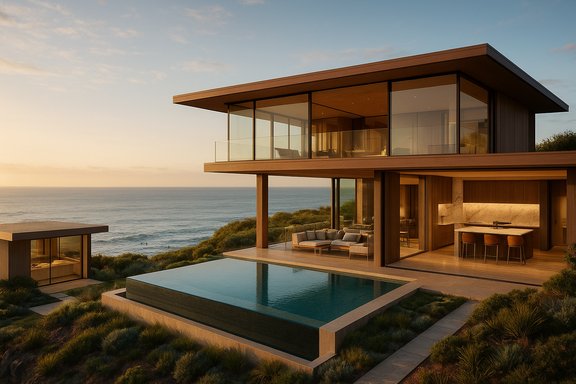
The design emphasises panoramic, unobstructed ocean sightlines through extensive use of floor‑to‑ceiling glazing and a considered two‑level plan that places the principal living areas on the first floor to maximise views. The result is a continuous visual connection to the Tasman Sea that becomes the dominant interior datum — an architecturally deliberate choice that shapes circulation and room orientation. This front‑row siting is repeatedly cited by the listing agents as the property’s defining advantage.Internal finishes and the kitchen
The kitchen is described as a state‑of‑the‑art space with marble surfaces, premium appliances, a dedicated butler’s pantry and an oceanfront breakfast bar. These elements are more than cosmetic: the pairing of high‑grade stonework with a large, serviced pantry suggests an emphasis on theatrical entertaining and practical servicing for large gatherings. The marble‑lined interior aesthetic is repeated across living spaces, reinforcing a cohesive high‑end material palette.Living zones and flexibility
The home is arranged to provide multiple living and entertaining zones: an expansive open‑plan living/dining/kitchen on the first floor, plus a media room and two bedrooms on that level; downstairs contains three further bedrooms, a rumpus, mudroom, laundry and direct access to the outdoors and garage. This split allows for multi‑generational living, dedicated guest accommodation, or an easy separation between formal and informal family zones. The separate studio with its own kitchen and bathroom expands options further — it can be rented, used as a home office, or retained for long‑term guests.Outdoor living: pool, terraces and landscaping
The property’s outdoor program is central to its luxury pitch. An infinity‑edge pool appears to sit visually aligned with the ocean horizon, creating the sought‑after “pool‑to‑sea” effect that luxury buyers prize. Expansive alfresco terraces and landscaped gardens provide layered spaces for entertaining, casual living and sun‑soaked retreats. The terrace and pool design, coupled with the home’s orientation, is consistently highlighted as enabling “sunrise coffee and long summer lunches” with a direct ocean backdrop. These outdoor investments carry both lifestyle value and maintenance obligations: coastal pools and terraces require more vigilant material selection, corrosion‑resistant fixtures, and a proactive maintenance schedule — considerations that prospective buyers will want to quantify in any due diligence. The property’s smart home automation and climate control systems help manage indoor comfort, but outdoor durability remains a specialist issue at this exposure.Market context: Kiama, Gwinganna Avenue and comparables
Local pricing signals
Gwinganna Avenue is one of Kiama’s premier streets. Recent sold records for the street show high engagement from affluent buyers, but the current street record prior to this listing sits materially below the $8 million guide. Industry reporting highlights a prior top sale of $4.8 million (2021), meaning this listing’s guide price represents a quantum leap from recent street records and signals potential for a new benchmark sale if buyer demand aligns with the vendor’s expectation. The agency marketing and news coverage point to immediate interest from Sydney and overseas buyers — a typical pattern for coastal prestige stock that combines amenity, accessibility and design pedigree. The owners completed the build in 2023, so this is effectively a new‑build luxury home being sold at or near delivery, which can appeal to buyers seeking modern services, warranties and turnkey condition.How this listing compares
- Price differential: The $8M guide is approximately 67% higher than the reported street record of $4.8M, indicating either (1) a genuine market re‑rating for exceptional absolute‑frontage homes in Kiama, or (2) a premium that may challenge comparable buyer expectations if macro market conditions soften.
- Build quality and size: With ~426 m² of internal space on an ~874 m² parcel and a suite of premium finishes, the house sits at the upper end of local product both in scale and finish. That combination is rare in Kiama and competes with other premium coastal markets for buyer attention.
Valuation lens: what $8 million buys in Kiama
A buyer considering this property should weigh three valuation drivers:- Location premium — absolute waterfront frontage and uninterrupted ocean views are scarce and command a demonstrable premium relative to near‑coast properties. The market typically rewards visual exclusivity.
- Architectural quality and services — large internal area, luxury finishes and integrated systems reduce short‑term capex for the buyer and support higher asking prices for turnkey homes.
- Comparative sales momentum — surpassing recent street records requires buyer conviction; comparables from 2021–2024 show strong sales, but not at the $8M level, so the sale price will partly depend on market sentiment and the EOI competition.
Strengths — what stands out
- Absolute waterfront, uninterrupted ocean views: the primary value driver and marketing focal point.
- Large, contemporary internal area (~426 m²) with versatile floor plan: supports multiple lifestyles, from family living to holiday rental arrangements.
- Premium materials and appliances: marble‑lined kitchen, butler’s pantry and premium appliances that reduce immediate refurbishment needs.
- Separate studio: adds real utility for guest accommodation, rental income, or dedicated workspace; a high‑value addition in luxury coastal homes.
- Turnkey condition: newly completed home with modern services, smart automation and climate control.
Risks and considerations — what every buyer should examine
No property is without trade‑offs. For buyers, the following risks warrant careful attention:- Market concentration at the top end: Luxury coastal stock can have thin buyer pools. The step from previous record sales (~$4.8M) to a $8M guide is significant; if competing comparable sales are scarce, price discovery can be volatile. Expect an active, sometimes protracted, negotiation cycle if the market does not clear at guide price.
- Coastal exposure and maintenance burden: salt‑laden air, wind, and spray accelerate wear on metals, joinery and external finishes. Pool plant and outdoor systems require specialised, corrosion‑resistant installation and higher maintenance budgets. Prospective buyers should obtain independent building and services inspections that account for coastal conditions.
- Insurance and risk premiums: absolute‑waterfront properties often attract higher home‑insurance costs, especially for policies that include storm, flood or coastal erosion cover. Buyers should secure indicative insurance quotes early in the due diligence process to quantify annual holding costs.
- Environmental and planning constraints: properties on coastal headlands may be subject to specific council controls, coastal hazard mapping and permitted works restrictions. Any future modification or replacement build could face additional approvals. Confirm zoning and any coastal hazard overlays with the local council.
- Liquidity and resale: while the asset class is desirable, resale timelines for niche $8M‑plus coastal homes can be longer than for mid‑market houses. Buyers who may resell in the short term should plan exit scenarios and understand peer comparables beyond Kiama if regional demand softens.
Due diligence checklist for serious buyers
- Commission a full pre‑purchase building inspection with coastal expertise (pay particular attention to pool plant, marine‑grade fixtures and glazing seals).
- Obtain insurance quotations specific to the site (including storm and flood cover).
- Verify coastal hazard mapping and council overlays for future development risk.
- Review warranty documents for newly completed works and any active builder guarantees.
- Assess running costs — council rates, pool servicing, landscaping, and automation/platform subscriptions.
- Seek independent valuation from a valuer who has experience with premium coastal stock and local sold evidence.
- Consider rental income prospects for the studio if that forms part of the purchase rationale.
Buying process and timing
The vendor is using an Expressions of Interest process, which is a common approach to generate competitive tension and allow the vendor to evaluate offers in a defined timeframe. EOIs typically require:- A written offer / EOI submission.
- Proof of funds or finance pre‑approval.
- Possible non‑binding indicative price.
- Negotiation after the EOI deadline with selected bidders.
Who is the buyer for this home?
The marketing language and product positioning suggest three core buyer archetypes:- Affluent Sydney families seeking a coastal primary or second residence with direct beach access and resort‑style amenities.
- Empty nesters and down‑sizers who prioritise finish quality, low‑intervention living and proximity to regional lifestyle infrastructure.
- Investors or lifestyle landlords targeting high‑end short‑stay rentals (subject to local regulatory rules and practical amenity), leveraging the separate studio to segment offering.
Final analysis — opportunity vs. premium
2 Gwinganna Avenue is a textbook example of how scarcity (absolute waterfront), architectural design and turnkey condition converge to create a high‑value coastal listing. The property’s architectural choreography — placing living areas to capture ocean panoramas, combining luxury finishes with modern services and providing a separate studio — is well aligned with the expectations of high‑net‑worth buyers. The vendor’s chosen EOI method and $8 million guide articulate confidence in both the product and market appetite. That said, the price guide represents a meaningful step up from recent local records. Realising a sale near the guide will require a competitive field of well‑qualified bidders or a buyer prepared to pay a significant premium for waterfront exclusivity. Buyers should proceed with full coastal due diligence and layer in realistic maintenance and insurance costs when assessing total ownership economics.Practical takeaway
- 2 Gwinganna Avenue is one of Kiama’s rare absolute‑frontage offers with resort‑level finishes, a separate studio and modern systems — a compelling package for lifestyle buyers.
- The $8 million price guide places the home above all recorded street sales to date and represents both an opportunity to set a new local benchmark and a valuation stretch that demands careful buyer scrutiny.
- Interested parties should act quickly to inspect, secure specialist coastal inspections, obtain insurance quotes and lodge EOIs before the 5pm Monday 24 November deadline. Contact details for the listing agents are published in the marketing materials.
Conclusion
2 Gwinganna Avenue offers what luxury coastal buyers most frequently seek: privacy, design excellence and direct beach access packaged in a newly completed, turnkey residence. The vendor’s EOI campaign and $8 million guide make it one of the most consequential Kiama listings in recent memory, but buyers must balance the emotional pull of the location against the commercial realities of coastal maintenance, insurance and comparables. For those who prize front‑row ocean living and can navigate the premium, this is a rare chance to secure a true architecturally significant waterfront home in one of the Illawarra’s most desirable streets.
Source: psnews.com.au Kiama architectural masterpiece with front row ocean views | PS News