

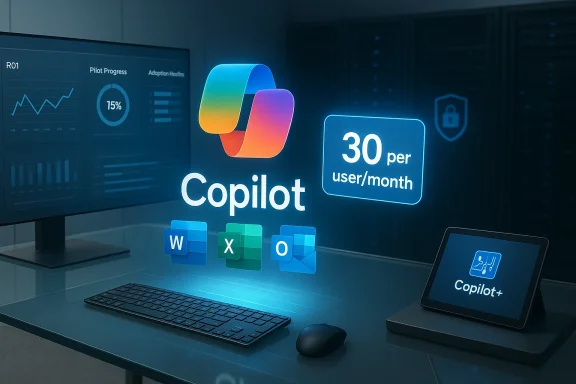
Microsoft’s Copilot push promised a simple narrative: embed generative AI across Office and Windows, charge a premium, and convert vast installed bases into a recurring, high-margin revenue stream—yet the early returns look far more complicated than the marketing storyboard suggested. rosoft first set public expectations for Microsoft 365 Copilot’s commercial pricing at $30 per user, per month, framing the product as an enterprise-grade AI assistant that reasons over an organization’s emails, documents, chats and meetings while staying within the tenant’s security controls.
That pricing, combined with aggressive marketing and high-visibility demos, positioned Copilot as both a long-term strategic moat and a near-term monetization lever. Microsoft also rolled out consumer- and small-business–facing options—Copilot Pro and later bundling moves—bringing more permutations to the product family and to the pricing conversation.
But since the initial launch cadence, reporting and field accounts have started to complicate the tidy story Microsoft sold. Investigations into adoption curves, internal quota conversations, and hands-on community testing suggest that demo-level reliability and real-world production reliability are not yet matched—and that mismatch is materially shaping purchase decisions.
Microsoft’s Copilot strategy is notable for three tightly linked ambitions:
Independent hands-on tests and community reports documented inconsistent outcomes: image misclassification, Excel logic that needs repeated prompting, and agents that struggle to interact reliably with complex internal apps. Those blunt failures matter more in the enterprise where a single incorrect automation can break workflows or create compliance headaches.
Enterprises often underestimate the plumbing work required to scale agentic AI: connectors, ETL, identity mappings, data normalization and testing against messy real-world applications. Those are engineering projects in their own right—far from zero-friction upgrades.
For IT and procurement teams the problem is rarely the headline price alone—it's the combination of seat licensing plus variable consumption charges for heavy model usage. That makes the total cost of ownership harder to forecast and harder to commit to at scale without pilot-derived usage data and contractual protections.
The net effect is a revenue cadence that may be muted in the near term: pilots proliferate, but conversions into broad, paid deployments slow because CIOs ask for measurable ROI and predictable billing structures.
Investor scrutiny will remain focused on execution: capex intensity demands faster monetization or demonstrable longer-term productivity gains. The broader market is shifting from “AI buzz” to “AI measurable outcomes,” which favors vendors and product teams that deliver predictable, auditable improvements to core business processes.
For users and IT professionals, the right posture is pragmatic: pilot narrowly, measure precisely, and insist on contractual clarity. For investors and market watchers, the story is one of execution risk rather than failed vision—Copilot represents a plausible route to material new revenue, but only if Microsoft closes the gap between headline demos and everyday, auditable, cost-predictable value.
The Barron’s framing—that Microsoft staged an ambitious test that may not yet be working to spec—captures the central tension: a powerful technical capability running headlong into the messy realities of enterprise systems, procurement, and human expectations. That tension is fixable, but not without time, focus, and a willingness to trade showmanship for reliability.
Conclusion: Copilot’s promise is real; the path to realizing that promise—at scale, profitably, and reliably—remains a work in progress. The coming quarters will determine whether Microsoft can convert an ambitious staged test into everyday, enterprise-grade value.
Source: Barron's https://www.barrons.com/articles/microsoft-copilot-meta-alphabet-ai-earnings-2e220f19?gaa_at=eafs/
That pricing, combined with aggressive marketing and high-visibility demos, positioned Copilot as both a long-term strategic moat and a near-term monetization lever. Microsoft also rolled out consumer- and small-business–facing options—Copilot Pro and later bundling moves—bringing more permutations to the product family and to the pricing conversation.
But since the initial launch cadence, reporting and field accounts have started to complicate the tidy story Microsoft sold. Investigations into adoption curves, internal quota conversations, and hands-on community testing suggest that demo-level reliability and real-world production reliability are not yet matched—and that mismatch is materially shaping purchase decisions.
 Why Copilot mattered to Microsoft
Microsoft’s Copilot strategy is notable for three tightly linked ambitions:- Convert Microsoft’s enormous productivity footprint into a repeatable AI revenue stream, via seat-baseus cloud consumption for model inference.
- Differentiate Windows and Microsoft 365 with ambient, multimodal AI that is deeply integrated (Word, Excel, PowerPoint, Outlook, Teams, Windows).
- Lock in enterprise customers with tenant-isolated, auditable AI that meets enterprise security and compliance demands.
The reality in the field: technical and operational friction
Multimodal brittleness
Copilot is not a single model or experience—it's a family of features that include text summarization, spreadsheeneration, image understanding, and agentic workflows (agents that run background tasks and integrate with internal systems). Each of those capabilities has different runtime demands, connectors, and failure modes.Independent hands-on tests and community reports documented inconsistent outcomes: image misclassification, Excel logic that needs repeated prompting, and agents that struggle to interact reliably with complex internal apps. Those blunt failures matter more in the enterprise where a single incorrect automation can break workflows or create compliance headaches.
Hardware gating and on-deviceintroduced the idea of Copilot+ devices—hardware that includes NPUs and specific driver support to enable richer local inference. This created a two-tier user experience: some Copilot features that can be executed locally on capable devices, and many that remain cloud-bound.
The practical consequence is fragmentation: two users running the same apps can have widely different experiences depending on CPU, NPU, OEM drivers, and update rollouts. That hardware gating complicates troubleshooting, IT management, and rollout planning across heterogeneous fleets.Containment, governance, and lifecycle complexity
To meet enterprise security expectations, Microsoft designed agentic features with conn scoped, low-privilege Windows accounts, with auditing, signing and revocation controls. That design reduces certain attack surfaces but also increases operational overhead: lifecycle management, permission prompts, connector maintenance, and help-desk incidents multiply.Enterprises often underestimate the plumbing work required to scale agentic AI: connectors, ETL, identity mappings, data normalization and testing against messy real-world applications. Those are engineering projects in their own right—far from zero-friction upgrades.
Business implications: pricing, sales and investor expectations
Price signals and consumer reaction
Microsoft publicly positioned Copilot’s commercial SKU at $30 per user per month for eligible Microsoft 365 commercial plans. For consumers, Microsoft introduced Copilot Pro and later combined consumer bundles and price changes that drew broad attention and some pushback. Industry coverage captured both the explicit pricing and the perception of a meaningful subscription increase associated with adding Copilot functionality.For IT and procurement teams the problem is rarely the headline price alone—it's the combination of seat licensing plus variable consumption charges for heavy model usage. That makes the total cost of ownership harder to forecast and harder to commit to at scale without pilot-derived usage data and contractual protections.
Sales quotas, recalibrations and public signaling
Recent reporting showed that some Microsoft sales units and product-level growth targets were recalibrated after sellers missed aggressive AI adoption goals. Microsoft publicly disputed that company-wide quotas were lowered, but third-party reporting and field checks painted a picture of product-specific target adjustments and a more cautious tone in the field. Those signals matter: when a vendor publicly resets expectations, enterprise buyers and investors reflexively interpret that as a sign th than hoped.The net effect is a revenue cadence that may be muted in the near term: pilots proliferate, but conversions into broad, paid deployments slow because CIOs ask for measurable ROI and predictable billing structures.
CapEx pressure and the monetization clock
Microsoft’s AI ambitions required heavy infrastructure investments—GPUs, model servers, and the engineering teams to support them. That capex baseline raises the bar for how quickly Copilot adoption must scale to create the financial returns investors expect. If adoption curves flatten or move more slowly, companies like Microsoft face a longer and more uncertain path to recoup those investments.Competitive dynamics: not the only game in town
Microsoft is not alone in embedding AI into productivity suites. Google, Apple, Adobe, Salesforce and smaller SaaS vendors are adding AI assistants and automation capabilities—often with different pricing and data governance approaches.- Google’s approach often layers AI into the base product for free or without a seat-based incremental fee, creating a different buyer calculus for organizations comparing total cost and disruption.
- Startups and vertical vendors sell narrower, high-accuracy copilots tailored to specific workflows where ROI is easier to measure (legal, finance, medical).
- New model providers and model-market entrants (including Anthropic and others) are being evaluated by major platform vendors, complicating long-term sourcing choices.
What’s working: strengths and the road to durable value
Despite the frictions, Copilot brings several concrete advantages that validate Microsoft’s long-term vision:- Deep application integration. Copilot is embedded into Word, Excel, PowerPoint, Outlook and Teams, enabling scenarios that short-circuit context-switching and consolidate workflows.
- Enterprise-oriented governance. Tenant isolation, activity auditing and RBAC-friendly designs make Copilot more acceptable for regulated industries than many consumer-grade tools.
- Platform leverage. Microsoft can cross-sell Copilot and related Azure services to an enormous installed base—if it can simplify the path from pilot to production.
Risks and unanswered questions
- Cost predictability. Seat-based SKUs plus consumption billing create opaque TCOs. Without predictable billing, finance teams will resist wide rollouts.
- False confidence and automation risk. Generative models are probabilistic; mistakes can be subtle and costly in regulated contexts.
- Vendor and model sourcing risk. Heavy reliance on any single model provider (or a single vendor’s stack) creates strategic exposure. Microsoft’s conversations with multiple model providers highlight a desire to hedge that risk—but also introduce integration complexity.
- Operational overhead. Agent lifecycle management, connector maintenance and incident response require staff time that must be funded and justified.
- Customer experience fragmentation. Hardware gating and feature permutations make support and training far harder for heterogeneous organizations.
Practical advice for IT leaders and procure managing Microsoft 365 estates or evaluating Copilot pilots, treat Copilot as a strategic but still-maturing technology. Concrete steps:
- Start with narrow, measurable pilots. Limit scope to workloads where outcomes are clearly measurable (e.g., time to create a standard financial model, time saved on monthly reporting).
- Build deterministic connectors. Expect to spend engineering time on secure, auditable connectors rather than assuming canned integration will “just work.”
- Model TCO rigorously. Include seat fees, projected cloud inference consumption, and implementation and maintenance labor.
- Define rollback and human-in-the-loop rules. Put guardrails around automated outputs and create audit trails for decisions made or suggested by Copilot.
- Negotiate commercial protections. Seek fixed-price pilots, consumption caps, or phased billing tied to milestones for early adoption phases.
- Treat governance as a first-class deliverable. Data classification, consent flows, and least-privilege access models must be baked in before broad rollouts.
Long-term outlook
Microsoft’s Copilot thesis is strategically sensible: leverage the largest productivity suite in the world to create an AI-centered flywheel of seats and cloud consumption. However, the mechanics of enterprise adoption are different from marketing demos. For Copilot to become the durable revenue engine Microsoft envisions, the company must simplify pricing, reduce friction in integration, and increase day-to-day reliability across the broad array of tasks customers expect it to automate.Investor scrutiny will remain focused on execution: capex intensity demands faster monetization or demonstrable longer-term productivity gains. The broader market is shifting from “AI buzz” to “AI measurable outcomes,” which favors vendors and product teams that deliver predictable, auditable improvements to core business processes.
Final verdict — cautious optimism, with a large caveat
Microsoft’s Copilot is a bold experiment at an industrial scale. Its greatest strength is the platform advantage—tight integration into the apps people use every day. Its greatest weakness is operational and commercial complexity: the technology works for many scenarios, but the work to scale it reliably and cheaply across large organizations is not trivial.For users and IT professionals, the right posture is pragmatic: pilot narrowly, measure precisely, and insist on contractual clarity. For investors and market watchers, the story is one of execution risk rather than failed vision—Copilot represents a plausible route to material new revenue, but only if Microsoft closes the gap between headline demos and everyday, auditable, cost-predictable value.
The Barron’s framing—that Microsoft staged an ambitious test that may not yet be working to spec—captures the central tension: a powerful technical capability running headlong into the messy realities of enterprise systems, procurement, and human expectations. That tension is fixable, but not without time, focus, and a willingness to trade showmanship for reliability.
Quick reference: key factual anchors
- Microsoft announced commercial Microsoft 365 Copilot priced at $30 per user per month when broadly available, and tied Copilot to Microsoft 365 security and tenant controls.
- Microsoft introduced Copilot Pro and consumer bundling options and adjusted consumer plans in ways that incorporated Copilot features and prompted consumer price changes.
- Reporting from multiple outlets indicates product-level sales target recalibrations and slower-than-expected enterprise seat conversions; Microsoft has publicly disputed company-wide quota-lowering claims while acknowledging nuances in product-level growth expectations.
- Independent testing and community reports describe brittleness in some multimodal and agentic scenarios, increasing the integration and governance burden for large enterprises.
Conclusion: Copilot’s promise is real; the path to realizing that promise—at scale, profitably, and reliably—remains a work in progress. The coming quarters will determine whether Microsoft can convert an ambitious staged test into everyday, enterprise-grade value.
Source: Barron's https://www.barrons.com/articles/microsoft-copilot-meta-alphabet-ai-earnings-2e220f19?gaa_at=eafs/
