

Konverge AI said on May 9, 2026, that it has become a Microsoft Data & AI Partner, giving the Wilmington, Delaware-based decision-science and AI engineering firm deeper access to Microsoft’s Azure, marketplace, support, and advisory ecosystem. The announcement is not just another partner-program badge in the cloud channel’s endless credential parade. It is a small but telling example of how Microsoft’s AI strategy is spreading through specialist integrators, packaged accelerators, and consulting firms that promise to turn enterprise data estates into working AI systems. For WindowsForum readers, the story matters because the next phase of Microsoft AI adoption will not be won by Copilot branding alone; it will be won or lost in the messy middle of Azure data platforms, governance controls, retrieval pipelines, and business workflows.
Microsoft has spent the past several years making AI feel like a product you can buy. Copilot is the marquee name, Azure AI Foundry is the developer and platform story, and Microsoft Marketplace is increasingly the procurement layer where software, services, and AI accelerators are supposed to become discoverable and billable. But enterprises rarely adopt AI by pressing a single button in a tenant admin center.
That is where partner announcements like Konverge AI’s become more meaningful than their press-release language first suggests. Microsoft can sell the platform, but customers still need someone to model the data, wire up the pipelines, define the security posture, connect business systems, and defend the budget. The Microsoft partner ecosystem exists because the last mile of enterprise technology is rarely last-mile at all; it is usually another highway.
Konverge AI describes itself as a decision-science and AI engineering firm focused on enterprise-ready AI, generative AI, agentic AI frameworks, and data-driven operational systems. Its new Microsoft Data & AI Partner status gives it access to ecosystem benefits such as Azure credits, cloud services, software licenses, developer tools, technical support, and advisory resources. Those benefits are not merely perks. They are the machinery that lets a smaller specialist firm build, test, demonstrate, and scale around Microsoft’s cloud stack without carrying the entire platform burden alone.
The announcement also places Konverge AI inside a broader Microsoft motion that has become increasingly clear: AI is not being treated as a separate category for long. It is being folded into data modernization, cloud migration, security, business applications, managed services, and industry workflows. The partner that can speak all of those languages has a better chance of surviving the AI services shakeout than the firm that merely says it can “do ChatGPT for your documents.”
That caveat is important because the AI services market is full of inflated claims. Nearly every consultancy now says it can build copilots, agents, workflow automation, and retrieval-augmented generation systems. The vocabulary has become cheap. The hard part is making those systems reliable enough for production, governed enough for compliance teams, and maintainable enough that they do not become a science-fair demo abandoned after the first executive showcase.
Konverge AI’s announcement leans heavily into the phrase enterprise-ready, and that is the right battlefield. The company says the partnership will support work across enterprise AI and generative AI solution development, Azure-based data modernization, intelligent automation, reusable frameworks, governance, security, responsible AI, and technical architecture enablement. In other words, it is positioning itself not as an AI novelty shop but as a systems integrator for the AI era.
That positioning fits the moment. The first wave of enterprise generative AI was dominated by experimentation: internal chatbots, proof-of-concept search tools, pilot document assistants, and narrow automation tests. The second wave is about operationalization. That means uptime, identity integration, audit trails, data classification, model evaluation, cost management, and the unglamorous obligation to make sure the AI system does not leak confidential information or confidently answer from the wrong source.
That matters because Microsoft’s marketplace strategy is increasingly tied to enterprise buying behavior. If a tool is available through Microsoft’s commercial marketplace, it can be easier for Azure customers to discover, evaluate, procure, and deploy it within an existing cloud relationship. The listing does not magically validate the quality of every deployment, but it does put the product in the path of organizations already standardizing procurement around Microsoft cloud services.
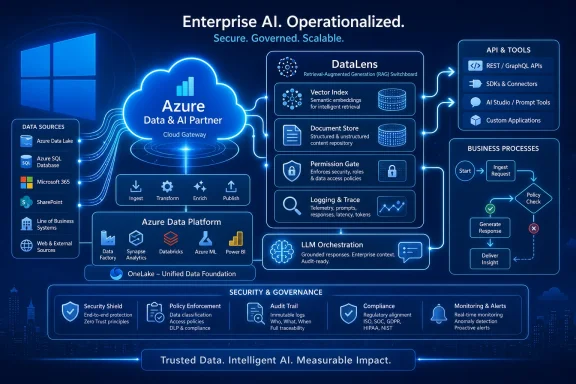
DataLens also points to where the AI accelerator market is headed. Enterprises do not just want a generic chatbot. They want a layer that connects to data warehouses, document repositories, data lakes, application stores, and model providers while enforcing access controls and governance policies. The promise is not only faster development; it is reduced architectural thrash.
The risk, of course, is abstraction theater. Many AI platforms claim to abstract model providers, vector databases, connectors, governance, and application patterns. In practice, abstraction can be leaky. Each customer’s data estate has its own irregularities, permissions model, retention requirements, latency needs, cost ceilings, and integration debts. The useful accelerator is not the one that pretends these differences disappear. It is the one that shortens the path through them.
In practice, RAG is one of the places where AI projects go from easy demo to difficult system. A polished prototype can answer questions over a folder of PDFs. A production deployment must handle stale documents, conflicting sources, permissions, metadata quality, multilingual content, scanned images, version histories, and users who ask ambiguous questions. The model is only part of the product; the retrieval layer often determines whether the system is trusted.
This is why Konverge AI’s emphasis on data platforms and governance is more important than the more fashionable references to agentic AI. Before enterprises can safely automate decisions or actions, they need a reliable understanding of what the AI system knows, what it is allowed to access, and how its answers can be traced. A bad RAG system is worse than a bad search engine because it can convert weak retrieval into confident prose.
For Windows and Microsoft administrators, that point should sound familiar. The hardest problems in enterprise IT are often identity, access, lifecycle management, and data hygiene wearing new clothes. AI does not repeal those problems. It magnifies them.
Microsoft also benefits. Every partner that builds serious AI workloads on Azure reinforces the cloud platform’s relevance. If DataLens deployments consume Azure compute, storage, database, AI, and marketplace services, Microsoft participates in the value chain even when the customer-facing engagement belongs to the partner. This is the classic platform play, updated for the AI cycle.
But Azure gravity cuts both ways. Customers want integration, not lock-in dressed as convenience. Konverge AI’s marketplace messaging around model-agnostic architecture and interoperability with existing infrastructure is therefore a notable part of the pitch. Buyers increasingly want the option to shift models, swap vector stores, connect multiple data platforms, and avoid being trapped inside a single vendor’s roadmap.
The practical tension is familiar to any enterprise architect. The more deeply a solution integrates with Azure identity, governance, networking, billing, and monitoring, the easier it may be to operate in a Microsoft estate. The more it depends on Azure-specific assumptions, the harder it may be to move later. Good architecture does not eliminate that tradeoff; it makes the tradeoff explicit.
Partners are the translation layer. They turn Microsoft’s platform map into project plans, migration roadmaps, proof-of-value exercises, and industry-specific packages. They also absorb some of the customer’s uncertainty: which model should be used, which data should be indexed, which workloads belong in Fabric, which business process is actually worth automating, and which governance controls must be implemented before launch.
That role is becoming more important because the gap between AI enthusiasm and AI readiness remains wide. Executives want productivity gains and new digital products. IT teams see fragmented data, unclear ownership, compliance exposure, cost unpredictability, and a shortage of people who understand both machine learning and enterprise operations. A credible partner has to manage both sides of that conversation.
Konverge AI’s announcement uses the language of “moving from experimentation to enterprise-scale adoption.” That phrase captures the central challenge of 2026. The easy AI wins have either been captured or exposed as superficial. The next wins will require organizations to rewire the way data, applications, process ownership, and risk management interact.
Agentic systems imply AI that can take steps toward a goal, invoke tools, call APIs, perform tasks, or coordinate workflows with some degree of autonomy. That is powerful in theory and dangerous in sloppy implementations. A chatbot that gives a bad answer is one category of risk. An agent that updates a record, emails a customer, changes a ticket, modifies a configuration, or triggers a financial workflow is another.
This is why governance cannot be treated as a compliance afterthought. The enterprise AI stack needs policy controls, approval workflows, observability, identity boundaries, and human escalation paths. It also needs mechanisms for evaluating outputs and behavior over time, because a system that behaves well in a pilot can degrade when connected to more data, more users, and more edge cases.
The strongest part of Konverge AI’s positioning is that it pairs AI acceleration with responsible AI and security language. The weakest possible version of that positioning would be to treat governance as a checkbox on the sales slide. The market will punish firms that cannot show customers how the guardrails actually work.
For vendors, marketplace presence can reduce friction. A customer already buying Azure services may find it easier to procure a marketplace-listed solution than to onboard an entirely separate vendor through a traditional process. For Microsoft, marketplace growth helps keep cloud spending inside its commercial ecosystem. For customers, the benefit is centralization, though that benefit depends on whether procurement convenience is matched by operational clarity.
This is especially relevant for AI accelerators. The market is crowded with tools that promise to speed up LLM application development, connect enterprise data, and impose governance. Marketplace visibility may help buyers filter the noise, but it is not a substitute for technical due diligence. A listing can answer where to buy. It cannot answer whether the solution fits a customer’s architecture.
Still, Microsoft’s marketplace has become a key part of the AI channel. A partner with both a services practice and a listed accelerator can pursue a hybrid model: sell consulting to design the system, sell software to accelerate deployment, and use Azure consumption as the platform economics underneath. That model is likely to become more common as enterprises demand repeatable AI patterns rather than one-off bespoke builds.
DataLens appears designed for that purpose. Its advertised value is not that Konverge AI knows how to build a document copilot once. It is that the company has captured enough common architecture to help customers build those systems faster across multiple use cases. That is the difference between being an AI contractor and becoming a platform-adjacent solution provider.
This productization push has a familiar downside. Accelerators can become rigid if they overfit yesterday’s architecture. The AI infrastructure stack is still changing quickly: model providers evolve, context windows expand, vector search approaches mature, evaluation tooling improves, and enterprise controls become more demanding. A useful accelerator in 2026 must be maintained like a living product, not sold like a static template.
Konverge AI’s access to Microsoft technical support and advisory resources could help here. A partner plugged more deeply into Microsoft’s roadmap may be better positioned to adapt its tooling as Azure AI, marketplace requirements, and enterprise governance patterns evolve. But access is only valuable if it translates into implementation discipline.
Those questions should start with architecture. How does DataLens connect to existing data platforms? How are permissions enforced? Does the system respect document-level access controls? How are embeddings stored, secured, refreshed, and deleted? What logging exists for prompts, retrieval results, model outputs, and user actions? How does the solution handle regulated data?
They should continue with operations. Who owns monitoring? What happens when a model changes behavior? How are hallucinations measured and reduced? What evaluation framework is used before production rollout? How are costs forecast and controlled? Can the customer switch model providers or deployment patterns without rebuilding the entire system?
They should also include commercial questions. Marketplace procurement can simplify buying, but customers still need to understand support boundaries, licensing terms, data processing obligations, service-level expectations, and long-term maintenance. AI pilots often fail not because the demo was weak, but because nobody planned for the second year of ownership.
A company adopting AI through Azure will usually touch Microsoft Entra ID, role-based access controls, Microsoft 365 data, SharePoint repositories, Teams workflows, Power BI reports, endpoint management, and security tooling. Even when the AI application is not a Windows application in the traditional sense, the operational surface area often runs through systems Windows administrators already manage.
The rise of AI document search and business copilots also raises expectations for internal knowledge access. Once executives see a working AI assistant over a curated dataset, they tend to ask why the rest of the company’s content cannot work the same way. That request quickly becomes an information architecture problem involving permissions, stale files, retention policies, data classification, and user behavior.
This is where Microsoft partners can either help or create new sprawl. A well-designed AI deployment can reinforce existing governance and identity models. A poorly designed one can create yet another shadow index of corporate knowledge, with unclear access rules and incomplete lifecycle management. The difference will matter more as AI moves from optional pilot to everyday interface.
Most enterprises do not want to become AI infrastructure companies. They want working systems that improve support, sales, finance, operations, engineering, legal review, or supply-chain decision-making. If Microsoft and its partners can turn Azure AI infrastructure into repeatable business outcomes, the platform becomes stickier. If customers experience only cost overruns and fragile pilots, the AI enthusiasm will cool.
Konverge AI’s announcement is therefore part of a larger contest over who makes AI operational. Microsoft provides the platform. Partners provide domain translation, integration labor, and packaged accelerators. Customers provide the data, workflows, budgets, and risk tolerance. The successful projects will be the ones where those roles are honest rather than blurred.
The danger for the ecosystem is overpromising. AI is already suffering from a credibility problem in parts of the enterprise, not because the technology is useless, but because expectations have been badly managed. A partner that can say “no,” narrow a use case, and fix the data foundation may ultimately be more valuable than one that promises an agent for everything.
Source: openPR.com https://www.openpr.com/news/4506882/konverge-ai-becomes-microsoft-data-ai-partner/
 Microsoft’s AI Channel Is Becoming the Real Deployment Engine
Microsoft has spent the past several years making AI feel like a product you can buy. Copilot is the marquee name, Azure AI Foundry is the developer and platform story, and Microsoft Marketplace is increasingly the procurement layer where software, services, and AI accelerators are supposed to become discoverable and billable. But enterprises rarely adopt AI by pressing a single button in a tenant admin center.That is where partner announcements like Konverge AI’s become more meaningful than their press-release language first suggests. Microsoft can sell the platform, but customers still need someone to model the data, wire up the pipelines, define the security posture, connect business systems, and defend the budget. The Microsoft partner ecosystem exists because the last mile of enterprise technology is rarely last-mile at all; it is usually another highway.
Konverge AI describes itself as a decision-science and AI engineering firm focused on enterprise-ready AI, generative AI, agentic AI frameworks, and data-driven operational systems. Its new Microsoft Data & AI Partner status gives it access to ecosystem benefits such as Azure credits, cloud services, software licenses, developer tools, technical support, and advisory resources. Those benefits are not merely perks. They are the machinery that lets a smaller specialist firm build, test, demonstrate, and scale around Microsoft’s cloud stack without carrying the entire platform burden alone.
The announcement also places Konverge AI inside a broader Microsoft motion that has become increasingly clear: AI is not being treated as a separate category for long. It is being folded into data modernization, cloud migration, security, business applications, managed services, and industry workflows. The partner that can speak all of those languages has a better chance of surviving the AI services shakeout than the firm that merely says it can “do ChatGPT for your documents.”
The Badge Matters Less Than the Work It Enables
A Microsoft partner designation can mean many things, and serious IT buyers have learned not to confuse a logo with a guarantee. Microsoft’s partner programs identify capability, relationship, access, and sometimes commercial readiness, but they do not automatically prove that every project will be well architected or every consultant will be a wizard. The badge is an opening credential, not a final verdict.That caveat is important because the AI services market is full of inflated claims. Nearly every consultancy now says it can build copilots, agents, workflow automation, and retrieval-augmented generation systems. The vocabulary has become cheap. The hard part is making those systems reliable enough for production, governed enough for compliance teams, and maintainable enough that they do not become a science-fair demo abandoned after the first executive showcase.
Konverge AI’s announcement leans heavily into the phrase enterprise-ready, and that is the right battlefield. The company says the partnership will support work across enterprise AI and generative AI solution development, Azure-based data modernization, intelligent automation, reusable frameworks, governance, security, responsible AI, and technical architecture enablement. In other words, it is positioning itself not as an AI novelty shop but as a systems integrator for the AI era.
That positioning fits the moment. The first wave of enterprise generative AI was dominated by experimentation: internal chatbots, proof-of-concept search tools, pilot document assistants, and narrow automation tests. The second wave is about operationalization. That means uptime, identity integration, audit trails, data classification, model evaluation, cost management, and the unglamorous obligation to make sure the AI system does not leak confidential information or confidently answer from the wrong source.
DataLens Shows the Marketplace Strategy Behind the Announcement
The most concrete asset in Konverge AI’s announcement is DataLens, the company’s generative AI accelerator listed on Microsoft’s marketplace. DataLens is described as a switchboard for large language model and retrieval-augmented generation applications, designed to connect with existing enterprise data infrastructure while abstracting some of the complexity of implementation. The marketplace listing frames it around use cases such as document copilots, conversational SQL, and intelligent document search.That matters because Microsoft’s marketplace strategy is increasingly tied to enterprise buying behavior. If a tool is available through Microsoft’s commercial marketplace, it can be easier for Azure customers to discover, evaluate, procure, and deploy it within an existing cloud relationship. The listing does not magically validate the quality of every deployment, but it does put the product in the path of organizations already standardizing procurement around Microsoft cloud services.
DataLens also points to where the AI accelerator market is headed. Enterprises do not just want a generic chatbot. They want a layer that connects to data warehouses, document repositories, data lakes, application stores, and model providers while enforcing access controls and governance policies. The promise is not only faster development; it is reduced architectural thrash.
The risk, of course, is abstraction theater. Many AI platforms claim to abstract model providers, vector databases, connectors, governance, and application patterns. In practice, abstraction can be leaky. Each customer’s data estate has its own irregularities, permissions model, retention requirements, latency needs, cost ceilings, and integration debts. The useful accelerator is not the one that pretends these differences disappear. It is the one that shortens the path through them.
Retrieval-Augmented Generation Is Where AI Hype Meets Enterprise Reality
The mention of retrieval-augmented generation, or RAG, is not incidental. RAG has become the default pattern for enterprises trying to make large language models useful without retraining them on every internal document. The basic idea is straightforward: retrieve relevant enterprise content, feed it into the model as context, and generate an answer grounded in that retrieved material.In practice, RAG is one of the places where AI projects go from easy demo to difficult system. A polished prototype can answer questions over a folder of PDFs. A production deployment must handle stale documents, conflicting sources, permissions, metadata quality, multilingual content, scanned images, version histories, and users who ask ambiguous questions. The model is only part of the product; the retrieval layer often determines whether the system is trusted.
This is why Konverge AI’s emphasis on data platforms and governance is more important than the more fashionable references to agentic AI. Before enterprises can safely automate decisions or actions, they need a reliable understanding of what the AI system knows, what it is allowed to access, and how its answers can be traced. A bad RAG system is worse than a bad search engine because it can convert weak retrieval into confident prose.
For Windows and Microsoft administrators, that point should sound familiar. The hardest problems in enterprise IT are often identity, access, lifecycle management, and data hygiene wearing new clothes. AI does not repeal those problems. It magnifies them.
Azure Gives Partners a Platform, but Also a Gravity Well
For Konverge AI, the Microsoft relationship brings obvious advantages. Azure is a natural home for enterprise data modernization projects, especially for organizations already invested in Microsoft identity, Microsoft 365, Power BI, Fabric, SQL Server, Dynamics, and Windows-based management. A partner building AI systems on Azure can take advantage of that installed base rather than asking customers to start from scratch.Microsoft also benefits. Every partner that builds serious AI workloads on Azure reinforces the cloud platform’s relevance. If DataLens deployments consume Azure compute, storage, database, AI, and marketplace services, Microsoft participates in the value chain even when the customer-facing engagement belongs to the partner. This is the classic platform play, updated for the AI cycle.
But Azure gravity cuts both ways. Customers want integration, not lock-in dressed as convenience. Konverge AI’s marketplace messaging around model-agnostic architecture and interoperability with existing infrastructure is therefore a notable part of the pitch. Buyers increasingly want the option to shift models, swap vector stores, connect multiple data platforms, and avoid being trapped inside a single vendor’s roadmap.
The practical tension is familiar to any enterprise architect. The more deeply a solution integrates with Azure identity, governance, networking, billing, and monitoring, the easier it may be to operate in a Microsoft estate. The more it depends on Azure-specific assumptions, the harder it may be to move later. Good architecture does not eliminate that tradeoff; it makes the tradeoff explicit.
The Partner Economy Is Microsoft’s Answer to AI Complexity
Microsoft’s own AI portfolio has become sprawling. Customers can build with Azure AI services, manage models and agents through newer platform layers, connect analytics through Fabric, expose experiences through Copilot Studio, and transact third-party solutions through the marketplace. For large enterprises, this breadth is a strength. For teams trying to decide where to begin, it can be paralyzing.Partners are the translation layer. They turn Microsoft’s platform map into project plans, migration roadmaps, proof-of-value exercises, and industry-specific packages. They also absorb some of the customer’s uncertainty: which model should be used, which data should be indexed, which workloads belong in Fabric, which business process is actually worth automating, and which governance controls must be implemented before launch.
That role is becoming more important because the gap between AI enthusiasm and AI readiness remains wide. Executives want productivity gains and new digital products. IT teams see fragmented data, unclear ownership, compliance exposure, cost unpredictability, and a shortage of people who understand both machine learning and enterprise operations. A credible partner has to manage both sides of that conversation.
Konverge AI’s announcement uses the language of “moving from experimentation to enterprise-scale adoption.” That phrase captures the central challenge of 2026. The easy AI wins have either been captured or exposed as superficial. The next wins will require organizations to rewire the way data, applications, process ownership, and risk management interact.
Agentic AI Is the Flashy Term, but Governance Is the Serious One
The press release says the Microsoft partnership positions Konverge AI to expand work across agentic AI, generative AI, cloud modernization, advanced analytics, and intelligent automation. Of those terms, agentic AI is the one most likely to attract attention. It is also the one most likely to cause trouble if used carelessly.Agentic systems imply AI that can take steps toward a goal, invoke tools, call APIs, perform tasks, or coordinate workflows with some degree of autonomy. That is powerful in theory and dangerous in sloppy implementations. A chatbot that gives a bad answer is one category of risk. An agent that updates a record, emails a customer, changes a ticket, modifies a configuration, or triggers a financial workflow is another.
This is why governance cannot be treated as a compliance afterthought. The enterprise AI stack needs policy controls, approval workflows, observability, identity boundaries, and human escalation paths. It also needs mechanisms for evaluating outputs and behavior over time, because a system that behaves well in a pilot can degrade when connected to more data, more users, and more edge cases.
The strongest part of Konverge AI’s positioning is that it pairs AI acceleration with responsible AI and security language. The weakest possible version of that positioning would be to treat governance as a checkbox on the sales slide. The market will punish firms that cannot show customers how the guardrails actually work.
Marketplace Listings Are Becoming the New Enterprise Shelf Space
The availability of DataLens on Microsoft’s marketplace is not just a distribution note. It reflects a shift in how enterprise software is packaged and purchased. Microsoft wants its marketplace to be a unified storefront for cloud solutions, AI applications, and partner services that align with customers’ existing cloud commitments.For vendors, marketplace presence can reduce friction. A customer already buying Azure services may find it easier to procure a marketplace-listed solution than to onboard an entirely separate vendor through a traditional process. For Microsoft, marketplace growth helps keep cloud spending inside its commercial ecosystem. For customers, the benefit is centralization, though that benefit depends on whether procurement convenience is matched by operational clarity.
This is especially relevant for AI accelerators. The market is crowded with tools that promise to speed up LLM application development, connect enterprise data, and impose governance. Marketplace visibility may help buyers filter the noise, but it is not a substitute for technical due diligence. A listing can answer where to buy. It cannot answer whether the solution fits a customer’s architecture.
Still, Microsoft’s marketplace has become a key part of the AI channel. A partner with both a services practice and a listed accelerator can pursue a hybrid model: sell consulting to design the system, sell software to accelerate deployment, and use Azure consumption as the platform economics underneath. That model is likely to become more common as enterprises demand repeatable AI patterns rather than one-off bespoke builds.
Smaller AI Firms Are Racing to Productize Their Expertise
Konverge AI’s move also illustrates a broader trend among specialist AI consultancies: the race to turn services knowledge into reusable products. Pure consulting can be lucrative, but it is hard to scale. A packaged accelerator can create repeatability, shorten sales cycles, and give the firm a clearer identity in a crowded field.DataLens appears designed for that purpose. Its advertised value is not that Konverge AI knows how to build a document copilot once. It is that the company has captured enough common architecture to help customers build those systems faster across multiple use cases. That is the difference between being an AI contractor and becoming a platform-adjacent solution provider.
This productization push has a familiar downside. Accelerators can become rigid if they overfit yesterday’s architecture. The AI infrastructure stack is still changing quickly: model providers evolve, context windows expand, vector search approaches mature, evaluation tooling improves, and enterprise controls become more demanding. A useful accelerator in 2026 must be maintained like a living product, not sold like a static template.
Konverge AI’s access to Microsoft technical support and advisory resources could help here. A partner plugged more deeply into Microsoft’s roadmap may be better positioned to adapt its tooling as Azure AI, marketplace requirements, and enterprise governance patterns evolve. But access is only valuable if it translates into implementation discipline.
For IT Buyers, the Announcement Is a Signal to Ask Better Questions
The immediate temptation is to read the announcement as validation: Konverge AI is now a Microsoft Data & AI Partner, therefore customers can trust it with AI programs. That would be too simplistic. The better interpretation is that Konverge AI has moved into a stronger position within Microsoft’s ecosystem, and prospective customers now have a clearer basis for asking more detailed questions.Those questions should start with architecture. How does DataLens connect to existing data platforms? How are permissions enforced? Does the system respect document-level access controls? How are embeddings stored, secured, refreshed, and deleted? What logging exists for prompts, retrieval results, model outputs, and user actions? How does the solution handle regulated data?
They should continue with operations. Who owns monitoring? What happens when a model changes behavior? How are hallucinations measured and reduced? What evaluation framework is used before production rollout? How are costs forecast and controlled? Can the customer switch model providers or deployment patterns without rebuilding the entire system?
They should also include commercial questions. Marketplace procurement can simplify buying, but customers still need to understand support boundaries, licensing terms, data processing obligations, service-level expectations, and long-term maintenance. AI pilots often fail not because the demo was weak, but because nobody planned for the second year of ownership.
Windows Shops Will Feel This Through Identity, Data, and Copilot Expectations
WindowsForum readers may reasonably ask whether a partner announcement around enterprise AI has much to do with Windows itself. The answer is yes, but indirectly. Windows environments sit inside broader Microsoft estates, and the AI push is increasingly tied to Microsoft identity, endpoint posture, data governance, and productivity workflows.A company adopting AI through Azure will usually touch Microsoft Entra ID, role-based access controls, Microsoft 365 data, SharePoint repositories, Teams workflows, Power BI reports, endpoint management, and security tooling. Even when the AI application is not a Windows application in the traditional sense, the operational surface area often runs through systems Windows administrators already manage.
The rise of AI document search and business copilots also raises expectations for internal knowledge access. Once executives see a working AI assistant over a curated dataset, they tend to ask why the rest of the company’s content cannot work the same way. That request quickly becomes an information architecture problem involving permissions, stale files, retention policies, data classification, and user behavior.
This is where Microsoft partners can either help or create new sprawl. A well-designed AI deployment can reinforce existing governance and identity models. A poorly designed one can create yet another shadow index of corporate knowledge, with unclear access rules and incomplete lifecycle management. The difference will matter more as AI moves from optional pilot to everyday interface.
Microsoft Wins When Partners Make Azure Feel Less Like Plumbing
One of Microsoft’s enduring strengths is that it can make complex infrastructure feel like a business platform. Azure is not merely compute and storage; it is identity, analytics, developer tooling, compliance, marketplace procurement, and partner delivery wrapped into a commercial ecosystem. AI makes that packaging even more important.Most enterprises do not want to become AI infrastructure companies. They want working systems that improve support, sales, finance, operations, engineering, legal review, or supply-chain decision-making. If Microsoft and its partners can turn Azure AI infrastructure into repeatable business outcomes, the platform becomes stickier. If customers experience only cost overruns and fragile pilots, the AI enthusiasm will cool.
Konverge AI’s announcement is therefore part of a larger contest over who makes AI operational. Microsoft provides the platform. Partners provide domain translation, integration labor, and packaged accelerators. Customers provide the data, workflows, budgets, and risk tolerance. The successful projects will be the ones where those roles are honest rather than blurred.
The danger for the ecosystem is overpromising. AI is already suffering from a credibility problem in parts of the enterprise, not because the technology is useless, but because expectations have been badly managed. A partner that can say “no,” narrow a use case, and fix the data foundation may ultimately be more valuable than one that promises an agent for everything.
The Real Test Begins After the Press Release
The important facts are straightforward, and the implications are more interesting than the announcement’s ceremonial tone suggests.- Konverge AI announced on May 9, 2026, that it has become a Microsoft Data & AI Partner.
- The company says the partnership gives it access to Microsoft ecosystem benefits including Azure credits, cloud services, software licenses, developer tools, technical support, and advisory resources.
- Konverge AI is positioning the relationship around enterprise AI, generative AI, agentic AI, Azure data modernization, intelligent automation, governance, and responsible AI implementation.
- Its DataLens accelerator is listed on Microsoft’s marketplace and is aimed at RAG-based enterprise use cases such as document copilots, conversational SQL, and intelligent document search.
- For customers, the partnership is best read as a stronger ecosystem signal rather than a substitute for architecture review, security assessment, and operational due diligence.
- For Microsoft, the announcement reinforces the company’s broader strategy of using partners and marketplace offerings to turn Azure AI infrastructure into deployable enterprise solutions.
Source: openPR.com https://www.openpr.com/news/4506882/konverge-ai-becomes-microsoft-data-ai-partner/
