

KPMG’s announcement that it has earned additional Microsoft AI credentials — namely advanced specializations for AI for Microsoft Copilot and Build AI Apps on Microsoft Azure — is more than a badge change; it signals a deliberate push by one of the Big Four to convert early AI experimentation into repeatable, auditable enterprise services that sit squarely on the Microsoft stack. This development underscores three concurrent trends: the rapid formalization of partner competence signals inside the Microsoft ecosystem, KPMG’s step-up as a platform integrator for agentic AI in regulated workflows, and the growing importance of verifiable governance, skilling, and measurable adoption when buyers evaluate Copilot and Azure AI projects.
KPMG’s recent communications frame the new specializations as part of a broader strategy to embed AI and cloud across its operations and client workstreams. The firm points to a multiyear alliance with Microsoft and earlier work to integrate generative AI into KPMG Clara — its global smart audit platform — and other advisory offerings. KPMG says these investments gave its teams early, practical experience with Microsoft AI tooling and positioned them to help clients move from exploration to enterprise transformation. Microsoft, in parallel, has been formalizing partner-level signals that attempt to separate partners who have built repeatable, governed Copilot and Azure AI solutions from those who only run proofs-of-concept. New program structures, including the Copilot advanced specialization and updated Azure specialization paths (for example, Build AI Apps on Microsoft Azure), are designed to require measurable adoption metrics, certified personnel, and customer references — turning marketing claims into audit‑grade evidence partners can present to procurement teams.
Conclusion
The awarding of Microsoft advanced specializations to KPMG for Copilot and Build AI Apps on Azure is a meaningful milestone for the enterprise AI market: it recognizes that delivery at scale requires audited capability across advisory, implementation, and operations. KPMG’s public work on KPMG Clara and numerous Microsoft customer stories show practical deployments and a technology stack built on Azure primitives. Yet the practical reality for buyers is unchanged — demand documentation, validate telemetry, insist on governance, and price-in operational ownership. Specializations make shortlists easier; they do not replace rigorous technical and procurement validation when enterprise risk and regulatory compliance are on the line.
Source: KPMG KPMG achieves new Microsoft AI specializations
 Background
KPMG’s recent communications frame the new specializations as part of a broader strategy to embed AI and cloud across its operations and client workstreams. The firm points to a multiyear alliance with Microsoft and earlier work to integrate generative AI into KPMG Clara — its global smart audit platform — and other advisory offerings. KPMG says these investments gave its teams early, practical experience with Microsoft AI tooling and positioned them to help clients move from exploration to enterprise transformation. Microsoft, in parallel, has been formalizing partner-level signals that attempt to separate partners who have built repeatable, governed Copilot and Azure AI solutions from those who only run proofs-of-concept. New program structures, including the Copilot advanced specialization and updated Azure specialization paths (for example, Build AI Apps on Microsoft Azure), are designed to require measurable adoption metrics, certified personnel, and customer references — turning marketing claims into audit‑grade evidence partners can present to procurement teams. What KPMG announced — the plain facts
- KPMG reports it has achieved Microsoft advanced specializations for:
- AI for Microsoft Copilot (a specialization that signals competency delivering Copilot advisory, secure deployments, agent development and adoption programs), and
- Build AI Apps on Microsoft Azure (an Azure-aligned specialization focused on building scalable, governed AI applications on Azure services).
- These recognitions are presented by KPMG as additions to an existing set of Microsoft Solutions Partner designations and other specializations across Business Applications, Data & AI (Azure), Digital & App Innovation (Azure), Infrastructure (Azure), Modern Work, and Security.
Why this matters to enterprise IT and procurement teams
1. A clearer procurement signal in a messy partner market
Microsoft’s advanced specializations (and the newer Copilot specialization) are intended to be audited signals that go beyond one-off demos. They typically require measurable adoption metrics (MAU or adoption growth), a roster of certified personnel, and customer references showing operational impact. For buyers, a partner that can present Partner Center evidence supporting those gates shortens vendor due diligence — provided the artifacts are credible and recent. However, a specialization badge is an initial screen, not a contract guarantee. Ask for Partner Center proof, certification rosters, and audited reference case studies in RFPs.2. Copilot and agentic AI are now an enterprise operations problem, not just an ML problem
What enterprises pay for is predictable operations: identity and least‑privilege for agents, human‑in‑the‑loop gating, observability for agent actions (tracing and logs), and FinOps for inference/session costs. Partners that truly "deliver Copilot" must integrate tenant controls, data-grounding strategies (Fabric/Dataverse/OneLake), and CI/CD for agent flows — plus runbooks for incidents. KPMG’s stated emphasis on Trusted AI and governance aligns with those expectations but must be validated to customers with technical artefacts and runbooks.3. Industry and regulated use cases elevate the stakes
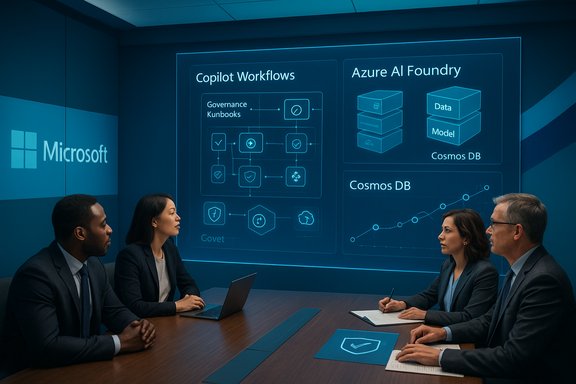
KPMG’s core clients — auditors, finance teams, regulated enterprises — require auditable provenance and reproducible controls. KPMG’s integration of Copilot, Azure OpenAI, Azure AI Foundry and Cosmos DB for KPMG Clara indicates a stack designed for enterprise-scale data ingestion, agent orchestration and traceability. These are precisely the scenarios where Microsoft’s partner gatekeepers expect to see demonstrable governance and testing artifacts. If you operate in regulated sectors, demand the following: immutable audit logs, red-team results and human-approval gating for all actions that could change records or financial statements.Technical reality check — what’s verifiable today
KPMG and Microsoft have publicly documented parts of the technical stack underpinning KPMG Clara and KPMG’s AI work:- KPMG Clara and agentic components have been described as built on Microsoft Azure, leveraging Azure AI Foundry, Azure Cosmos DB, Azure App Service, and a .NET‑first application layer. Microsoft’s customer story and KPMG press materials both reference these technologies in describing the agent orchestration and storage architecture. These claims are corroborated across KPMG and Microsoft customer narratives.
- Microsoft’s partner program updates show the Build AI Apps on Microsoft Azure specialization receiving an updated path (Azure specialization V.Next) to streamline audit Module B requirements and map partner-led scenario data into qualification evidence — an administrative but tangible change that reduces friction for partners to earn that specialization. This change was documented in Microsoft’s partner blog.
- Microsoft’s Cloud Blog lists dozens of customer stories referencing KPMG’s use of Copilot, Fabric, Azure OpenAI and other platform services to build onboarding agents, Comply AI, KymChat, and other client solutions — reinforcing the public record that KPMG is actively shipping agentic solutions built on Microsoft services. These customer stories are curated by Microsoft and describe measurable customer outcomes.
Strengths in KPMG’s positioning
- Scale and domain depth: KPMG’s integration of AI into KPMG Clara, together with its global audit footprint, provides an immediate operational domain for Copilot-style agents and makes KPMG a high-value partner for finance and audit transformations. The move from sampling to whole-dataset analysis is emphasized by both KPMG and Microsoft as a step-change for audit processes.
- End-to-end advisory-to-operations capability: KPMG is not only advising — it’s engineering, operating, and upskilling. That combination matters for enterprises that must move from pilots to production with clear governance. The new specializations are intended to validate exactly that capability: advisory + implementation + operationalization.
- Microsoft alignment and early access benefits: Membership in Microsoft partner programs (Inner Circle and advanced specializations) typically brings earlier technical previews, closer engineering engagement, and commercial co-sell advantages — all meaningful when buying enterprise Copilot and Azure AI services. Several partner-level benefits and case studies suggest KPMG is a repeat collaborator on Microsoft-enabled projects.
Risks and blind spots enterprises must examine
- Vendor coupling and portability: Deep integration into Microsoft Copilot Studio, Fabric, Azure AI Foundry, and MCP (Model Context Protocol) can yield huge short-term velocity but creates operational lock-in. Ask for portability plans for knowledge artifacts, backups of agent configurations and documented migration strategies if you ever need to move platforms.
- Model, data and audit risk: For audit and regulatory work, the use of generative models introduces model risk (hallucination, bias), data lineage risk (what data grounded responses used), and independence concerns (when an audit firm both advises and audits). Firms like KPMG must demonstrate how they measure model accuracy, detect drift, and reconcile AI outputs with human review. Require red-team results and drift‑monitoring reports.
- Proof vs. production gap: Microsoft’s specialization gates expect measurable MAU and customer references. However, press claims do not always translate into sustained production usage. Buyers should insist on telemetry showing real usage and impact over a period (e.g., MAU growth, reduction in cycle time, accuracy metrics) rather than short-lived pilots.
- Regulatory scrutiny and audit-quality measurement: Independent regulators are increasingly asking how audit quality is affected by automation. Firms must publish or provide independent validation that automation improves outcomes and does not merely accelerate flawed processes. This is particularly sensitive in audit and financial reporting work.
Practical checklist for CIOs and procurement teams evaluating KPMG (or any Copilot/Azure AI partner claiming advanced specializations)
- Request Partner Center proof of the advanced specialization(s), including award date.
- Obtain the roster of certified personnel (exam IDs and dates) mapped against the specialization’s role requirements.
- Ask for at least three customer references tied to production deployments — one must be an agentic implementation with measurable KPIs (time saved, MAU, error reduction).
- Review the architecture for RAG (retrieval-augmented generation), connector governance, and data residency. Confirm where data is stored and how Purview/DLP controls are applied.
- Require red-team and hallucination mitigation reports and a summary of model evaluation pipelines.
- Inspect runbooks for human-in-the-loop gating and incident response (including SOC/IR integration).
- Clarify ownership of agent code, configuration backups, and portability clauses in contracts.
- Obtain a forward cost model for Copilot sessions, Azure inference hosting (Foundry/VM/Container costs), and three-year managed services run rates.
- Validate FinOps tooling for inference metering and set budget alerts tied to production SLAs.
- Confirm SLAs and rollback/rollback-testing procedures for model updates.
What partners and sysadmins should do next
- For technical teams: insist on end-to-end observability (OpenTelemetry traces for agent actions), strict identity models (short‑lived Entra tokens for agent identities), and deterministic tool contracts (MCP manifests) before approving any agent to act on your ERP or financial systems. Microsoft’s emerging MCP/Agent Framework patterns and Azure AI Foundry runtime protections are explicitly designed to address these needs.
- For security teams: require integration evidence with Microsoft Purview and Defender, and validate DLP/prompt shields for data that enters Copilot sessions. Confirm SOC playbooks and how Microsoft Security Copilot (if used) integrates into detection and response workflows.
- For program owners: define measurable KPIs early (MAU, task completion rate, error rate, days-to-close) and require an implementation roadmap that moves from narrow, high-value pilots to scoped production with documented governance and audit trails.
How to interpret the new specializations in plain terms
- A partner that can show the Partner Center evidence and the required artifacts has likely passed a rigorous, Microsoft-audited set of gates that include skilling, adoption, and customer evidence — meaning they can help you operationalize Copilot in regulated contexts.
- A press release alone is not sufficient. Good procurement practice is to treat specialization badges as a starting point for deeper technical validation — particularly for agentic systems that can take actions on enterprise data.
- KPMG’s scale and earlier investments in KPMG Clara mean they are a sensible candidate for large finance, audit, and regulated AI programs — but the same due diligence applies: ask for telemetry, red-team outcomes and documented governance.
Final assessment
KPMG’s claim of new Microsoft advanced specializations — combined with public evidence of large-scale KPMG Clara AI work and Microsoft’s partner program adjustments — is consistent with the trajectory of enterprise AI over the last two years: shift from experimentation to governed, partner-led production. The recognition signals that KPMG has invested in the people, processes, and technology stack (Copilot Studio, Azure AI Foundry, Cosmos DB, .NET runtime patterns, Fabric/Dataverse grounding) required for enterprise deployments. That said, the specialization is a procurement filter rather than a guarantee. When mission-critical or regulated data and processes are involved, the burden remains on buyers to validate Partner Center proof, certified people rosters, red-team testing results, telemetry demonstrating meaningful adoption, and contractual commitments on portability and operational ownership.Takeaway for WindowsForum readers focused on business IT
KPMG’s new Microsoft AI specializations are an important market signal: Copilot and Azure AI are now procurement-grade technologies, and the ecosystem’s top partners are being held to quantifiable standards. For organizations evaluating enterprise Copilot or agentic AI initiatives, the sensible path is measured: pilot quickly on tightly scoped, high-value tasks; mandate robust governance and auditability from day one; and require partners to present auditable evidence of adoption, certified skills, and production telemetry before expanding to enterprise scale. When those gates are met, Copilot and Azure AI can deliver material productivity and quality gains — but without those artifacts, buyers are buying promise, not proven, repeatable outcomes.Conclusion
The awarding of Microsoft advanced specializations to KPMG for Copilot and Build AI Apps on Azure is a meaningful milestone for the enterprise AI market: it recognizes that delivery at scale requires audited capability across advisory, implementation, and operations. KPMG’s public work on KPMG Clara and numerous Microsoft customer stories show practical deployments and a technology stack built on Azure primitives. Yet the practical reality for buyers is unchanged — demand documentation, validate telemetry, insist on governance, and price-in operational ownership. Specializations make shortlists easier; they do not replace rigorous technical and procurement validation when enterprise risk and regulatory compliance are on the line.
Source: KPMG KPMG achieves new Microsoft AI specializations
