

KPMG will begin measuring how staff use company AI tools and will include those measurements in annual performance reviews starting with the 2026 cycle, a significant shift that formalizes the expectation that consultants and professional-services staff must not only use generative AI but demonstrate measurable value from it in their day-to-day work. The move—reported across multiple major news outlets and described by KPMG’s internal AI leaders as tracking usage through enterprise tools such as Microsoft 365 Copilot—is both a clear signal that AI has moved from experiment to operational standard and a practical test of how organizations balance adoption, accountability, and employee rights.
KPMG’s announcement frames AI adoption as a firm-wide responsibility: everyone from senior partners to juniors will have objectives tied to bringing AI into their work. According to KPMG’s own AI workforce leadership, the firm is already collecting engagement data from enterprise AI tooling and plans to translate those inputs into year-end objectives and performance conversations in 2026. KPMG leadership describes monitoring as not punitive—the stated intention is to measure return on AI investments and make sure staff adopt best practices—but the change comes amid a broader professional-services pivot toward AI-driven productivity that has also triggered layoffs and reorganizations at peer firms.
The context matters. Major consulting and professional-services companies invested heavily in generative AI and agent platforms over the past two years. As firms pursue higher margins and defend revenue in a softer market, they are looking to AI both to cut time on routine tasks and to scale specialized expertise. At the same time, some competitors have taken harder stances: one large global consultancy announced workforce exits for roles that could not be retrained for AI-era work, underscoring how quickly adoption pressure can convert into hard HR decisions.
Key measurement modalities available to enterprises include:
For IT leaders, HR professionals, and employees, the immediate imperative is governance and transparency. Technical measurement tools are now mature enough to provide meaningful signals, but those signals must be interpreted with human judgment, role-context, and legal care. The organizations that navigate this transition best will be those that treat AI objectives as part of a holistic talent and risk-management program—combining measurement with reskilling, secure telemetry practices, and explicit human oversight—ensuring that AI amplifies professional judgment rather than replacing it.
Source: International Accounting Bulletin KPMG to include AI performance reviews
 Background
KPMG’s announcement frames AI adoption as a firm-wide responsibility: everyone from senior partners to juniors will have objectives tied to bringing AI into their work. According to KPMG’s own AI workforce leadership, the firm is already collecting engagement data from enterprise AI tooling and plans to translate those inputs into year-end objectives and performance conversations in 2026. KPMG leadership describes monitoring as not punitive—the stated intention is to measure return on AI investments and make sure staff adopt best practices—but the change comes amid a broader professional-services pivot toward AI-driven productivity that has also triggered layoffs and reorganizations at peer firms.The context matters. Major consulting and professional-services companies invested heavily in generative AI and agent platforms over the past two years. As firms pursue higher margins and defend revenue in a softer market, they are looking to AI both to cut time on routine tasks and to scale specialized expertise. At the same time, some competitors have taken harder stances: one large global consultancy announced workforce exits for roles that could not be retrained for AI-era work, underscoring how quickly adoption pressure can convert into hard HR decisions.
Why this matters: the organizational logic behind AI performance metrics
AI tools promise measurable productivity gains: fewer hours on low-value tasks, faster draft generation, improved research and analytics. From a firm management perspective, moving AI adoption into objective-based performance reviews is a natural extension of that promise—the firm can:- Tie an investment (licensing, integration, security) to measurable usage and business impact.
- Encourage consistent adoption across teams to avoid fragmented tool stacks and shadow AI usage.
- Create a common baseline for reskilling and resource allocation.
- Identify pockets where AI is delivering value and scale those patterns firm-wide.
How firms measure AI adoption today: technical mechanics
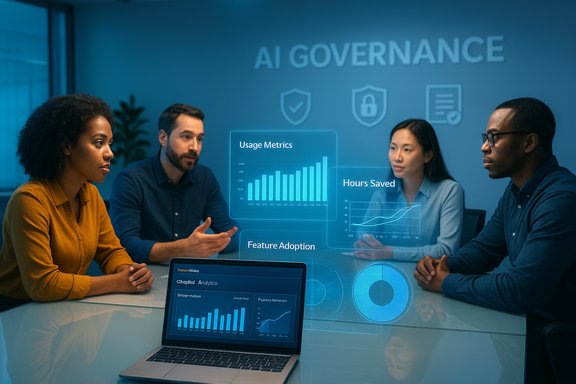
Enterprise AI platforms now ship with telemetry and analytics designed for organizational adoption and governance. Large vendors provide admin consoles and dedicated reporting products that allow IT and leadership to monitor how tools are used, what features are engaged, and where training or policy intervention is needed.Key measurement modalities available to enterprises include:
- Usage and adoption metrics: Active users, returning users, session count, and actions-per-user are basic signals of engagement.
- Feature-level telemetry: Which Copilot features, agents, or workflows are being used—e.g., document summarization, meeting preparation, or code generation.
- Assisted hours and time-savings estimates: Some dashboards report the number of hours “assisted” by AI, a derived metric intended to approximate time saved.
- Prompt and response analytics: Aggregated prompts and response quality feedback (thumbs-up/thumbs-down) help evaluate effectiveness and training needs.
- Agent and extension telemetry: For custom agents and Copilot extensions, application insights and telemetry capture invocation patterns and errors.
- Audit logs and retention: Integration with auditing platforms preserves trails for compliance, security reviews, and incident response.
- Cross-team benchmarking: Anonymous comparisons across cohorts, functions, or geographies to surface adoption gaps and best practices.
The practical example: Microsoft 365 Copilot and enterprise analytics
Modern Copilot deployments typically include:- Copilot Dashboard and Copilot Analytics: Strategic reports for adoption, broken down by app and team.
- Viva Insights integrations: To correlate AI activity with employee wellbeing or engagement surveys.
- Microsoft Purview and Application Insights: For auditing, telemetry, and integration with Security Information and Event Management (SIEM) solutions.
- Admin center reports: Operational visibility into license utilization and feature adoption.
Benefits: why KPMG and others are taking this step
- Accelerated adoption: Making AI a performance objective eliminates ambiguity; adoption rates rise when usage is expected and rewarded.
- Return-on-investment accountability: Licenses and engineering effort have explicit performance expectations, helping leadership quantify value.
- Skill upscaling: Performance objectives tied to AI encourage upskilling in prompt engineering, validation, and AI-assisted workflows.
- Standardized best practices: Monitoring helps identify successful templates, agents, and prompt patterns that can be rolled out firm-wide.
- Risk reduction through oversight: Auditable trails make it easier to detect misuse, data leakage, or unsafe generations when paired with governance.
Risks and downsides: what can go wrong
- Oversimplified KPIs and gaming: Counting superficial metrics (number of prompts, minutes of Copilot use) can incentivize meaningless activity. Employees may adapt behavior to meet metrics without delivering true business impact.
- Bias and fairness: AI-augmented productivity may advantage certain roles or seniority levels. Using AI adoption as a blanket performance requirement risks discriminating against roles where AI applicability is lower.
- Privacy, surveillance, and legal exposure: Telemetry that captures content, prompts, or context can include sensitive client data or personal information. Monitoring programs trigger legal obligations under data-protection regimes, labor law, and sector-specific confidentiality rules.
- Security and IP leakage: Aggregated prompt logs and telemetry that are not properly protected can become a vector for confidential information leakage.
- Overreliance on AI outputs: If performance incentives reward AI use without insisting on human review, quality can degrade due to hallucinations or factual errors.
- Employee morale and trust issues: Even with assurances that monitoring is not punitive, staff may perceive surveillance and pressurize behavior that undermines autonomy or creativity.
Legal and regulatory considerations
Tracking how employees use AI tools sits at the intersection of employment law, data protection, and professional responsibilities:- Data protection: In jurisdictions with privacy laws (e.g., GDPR-equivalent regimes), telemetry that includes personal data, client identifiers, or content may require clear lawful bases, retention limits, and employee notice/consent.
- Labor law and collective bargaining: Performance metrics can become bargaining points with unions or employee representatives. Transparent consultation is often required when monitoring practices change materially.
- Professional/regulatory obligations: Accountants and consultants must adhere to client confidentiality and professional standards; AI use that risks exposing client information or delivering unverified advice can create regulatory breaches.
- Sector-specific rules: Financial, healthcare, and government work often has extra constraints on data sharing and auditability.
Human resources implications: fairness, evaluation, and career paths
Turning AI objectives into performance criteria raises several HR design questions:- How will AI objectives be calibrated by role and seniority?
- Will there be different expectations for client-facing consultants vs. internal support roles?
- How will managers evaluate quality of AI-enabled work, not just quantity of use?
- What reskilling pathways will be funded for staff who lag behind?
- How will performance-improvement plans differ for AI-related objectives versus traditional skill gaps?
Practical guidance for IT and security teams
To operationalize measurement while minimizing risk, IT leaders should adopt a governance-first approach. Recommended checklist:- Establish a cross-functional AI governance board with representatives from IT, legal, HR, security, and business units.
- Define what telemetry will be collected and why—separate operational adoption metrics from content-level logs.
- Minimize content collection: prefer aggregated usage counts and feature flags over raw prompt storage whenever possible.
- Implement retention limits and secure storage for any logs that contain content or sensitive metadata.
- Use role-based access controls for analytics dashboards; limit who can view individual-level data.
- Integrate telemetry with SIEM and Purview-like auditing to detect anomalous behavior and data exfiltration attempts.
- Provide clear employee communication and training on what is monitored, for what purpose, and how the data will be used in reviews.
- Pilot metrics in small cohorts and validate correlation between AI usage and business outcomes before scaling to performance reviews.
- Produce interpretability and quality checks—e.g., manual audits of AI-assisted deliverables to ensure output quality.
- Offer substantive reskilling programs with measurable competencies (prompt engineering, AI verification, domain integration), not just one-off training.
Guidance for managers and HR: designing fair AI objectives
Managers should treat AI objectives like any other competency: role-specific, measurable, and linked to business outcomes. A pragmatic approach:- Define three tiers of objectives:
- Tier A: Applicability — demonstrate situation-specific use-cases for AI in daily tasks.
- Tier B: Quality — show validation, explainability, and human oversight in AI-assisted outputs.
- Tier C: Impact — quantify time saved, client value added, or process improvements attributable to AI.
- Use mixed evidence: combine telemetry with work samples, client feedback, and peer reviews.
- Avoid binary pass/fail adoption rules. Instead, use progressive expectations that match experience and role complexity.
- Tie outcomes to development budgets and career plans—AI competency should open opportunities, not simply weed out staff.
What employees should do now
- Build a portfolio of AI-assisted work: save drafts, version histories, and rationales showing how AI contributed to outcomes.
- Document validation steps: record how outputs were checked for accuracy and compliance.
- Learn the tools: get comfortable with prompt engineering, Copilot features, and the firm’s governance constraints.
- Focus on hybrid skills: blend domain expertise with AI literacy—clients pay for domain judgment as much as output speed.
- Engage managers: clarify expectations and request objective-setting conversations that are role-appropriate.
- Watch for transparency: insist on visibility into what telemetry is collected and how it’s used.
Wider industry consequences: a tipping point in consulting culture
The KPMG move illustrates a broader mechanical shift: AI is being baked into job design and compensation frameworks at scale. That shift could:- Reduce time spent on repetitive tasks across firms, changing staffing models for lower-level billable work.
- Reallocate talent to higher-value advisory and AI-augmented roles, thereby increasing demand for data, validation, and governance skills.
- Create market pressure for standardized competency frameworks around AI use in professional services.
Potential pitfalls to watch: five red flags
- Single-metric dependency: Using one adoption metric as the basis for appraisal is a recipe for distortion.
- Opaque monitoring: Lack of employee-facing transparency about telemetry and usage will erode trust.
- Insufficient context: Failing to calibrate expectations by role, region, or project type will create unfair outcomes.
- Poor security of logs: Storing prompts and outputs without strict controls risks client confidentiality and compliance breaches.
- Neglecting human oversight: Incentivizing speed over verification invites quality failures and regulatory scrutiny.
A playbook for boards and C‑suite
- Accept measurement as a governance tool, not merely an enforcement mechanism.
- Require pilot evidence linking AI use to business metrics before rolling into appraisal frameworks.
- Fund reskilling and redeployment completely and transparently; tie objective changes to career pathways.
- Mandate privacy impact assessments and labor-law reviews prior to deployment.
- Publicly commit to a set of AI usage principles—clarity in purpose reduces risk and builds trust.
Conclusion
KPMG’s decision to include AI adoption in performance reviews crystallizes a shift many firms have only flirted with until now. The move acknowledges that enterprise AI is no longer a discretionary convenience—it is part of professional competence in knowledge-heavy fields. Done thoughtfully, measuring AI usage can accelerate skills, deliver measurable value, and make enterprise investments accountable. Done poorly, it risks surveillance, unfairness, security lapses, and degraded trust.For IT leaders, HR professionals, and employees, the immediate imperative is governance and transparency. Technical measurement tools are now mature enough to provide meaningful signals, but those signals must be interpreted with human judgment, role-context, and legal care. The organizations that navigate this transition best will be those that treat AI objectives as part of a holistic talent and risk-management program—combining measurement with reskilling, secure telemetry practices, and explicit human oversight—ensuring that AI amplifies professional judgment rather than replacing it.
Source: International Accounting Bulletin KPMG to include AI performance reviews
