

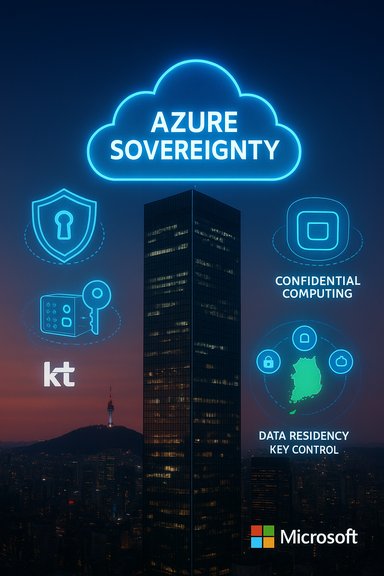
KT Corp.’s new sovereign public cloud — built on Microsoft’s Azure infrastructure and announced this week — is a clear shot across the bow of Korea’s cloud market: it packages confidential computing, managed HSM controls and strict in‑country governance into a commercially supported, multi‑tenant public offering aimed first at financial institutions and manufacturing firms.
South Korea’s regulated industries have long been constrained by stringent data‑residency and separation rules that limited which cloud platforms public and sensitive workloads could use. Over the last two years the government’s tiered Cloud Security Assurance Program (CSAP) and evolving procurement rules have opened the door for global hyperscalers — but only under strict conditions. That regulatory context is the immediate reason KT has chosen to design a sovereign public cloud, and it explains why the company has tightly coupled the platform with Microsoft’s “Cloud for Sovereignty” capabilities. KT and Microsoft’s multi‑year cooperation goes beyond a simple reseller or technology agreement. The two companies framed a broad strategic partnership covering AI, localized LLM development, joint R&D and a sovereign cloud rollout designed to meet Korea’s regulatory and operational expectations. KT’s announcement positions the service as an extension of its existing cloud portfolio — including KT Cloud (CSAP‑certified) and KT’s multi‑cloud managed services — while offering a Microsoft‑backed path for clients to access Azure capabilities inside a governance and locality envelope controlled by a Korean operator.
Yet the offering is not a turnkey cure for all sovereignty fears. The ultimate value will depend on the technical fidelity of the confidential compute and HSM integrations, the contractual clarity around audit and access, and the operational transparency KT and Microsoft provide to independent verifiers. For CIOs and procurement teams, the new sovereign cloud is worth piloting — but only with a disciplined checklist, independent verification and clear exit/backup plans that preserve control over keys, logs and recovery.
The KT‑Microsoft sovereign cloud is a strategic evolution in Korea’s cloud market: it reduces the friction that once separated local regulation from hyperscale innovation, while shifting the hard work to careful engineering, contract design and operational assurance. For companies needing both scale and sovereignty, that is a welcome, if not yet complete, set of options.
Source: The Korea Herald https://www.koreaherald.com/article/10614445/
 Background
South Korea’s regulated industries have long been constrained by stringent data‑residency and separation rules that limited which cloud platforms public and sensitive workloads could use. Over the last two years the government’s tiered Cloud Security Assurance Program (CSAP) and evolving procurement rules have opened the door for global hyperscalers — but only under strict conditions. That regulatory context is the immediate reason KT has chosen to design a sovereign public cloud, and it explains why the company has tightly coupled the platform with Microsoft’s “Cloud for Sovereignty” capabilities. KT and Microsoft’s multi‑year cooperation goes beyond a simple reseller or technology agreement. The two companies framed a broad strategic partnership covering AI, localized LLM development, joint R&D and a sovereign cloud rollout designed to meet Korea’s regulatory and operational expectations. KT’s announcement positions the service as an extension of its existing cloud portfolio — including KT Cloud (CSAP‑certified) and KT’s multi‑cloud managed services — while offering a Microsoft‑backed path for clients to access Azure capabilities inside a governance and locality envelope controlled by a Korean operator. What KT announced and why it matters
KT’s sovereign public cloud is described by the company as a public, multi‑tenant platform running on Azure where data storage, governance and operational controls are localized in Korea and where customers gain enhanced control over resource management and cryptographic keys. The initial go‑to market focuses on regulated sectors — financial services and manufacturing — where data sensitivity, intellectual property protection, and regulatory oversight create strong demand for transparently governed cloud infrastructure. Three design principles were emphasized by KT:- End‑to‑end data protection: Data must remain encrypted and protected at rest, in transit and in use.
- Customer control: Customers must be able to control resource administration and cryptographic keys.
- Localization: Data storage, governance and administrative operations must remain inside Korea.
The technical anatomy: confidential compute + managed HSM
Confidential computing: protecting data while it’s being processed
One of KT’s headline features is the platform’s use of confidential computing, a set of technologies that encrypt data while it is being processed in memory. Confidential computing relies on hardware‑based Trusted Execution Environments (TEEs) — for example Intel SGX, Intel TDX or AMD SEV variants — to create an enclave where application code and data are isolated from the host OS, hypervisor and cloud operator. This means data remains encrypted in memory and is only revealed to the CPU enclave after the platform proves the execution environment is trusted. Azure’s confidential computing portfolio already exposes confidential VMs, confidential containers and enclave SDKs that enable these protections. Why this matters: confidential computing materially reduces one of the long‑standing worries for regulated customers — that sensitive plaintext might be visible to privileged cloud personnel or compromised host software — by creating a verifiable, hardware‑rooted execution envelope.Managed HSM and customer key control
KT’s sovereign cloud also integrates managed Hardware Security Module (HSM) functionality so customers can generate, store and manage their own cryptographic keys while running workloads on Azure infrastructure. Microsoft’s key management options — including Azure Key Vault, Key Vault Managed HSM and Azure Dedicated HSM — offer different tradeoffs between multi‑tenant convenience and single‑tenant key sovereignty. Managed HSM pools provide FIPS‑validated single‑tenant cryptographic domains where keys never leave the HSM boundary and where Microsoft’s operational staff cannot extract plaintext keys. These capabilities enable Bring‑Your‑Own‑Key (BYOK) or external key management patterns that are essential for high‑assurance procurement. The KT platform reportedly stitches these two layers together: confidential compute ensures data is encrypted in use while managed HSMs protect key material in a hardware root‑of‑trust and allow customers or audited custodians to maintain cryptographic control.How the service differs from a standard Azure tenancy
KT’s sovereign offering is not simply “Azure via a local reseller.” The differences being emphasized are operational and contractual as well as technical:- Operational localization: administrative controls, support personnel and governance are located in Korea, with audit logs and governance policies tailored for local regulations.
- Cryptographic separation: keys can be held under customer control or by a trusted, auditable custodian using HSMs, enabling external key management and double‑key patterns.
- Confidential compute by default: targeted use of TEEs for sensitive workloads to reduce privileged‑insider risk.
- Service packaging for regulated buyers: predefined templates, compliance artifacts and procurement terms that aim to satisfy CSAP and sector‑specific controls.
The rollout plan and market positioning
KT plans an initial phased rollout to the financial and manufacturing sectors — industries that combine high data sensitivity, regulatory scrutiny and a need for advanced compute (for analytics, real‑time control systems and AI). After the initial verticals, KT aims to broaden the offering across public sector and enterprise customers that require stronger in‑country controls. The sovereign cloud is positioned as complementary to KT’s existing CSAP‑certified KT Cloud and to customers’ multi‑cloud strategies (including AWS and other global platforms). Strategically, KT is selling more than infrastructure: the company is packaging Microsoft‑backed AI and cloud tools, local engineering expertise, and an AX‑specialized services company to accelerate enterprise migrations and AI adoption. For Microsoft, these arrangements expand Azure’s reach into high‑assurance markets through trusted local operators; for KT, they add a path to monetize its domestic sales channels and regulatory relationships.Strengths: what KT’s approach gets right
- Practical sovereignty model: mixing hyperscaler services with local governance and HSM‑based key custody is a pragmatic compromise that preserves innovation access while meeting many legal and audit demands.
- Confidential compute for high‑assurance workloads: encrypting data in memory closes a frequently cited gap — protection of data while processed by AI models or large analytics jobs. Azure’s confidential compute capabilities are mature enough to support real workloads today.
- HSM-backed key control: managed HSMs provide a hardware root of trust and customer control over keys, enabling BYOK and External Key Management architectures essential for regulated buyers.
- Enterprise go‑to‑market: KT’s local sales, compliance artifacts and CSAP experience (through KT Cloud) lower procurement friction for Korean customers who previously hesitated to use global cloud services.
Risks, trade‑offs and the fine print
The architecture is pragmatic, but it is not a silver bullet. Several non‑trivial risks and tradeoffs exist:- Custodian and third‑party risk: hosting HSMs or relying on a managed custodian still introduces a third party into the trust boundary. Legal process, personnel access and supply‑chain risks need contractual mitigation, audit rights and independent attestation. Labeling a model “sovereign” does not automatically remove judicial or extraterritorial exposure for U.S.‑based suppliers.
- Availability and recovery tradeoffs: customer‑owned keys can be revoked or mismanaged. Revocation is powerful but can render data permanently unreadable if recovery and escrow are not ironed out. High‑availability, cross‑site failover and rekeying strategies must be designed up front.
- Performance and latency: routing cryptographic operations through an external HSM, or running in TEEs, can create latency and throughput impacts. Architects must test real workloads (TDE for high‑throughput databases, TLS termination, high‑frequency key usage) and size HSM capacity appropriately.
- Auditability and independent verification: procurement teams should insist on contractual rights to independent audits, tamper‑evident logs and transparency over operational access — public announcements and governance boards are helpful but do not replace technical attestations.
- Feature parity and timeline risks: “sovereign” offerings sometimes lag mainstream hyperscaler features (new AI SKUs, GPU availability, certain PaaS services) or introduce day‑one gaps. Buyers must obtain a written day‑one service list and test compatibility for critical workloads.
Practical checklist for CIOs and procurement teams
Before moving sensitive workloads to KT’s sovereign public cloud, teams should validate the following:- Confirm the list of Azure services and processor/GPU SKUs available day‑one in the KT sovereign footprint.
- Request independent audit reports (SOC, ISO, FIPS attestation for HSMs) and contractual audit rights for the provider and any HSM custodian.
- Validate key custody model: BYOK import, Managed HSM ownership, revocation semantics, escrow and rekey procedures.
- Test confidential compute flows end‑to‑end: enclave attestation, data‑in‑use encryption, and model inference workflows for performance and correctness.
- Run performance PoCs for critical paths (DB TDE unwraps, TLS handshakes, high‑frequency cryptographic operations).
- Confirm data residency guarantees and procedural constraints on cross‑border access (including Microsoft and KT engineering support access policies).
- Negotiate clear incident response and liability clauses, including timelines and evidence rights for subpoenas or legal requests.
- Define business continuity: cross‑region failover, HSM replication, and key recovery drills.
- Evaluate vendor lock‑in and portability: ability to move keys and workloads to alternate clouds or on‑prem HSMs if needed.
- Check regulatory fit: map workloads to CSAP tiering and sectoral laws (financial supervision acts, personal data protection requirements).
Market implications and competitive landscape
KT’s sovereign public cloud is likely to accelerate cloud adoption in Korea’s regulated verticals by reducing procurement friction and offering a familiar local partner experience layered on Azure technology. That will intensify competition among domestic cloud providers (Naver Cloud, NHN Cloud) and will shape hyperscaler strategies — Microsoft expands Azure’s reach through local operator partnerships, while AWS and Google are pursuing similar sovereign or local‑partner approaches. The net effect should be increased choice for buyers, but also more complex procurement decisions that hinge on auditability and contractual robustness rather than raw feature lists alone. For KT, the strategic upside is clear: the company can leverage decades of domestic sales relationships and regulatory know‑how to capture high‑value enterprise and public sector customers while monetizing Azure capabilities. For Microsoft, KT is a channel and governance partner to penetrate markets where control and locality are essential.What to watch next
- Publication of independent audit and attestation reports for the KT sovereign cloud and any third‑party HSM custodians.
- Day‑one service matrix: which Azure PaaS services, GPU SKUs and AI features will be available immediately within the sovereign environment.
- Reference customers and pilots in banking and manufacturing that demonstrate real‑world latency, availability and regulatory acceptance.
- Contractual appendices defining data‑access notification timelines, cross‑border exceptions and audit rights — the commercial wording will determine how reusable the offering is for public sector tenders.
- Progress on feature parity with mainstream Azure (particularly around AI inference workloads and GPU availability) and the roadmap for adding missing services.
Conclusion
KT’s sovereign public cloud with Microsoft is an important, pragmatic step for Korean regulated markets. It combines Azure’s advanced platform capabilities — particularly confidential computing and HSM‑based key control — with KT’s local governance, procurement experience and sales channels. That combination is potent: it gives banks, manufacturers and public agencies a credible path to adopt cloud and AI without surrendering the controls they need.Yet the offering is not a turnkey cure for all sovereignty fears. The ultimate value will depend on the technical fidelity of the confidential compute and HSM integrations, the contractual clarity around audit and access, and the operational transparency KT and Microsoft provide to independent verifiers. For CIOs and procurement teams, the new sovereign cloud is worth piloting — but only with a disciplined checklist, independent verification and clear exit/backup plans that preserve control over keys, logs and recovery.
The KT‑Microsoft sovereign cloud is a strategic evolution in Korea’s cloud market: it reduces the friction that once separated local regulation from hyperscale innovation, while shifting the hard work to careful engineering, contract design and operational assurance. For companies needing both scale and sovereignty, that is a welcome, if not yet complete, set of options.
Source: The Korea Herald https://www.koreaherald.com/article/10614445/
