

KT said on May 10, 2026, that it participated in NATO CCDCOE’s Locked Shields 2026 cyber defence exercise from April 20 to 24 as part of a South Korea-Hungary joint team, marking the Korean telecom operator’s second consecutive year in the drill. The announcement is not just another corporate security trophy; it is a sign that telecom operators are being pulled deeper into the front line of national cyber resilience. For WindowsForum readers, the interesting part is not the press-release phrase “global-level response capabilities.” It is that the systems being defended now look much more like the messy hybrid estate that real administrators already run: Windows servers, web services, satellite links, 5G networks, forensics queues, and service-continuity plans under pressure.
Locked Shields has always been sold as a cyber exercise, but that description undersells what it has become. The NATO Cooperative Cyber Defence Centre of Excellence in Tallinn describes it as the world’s largest and most complex live-fire cyber defence exercise, held annually since 2010 and built around national teams defending simulated critical infrastructure against coordinated attacks. In 2026, the exercise involved more than 4,000 cyber defenders from 41 nations, with teams responding to thousands of attacks against systems such as power grids, 5G networks, satellite infrastructure, battle-management platforms, and election systems.
That context matters because KT is not a niche cybersecurity vendor showing off a tool in a controlled lab. It is a national backbone communications operator, which means its everyday business already sits at the uncomfortable intersection of civilian dependency, military relevance, public safety, and economic continuity. When a telecom company trains in a NATO-run scenario, it is rehearsing the kind of event where the network is not merely a target but also the recovery path for everyone else.
KT’s participation for a second straight year suggests that the company sees Locked Shields less as a one-off prestige exercise and more as a proving ground. Last year, KT joined a South Korea-Canada team and defended a fictional country’s 5G network and critical information and communications infrastructure. This year, it moved into a South Korea-Hungary joint team and worked across satellite communications infrastructure, Windows server security, web service security, and digital forensics and incident response.
That shift is revealing. The story is not “KT did cyber.” The story is that a telecom operator is testing whether its security organization can work across the stack when the stack is being deliberately broken.
The 2026 scenario used the fictional ally Berylia, a familiar construct in the exercise’s world, but the systems inside that fiction keep getting more recognizable. The NATO CCDCOE said this year’s attacks targeted power grids, 5G networks, satellite and battle-management systems, and an election system. That is not a random grab bag of dramatic infrastructure. It is a map of how modern states actually fail when digital dependencies are attacked together rather than one by one.
For a company like KT, that integrated pressure is the point. A telecom operator can have strong perimeter controls, capable security analysts, and well-written incident-response plans, yet still discover during a crisis that the real bottleneck is coordination. Does the security team know what the network operations team can safely shut down? Does legal know when an incident has crossed a reporting threshold? Does management understand the trade-off between preserving evidence and restoring service? Does the communications team know what can be said without creating new operational risk?
The public material from KT emphasizes digital forensics and incident response, where the company reportedly posted strong results. That is meaningful because DFIR is the discipline that turns chaos into sequence. In a real incident, defenders rarely begin with a clean diagram and a known adversary. They begin with conflicting alerts, partial logs, executive pressure, and the possibility that the systems used for investigation are themselves compromised.
Locked Shields is designed to make that discomfort unavoidable. The winning team is not simply the one that blocks the most packets. It is the one that keeps enough of the fictional country running while proving, under stress, that it understands what happened.
That is why the Windows angle in this story deserves more than a passing mention. The modern enterprise attack chain often begins with something ordinary: a stolen credential, an exposed service, a misconfigured server, a vulnerable web application, an over-permissioned account, or a weak segmentation boundary. From there, attackers look for the systems that let them turn a foothold into control.
A telecom operator’s Windows estate is not just office IT. It can be tied into customer systems, billing platforms, monitoring dashboards, identity services, operational tools, and the administrative plane for network functions. Even where the packet-moving infrastructure is not Windows-based, the humans and workflows around that infrastructure often are.
The uncomfortable lesson for administrators is that “critical infrastructure” is not protected by being exotic. It is often endangered by being familiar. The server nobody wants to patch because it supports a legacy workflow may become the route into something far more important than its hostname suggests.
KT’s involvement in Windows server security during Locked Shields therefore lands close to home for the WindowsForum audience. It is a reminder that cyber resilience is not built only in specialist appliances and classified rooms. It is built in Group Policy hygiene, credential tiering, logging discipline, patch cadence, backup validation, least privilege, and the willingness to treat administrative convenience as a risk factor.
That interaction is where the value lies. A red team that merely proves it can break in produces drama. A red team that forces the blue team, infrastructure owners, and executives to close specific gaps produces resilience.
The distinction matters because many organizations still treat offensive testing as a periodic exam rather than a feedback loop. They hire testers, receive a report, patch the most embarrassing findings, and then return to business as usual. That model is too slow for environments where attackers automate reconnaissance, credential attacks, exploit chaining, and evasion.
KT says its Red Team tests possible intrusion routes and defence responsiveness based on the tactics and attack techniques used by real hacking groups. If that process is tied to blue-team improvements, it can help answer the question that matters most after any expensive security investment: not whether the control exists, but whether it works when an attacker behaves like an attacker.
For telecom operators, that question has national implications. A mobile or backbone network can be hardened in theory and still fail operationally if defenders cannot identify which alerts matter, isolate affected systems without cascading outages, or recover service without reintroducing the intruder. Locked Shields compresses those dilemmas into a staged crisis, but the underlying management problem is real.
The mature version of red-team culture is not “we got domain admin.” It is “we found the path, changed the architecture, improved detection, rehearsed containment, and verified the fix.” KT’s public framing suggests it wants to be seen in that second category. The proof, as always, will be whether exercise lessons turn into durable changes rather than slide-deck confidence.
Automated vulnerability discovery, phishing at scale, malware variation, log evasion, and target-specific reconnaissance all become more dangerous when attackers can reduce the cost of iteration. The defender’s problem is not only better malware. It is less time to notice weak signals before they turn into operational impact.
KT says it is strengthening systems to automate vulnerability assessments, improve analysis efficiency, and raise verification quality. That is the right direction, provided automation does not become another dashboard that creates work without closing risk. Vulnerability management has long suffered from the gap between identifying problems and actually reducing exposure. AI can widen that gap if it produces more findings than teams can prioritize, or it can narrow it if it helps defenders connect vulnerabilities to business-critical paths.
The more interesting phrase in KT’s announcement is Cyber Resilience. The company says it is focusing beyond simple detection and blocking toward maintaining service continuity even after an incident occurs. That is the modern standard, and it is much harder than buying another prevention tool.
Resilience assumes breach, degradation, and uncertainty. It asks how long the organization can continue providing essential services while parts of the environment are distrusted, under investigation, or being rebuilt. For a telecom operator, that question cannot be answered only by the security office. It belongs to network engineering, infrastructure, business continuity, executive leadership, suppliers, and regulators.
This is where Locked Shields becomes strategically useful. A live-fire exercise makes it harder to pretend that incident response is a binder, a ticket queue, or a tabletop meeting with sandwiches. It exposes whether teams can preserve mission function when the clean-room assumptions vanish.
That public-private-military mix is significant. Cyber defence in a country like South Korea cannot be handled as a purely military function because much of the infrastructure that matters is privately operated. Telecom networks, cloud platforms, banks, hospitals, industrial systems, software vendors, and managed service providers all shape national resilience.
KT’s role as the only domestic telecom operator in the 2026 South Korean contingent therefore carries weight. It means the exercise included an operator with direct experience maintaining national communications infrastructure, not just agencies that regulate or defend it. That matters because cyber war-game scenarios can drift into abstraction if they lack participants who understand how systems behave at scale.
The South Korea-Hungary team-up also illustrates one of Locked Shields’ more practical functions: it forces multinational coordination before a real crisis demands it. Countries that do not share identical legal systems, languages, network architectures, or operational cultures must still defend a common scenario. That kind of friction is not a bug. It is the rehearsal.
In a real cross-border incident, no one gets to wait until the org chart is elegant. Providers, governments, vendors, and allies must exchange enough information quickly enough to reduce harm without leaking sensitive details or creating panic. Exercises like Locked Shields cannot solve that problem, but they can make the weak points visible before adversaries do.
That is especially true as 5G, satellite communications, edge computing, and software-defined networking blur old boundaries. A telecom provider is no longer just switching calls and moving packets. It is operating a programmable, virtualized, highly interdependent environment that can host enterprise services, connect operational technology, support government systems, and enable battlefield communications.
This expands the attack surface. It also expands the consequence of administrative mistakes. A misconfiguration in a management plane, a compromised supplier credential, or a vulnerable web service may have effects that would once have been limited to an IT application but now touch service availability across a wide area.
KT’s Locked Shields role across satellite communications, Windows servers, web services, and DFIR reflects that convergence. These are not separate kingdoms. They are the layers through which modern incidents propagate.
For sysadmins and security teams, the lesson is that resilience planning cannot stop at the boundary of “our servers.” Your organization depends on carriers, cloud platforms, identity providers, DNS, certificate authorities, software update channels, and managed security tools. Every dependency is a potential point of failure, and every recovery plan should ask what happens when one of those dependencies is degraded or untrusted.
Exercises have a tendency to produce two kinds of output. The first is external: press releases, photos, and phrases about global capability. The second is internal: painful notes about missing logs, unclear authority, brittle systems, confused escalation paths, incomplete asset inventories, untested backups, and tools that work well until the network is under stress. The second output is the valuable one.
For Windows-heavy environments, institutional memory often fails at the boring layer. Teams learn that privileged access is too broad, but exceptions remain. They learn that logs are incomplete, but storage budgets win. They learn that incident-response authority is unclear, but no one wants to rewrite the escalation model. They learn that backups exist, but restoration under adversarial conditions has not been practiced.
The point of Locked Shields is not to simulate a Hollywood cyberattack. It is to make these operational truths visible in a setting where failure is safe enough to study. If KT translates its experience into sharper detection engineering, better segmentation, stronger Windows hardening, improved forensic readiness, and tested continuity plans, then the exercise has value beyond the scoreboard.
That conversion is the hard part. Security organizations are often good at learning lessons and less good at forcing the rest of the enterprise to pay for them. A telecom provider has an advantage here because its leadership already understands uptime as a core product. The challenge is to make cyber resilience part of uptime rather than a separate compliance function.
The connective tissue is operational dependency. Whether the target is a telecom backbone or a regional manufacturer, attackers look for identity systems, exposed services, privileged accounts, weak monitoring, flat networks, and recovery gaps. They exploit the distance between what architecture diagrams claim and what production environments actually contain.
Windows Server remains central because it often carries the keys to the rest of the estate. Active Directory, certificate services, remote management, file shares, application servers, and administrative workstations create pathways that attackers understand extremely well. Defenders who treat Windows hardening as routine maintenance rather than strategic defence are leaving one of the most important doors half open.
KT’s participation also reinforces the importance of DFIR readiness before the incident begins. Forensics is not something an organization “does” after a breach if the logs were never collected, clocks were not synchronized, endpoint telemetry was incomplete, and administrators overwrote evidence while trying to restore service. The ability to understand an attack is engineered ahead of time.
The practical implication for IT pros is uncomfortable but useful: cyber resilience is mostly built before the exciting part starts. It is built when teams remove stale admin rights, test restore procedures, document dependencies, isolate management networks, patch exposed systems, and rehearse who gets to make decisions when normal approval chains are too slow.
That matters because telecom operators are increasingly judged by their ability to keep society functioning under degraded conditions. The next major cyber crisis may not look like a clean data breach. It may look like intermittent service failures, manipulated systems, stolen credentials, disinformation pressure, regulatory notifications, and executive decisions made while defenders still do not know the full blast radius.
In that kind of crisis, the difference between detection and resilience becomes stark. Detection tells you something is wrong. Resilience determines whether customers, government agencies, emergency services, and downstream businesses can keep operating while you find out how wrong it is.
KT’s focus on Red Team and Blue Team collaboration, automated vulnerability assessment, DFIR, and service continuity lines up with that reality. The company’s public statement is polished, as corporate statements always are, but the underlying direction is the right one. The network is too important to defend only at the perimeter, and too complex to recover by improvisation.
The wider industry should read this as a signal. Telecoms, cloud providers, software vendors, and large enterprises are all being pushed toward the same standard: assume adversaries are fast, assume infrastructure is interconnected, assume public trust is part of the incident, and assume recovery matters as much as prevention.
Source: 디지털투데이 KT joins NATO Locked Shields cyber drill for second straight year
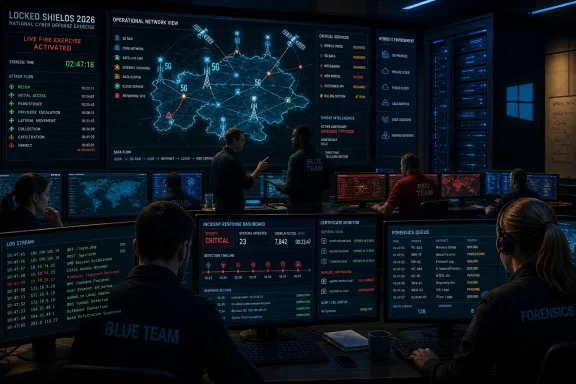 A Telecom Operator Walks Into a War Game and Finds Its Real Job
Locked Shields has always been sold as a cyber exercise, but that description undersells what it has become. The NATO Cooperative Cyber Defence Centre of Excellence in Tallinn describes it as the world’s largest and most complex live-fire cyber defence exercise, held annually since 2010 and built around national teams defending simulated critical infrastructure against coordinated attacks. In 2026, the exercise involved more than 4,000 cyber defenders from 41 nations, with teams responding to thousands of attacks against systems such as power grids, 5G networks, satellite infrastructure, battle-management platforms, and election systems.That context matters because KT is not a niche cybersecurity vendor showing off a tool in a controlled lab. It is a national backbone communications operator, which means its everyday business already sits at the uncomfortable intersection of civilian dependency, military relevance, public safety, and economic continuity. When a telecom company trains in a NATO-run scenario, it is rehearsing the kind of event where the network is not merely a target but also the recovery path for everyone else.
KT’s participation for a second straight year suggests that the company sees Locked Shields less as a one-off prestige exercise and more as a proving ground. Last year, KT joined a South Korea-Canada team and defended a fictional country’s 5G network and critical information and communications infrastructure. This year, it moved into a South Korea-Hungary joint team and worked across satellite communications infrastructure, Windows server security, web service security, and digital forensics and incident response.
That shift is revealing. The story is not “KT did cyber.” The story is that a telecom operator is testing whether its security organization can work across the stack when the stack is being deliberately broken.
Locked Shields Is No Longer Just a Technical Contest
For years, live-fire cyber exercises were mostly discussed as if they were capture-the-flag events with better branding. That framing is now badly out of date. Locked Shields still has a technical core, but its value increasingly comes from making teams defend infrastructure while also handling legal issues, communications pressure, operational decisions, and incomplete information.The 2026 scenario used the fictional ally Berylia, a familiar construct in the exercise’s world, but the systems inside that fiction keep getting more recognizable. The NATO CCDCOE said this year’s attacks targeted power grids, 5G networks, satellite and battle-management systems, and an election system. That is not a random grab bag of dramatic infrastructure. It is a map of how modern states actually fail when digital dependencies are attacked together rather than one by one.
For a company like KT, that integrated pressure is the point. A telecom operator can have strong perimeter controls, capable security analysts, and well-written incident-response plans, yet still discover during a crisis that the real bottleneck is coordination. Does the security team know what the network operations team can safely shut down? Does legal know when an incident has crossed a reporting threshold? Does management understand the trade-off between preserving evidence and restoring service? Does the communications team know what can be said without creating new operational risk?
The public material from KT emphasizes digital forensics and incident response, where the company reportedly posted strong results. That is meaningful because DFIR is the discipline that turns chaos into sequence. In a real incident, defenders rarely begin with a clean diagram and a known adversary. They begin with conflicting alerts, partial logs, executive pressure, and the possibility that the systems used for investigation are themselves compromised.
Locked Shields is designed to make that discomfort unavoidable. The winning team is not simply the one that blocks the most packets. It is the one that keeps enough of the fictional country running while proving, under stress, that it understands what happened.
Windows Server Security Still Sits in the Blast Radius
KT’s stated role included Windows server security, which may sound mundane compared with satellite communications or AI-enabled attacks. It is not. In critical infrastructure, Windows servers remain deeply embedded in identity, administration, file services, monitoring platforms, application hosting, and operational support environments. If an attacker can compromise Active Directory, abuse privileged credentials, or move laterally through Windows management infrastructure, the glamour systems become much easier to reach.That is why the Windows angle in this story deserves more than a passing mention. The modern enterprise attack chain often begins with something ordinary: a stolen credential, an exposed service, a misconfigured server, a vulnerable web application, an over-permissioned account, or a weak segmentation boundary. From there, attackers look for the systems that let them turn a foothold into control.
A telecom operator’s Windows estate is not just office IT. It can be tied into customer systems, billing platforms, monitoring dashboards, identity services, operational tools, and the administrative plane for network functions. Even where the packet-moving infrastructure is not Windows-based, the humans and workflows around that infrastructure often are.
The uncomfortable lesson for administrators is that “critical infrastructure” is not protected by being exotic. It is often endangered by being familiar. The server nobody wants to patch because it supports a legacy workflow may become the route into something far more important than its hostname suggests.
KT’s involvement in Windows server security during Locked Shields therefore lands close to home for the WindowsForum audience. It is a reminder that cyber resilience is not built only in specialist appliances and classified rooms. It is built in Group Policy hygiene, credential tiering, logging discipline, patch cadence, backup validation, least privilege, and the willingness to treat administrative convenience as a risk factor.
Red Teams Are Useful Only When Blue Teams Are Allowed to Change
KT’s announcement puts notable emphasis on its Red Team, the specialist organization that tests security systems from the perspective of a real attacker. In corporate cybersecurity messaging, “red team” can become a prestige label, a way to signal maturity without saying much about what changes afterward. The more important part of KT’s description is that its Red Team works with the Blue Team responsible for detection, monitoring, and incident response to confirm the effectiveness of the overall security system.That interaction is where the value lies. A red team that merely proves it can break in produces drama. A red team that forces the blue team, infrastructure owners, and executives to close specific gaps produces resilience.
The distinction matters because many organizations still treat offensive testing as a periodic exam rather than a feedback loop. They hire testers, receive a report, patch the most embarrassing findings, and then return to business as usual. That model is too slow for environments where attackers automate reconnaissance, credential attacks, exploit chaining, and evasion.
KT says its Red Team tests possible intrusion routes and defence responsiveness based on the tactics and attack techniques used by real hacking groups. If that process is tied to blue-team improvements, it can help answer the question that matters most after any expensive security investment: not whether the control exists, but whether it works when an attacker behaves like an attacker.
For telecom operators, that question has national implications. A mobile or backbone network can be hardened in theory and still fail operationally if defenders cannot identify which alerts matter, isolate affected systems without cascading outages, or recover service without reintroducing the intruder. Locked Shields compresses those dilemmas into a staged crisis, but the underlying management problem is real.
The mature version of red-team culture is not “we got domain admin.” It is “we found the path, changed the architecture, improved detection, rehearsed containment, and verified the fix.” KT’s public framing suggests it wants to be seen in that second category. The proof, as always, will be whether exercise lessons turn into durable changes rather than slide-deck confidence.
AI Raises the Tempo, but Resilience Still Wins the Day
KT also tied its security strategy to the possibility of AI-based attack automation. That is now a familiar line in cybersecurity statements, but it is not meaningless. The risk is not that artificial intelligence magically invents entirely new categories of intrusion overnight. The nearer-term risk is that it increases the speed, scale, and adaptability of what attackers already do.Automated vulnerability discovery, phishing at scale, malware variation, log evasion, and target-specific reconnaissance all become more dangerous when attackers can reduce the cost of iteration. The defender’s problem is not only better malware. It is less time to notice weak signals before they turn into operational impact.
KT says it is strengthening systems to automate vulnerability assessments, improve analysis efficiency, and raise verification quality. That is the right direction, provided automation does not become another dashboard that creates work without closing risk. Vulnerability management has long suffered from the gap between identifying problems and actually reducing exposure. AI can widen that gap if it produces more findings than teams can prioritize, or it can narrow it if it helps defenders connect vulnerabilities to business-critical paths.
The more interesting phrase in KT’s announcement is Cyber Resilience. The company says it is focusing beyond simple detection and blocking toward maintaining service continuity even after an incident occurs. That is the modern standard, and it is much harder than buying another prevention tool.
Resilience assumes breach, degradation, and uncertainty. It asks how long the organization can continue providing essential services while parts of the environment are distrusted, under investigation, or being rebuilt. For a telecom operator, that question cannot be answered only by the security office. It belongs to network engineering, infrastructure, business continuity, executive leadership, suppliers, and regulators.
This is where Locked Shields becomes strategically useful. A live-fire exercise makes it harder to pretend that incident response is a binder, a ticket queue, or a tabletop meeting with sandwiches. It exposes whether teams can preserve mission function when the clean-room assumptions vanish.
South Korea’s Cyber Role Is Moving From Regional Concern to Alliance Practice
South Korea’s participation is also part of a larger geopolitical story. The country joined the NATO CCDCOE in 2022 as the centre’s first Asian member, a move that reflected both Seoul’s advanced digital economy and its exposure to persistent state-linked cyber threats. In 2026, South Korea reportedly sent more than 170 experts from 47 public, private, and military organizations to Locked Shields.That public-private-military mix is significant. Cyber defence in a country like South Korea cannot be handled as a purely military function because much of the infrastructure that matters is privately operated. Telecom networks, cloud platforms, banks, hospitals, industrial systems, software vendors, and managed service providers all shape national resilience.
KT’s role as the only domestic telecom operator in the 2026 South Korean contingent therefore carries weight. It means the exercise included an operator with direct experience maintaining national communications infrastructure, not just agencies that regulate or defend it. That matters because cyber war-game scenarios can drift into abstraction if they lack participants who understand how systems behave at scale.
The South Korea-Hungary team-up also illustrates one of Locked Shields’ more practical functions: it forces multinational coordination before a real crisis demands it. Countries that do not share identical legal systems, languages, network architectures, or operational cultures must still defend a common scenario. That kind of friction is not a bug. It is the rehearsal.
In a real cross-border incident, no one gets to wait until the org chart is elegant. Providers, governments, vendors, and allies must exchange enough information quickly enough to reduce harm without leaking sensitive details or creating panic. Exercises like Locked Shields cannot solve that problem, but they can make the weak points visible before adversaries do.
The Telecom Network Is Becoming a Strategic Platform, Not a Utility Pipe
The reason telecom participation matters so much is that the network has stopped being a neutral background service. It is now the platform for emergency response, military mobility, remote administration, cloud access, financial transactions, industrial monitoring, and public communication. When the network fails, other recovery plans fail with it.That is especially true as 5G, satellite communications, edge computing, and software-defined networking blur old boundaries. A telecom provider is no longer just switching calls and moving packets. It is operating a programmable, virtualized, highly interdependent environment that can host enterprise services, connect operational technology, support government systems, and enable battlefield communications.
This expands the attack surface. It also expands the consequence of administrative mistakes. A misconfiguration in a management plane, a compromised supplier credential, or a vulnerable web service may have effects that would once have been limited to an IT application but now touch service availability across a wide area.
KT’s Locked Shields role across satellite communications, Windows servers, web services, and DFIR reflects that convergence. These are not separate kingdoms. They are the layers through which modern incidents propagate.
For sysadmins and security teams, the lesson is that resilience planning cannot stop at the boundary of “our servers.” Your organization depends on carriers, cloud platforms, identity providers, DNS, certificate authorities, software update channels, and managed security tools. Every dependency is a potential point of failure, and every recovery plan should ask what happens when one of those dependencies is degraded or untrusted.
The Exercise Result Matters Less Than the Institutional Memory
KT says it achieved strong results in DFIR during Locked Shields 2026. That is good news for the company, but rankings and performance claims are the least durable part of any exercise. What matters is whether the lessons survive the return to normal operations.Exercises have a tendency to produce two kinds of output. The first is external: press releases, photos, and phrases about global capability. The second is internal: painful notes about missing logs, unclear authority, brittle systems, confused escalation paths, incomplete asset inventories, untested backups, and tools that work well until the network is under stress. The second output is the valuable one.
For Windows-heavy environments, institutional memory often fails at the boring layer. Teams learn that privileged access is too broad, but exceptions remain. They learn that logs are incomplete, but storage budgets win. They learn that incident-response authority is unclear, but no one wants to rewrite the escalation model. They learn that backups exist, but restoration under adversarial conditions has not been practiced.
The point of Locked Shields is not to simulate a Hollywood cyberattack. It is to make these operational truths visible in a setting where failure is safe enough to study. If KT translates its experience into sharper detection engineering, better segmentation, stronger Windows hardening, improved forensic readiness, and tested continuity plans, then the exercise has value beyond the scoreboard.
That conversion is the hard part. Security organizations are often good at learning lessons and less good at forcing the rest of the enterprise to pay for them. A telecom provider has an advantage here because its leadership already understands uptime as a core product. The challenge is to make cyber resilience part of uptime rather than a separate compliance function.
The Windows Admin’s Stake in a NATO Cyber Drill
It would be easy for a Windows administrator in a midsize business to read about KT, NATO, satellite systems, and national backbone networks and decide this story belongs to someone else. That would be a mistake. The same attack patterns that appear in national exercises eventually show up in ordinary enterprise incidents, minus the dramatic fictional country.The connective tissue is operational dependency. Whether the target is a telecom backbone or a regional manufacturer, attackers look for identity systems, exposed services, privileged accounts, weak monitoring, flat networks, and recovery gaps. They exploit the distance between what architecture diagrams claim and what production environments actually contain.
Windows Server remains central because it often carries the keys to the rest of the estate. Active Directory, certificate services, remote management, file shares, application servers, and administrative workstations create pathways that attackers understand extremely well. Defenders who treat Windows hardening as routine maintenance rather than strategic defence are leaving one of the most important doors half open.
KT’s participation also reinforces the importance of DFIR readiness before the incident begins. Forensics is not something an organization “does” after a breach if the logs were never collected, clocks were not synchronized, endpoint telemetry was incomplete, and administrators overwrote evidence while trying to restore service. The ability to understand an attack is engineered ahead of time.
The practical implication for IT pros is uncomfortable but useful: cyber resilience is mostly built before the exciting part starts. It is built when teams remove stale admin rights, test restore procedures, document dependencies, isolate management networks, patch exposed systems, and rehearse who gets to make decisions when normal approval chains are too slow.
The Signal Inside KT’s Second Locked Shields Run
KT’s second consecutive Locked Shields appearance is not proof that the company is immune to serious incidents. No exercise can prove that. What it does show is that KT wants its security posture measured against multinational, multi-domain pressure rather than only domestic compliance expectations or vendor-led benchmarks.That matters because telecom operators are increasingly judged by their ability to keep society functioning under degraded conditions. The next major cyber crisis may not look like a clean data breach. It may look like intermittent service failures, manipulated systems, stolen credentials, disinformation pressure, regulatory notifications, and executive decisions made while defenders still do not know the full blast radius.
In that kind of crisis, the difference between detection and resilience becomes stark. Detection tells you something is wrong. Resilience determines whether customers, government agencies, emergency services, and downstream businesses can keep operating while you find out how wrong it is.
KT’s focus on Red Team and Blue Team collaboration, automated vulnerability assessment, DFIR, and service continuity lines up with that reality. The company’s public statement is polished, as corporate statements always are, but the underlying direction is the right one. The network is too important to defend only at the perimeter, and too complex to recover by improvisation.
The wider industry should read this as a signal. Telecoms, cloud providers, software vendors, and large enterprises are all being pushed toward the same standard: assume adversaries are fast, assume infrastructure is interconnected, assume public trust is part of the incident, and assume recovery matters as much as prevention.
The Drill’s Real Message Is Written in Admin Work
KT’s Locked Shields appearance is a geopolitical story, a telecom story, and a Windows security story at the same time. The most concrete lesson is that high-end cyber defence increasingly depends on basic operational competence executed under pressure.- KT participated in Locked Shields for the second consecutive year, joining a South Korea-Hungary team in 2026 after working with a South Korea-Canada team in 2025.
- Locked Shields 2026 brought together more than 4,000 defenders from 41 nations and simulated attacks against critical infrastructure including 5G, satellite, power, military, and election-related systems.
- KT’s role included satellite communications infrastructure, Windows server security, web service security, and digital forensics and incident response.
- The company’s emphasis on Red Team and Blue Team collaboration reflects a broader shift from finding vulnerabilities to validating whether defences actually work.
- The move toward Cyber Resilience means service continuity after compromise is becoming as important as blocking the initial attack.
Source: 디지털투데이 KT joins NATO Locked Shields cyber drill for second straight year
