

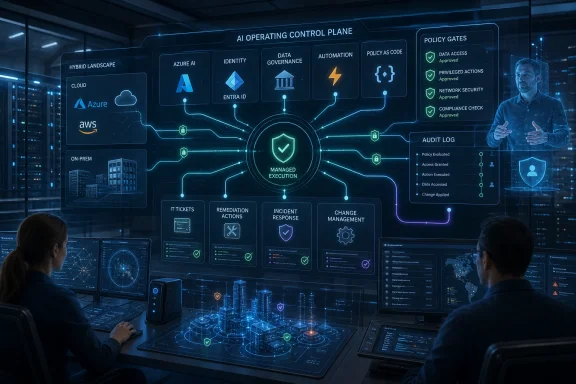
Kyndryl and Microsoft are pitching a May 2026 enterprise AI model that combines Kyndryl’s operational services, Agentic AI Framework, Digital Trust governance, and Bridge platform with Microsoft Azure, Azure AI, security, data, and productivity services to move AI from pilots into managed business execution. The important word is not AI but managed. This is not another promise that a chatbot will make the enterprise faster by magic. It is a bet that the next phase of AI adoption will look less like innovation theater and more like infrastructure operations: governed, monitored, auditable, and wired into the systems that already run the business.
That framing matters because the enterprise AI market has reached the point where ambition is cheap and operational discipline is scarce. Boards want productivity, regulators want accountability, employees want tools that do not create more work, and CIOs are being asked to modernize decades of technical debt without breaking the systems that keep money, healthcare, logistics, energy, and government services moving. Kyndryl and Microsoft are trying to occupy the uncomfortable but valuable space between the demo and the durable operating model.
The first wave of generative AI inside big companies was defined by access. Give employees a copilot, connect a model to a document library, test a customer-service assistant, and see what happens. That was rational enough in 2023 and 2024, when the technology was moving faster than procurement cycles and most organizations had no internal vocabulary for model behavior, prompt governance, retrieval pipelines, or agent authorization.
But access is no longer the hard part. The harder problem is deciding which AI systems should be allowed to act, on what data, under whose authority, with what controls, and with what rollback plan when something goes wrong. The industry’s favorite word for this next phase is agentic, but the less fashionable phrase is the more accurate one: operational delegation.
Kyndryl’s argument, as presented in its latest Microsoft-focused AI messaging, is that enterprises should not treat AI as a sidecar bolted onto existing modernization projects. They should treat it as an operating capability that spans data, security, workflows, human oversight, and continuous service management. That is consultant language, yes, but it points to a real shift in buyer behavior.
A model that summarizes emails can be deployed like software. A model that changes a ticket priority, rewrites a runbook, initiates remediation, or routes a compliance-sensitive workflow needs to be deployed like part of the control plane. That distinction is where many enterprise AI projects are now getting stuck.
That is why the company keeps returning to its run-transform-run operating model. In plain English, Kyndryl is saying it can keep old systems stable while modernizing them, then run the modernized environment after the transformation. For AI, that is a more important claim than it may first appear. Enterprises do not merely need proof that an AI workflow can be built; they need proof that it can be governed on Tuesday morning during a regional outage, a security incident, or a quarter-end close.
The pitch is especially relevant because AI projects often fail at the seams between systems. A proof of concept can work beautifully against a curated data set and then collapse when confronted with duplicate records, inconsistent permissions, brittle APIs, missing documentation, and business rules that live in the heads of three senior employees. Kyndryl’s proposition is that it can expose those seams through operational telemetry and consulting patterns, then turn them into repeatable modernization work.
This is where Kyndryl Bridge becomes strategically important. The company describes Bridge as an AI-powered open integration platform that provides operational intelligence across customer estates. In the Microsoft context, Bridge is being positioned as a way to understand system dependencies, ingest code and policies, and feed that knowledge into AI-driven workflows that can act across IT and business processes.
There is a sharp commercial logic here. Microsoft owns the platform gravity; Kyndryl wants to own the operational translation layer. Azure can provide compute, identity, security tooling, data services, AI development environments, and productivity integration. Kyndryl can tell the enterprise what is safe to connect, what should be modernized first, and where an agent should be allowed to touch production.
That is why the Kyndryl message emphasizes integration across cloud infrastructure, data, AI, security, and productivity. Microsoft does not want AI to be a special project living in an innovation lab. It wants AI to show up in the places work already happens: Microsoft 365, Teams, Dynamics, Azure operations, developer platforms, security consoles, and business process systems.
For WindowsForum readers, this is the practical Microsoft angle. The future Microsoft is selling to enterprise customers is not just a smarter Office or a more capable Azure AI Foundry. It is an environment in which identity, policy, data governance, endpoint posture, cloud telemetry, and workflow automation are all inputs into AI-assisted action. That can be powerful, but it also raises the cost of poor architecture.
If permissions are sloppy, AI scales sloppiness. If data estates are fragmented, AI becomes an expensive interface to fragmentation. If business processes are undocumented, agents can automate confusion faster than humans can correct it. Microsoft’s integrated platform helps only if the enterprise has done the hard work of organizing the estate around trust, data quality, and operational ownership.
That is the hole Kyndryl is trying to fill. It is not saying, “Use Azure and AI will work.” It is saying, “Use Azure as the foundation, then impose an operating model capable of making AI work under real enterprise constraints.” The distinction is the difference between a product sale and a managed transformation program.
Kyndryl’s Agentic AI Framework is aimed at that runtime challenge. The company has described capabilities such as ingesting code, policies, and system interdependencies so agents can operate with an understanding of the environment rather than as isolated model calls. It has also been promoting Agentic AI Digital Trust as a way to provide visibility into how AI agents make decisions and to support governance of agents at scale.
The important concept is not that AI agents need more dashboards. It is that enterprises need enforceable boundaries. An agent that recommends a remediation step is one class of risk. An agent that executes the remediation across a hybrid environment is another. An agent that does so while touching regulated data, production systems, or third-party dependencies is another again.
Kyndryl’s recent messaging around policy-governed workflows and “policy as code” fits this pattern. The idea is to express organizational rules, compliance constraints, and operational limits in machine-readable form so that agents operate inside defined boundaries. That is likely to become one of the defining enterprise AI patterns, because manual governance cannot keep pace with autonomous workflow execution.
But this is also where customers should stay skeptical. Visibility into agent decisions is not the same as accountability. Policy enforcement is not the same as business judgment. And “human in the loop” can become a comforting phrase that masks unclear ownership if the human is overloaded, undertrained, or asked to approve actions they cannot reasonably evaluate.
That is a far more difficult ambition. It requires reusable patterns, reference architectures, change management, risk classification, service management integration, data controls, and metrics that can survive beyond a single executive sponsor. It also requires saying no to use cases that are technically possible but operationally reckless.
Kyndryl’s advisory, implementation, and managed services framing is designed to meet that need. The company wants to help customers assess their estates, identify modernization opportunities, implement AI workflows on Microsoft technologies, and then manage the environment once it is live. In other words, Kyndryl is not merely chasing AI project revenue; it is trying to convert AI transformation into a long-term operations business.
That matters because enterprise AI value often depends less on model sophistication than on organizational absorption. A workflow that saves ten minutes per employee per week is not valuable if nobody trusts it, if it violates data policy, or if the savings vanish into exception handling. A remediation agent that prevents outages is valuable only if it is integrated with incident management, identity controls, observability, and escalation paths.
The winners in enterprise AI may therefore be the companies that make AI less exotic. The more AI becomes a standard operating capability, the more demand shifts toward governance, integration, assurance, and lifecycle management. That is a market Kyndryl understands better than it understands consumer AI glamour.
That is a subtle but important reversal of some AI hype. The fantasy version says AI will reduce the need for technical plumbing. The enterprise version says AI makes the plumbing more consequential because agents can amplify whatever the plumbing permits. A poorly scoped service account is no longer just a bad practice; it may become an action surface for automated workflows.
For Windows estates, this means familiar disciplines return with new urgency. Active Directory hygiene, Entra ID configuration, device compliance, Defender telemetry, Microsoft Purview policies, Intune management, and Azure governance all become part of the AI readiness conversation. AI does not replace these controls. It consumes them.
This is why Microsoft’s platform advantage is real. The company can connect productivity data, identity, security signals, cloud resources, and developer tooling in ways that few competitors can match inside Microsoft-heavy enterprises. But that advantage also creates concentration risk. If a customer’s AI operating model is deeply tied to Microsoft’s stack, architectural decisions made today may shape switching costs for years.
Kyndryl’s involvement may soften that risk if it acts as a genuine integrator across hybrid and multi-cloud estates. But customers should pay attention to where governance logic lives, where telemetry is stored, how portable workflows are, and whether operational knowledge becomes locked into proprietary service layers. The promise of an open integration platform should be tested in procurement language, not accepted as a slogan.
In those environments, the question is not whether AI can write a ticket summary. It is whether AI can reduce downtime, accelerate recovery, detect operational risk, support compliance evidence, improve service management, and help scarce experts manage systems that have become too complex for manual oversight alone. That is the heart of Kyndryl’s positioning.
The company’s emphasis on resiliency and mission-critical systems is not accidental. Enterprise buyers have seen enough demos. They want to know whether AI can make production safer, cheaper, and more responsive without introducing new categories of failure. That is a different standard from the one used to judge consumer AI assistants.
Digital trust becomes a commercial necessity in this world. If an AI agent recommends a change to a payment system, a manufacturing control process, or a healthcare workflow, the organization needs a record of what happened, why it happened, what data was used, what policy allowed it, and who retained authority. Without that, the agent is not an enterprise asset. It is an audit problem waiting to happen.
If agents can execute parts of IT operations and business workflows, organizations will need to redraw the boundaries between human judgment, automated execution, and supervised exception handling. Some roles will become more analytical. Some will become more supervisory. Some low-level coordination work will disappear. Some new work will emerge around policy design, agent testing, workflow monitoring, and evidence review.
This is where AI operating models become political inside companies. A pilot can be celebrated without threatening anyone’s org chart. A scaled operating capability changes budgets, responsibilities, escalation paths, and performance measures. That is why Kyndryl’s change-management and consulting components are not decorative; they are essential to making the technology stick.
The uncomfortable truth is that many enterprises are not culturally ready for autonomous workflows. They may have the licensing, the cloud foundation, and the executive mandate, but still lack agreement on who owns the outcome when an AI-assisted process makes the wrong call. Until that question is answered, production deployment will remain cautious.
Microsoft can supply the platform. Kyndryl can supply the operating pattern. The customer still has to supply governance authority. That may be the hardest part of all.
Buyers should ask for evidence in operational terms. How many incidents were avoided? How much mean time to resolution improved? Which workflows moved from advisory to autonomous action? What percentage of AI recommendations were accepted, rejected, or escalated? How often did policy prevent an unsafe action? What happened when the model was uncertain?
They should also ask what “full visibility” into agent decisions means in practice. Does it include model inputs and outputs, tool calls, policy checks, identity context, data lineage, and human approvals? Can those records be exported into the customer’s own audit and SIEM systems? Can a regulator or internal auditor reconstruct a decision without relying on a vendor narrative?
And they should distinguish between automation that is merely AI-branded and automation that genuinely benefits from AI reasoning. Many IT operations tasks have long been candidates for deterministic automation. Adding an agent does not automatically improve them. The best use cases will be those where AI can interpret context, correlate signals, reason over messy dependencies, and still operate within strict limits.
This is the enterprise AI line to watch. The industry will not be transformed by agents that can do anything. It will be transformed, if at all, by agents that can do specific things reliably under policy, with evidence, in systems where downtime and compliance failures have real costs.
Source: Kyndryl How Kyndryl and Microsoft are operationalizing AI
That framing matters because the enterprise AI market has reached the point where ambition is cheap and operational discipline is scarce. Boards want productivity, regulators want accountability, employees want tools that do not create more work, and CIOs are being asked to modernize decades of technical debt without breaking the systems that keep money, healthcare, logistics, energy, and government services moving. Kyndryl and Microsoft are trying to occupy the uncomfortable but valuable space between the demo and the durable operating model.
 The Enterprise AI Story Is Moving From Invention to Control
The first wave of generative AI inside big companies was defined by access. Give employees a copilot, connect a model to a document library, test a customer-service assistant, and see what happens. That was rational enough in 2023 and 2024, when the technology was moving faster than procurement cycles and most organizations had no internal vocabulary for model behavior, prompt governance, retrieval pipelines, or agent authorization.But access is no longer the hard part. The harder problem is deciding which AI systems should be allowed to act, on what data, under whose authority, with what controls, and with what rollback plan when something goes wrong. The industry’s favorite word for this next phase is agentic, but the less fashionable phrase is the more accurate one: operational delegation.
Kyndryl’s argument, as presented in its latest Microsoft-focused AI messaging, is that enterprises should not treat AI as a sidecar bolted onto existing modernization projects. They should treat it as an operating capability that spans data, security, workflows, human oversight, and continuous service management. That is consultant language, yes, but it points to a real shift in buyer behavior.
A model that summarizes emails can be deployed like software. A model that changes a ticket priority, rewrites a runbook, initiates remediation, or routes a compliance-sensitive workflow needs to be deployed like part of the control plane. That distinction is where many enterprise AI projects are now getting stuck.
Kyndryl Sells the Boring Part Because the Boring Part Is Where AI Usually Fails
Kyndryl’s role in this partnership is not to be the flashiest AI lab in the room. It is to be the operator that understands messy estates: hybrid infrastructure, mainframes, SAP landscapes, regulated workloads, outsourcing contracts, identity boundaries, and the uncomfortable fact that many critical systems were never designed for autonomous software agents.That is why the company keeps returning to its run-transform-run operating model. In plain English, Kyndryl is saying it can keep old systems stable while modernizing them, then run the modernized environment after the transformation. For AI, that is a more important claim than it may first appear. Enterprises do not merely need proof that an AI workflow can be built; they need proof that it can be governed on Tuesday morning during a regional outage, a security incident, or a quarter-end close.
The pitch is especially relevant because AI projects often fail at the seams between systems. A proof of concept can work beautifully against a curated data set and then collapse when confronted with duplicate records, inconsistent permissions, brittle APIs, missing documentation, and business rules that live in the heads of three senior employees. Kyndryl’s proposition is that it can expose those seams through operational telemetry and consulting patterns, then turn them into repeatable modernization work.
This is where Kyndryl Bridge becomes strategically important. The company describes Bridge as an AI-powered open integration platform that provides operational intelligence across customer estates. In the Microsoft context, Bridge is being positioned as a way to understand system dependencies, ingest code and policies, and feed that knowledge into AI-driven workflows that can act across IT and business processes.
There is a sharp commercial logic here. Microsoft owns the platform gravity; Kyndryl wants to own the operational translation layer. Azure can provide compute, identity, security tooling, data services, AI development environments, and productivity integration. Kyndryl can tell the enterprise what is safe to connect, what should be modernized first, and where an agent should be allowed to touch production.
Microsoft Provides the Platform, but the Platform Alone Is Not an Operating Model
Microsoft’s side of the story is broader and more familiar. Azure is no longer just infrastructure-as-a-service in the old cloud migration sense. It is Microsoft’s substrate for data platforms, AI development, security operations, identity, endpoint management, collaboration, and business applications. The company’s enterprise AI strategy depends on convincing customers that these layers work better together than as a collection of disconnected tools.That is why the Kyndryl message emphasizes integration across cloud infrastructure, data, AI, security, and productivity. Microsoft does not want AI to be a special project living in an innovation lab. It wants AI to show up in the places work already happens: Microsoft 365, Teams, Dynamics, Azure operations, developer platforms, security consoles, and business process systems.
For WindowsForum readers, this is the practical Microsoft angle. The future Microsoft is selling to enterprise customers is not just a smarter Office or a more capable Azure AI Foundry. It is an environment in which identity, policy, data governance, endpoint posture, cloud telemetry, and workflow automation are all inputs into AI-assisted action. That can be powerful, but it also raises the cost of poor architecture.
If permissions are sloppy, AI scales sloppiness. If data estates are fragmented, AI becomes an expensive interface to fragmentation. If business processes are undocumented, agents can automate confusion faster than humans can correct it. Microsoft’s integrated platform helps only if the enterprise has done the hard work of organizing the estate around trust, data quality, and operational ownership.
That is the hole Kyndryl is trying to fill. It is not saying, “Use Azure and AI will work.” It is saying, “Use Azure as the foundation, then impose an operating model capable of making AI work under real enterprise constraints.” The distinction is the difference between a product sale and a managed transformation program.
Agentic AI Makes Governance a Runtime Problem
The phrase agentic AI has already been stretched by marketing departments, but the underlying issue is real. Once AI systems can plan, call tools, coordinate with other agents, and initiate actions, governance cannot be limited to a design review before deployment. Governance has to follow the agent while it works.Kyndryl’s Agentic AI Framework is aimed at that runtime challenge. The company has described capabilities such as ingesting code, policies, and system interdependencies so agents can operate with an understanding of the environment rather than as isolated model calls. It has also been promoting Agentic AI Digital Trust as a way to provide visibility into how AI agents make decisions and to support governance of agents at scale.
The important concept is not that AI agents need more dashboards. It is that enterprises need enforceable boundaries. An agent that recommends a remediation step is one class of risk. An agent that executes the remediation across a hybrid environment is another. An agent that does so while touching regulated data, production systems, or third-party dependencies is another again.
Kyndryl’s recent messaging around policy-governed workflows and “policy as code” fits this pattern. The idea is to express organizational rules, compliance constraints, and operational limits in machine-readable form so that agents operate inside defined boundaries. That is likely to become one of the defining enterprise AI patterns, because manual governance cannot keep pace with autonomous workflow execution.
But this is also where customers should stay skeptical. Visibility into agent decisions is not the same as accountability. Policy enforcement is not the same as business judgment. And “human in the loop” can become a comforting phrase that masks unclear ownership if the human is overloaded, undertrained, or asked to approve actions they cannot reasonably evaluate.
The Real Product Is a Portfolio-Level Adoption Machine
One of the more revealing parts of Kyndryl’s argument is its insistence on portfolio-level adoption. That language sounds dull, but it marks a departure from the pilot culture that has dominated enterprise AI. A portfolio approach means the organization is not asking whether one chatbot can deliver a clever use case; it is asking which workflows, systems, and operating domains should be AI-enabled under a common governance model.That is a far more difficult ambition. It requires reusable patterns, reference architectures, change management, risk classification, service management integration, data controls, and metrics that can survive beyond a single executive sponsor. It also requires saying no to use cases that are technically possible but operationally reckless.
Kyndryl’s advisory, implementation, and managed services framing is designed to meet that need. The company wants to help customers assess their estates, identify modernization opportunities, implement AI workflows on Microsoft technologies, and then manage the environment once it is live. In other words, Kyndryl is not merely chasing AI project revenue; it is trying to convert AI transformation into a long-term operations business.
That matters because enterprise AI value often depends less on model sophistication than on organizational absorption. A workflow that saves ten minutes per employee per week is not valuable if nobody trusts it, if it violates data policy, or if the savings vanish into exception handling. A remediation agent that prevents outages is valuable only if it is integrated with incident management, identity controls, observability, and escalation paths.
The winners in enterprise AI may therefore be the companies that make AI less exotic. The more AI becomes a standard operating capability, the more demand shifts toward governance, integration, assurance, and lifecycle management. That is a market Kyndryl understands better than it understands consumer AI glamour.
Windows and Microsoft Shops Will Feel This Through the Admin Plane
Although this partnership language is aimed at the C-suite, the consequences will land on administrators and operations teams first. If AI becomes embedded into Microsoft-centered enterprise execution, the admin plane becomes more important, not less. Identity design, conditional access, privileged access management, logging, endpoint posture, and data classification all become prerequisites for safe automation.That is a subtle but important reversal of some AI hype. The fantasy version says AI will reduce the need for technical plumbing. The enterprise version says AI makes the plumbing more consequential because agents can amplify whatever the plumbing permits. A poorly scoped service account is no longer just a bad practice; it may become an action surface for automated workflows.
For Windows estates, this means familiar disciplines return with new urgency. Active Directory hygiene, Entra ID configuration, device compliance, Defender telemetry, Microsoft Purview policies, Intune management, and Azure governance all become part of the AI readiness conversation. AI does not replace these controls. It consumes them.
This is why Microsoft’s platform advantage is real. The company can connect productivity data, identity, security signals, cloud resources, and developer tooling in ways that few competitors can match inside Microsoft-heavy enterprises. But that advantage also creates concentration risk. If a customer’s AI operating model is deeply tied to Microsoft’s stack, architectural decisions made today may shape switching costs for years.
Kyndryl’s involvement may soften that risk if it acts as a genuine integrator across hybrid and multi-cloud estates. But customers should pay attention to where governance logic lives, where telemetry is stored, how portable workflows are, and whether operational knowledge becomes locked into proprietary service layers. The promise of an open integration platform should be tested in procurement language, not accepted as a slogan.
The Regulated Enterprise Is the Real Battlefield
The most interesting customers for this model are not the companies with the cleanest cloud-native stacks. They are the banks, insurers, manufacturers, utilities, healthcare systems, airlines, retailers, and public-sector organizations that cannot simply rebuild around the newest AI architecture. These organizations have the most to gain from AI-assisted operations and the least tolerance for uncontrolled behavior.In those environments, the question is not whether AI can write a ticket summary. It is whether AI can reduce downtime, accelerate recovery, detect operational risk, support compliance evidence, improve service management, and help scarce experts manage systems that have become too complex for manual oversight alone. That is the heart of Kyndryl’s positioning.
The company’s emphasis on resiliency and mission-critical systems is not accidental. Enterprise buyers have seen enough demos. They want to know whether AI can make production safer, cheaper, and more responsive without introducing new categories of failure. That is a different standard from the one used to judge consumer AI assistants.
Digital trust becomes a commercial necessity in this world. If an AI agent recommends a change to a payment system, a manufacturing control process, or a healthcare workflow, the organization needs a record of what happened, why it happened, what data was used, what policy allowed it, and who retained authority. Without that, the agent is not an enterprise asset. It is an audit problem waiting to happen.
The Labor Story Is Augmentation, but the Management Story Is Reorganization
Kyndryl and Microsoft are careful to frame AI in people-centered terms, and they are right to do so. Enterprise AI systems that ignore human workflow usually fail, either because employees do not trust them or because they create a new class of invisible work. But the deeper labor story is not just augmentation; it is reorganization.If agents can execute parts of IT operations and business workflows, organizations will need to redraw the boundaries between human judgment, automated execution, and supervised exception handling. Some roles will become more analytical. Some will become more supervisory. Some low-level coordination work will disappear. Some new work will emerge around policy design, agent testing, workflow monitoring, and evidence review.
This is where AI operating models become political inside companies. A pilot can be celebrated without threatening anyone’s org chart. A scaled operating capability changes budgets, responsibilities, escalation paths, and performance measures. That is why Kyndryl’s change-management and consulting components are not decorative; they are essential to making the technology stick.
The uncomfortable truth is that many enterprises are not culturally ready for autonomous workflows. They may have the licensing, the cloud foundation, and the executive mandate, but still lack agreement on who owns the outcome when an AI-assisted process makes the wrong call. Until that question is answered, production deployment will remain cautious.
Microsoft can supply the platform. Kyndryl can supply the operating pattern. The customer still has to supply governance authority. That may be the hardest part of all.
The Vendor Narrative Is Sensible, but Buyers Should Demand Proof
The Kyndryl-Microsoft story is coherent because it maps to an obvious enterprise need. AI has to move beyond experiments, and the companies most likely to extract value will be those that embed it into governed operations. Still, coherence is not proof.Buyers should ask for evidence in operational terms. How many incidents were avoided? How much mean time to resolution improved? Which workflows moved from advisory to autonomous action? What percentage of AI recommendations were accepted, rejected, or escalated? How often did policy prevent an unsafe action? What happened when the model was uncertain?
They should also ask what “full visibility” into agent decisions means in practice. Does it include model inputs and outputs, tool calls, policy checks, identity context, data lineage, and human approvals? Can those records be exported into the customer’s own audit and SIEM systems? Can a regulator or internal auditor reconstruct a decision without relying on a vendor narrative?
And they should distinguish between automation that is merely AI-branded and automation that genuinely benefits from AI reasoning. Many IT operations tasks have long been candidates for deterministic automation. Adding an agent does not automatically improve them. The best use cases will be those where AI can interpret context, correlate signals, reason over messy dependencies, and still operate within strict limits.
This is the enterprise AI line to watch. The industry will not be transformed by agents that can do anything. It will be transformed, if at all, by agents that can do specific things reliably under policy, with evidence, in systems where downtime and compliance failures have real costs.
The Hard Lessons Are Hidden in the Operating Model
The practical message for WindowsForum’s IT-pro audience is that AI readiness is not an AI-only project. It is a data project, an identity project, a security project, an endpoint project, a workflow project, and a service management project. Kyndryl and Microsoft are packaging that reality into a partnership story, but the underlying work remains the customer’s to confront.- Enterprises should treat agentic AI as part of the operational control plane, not as a productivity add-on that can bypass normal governance.
- Microsoft-heavy organizations will need stronger identity, data governance, endpoint compliance, and logging practices before they can safely delegate work to AI agents.
- Kyndryl’s strongest claim is not model innovation but operational translation across hybrid, regulated, and mission-critical environments.
- Agentic AI Digital Trust and policy-governed workflows are meaningful only if customers can audit decisions, export evidence, and enforce boundaries at runtime.
- The most credible AI use cases will be measured by operational outcomes such as avoided incidents, faster recovery, reduced manual toil, and safer modernization.
- Buyers should insist that vendor promises about openness, visibility, and governance are written into architecture, contracts, and measurable service levels.
Source: Kyndryl How Kyndryl and Microsoft are operationalizing AI
