

On May 19, 2026, Kyndryl announced that Kyndryl Cloud Uplift is now available in Microsoft Azure data center regions in Tokyo and Osaka, giving Japanese enterprises a local Azure path for modernizing IBM Power, AIX, IBM i, Linux, and x86 workloads. The news is not simply another regional cloud expansion. It is a bet that the next wave of enterprise cloud migration will be won less by glossy AI demos than by the unglamorous work of moving stubborn, business-critical systems without breaking them. For Microsoft, Kyndryl, and Japan’s largest IT shops, the real prize is the last mile of modernization: the old workloads that still run the business.
For the first decade of hyperscale cloud adoption, the industry sold enterprises on abstraction. Compute was compute, storage was storage, and the public cloud was pitched as a globally available utility where geography mattered less than elasticity, automation, and price.
That story has not collapsed, but it has become incomplete. The modern enterprise cloud buyer still wants global platforms, but now asks exactly where data sits, which legal regime can touch it, how failover is designed, and whether critical systems can remain operational during geopolitical, regulatory, or supplier shocks. In that environment, Tokyo and Osaka are not just dots on Microsoft’s data center map. They are part of the product.
Kyndryl’s announcement leans heavily into that shift. The company says the Japanese expansion is designed to let enterprises modernize mission-critical legacy applications on Azure while keeping data in Japan to meet sovereignty goals. That framing is telling: the migration pitch is no longer “come to the cloud because it is modern.” It is “come to the cloud because we can make it local, resilient, and less disruptive than your current estate.”
That is a much more mature argument, and a more realistic one. In regulated industries, manufacturing, finance, insurance, public services, and transportation, legacy does not mean obsolete. It often means the system that invoices customers, schedules production, reconciles accounts, or keeps a plant running. The reason those systems remain in place is not laziness. It is because the cost of being wrong is high.
Cloud Uplift is aimed at the middle path. It lets organizations move existing workloads with few or no changes, then connect those systems to Azure-native capabilities such as analytics, AI, machine learning, security tooling, resilience services, and DevOps pipelines. The immediate value is not that a decades-old application suddenly becomes cloud-native. It is that it can leave the data center without requiring a full application rewrite on day one.
That distinction is crucial. Many modernization programs fail because they confuse relocation with transformation, or because they attempt both at once. Moving a system, changing its runtime, rewriting its interfaces, altering its operational model, and retraining teams in a single program is a fine way to create a multi-year dependency graph with no obvious off-ramp.
Kyndryl’s pitch is more pragmatic. Lift the system into Azure-adjacent infrastructure first, reduce the physical data center burden, stabilize operations, then modernize around the edges. It is not the purest cloud architecture story. It may be more useful than the pure story for enterprises whose core applications were written long before Kubernetes, serverless functions, and platform engineering became conference vocabulary.
Kyndryl and Microsoft are also emphasizing business continuity through the two-region footprint in Tokyo and Osaka. That is not marketing filler in Japan. Regional resilience matters in a country that designs for earthquakes, typhoons, power disruptions, and supply-chain fragility. For systems that cannot tolerate extended downtime, geographic separation inside national borders is a significant part of the architecture conversation.
The sovereignty message is equally important. Japanese organizations operating under domestic compliance expectations may be willing to use global cloud platforms, but not if doing so creates uncertainty over residency, governance, or control. By making Cloud Uplift available in two Microsoft Japanese data center regions, Kyndryl is trying to remove one of the most common objections to moving sensitive legacy workloads into the public cloud.
There is also a competitive subtext. Microsoft Azure has spent years positioning itself as the enterprise-friendly hyperscaler, particularly for hybrid environments and workloads that cannot be easily refactored. Bringing IBM Power-oriented modernization into Japanese Azure regions strengthens that position. It tells CIOs that Azure is not only a destination for new cloud-native applications, Windows Server estates, and Microsoft 365-adjacent workloads, but also a plausible landing zone for the older systems that still carry the balance sheet.
Reality has been less tidy. The enterprise cloud market is now mature enough that the easy migrations have largely happened. The remaining workloads are harder, stranger, more valuable, and more politically protected inside organizations. They include systems with undocumented dependencies, specialized performance characteristics, expensive licensing assumptions, and teams whose operational knowledge may be more important than the source code.
That is why an Azure region expansion for IBM Power workloads is strategically meaningful. Microsoft does not need every workload to become a textbook Azure-native app immediately. It benefits if the workload lands in the Azure economic and operational orbit. Once there, the customer can attach monitoring, backup, identity, analytics, security, data integration, and AI services over time.
This is how hyperscalers increasingly win in the real enterprise: not by forcing every application through the same modernization funnel, but by surrounding old systems with new services until the center of gravity moves. The application may still look traditional. The platform around it becomes cloud.
For WindowsForum readers, that should sound familiar. Microsoft has used the same logic across hybrid identity, Windows Server management, Azure Arc, Defender, Entra, Intune, and Microsoft 365. The company rarely needs customers to throw everything away at once. It needs them to make Microsoft’s control plane the place where more decisions happen.
That middle is where a lot of money lives. IBM i and AIX systems may not generate the same developer excitement as containers or AI agents, but they often underpin high-value processes. They also tend to sit in organizations with large consulting budgets, deep compliance requirements, and long planning horizons. Kyndryl knows that world because it came out of IBM’s managed infrastructure services business.
The service-provider angle matters. Kyndryl is not simply offering raw infrastructure. The company is positioning itself across planning, development, migration, and managed services. That is a natural move because most customers with these workloads do not want only a cloud landing zone. They need dependency mapping, migration sequencing, test environments, operational runbooks, resilience design, and post-migration support.
This is also where Kyndryl’s pitch differs from a self-service cloud marketplace story. A technically capable team can provision many cloud services without a large services partner. But migrating a mission-critical IBM Power estate into Azure while satisfying internal auditors, application owners, business continuity teams, and executives is rarely a click-through exercise. Kyndryl is selling institutional confidence as much as infrastructure.
Cloud strategy is increasingly shaped by jurisdiction. The question is not simply whether a provider is secure or reliable, but whether the organization can demonstrate where data is stored, who can access it, how it is replicated, and what happens during a legal or geopolitical conflict. For multinational businesses, that has turned cloud architecture into a map of obligations.
Japan’s requirements are not identical to Europe’s, the United States’, or other Asian markets, but the direction of travel is similar. Data localization, operational resilience, supply-chain oversight, and sector-specific governance are becoming board-level issues. A cloud region is now part of a compliance story, not merely an availability-zone story.
This is why Kyndryl’s two-region Japanese availability carries more weight than a simple capacity expansion. A single local region can answer some residency concerns, but two regions enable a stronger conversation about disaster recovery and continuity within national boundaries. That does not automatically solve every compliance issue, but it gives architects more room to design systems that satisfy both regulators and operations teams.
That is plausible, but it should not be oversold. The hard part is not sprinkling AI on top of an IBM i estate. The hard part is governance, data quality, latency, access control, integration architecture, and deciding which business processes actually benefit from machine learning or generative AI. Old systems often contain high-value data, but they also contain decades of business assumptions encoded in ways that are not obvious to outsiders.
The near-term AI value may therefore be less glamorous than the keynote version. Better reporting, anomaly detection, predictive maintenance signals, automated documentation, improved search across operational data, and safer developer workflows may matter more than chatbots that promise to transform everything. In many enterprises, the first win is simply making legacy data accessible enough to be governed and analyzed without fragile custom plumbing.
That still matters. A workload trapped in an aging data center is harder to secure, harder to integrate, harder to monitor, and harder to use as part of modern data pipelines. Moving it into Azure’s orbit does not make it modern by magic, but it can make modernization more incremental and less theatrical.
This is the paradox of lift-and-shift modernization. The easier it is to move a workload, the easier it is to mistake movement for progress. If a customer simply relocates old systems and keeps every old process intact, the cloud bill may change faster than the operating model.
Kyndryl appears aware of this, which is why the company frames Cloud Uplift as part of a broader journey that includes strategy, development, migration, and managed services. The important word is journey, even if enterprise vendors have abused it into near-meaninglessness. The move into Azure should be the beginning of a controlled modernization sequence, not the final slide in a transformation deck.
For IT leaders, the discipline is to define what happens after migration before the migration begins. Which integrations will be replaced? Which operational tasks will be automated? Which data flows will be governed differently? Which applications should eventually be retired, refactored, or surrounded with APIs? The answers determine whether Cloud Uplift becomes a modernization platform or a more expensive hosting arrangement.
Windows-heavy organizations have their own equivalents. They may not be running IBM i, but they may have old .NET Framework applications, SQL Server estates with delicate dependencies, line-of-business apps tied to specific domain assumptions, file shares that became workflow systems, or Windows Server workloads that nobody wants to touch because they still work. The broader lesson is that cloud modernization is being redefined around continuity.
This has practical implications for sysadmins and architects. The future is not a clean break between old and new environments. It is a hybrid operational model where identity, security, monitoring, backup, and policy must stretch across platforms. The teams that succeed will be the ones that can manage old workloads with modern controls without pretending the old workloads are something they are not.
Microsoft benefits from this mindset because Azure is increasingly a management and integration layer, not just a place to run VMs. Kyndryl benefits because the harder the migration, the more valuable services and operational expertise become. Customers benefit only if they retain enough architectural control to avoid becoming passive passengers in a vendor-led transformation.
Cloud Uplift in Japanese Azure regions is designed for that exact contradiction. It gives executives a way to say they are modernizing mission-critical systems while lowering the immediate blast radius. It also gives IT teams a path that does not require them to win a theological argument about whether every application must become cloud-native.
That makes the offering politically useful. Large modernization programs live or die not only on technology, but on internal trust. Application owners need to believe their systems will not be broken. Security teams need to believe controls will improve. Finance needs to believe capital expenditure can be managed. Executives need to believe the program advances resilience and competitiveness, not just infrastructure hygiene.
The Tokyo and Osaka expansion strengthens that story for Japanese enterprises because it aligns the migration pitch with domestic continuity and sovereignty requirements. It gives Kyndryl and Microsoft a more credible answer when a customer asks why a core system should leave a known on-premises environment. The answer is no longer just “because cloud.” It is “because cloud, locally, with continuity options, and without forcing a rewrite first.”
Latency deserves particular attention. Many legacy applications were designed with assumptions about proximity between application servers, databases, storage, terminals, and batch systems. Moving part of the estate while leaving dependencies behind can create unpleasant surprises. The migration plan must account for the whole system, not merely the server inventory.
Cost is another issue. The promise of controlling capital expenditure is attractive, especially when hardware refresh cycles loom. But consumption-based infrastructure and managed services can produce new financial risks if workloads are always on, oversized, or poorly governed. Reserved capacity, right-sizing, monitoring, and chargeback models become part of the modernization project.
Security is also not automatic. Azure integration can improve identity, monitoring, and governance, but only if those capabilities are configured and operated well. Legacy systems may carry old authentication models, privileged access patterns, hardcoded secrets, or weak segmentation. Moving them to a more modern platform gives teams a chance to fix those issues. It does not fix them by itself.
The expansion also shows how sovereignty and resilience are being productized. Vendors are not merely promising better compliance documents; they are placing services in specific regions, building continuity stories around multiple locations, and tailoring migration offerings to national requirements. In the 2020s, geography has returned to computing with a vengeance.
For Microsoft, the win is strategic gravity. Every specialized workload that lands in Azure makes the platform more central to enterprise operations. For Kyndryl, the opportunity is to turn inherited infrastructure expertise into a modernization business with relevance beyond traditional outsourcing. For customers, the value depends on whether the move becomes a stepping stone toward better operations or merely a new address for old complexity.
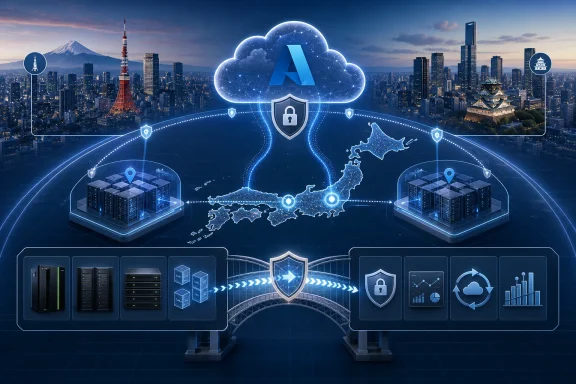 The Cloud Story Has Moved From Scale to Sovereignty
For the first decade of hyperscale cloud adoption, the industry sold enterprises on abstraction. Compute was compute, storage was storage, and the public cloud was pitched as a globally available utility where geography mattered less than elasticity, automation, and price.That story has not collapsed, but it has become incomplete. The modern enterprise cloud buyer still wants global platforms, but now asks exactly where data sits, which legal regime can touch it, how failover is designed, and whether critical systems can remain operational during geopolitical, regulatory, or supplier shocks. In that environment, Tokyo and Osaka are not just dots on Microsoft’s data center map. They are part of the product.
Kyndryl’s announcement leans heavily into that shift. The company says the Japanese expansion is designed to let enterprises modernize mission-critical legacy applications on Azure while keeping data in Japan to meet sovereignty goals. That framing is telling: the migration pitch is no longer “come to the cloud because it is modern.” It is “come to the cloud because we can make it local, resilient, and less disruptive than your current estate.”
That is a much more mature argument, and a more realistic one. In regulated industries, manufacturing, finance, insurance, public services, and transportation, legacy does not mean obsolete. It often means the system that invoices customers, schedules production, reconciles accounts, or keeps a plant running. The reason those systems remain in place is not laziness. It is because the cost of being wrong is high.
Kyndryl Is Selling a Bridge, Not a Rewrite
Kyndryl Cloud Uplift, formerly known as Skytap, is an Infrastructure as a Service offering that allows AIX, IBM i, Linux on IBM Power, and x86 workloads to run natively on Microsoft Azure. That matters because many enterprises running IBM Power platforms have been trapped between two unattractive options: keep aging on-premises infrastructure indefinitely, or attempt a risky re-platforming project that can consume years before delivering visible business value.Cloud Uplift is aimed at the middle path. It lets organizations move existing workloads with few or no changes, then connect those systems to Azure-native capabilities such as analytics, AI, machine learning, security tooling, resilience services, and DevOps pipelines. The immediate value is not that a decades-old application suddenly becomes cloud-native. It is that it can leave the data center without requiring a full application rewrite on day one.
That distinction is crucial. Many modernization programs fail because they confuse relocation with transformation, or because they attempt both at once. Moving a system, changing its runtime, rewriting its interfaces, altering its operational model, and retraining teams in a single program is a fine way to create a multi-year dependency graph with no obvious off-ramp.
Kyndryl’s pitch is more pragmatic. Lift the system into Azure-adjacent infrastructure first, reduce the physical data center burden, stabilize operations, then modernize around the edges. It is not the purest cloud architecture story. It may be more useful than the pure story for enterprises whose core applications were written long before Kubernetes, serverless functions, and platform engineering became conference vocabulary.
Japan Is an Especially Telling Market for This Play
Japan is not merely another stop on a cloud availability tour. It is a market where enterprise IT has long combined deep technical sophistication with conservative operational cultures, heavy regulatory sensitivity, and large installed bases of mission-critical systems. The appeal of a lower-risk route to Azure is therefore obvious.Kyndryl and Microsoft are also emphasizing business continuity through the two-region footprint in Tokyo and Osaka. That is not marketing filler in Japan. Regional resilience matters in a country that designs for earthquakes, typhoons, power disruptions, and supply-chain fragility. For systems that cannot tolerate extended downtime, geographic separation inside national borders is a significant part of the architecture conversation.
The sovereignty message is equally important. Japanese organizations operating under domestic compliance expectations may be willing to use global cloud platforms, but not if doing so creates uncertainty over residency, governance, or control. By making Cloud Uplift available in two Microsoft Japanese data center regions, Kyndryl is trying to remove one of the most common objections to moving sensitive legacy workloads into the public cloud.
There is also a competitive subtext. Microsoft Azure has spent years positioning itself as the enterprise-friendly hyperscaler, particularly for hybrid environments and workloads that cannot be easily refactored. Bringing IBM Power-oriented modernization into Japanese Azure regions strengthens that position. It tells CIOs that Azure is not only a destination for new cloud-native applications, Windows Server estates, and Microsoft 365-adjacent workloads, but also a plausible landing zone for the older systems that still carry the balance sheet.
Microsoft Gets the Workloads the Cloud Was Supposed to Leave Behind
The most interesting part of this announcement is that it runs against an older cloud narrative. Hyperscalers once implied that the future belonged to applications redesigned for distributed systems, commodity infrastructure, and managed services. Proprietary enterprise platforms, especially those associated with traditional vendors, were often treated as transitional baggage.Reality has been less tidy. The enterprise cloud market is now mature enough that the easy migrations have largely happened. The remaining workloads are harder, stranger, more valuable, and more politically protected inside organizations. They include systems with undocumented dependencies, specialized performance characteristics, expensive licensing assumptions, and teams whose operational knowledge may be more important than the source code.
That is why an Azure region expansion for IBM Power workloads is strategically meaningful. Microsoft does not need every workload to become a textbook Azure-native app immediately. It benefits if the workload lands in the Azure economic and operational orbit. Once there, the customer can attach monitoring, backup, identity, analytics, security, data integration, and AI services over time.
This is how hyperscalers increasingly win in the real enterprise: not by forcing every application through the same modernization funnel, but by surrounding old systems with new services until the center of gravity moves. The application may still look traditional. The platform around it becomes cloud.
For WindowsForum readers, that should sound familiar. Microsoft has used the same logic across hybrid identity, Windows Server management, Azure Arc, Defender, Entra, Intune, and Microsoft 365. The company rarely needs customers to throw everything away at once. It needs them to make Microsoft’s control plane the place where more decisions happen.
The Skytap DNA Still Matters
Kyndryl acquired Skytap in 2024, and the rebranding to Kyndryl Cloud Uplift did not erase what made the service distinct. Skytap built its reputation around running traditional enterprise workloads in cloud-like environments, especially where IBM Power compatibility was not optional. In that sense, Kyndryl did not buy a fashionable cloud-native platform. It bought a way to deal with the awkward middle of enterprise modernization.That middle is where a lot of money lives. IBM i and AIX systems may not generate the same developer excitement as containers or AI agents, but they often underpin high-value processes. They also tend to sit in organizations with large consulting budgets, deep compliance requirements, and long planning horizons. Kyndryl knows that world because it came out of IBM’s managed infrastructure services business.
The service-provider angle matters. Kyndryl is not simply offering raw infrastructure. The company is positioning itself across planning, development, migration, and managed services. That is a natural move because most customers with these workloads do not want only a cloud landing zone. They need dependency mapping, migration sequencing, test environments, operational runbooks, resilience design, and post-migration support.
This is also where Kyndryl’s pitch differs from a self-service cloud marketplace story. A technically capable team can provision many cloud services without a large services partner. But migrating a mission-critical IBM Power estate into Azure while satisfying internal auditors, application owners, business continuity teams, and executives is rarely a click-through exercise. Kyndryl is selling institutional confidence as much as infrastructure.
Sovereignty Has Become a Budget Line, Not a Talking Point
Kyndryl’s announcement cites its 2025 Readiness Report, which found that a large share of business leaders are concerned about geopolitical risk in global cloud environments and that many have already changed cloud strategies in response to data sovereignty rules. Vendor-sponsored surveys should always be read with caution, especially when the sponsor sells the remedy. Still, the broader trend is real.Cloud strategy is increasingly shaped by jurisdiction. The question is not simply whether a provider is secure or reliable, but whether the organization can demonstrate where data is stored, who can access it, how it is replicated, and what happens during a legal or geopolitical conflict. For multinational businesses, that has turned cloud architecture into a map of obligations.
Japan’s requirements are not identical to Europe’s, the United States’, or other Asian markets, but the direction of travel is similar. Data localization, operational resilience, supply-chain oversight, and sector-specific governance are becoming board-level issues. A cloud region is now part of a compliance story, not merely an availability-zone story.
This is why Kyndryl’s two-region Japanese availability carries more weight than a simple capacity expansion. A single local region can answer some residency concerns, but two regions enable a stronger conversation about disaster recovery and continuity within national boundaries. That does not automatically solve every compliance issue, but it gives architects more room to design systems that satisfy both regulators and operations teams.
The AI Angle Is Real, but It Comes Second
As expected in 2026, Kyndryl and Microsoft both connect the expansion to AI and data analytics. The argument is straightforward: once traditional workloads are running in or near Azure, organizations can use Azure-native services to extract more value from the data and processes locked inside those systems.That is plausible, but it should not be oversold. The hard part is not sprinkling AI on top of an IBM i estate. The hard part is governance, data quality, latency, access control, integration architecture, and deciding which business processes actually benefit from machine learning or generative AI. Old systems often contain high-value data, but they also contain decades of business assumptions encoded in ways that are not obvious to outsiders.
The near-term AI value may therefore be less glamorous than the keynote version. Better reporting, anomaly detection, predictive maintenance signals, automated documentation, improved search across operational data, and safer developer workflows may matter more than chatbots that promise to transform everything. In many enterprises, the first win is simply making legacy data accessible enough to be governed and analyzed without fragile custom plumbing.
That still matters. A workload trapped in an aging data center is harder to secure, harder to integrate, harder to monitor, and harder to use as part of modern data pipelines. Moving it into Azure’s orbit does not make it modern by magic, but it can make modernization more incremental and less theatrical.
The Risk Is That “Few or No Changes” Becomes a Sleeping Pill
The phrase “few or no changes” is powerful because it reduces migration fear. It is also dangerous if customers treat it as a reason to avoid deeper architectural thinking. A low-change migration can preserve business logic, but it can also preserve technical debt, brittle interfaces, weak observability, and operational habits that were designed for another era.This is the paradox of lift-and-shift modernization. The easier it is to move a workload, the easier it is to mistake movement for progress. If a customer simply relocates old systems and keeps every old process intact, the cloud bill may change faster than the operating model.
Kyndryl appears aware of this, which is why the company frames Cloud Uplift as part of a broader journey that includes strategy, development, migration, and managed services. The important word is journey, even if enterprise vendors have abused it into near-meaninglessness. The move into Azure should be the beginning of a controlled modernization sequence, not the final slide in a transformation deck.
For IT leaders, the discipline is to define what happens after migration before the migration begins. Which integrations will be replaced? Which operational tasks will be automated? Which data flows will be governed differently? Which applications should eventually be retired, refactored, or surrounded with APIs? The answers determine whether Cloud Uplift becomes a modernization platform or a more expensive hosting arrangement.
Windows Shops Should Pay Attention Even If They Do Not Run IBM i
At first glance, this announcement may look like niche news for IBM Power administrators. It is not. The same pattern applies across the enterprise stack: hyperscalers are building more accommodations for legacy systems because the remaining modernization opportunity depends on them.Windows-heavy organizations have their own equivalents. They may not be running IBM i, but they may have old .NET Framework applications, SQL Server estates with delicate dependencies, line-of-business apps tied to specific domain assumptions, file shares that became workflow systems, or Windows Server workloads that nobody wants to touch because they still work. The broader lesson is that cloud modernization is being redefined around continuity.
This has practical implications for sysadmins and architects. The future is not a clean break between old and new environments. It is a hybrid operational model where identity, security, monitoring, backup, and policy must stretch across platforms. The teams that succeed will be the ones that can manage old workloads with modern controls without pretending the old workloads are something they are not.
Microsoft benefits from this mindset because Azure is increasingly a management and integration layer, not just a place to run VMs. Kyndryl benefits because the harder the migration, the more valuable services and operational expertise become. Customers benefit only if they retain enough architectural control to avoid becoming passive passengers in a vendor-led transformation.
The Competitive Message Is Aimed at the CIO’s Hardest Slide
Every CIO has some version of the slide that says legacy modernization is urgent. The problem is that the next slide often explains why the organization cannot actually do it yet. The risks are too high, the dependencies are too poorly understood, the costs are too uncertain, or the business units cannot tolerate disruption.Cloud Uplift in Japanese Azure regions is designed for that exact contradiction. It gives executives a way to say they are modernizing mission-critical systems while lowering the immediate blast radius. It also gives IT teams a path that does not require them to win a theological argument about whether every application must become cloud-native.
That makes the offering politically useful. Large modernization programs live or die not only on technology, but on internal trust. Application owners need to believe their systems will not be broken. Security teams need to believe controls will improve. Finance needs to believe capital expenditure can be managed. Executives need to believe the program advances resilience and competitiveness, not just infrastructure hygiene.
The Tokyo and Osaka expansion strengthens that story for Japanese enterprises because it aligns the migration pitch with domestic continuity and sovereignty requirements. It gives Kyndryl and Microsoft a more credible answer when a customer asks why a core system should leave a known on-premises environment. The answer is no longer just “because cloud.” It is “because cloud, locally, with continuity options, and without forcing a rewrite first.”
The Small Print Belongs in the Architecture Review
None of this removes the need for careful technical evaluation. Running legacy workloads in a cloud-adjacent model can introduce its own constraints around performance, networking, licensing, storage behavior, backup design, operational responsibility, and cost predictability. A workload that behaved well on dedicated on-premises infrastructure may expose new bottlenecks when connected to cloud services and remote users in different ways.Latency deserves particular attention. Many legacy applications were designed with assumptions about proximity between application servers, databases, storage, terminals, and batch systems. Moving part of the estate while leaving dependencies behind can create unpleasant surprises. The migration plan must account for the whole system, not merely the server inventory.
Cost is another issue. The promise of controlling capital expenditure is attractive, especially when hardware refresh cycles loom. But consumption-based infrastructure and managed services can produce new financial risks if workloads are always on, oversized, or poorly governed. Reserved capacity, right-sizing, monitoring, and chargeback models become part of the modernization project.
Security is also not automatic. Azure integration can improve identity, monitoring, and governance, but only if those capabilities are configured and operated well. Legacy systems may carry old authentication models, privileged access patterns, hardcoded secrets, or weak segmentation. Moving them to a more modern platform gives teams a chance to fix those issues. It does not fix them by itself.
Japan’s Azure Expansion Shows Where Enterprise Cloud Is Heading
The most concrete lesson from Kyndryl’s announcement is that the cloud market is no longer defined only by new applications. It is increasingly defined by how convincingly vendors can absorb the old ones. That is a less glamorous contest, but it is where the next tranche of enterprise spending is likely to be decided.The expansion also shows how sovereignty and resilience are being productized. Vendors are not merely promising better compliance documents; they are placing services in specific regions, building continuity stories around multiple locations, and tailoring migration offerings to national requirements. In the 2020s, geography has returned to computing with a vengeance.
For Microsoft, the win is strategic gravity. Every specialized workload that lands in Azure makes the platform more central to enterprise operations. For Kyndryl, the opportunity is to turn inherited infrastructure expertise into a modernization business with relevance beyond traditional outsourcing. For customers, the value depends on whether the move becomes a stepping stone toward better operations or merely a new address for old complexity.
The Real Migration Is From Fear to Optionality
Kyndryl’s Japanese Cloud Uplift expansion is not a revolution, and that is precisely why it matters. It is a practical move aimed at enterprises that cannot afford revolutionary failure. The point is to create more options for systems that have historically had too few.- Kyndryl Cloud Uplift is now available in Microsoft Azure data center regions in Tokyo and Osaka for Japanese enterprises.
- The service targets AIX, IBM i, Linux on IBM Power, and x86 workloads that organizations want to move with minimal application change.
- The two-region Japanese footprint strengthens the case for domestic data residency and business continuity planning.
- The offering gives Microsoft a deeper path into legacy enterprise estates that are difficult to modernize through conventional cloud-native approaches.
- The biggest customer risk is treating low-change migration as the end of modernization rather than the start of a longer operating-model shift.
- The most important evaluation work remains architecture-specific, especially around latency, licensing, security, storage behavior, and long-term cost.
References
- Primary source: Kyndryl
Published: 2026-05-19T07:30:09.354105
Kyndryl Cloud Uplift expands into Japan
Kyndryl Cloud Uplift is now available in Microsoft Azure regions in Tokyo and Osaka, helping Japanese enterprises modernize legacy workloads.www.kyndryl.com - Related coverage: help.skytap.com
Adding a Kyndryl Cloud Uplift on Azure subscription to your Microsoft Azure account | Kyndryl Cloud Uplift help and documentation
Create and configure a Kyndryl Cloud Uplift SaaS instance on Microsoft Azure.help.skytap.com
- Related coverage: gartner.com
Kyndryl Cloud Uplift Reviews & Ratings 2026 | Gartner Peer Insights
Explore 14 in-depth Kyndryl Cloud Uplift reviews and insights from real users verified by Gartner, and choose your business software with confidence.www.gartner.com - Official source: marketplace.microsoft.com
Kyndryl Cloud Uplift United States (US only)
Easily migrate your IBM Power workloads to the cloud without the need to rewrite or replatformmarketplace.microsoft.com
- Official source: learn.microsoft.com
Migrate IBM i series to Azure with Skytap - Azure Architecture Center | Microsoft Learn
This example architecture shows how to use the native IBM i backup and recovery services with Microsoft Azure components.learn.microsoft.com - Related coverage: skytap.com
Kyndryl Cloud Uplift
Kyndryl Cloud Uplift, formerly Skytap, allows you to run IBM Power workloads such as AIX, IBM i, and x86 in Azure without rewriting or refactoring.www.skytap.com
