

Kyndryl announced on July 1, 2026, in New York that it is expanding its sovereignty services with Microsoft, combining Kyndryl Sovereignty Solutioning with Microsoft Sovereign Cloud capabilities to help governments and regulated enterprises design, build, and operate compliant cloud architectures. The announcement is not a new cloud region, a single product launch, or a magic compliance badge. It is a bet that the next phase of enterprise cloud will be won by the companies that can turn political, legal, and operational anxiety into running systems. For Windows shops, Azure tenants, and Microsoft 365 estates, that makes sovereignty less of a slogan and more of an architecture review.
For years, digital sovereignty sounded like a Brussels seminar topic: important, abstract, and always one procurement cycle away from implementation. That phase is ending. Kyndryl and Microsoft are responding to a market where governments, banks, utilities, healthcare organizations, and critical infrastructure operators increasingly need to prove not only where data sits, but who can operate the systems around it.
The distinction matters. Data residency alone is a relatively narrow promise: store information in a particular country or region. Sovereignty is broader and more difficult because it asks about administrative access, support workflows, encryption key control, operational dependency, auditability, continuity, and legal exposure. The hard part is not saying “local”; the hard part is keeping a modern cloud platform useful while imposing boundaries that cloud was originally designed to blur.
That is where Kyndryl’s role becomes strategically important. Microsoft can supply the sovereign cloud stack, including Azure, Microsoft 365, Azure Local, and disconnected deployment options. Kyndryl is positioning itself as the translator between the regulatory text and the messy estate: legacy workloads, identity sprawl, backup dependencies, outsourced operations, unmanaged data flows, and the practical realities of 24/7 support.
The announcement leans heavily on that translation layer. Kyndryl says customers can use its Sovereignty Readiness Assessment to examine data, operational, and technical domains, identify gaps, and build a phased roadmap. That phrasing may sound consulting-heavy, but in regulated IT it is often where the real work lives. Most organizations do not fail sovereignty requirements because they lack a cloud SKU; they fail because nobody can draw a clean line around their dependencies.
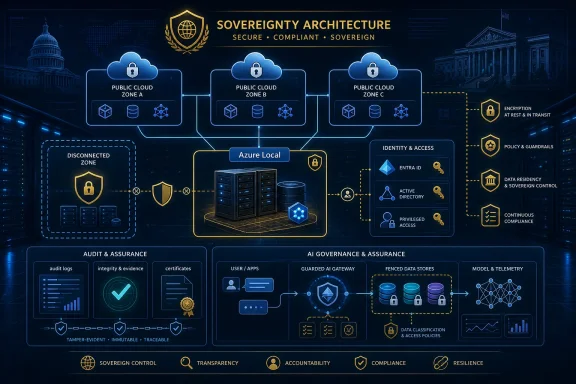
Sovereign cloud is not one place. It is a set of deployment models that range from mainstream public cloud with additional governance controls to private or partner-operated infrastructure, and finally to disconnected environments that can run without cloud connectivity. Microsoft has spent the past year pushing that message, particularly through Azure Local, Microsoft 365 Local, and tooling aimed at regulated workloads and sovereign AI use cases.
For WindowsForum readers, Azure Local is the hinge. Formerly rooted in the Azure Stack family lineage, Azure Local brings Azure-style compute, storage, networking, management, and governance closer to customer-controlled environments. In the sovereignty story, it lets Microsoft say that customers do not have to choose between the hyperscale control plane and a bunker full of aging servers. They can run a local cloud-like environment that keeps more operational control inside the customer, partner, national, or regional boundary.
The connected-versus-disconnected language is equally important. A connected Azure Local deployment can still participate in the broader Azure ecosystem, while a disconnected deployment is designed for environments where cloud connectivity is unavailable, unacceptable, or intermittently allowed under strict controls. That is not merely a feature for edge computing. It is a sovereignty argument aimed at defense, classified, critical infrastructure, and public-sector workloads where the network itself is part of the threat model.
The practical implication is that Microsoft is no longer selling sovereignty as a single European compliance wrapper. It is selling a portfolio of architectural patterns. Kyndryl’s expansion with Microsoft is about helping customers choose among those patterns without pretending that one pattern fits every law, every agency, or every workload.
That is the context in which sovereignty becomes a design principle. A bank may need to show that a workload can withstand provider disruption. A ministry may need assurance that administrative access is governed by local rules. A hospital may need to keep patient data, logs, and model inputs inside a defined jurisdiction. A utility may need to prove that its operational systems are not dependent on a control plane that could be cut off during a crisis.
None of those demands can be solved by a region selection drop-down. They require identity segmentation, privileged access management, encryption strategy, logging architecture, incident response procedures, backup location controls, support escalation rules, procurement terms, and evidence trails. That is why this announcement spends as much time on assessment and operations as it does on Microsoft product names.
This is also where Kyndryl’s heritage matters. The company inherited a large base of enterprise infrastructure work from IBM’s managed infrastructure services business, and it still lives in the world of mainframes, hybrid estates, regulated outsourcing, and mission-critical operations. That background is not glamorous, but it is directly relevant. Sovereignty projects usually fail at the seams between old and new systems, not inside the cleanest Azure reference architecture.
Azure Local is Microsoft’s answer to that reversal. It lets the company reframe on-premises infrastructure as part of Azure rather than as a retreat from Azure. That framing is clever because it preserves Microsoft’s cloud operating model while acknowledging that some customers will not, or cannot, put everything into a standard public region.
For Windows administrators, this is familiar terrain with new branding and tighter cloud integration. The enterprise has always had workloads that needed local control: domain services, file services, line-of-business applications, plant-floor systems, latency-sensitive databases, classified environments, and systems with awkward licensing or hardware dependencies. The difference now is that those exceptions are being pulled into a formal sovereignty architecture rather than treated as technical debt.
There is a tension here. If Azure Local depends too heavily on Microsoft’s software lifecycle, licensing model, and operational tooling, critics will argue that it is still hyperscaler dependency in a local costume. If it becomes too detached from Azure, it risks losing the management consistency and innovation pipeline that make it attractive in the first place. The value proposition lives in the balance.
Kyndryl’s pitch is that it can help customers strike that balance workload by workload. Some services may stay in Azure public cloud with residency and governance controls. Some may move to Azure Local in a customer or partner facility. Some may require disconnected operation. Some may remain on non-Microsoft infrastructure but be wrapped into the same governance and operational model.
That hybrid reality is less clean than the marketing diagram, but it is closer to how large organizations actually run. Sovereignty does not erase hybrid cloud. It makes hybrid cloud politically and operationally unavoidable.
Microsoft has been building toward this with sovereign AI messaging, local model execution, and private cloud options designed for regulated customers. The logic is straightforward: if governments and enterprises want AI productivity without leaking sensitive data or operational control, they need more than a checkbox promising regional storage. They need governance across the artifacts that surround the model.
That includes the source documents used for retrieval-augmented generation, the indexes generated from those documents, the logs retained for debugging, the model weights or local model endpoints, the identities allowed to invoke the service, and the administrators allowed to inspect or support it. It also includes mundane but crucial questions about where updates come from, who approves them, and what happens when connectivity to external services is deliberately disabled.
For Microsoft, sovereign AI is also a defensive move. The company wants Copilot, Azure AI, Foundry, and Microsoft 365 services to remain viable in markets where data movement and foreign operational access are politically sensitive. If regulated customers conclude that generative AI requires uncontrolled cloud dependency, adoption slows. If Microsoft can offer a credible local or sovereign path, the adoption story continues.
For Kyndryl, AI gives the services layer a new opening. Few organizations have mature inventories of where AI data goes, how model outputs are logged, or how shadow AI tools interact with regulated information. A readiness assessment that once focused on data residency and operational controls now has to include model locality, inference boundaries, and AI governance. That is consulting work, engineering work, and ongoing operations work.
The catch is that AI sovereignty is still a moving target. Regulators are still refining expectations, vendors are still changing architectures, and customers are still discovering use cases. Any provider that claims to have a universal answer should be treated skeptically. The credible path is incremental: classify workloads, map data flows, constrain the highest-risk systems first, and build evidence as the operating model matures.
Operational sovereignty is about who can touch what, from where, under whose authority, with what logging, and with what recourse. It asks whether support access is governed by local personnel rules. It asks whether privileged actions are visible to the customer. It asks whether keys are controlled by the customer or an approved third party. It asks whether incident response depends on people, systems, or jurisdictions that violate the customer’s obligations.
Those details are where sovereign cloud becomes either real or theatrical. A workload can sit in the right country and still fail a sovereignty test if administrators in another jurisdiction can access it without sufficient control. Conversely, a well-designed cloud architecture may satisfy many practical sovereignty goals even when it relies on a global provider, provided the controls, contracts, logs, and operating procedures are strong enough for the applicable risk model.
This is why Microsoft’s sovereign cloud approach increasingly emphasizes controls, transparency, and deployment choice rather than just geography. It is also why Kyndryl’s managed services angle is not an accessory. In many regulated environments, the operator is as important as the platform.
The uncomfortable truth is that sovereignty is not purely technical. It is a bundle of technical, legal, contractual, political, and operational assurances. That makes it harder for engineers, because a clean architecture diagram is not enough. It also makes it harder for vendors, because marketing claims can be challenged by procurement lawyers, auditors, national security officials, and rival cloud providers.
But the demand is not limited to Europe. Governments everywhere are reassessing cloud dependency in light of sanctions, cyber conflict, supply-chain risk, and critical infrastructure exposure. Financial regulators want stronger resilience. Defense agencies want disconnected operations. Healthcare systems want clearer control over patient data. Energy and telecom operators want cloud modernization without importing unacceptable jurisdictional risk.
This global spread complicates product strategy. A sovereign architecture that satisfies one country may not satisfy another. Some customers care mainly about data residency. Others care about operational independence. Others care about national ownership, local staffing, encryption key custody, or the ability to continue running during geopolitical disruption. The word “sovereign” hides many different requirements.
That variation favors large services firms. Kyndryl can enter the conversation as an interpreter of local rules and enterprise constraints, while Microsoft supplies the cloud technology. The partnership model lets Microsoft avoid pretending that product documentation alone can solve national compliance differences, and it lets Kyndryl attach its services to one of the most entrenched enterprise platforms in the world.
For customers, the risk is vendor lock-in dressed in regulatory language. A sovereignty roadmap built around Microsoft technologies may be pragmatic for Microsoft-heavy estates, but it can also deepen dependence on Microsoft licensing, identity, management, productivity, and AI platforms. That may be acceptable, especially when the alternative is fragmented infrastructure with weaker controls. But it should be a deliberate decision, not an accidental byproduct of compliance panic.
That critique will not disappear because Azure Local can run disconnected or because Kyndryl can operate regulated environments. Questions about foreign legal exposure, supply-chain dependency, software update control, licensing leverage, and strategic autonomy remain. In Europe especially, the debate is not only about whether data can be protected under current law. It is about whether public institutions and critical industries should depend so heavily on non-European platforms.
Microsoft’s counterargument is practical: customers want modern cloud capabilities, security tooling, productivity services, and AI innovation, and many already run Microsoft estates. Sovereign controls, local deployment options, and partner-operated models give them a way to satisfy requirements without abandoning the platforms their users and administrators already know. That is a compelling argument for many CIOs.
But credibility will depend on evidence, not phrasing. Customers will want to see how access controls work in practice, how support is staffed, how logs are exposed, how updates are handled, how outages are managed, and how contractual commitments survive real disputes. Regulators will increasingly ask for proof. Competitors will probe for gaps. Internal security teams will demand architecture-level answers.
This is where Kyndryl’s operational role could either strengthen or weaken the proposition. If Kyndryl provides genuine local operational control, strong documentation, disciplined runbooks, and transparent accountability, the partnership becomes more than a reseller motion. If it merely wraps familiar managed services around Microsoft branding, it risks being dismissed as sovereignty theater.
Administrators may find that decisions once treated as operational preferences become compliance controls. Where logs are stored becomes a sovereignty issue. Which support team can access a tenant becomes a sovereignty issue. Whether a workload depends on an external API becomes a sovereignty issue. Whether a Copilot feature processes data in a particular boundary becomes a sovereignty issue.
That creates governance sprawl. Organizations will need to classify workloads by sovereignty sensitivity, not just by business criticality. They will need to understand which Microsoft services support which residency and access controls. They will need to document exceptions. They will need to reconcile local infrastructure with cloud policy. They will need to make sure disaster recovery does not quietly violate the same rules production was designed to satisfy.
The burden will fall hardest on hybrid estates. A pure cloud-native startup can design around a small number of patterns. A national bank or ministry may have decades of Windows Server, Active Directory, SQL Server, Exchange history, third-party appliances, outsourced help desks, regional data centers, and overlapping regulatory obligations. Sovereignty lands in that environment like a new layer of gravity.
Kyndryl’s assessment-led approach is aimed directly at that complexity. Whether customers buy the service or not, the underlying method is sound: inventory, classify, map dependencies, identify gaps, design target patterns, migrate in phases, and operate with evidence. The alternative is to wait for an audit, procurement dispute, or geopolitical event to expose the weak points.
For Microsoft, the partner ecosystem is essential because sovereign requirements are local, political, and operationally specific. A global product team can build Azure Local and Microsoft 365 Local, but it cannot alone provide every customer with jurisdiction-specific design, migration, operations, and audit support. Partners become the last mile of sovereignty.
For Kyndryl, sovereignty is a way to move up the value chain. Traditional managed infrastructure services are under pressure from automation, cloud migration, and margin compression. Sovereignty work is stickier because it combines advisory, engineering, compliance evidence, and ongoing operations. Once a provider helps define the sovereign operating model, it is well positioned to run it.
The partnership also reflects a broader shift in enterprise IT services. The old outsourcing pitch was often about cost reduction. The new pitch is about controlled modernization under constraint. Customers still want efficiency, but they also want resilience, regulatory defensibility, cyber maturity, and AI adoption. Sovereignty bundles all of those anxieties into one board-level program.
That makes the market attractive, but it also raises expectations. A customer buying sovereign cloud services is not merely buying migration labor. It is buying assurance that the architecture can survive scrutiny. That assurance must be maintained as Microsoft changes services, regulators update guidance, and the customer’s own data estate evolves.
That matters because many organizations do not actually want to go back to the old data center model. They want cloud-like automation, elastic-ish resource pools, standardized governance, security tooling, modern identity, and integrated developer workflows. What they object to is uncontrolled dependency, ambiguous jurisdiction, and opaque operations. Azure Local exists precisely because Microsoft sees a market for cloud operating models outside standard cloud regions.
The likely outcome is not mass repatriation. It is workload sorting. Low-risk collaboration and productivity workloads may stay in standard public cloud. Sensitive regulated workloads may use sovereign public cloud patterns. Highly sensitive or classified workloads may move to local or disconnected environments. Legacy systems may remain where they are but get wrapped in stronger governance and monitoring.
This sorting will be messy. It will require uncomfortable conversations between legal, security, infrastructure, application, procurement, and business teams. It will expose applications whose data flows are poorly understood. It will reveal backup systems, monitoring agents, support tunnels, and SaaS integrations that quietly cross boundaries. It will force organizations to decide how much sovereignty they need, how much they can afford, and how much complexity they can operate.
That last point is crucial. Sovereignty is not free. Local and disconnected environments can increase operational burden, reduce access to hyperscale elasticity, complicate patching, and require specialized skills. The business case has to be tied to regulatory obligation, risk reduction, resilience, or strategic necessity. Otherwise, sovereignty becomes an expensive label.
No single architecture can satisfy every sovereignty demand. Some customers need local data residency but can accept global support under strict controls. Others need local operations by cleared personnel. Others need disconnected infrastructure. Others need national ownership or provider independence that a Microsoft-centered stack may not fully address. The right answer depends on the threat model, legal regime, workload sensitivity, and institutional risk appetite.
That means customers should resist buying sovereignty as a brand. They should define the control objectives first. What data must remain where? Who may access it? What operations must be locally controlled? What evidence is required? What happens during outage, investigation, sanctions event, or provider dispute? Which workloads truly require disconnected operation?
Only after those questions are answered does the product discussion make sense. Azure, Microsoft 365, Azure Local, and Kyndryl operations may be the right fit for many Microsoft-heavy organizations. They may be insufficient for others. They may need to be combined with regional providers, on-premises infrastructure, third-party key management, independent audit, or non-Microsoft platforms.
The best reading of this announcement is therefore pragmatic rather than utopian. Kyndryl and Microsoft are not solving the philosophical debate over digital sovereignty. They are commercializing a set of patterns that many real organizations can use to reduce risk and keep modernization moving. In enterprise IT, that is often what progress looks like.
The retrofit begins with discovery. Many organizations do not have a precise map of where Microsoft 365 data is stored, which Azure regions are used, which admins have privileged access, which logs are exported, which backups leave the country, or which third-party integrations process regulated information. Sovereignty forces those inventories into the open.
Next comes segmentation. Not every workload deserves the same treatment. An internal marketing site, a tax database, a police case-management system, a trading platform, and a generative AI assistant trained on confidential documents should not share one sovereignty pattern. The art is to avoid overengineering low-risk workloads while applying serious controls to the systems that matter.
Then comes operations. Policies must be enforced, exceptions reviewed, logs monitored, evidence retained, and changes assessed. A sovereign architecture that is compliant on day one can drift out of compliance within months if support processes, identity assignments, region choices, backup jobs, and AI features are not governed continuously.
This is where a managed-service provider can be useful, provided the customer does not outsource accountability. Regulators generally do not accept “our provider handled it” as a complete answer. Kyndryl may operate the environment, but the customer still needs ownership of risk decisions, control objectives, and evidence.
 Sovereignty Moves From Policy Decks to Production Runbooks
For years, digital sovereignty sounded like a Brussels seminar topic: important, abstract, and always one procurement cycle away from implementation. That phase is ending. Kyndryl and Microsoft are responding to a market where governments, banks, utilities, healthcare organizations, and critical infrastructure operators increasingly need to prove not only where data sits, but who can operate the systems around it.The distinction matters. Data residency alone is a relatively narrow promise: store information in a particular country or region. Sovereignty is broader and more difficult because it asks about administrative access, support workflows, encryption key control, operational dependency, auditability, continuity, and legal exposure. The hard part is not saying “local”; the hard part is keeping a modern cloud platform useful while imposing boundaries that cloud was originally designed to blur.
That is where Kyndryl’s role becomes strategically important. Microsoft can supply the sovereign cloud stack, including Azure, Microsoft 365, Azure Local, and disconnected deployment options. Kyndryl is positioning itself as the translator between the regulatory text and the messy estate: legacy workloads, identity sprawl, backup dependencies, outsourced operations, unmanaged data flows, and the practical realities of 24/7 support.
The announcement leans heavily on that translation layer. Kyndryl says customers can use its Sovereignty Readiness Assessment to examine data, operational, and technical domains, identify gaps, and build a phased roadmap. That phrasing may sound consulting-heavy, but in regulated IT it is often where the real work lives. Most organizations do not fail sovereignty requirements because they lack a cloud SKU; they fail because nobody can draw a clean line around their dependencies.
Microsoft’s Sovereign Cloud Is Becoming a Spectrum, Not a Place
The most interesting phrase in the announcement is “full spectrum.” Kyndryl says the expanded capabilities support Microsoft’s sovereign cloud approach across public cloud services and private cloud solutions using Azure Local. That is a quiet but important correction to the way sovereign cloud is often discussed.Sovereign cloud is not one place. It is a set of deployment models that range from mainstream public cloud with additional governance controls to private or partner-operated infrastructure, and finally to disconnected environments that can run without cloud connectivity. Microsoft has spent the past year pushing that message, particularly through Azure Local, Microsoft 365 Local, and tooling aimed at regulated workloads and sovereign AI use cases.
For WindowsForum readers, Azure Local is the hinge. Formerly rooted in the Azure Stack family lineage, Azure Local brings Azure-style compute, storage, networking, management, and governance closer to customer-controlled environments. In the sovereignty story, it lets Microsoft say that customers do not have to choose between the hyperscale control plane and a bunker full of aging servers. They can run a local cloud-like environment that keeps more operational control inside the customer, partner, national, or regional boundary.
The connected-versus-disconnected language is equally important. A connected Azure Local deployment can still participate in the broader Azure ecosystem, while a disconnected deployment is designed for environments where cloud connectivity is unavailable, unacceptable, or intermittently allowed under strict controls. That is not merely a feature for edge computing. It is a sovereignty argument aimed at defense, classified, critical infrastructure, and public-sector workloads where the network itself is part of the threat model.
The practical implication is that Microsoft is no longer selling sovereignty as a single European compliance wrapper. It is selling a portfolio of architectural patterns. Kyndryl’s expansion with Microsoft is about helping customers choose among those patterns without pretending that one pattern fits every law, every agency, or every workload.
The Compliance Acronyms Are the Start, Not the Architecture
Kyndryl’s announcement name-checks GDPR, DORA, and NIS2, and that trio explains the pressure behind the move. GDPR made data protection a board-level issue. DORA pushes financial entities and their technology providers toward stronger operational resilience. NIS2 expands cybersecurity obligations across a wider swath of essential and important entities. Together, they shift cloud governance away from checkbox privacy and toward demonstrable control.That is the context in which sovereignty becomes a design principle. A bank may need to show that a workload can withstand provider disruption. A ministry may need assurance that administrative access is governed by local rules. A hospital may need to keep patient data, logs, and model inputs inside a defined jurisdiction. A utility may need to prove that its operational systems are not dependent on a control plane that could be cut off during a crisis.
None of those demands can be solved by a region selection drop-down. They require identity segmentation, privileged access management, encryption strategy, logging architecture, incident response procedures, backup location controls, support escalation rules, procurement terms, and evidence trails. That is why this announcement spends as much time on assessment and operations as it does on Microsoft product names.
This is also where Kyndryl’s heritage matters. The company inherited a large base of enterprise infrastructure work from IBM’s managed infrastructure services business, and it still lives in the world of mainframes, hybrid estates, regulated outsourcing, and mission-critical operations. That background is not glamorous, but it is directly relevant. Sovereignty projects usually fail at the seams between old and new systems, not inside the cleanest Azure reference architecture.
Azure Local Gives Microsoft a Way Back Into the Data Center
The cloud industry spent a decade telling customers that the data center was a place to escape. Sovereignty has complicated that story. The public cloud remains powerful, but regulated customers increasingly want some workloads closer to home, under more visible operating rules, or inside environments that can continue functioning even when hyperscale connectivity is constrained.Azure Local is Microsoft’s answer to that reversal. It lets the company reframe on-premises infrastructure as part of Azure rather than as a retreat from Azure. That framing is clever because it preserves Microsoft’s cloud operating model while acknowledging that some customers will not, or cannot, put everything into a standard public region.
For Windows administrators, this is familiar terrain with new branding and tighter cloud integration. The enterprise has always had workloads that needed local control: domain services, file services, line-of-business applications, plant-floor systems, latency-sensitive databases, classified environments, and systems with awkward licensing or hardware dependencies. The difference now is that those exceptions are being pulled into a formal sovereignty architecture rather than treated as technical debt.
There is a tension here. If Azure Local depends too heavily on Microsoft’s software lifecycle, licensing model, and operational tooling, critics will argue that it is still hyperscaler dependency in a local costume. If it becomes too detached from Azure, it risks losing the management consistency and innovation pipeline that make it attractive in the first place. The value proposition lives in the balance.
Kyndryl’s pitch is that it can help customers strike that balance workload by workload. Some services may stay in Azure public cloud with residency and governance controls. Some may move to Azure Local in a customer or partner facility. Some may require disconnected operation. Some may remain on non-Microsoft infrastructure but be wrapped into the same governance and operational model.
That hybrid reality is less clean than the marketing diagram, but it is closer to how large organizations actually run. Sovereignty does not erase hybrid cloud. It makes hybrid cloud politically and operationally unavoidable.
The AI Angle Raises the Stakes Beyond Storage Location
The announcement’s reference to AI-enabled use cases is not decorative. AI changes the sovereignty conversation because sensitive data is no longer just stored, queried, and backed up. It may be embedded into prompts, fine-tuning pipelines, retrieval systems, vector databases, evaluation logs, telemetry streams, and model outputs. A sovereignty architecture that ignores the AI lifecycle is obsolete before it ships.Microsoft has been building toward this with sovereign AI messaging, local model execution, and private cloud options designed for regulated customers. The logic is straightforward: if governments and enterprises want AI productivity without leaking sensitive data or operational control, they need more than a checkbox promising regional storage. They need governance across the artifacts that surround the model.
That includes the source documents used for retrieval-augmented generation, the indexes generated from those documents, the logs retained for debugging, the model weights or local model endpoints, the identities allowed to invoke the service, and the administrators allowed to inspect or support it. It also includes mundane but crucial questions about where updates come from, who approves them, and what happens when connectivity to external services is deliberately disabled.
For Microsoft, sovereign AI is also a defensive move. The company wants Copilot, Azure AI, Foundry, and Microsoft 365 services to remain viable in markets where data movement and foreign operational access are politically sensitive. If regulated customers conclude that generative AI requires uncontrolled cloud dependency, adoption slows. If Microsoft can offer a credible local or sovereign path, the adoption story continues.
For Kyndryl, AI gives the services layer a new opening. Few organizations have mature inventories of where AI data goes, how model outputs are logged, or how shadow AI tools interact with regulated information. A readiness assessment that once focused on data residency and operational controls now has to include model locality, inference boundaries, and AI governance. That is consulting work, engineering work, and ongoing operations work.
The catch is that AI sovereignty is still a moving target. Regulators are still refining expectations, vendors are still changing architectures, and customers are still discovering use cases. Any provider that claims to have a universal answer should be treated skeptically. The credible path is incremental: classify workloads, map data flows, constrain the highest-risk systems first, and build evidence as the operating model matures.
The Real Product Is Operational Trust
The strongest version of the Kyndryl-Microsoft story is not “we can keep your data in Europe” or “we can run Azure locally.” It is “we can operate a complex Microsoft-centered environment in a way your regulator, board, and security team can understand.” That is a more difficult promise, and a more valuable one.Operational sovereignty is about who can touch what, from where, under whose authority, with what logging, and with what recourse. It asks whether support access is governed by local personnel rules. It asks whether privileged actions are visible to the customer. It asks whether keys are controlled by the customer or an approved third party. It asks whether incident response depends on people, systems, or jurisdictions that violate the customer’s obligations.
Those details are where sovereign cloud becomes either real or theatrical. A workload can sit in the right country and still fail a sovereignty test if administrators in another jurisdiction can access it without sufficient control. Conversely, a well-designed cloud architecture may satisfy many practical sovereignty goals even when it relies on a global provider, provided the controls, contracts, logs, and operating procedures are strong enough for the applicable risk model.
This is why Microsoft’s sovereign cloud approach increasingly emphasizes controls, transparency, and deployment choice rather than just geography. It is also why Kyndryl’s managed services angle is not an accessory. In many regulated environments, the operator is as important as the platform.
The uncomfortable truth is that sovereignty is not purely technical. It is a bundle of technical, legal, contractual, political, and operational assurances. That makes it harder for engineers, because a clean architecture diagram is not enough. It also makes it harder for vendors, because marketing claims can be challenged by procurement lawyers, auditors, national security officials, and rival cloud providers.
Europe Is the Test Bed, but Not the Only Market
The announcement quotes Kyndryl’s Giovanni Carraro saying the company understands sovereignty through firsthand experience with government expectations in Europe. That is not accidental. Europe has become the loudest laboratory for cloud sovereignty, driven by GDPR, public-sector procurement rules, geopolitical tension, industrial policy, and concern about dependence on non-European hyperscalers.But the demand is not limited to Europe. Governments everywhere are reassessing cloud dependency in light of sanctions, cyber conflict, supply-chain risk, and critical infrastructure exposure. Financial regulators want stronger resilience. Defense agencies want disconnected operations. Healthcare systems want clearer control over patient data. Energy and telecom operators want cloud modernization without importing unacceptable jurisdictional risk.
This global spread complicates product strategy. A sovereign architecture that satisfies one country may not satisfy another. Some customers care mainly about data residency. Others care about operational independence. Others care about national ownership, local staffing, encryption key custody, or the ability to continue running during geopolitical disruption. The word “sovereign” hides many different requirements.
That variation favors large services firms. Kyndryl can enter the conversation as an interpreter of local rules and enterprise constraints, while Microsoft supplies the cloud technology. The partnership model lets Microsoft avoid pretending that product documentation alone can solve national compliance differences, and it lets Kyndryl attach its services to one of the most entrenched enterprise platforms in the world.
For customers, the risk is vendor lock-in dressed in regulatory language. A sovereignty roadmap built around Microsoft technologies may be pragmatic for Microsoft-heavy estates, but it can also deepen dependence on Microsoft licensing, identity, management, productivity, and AI platforms. That may be acceptable, especially when the alternative is fragmented infrastructure with weaker controls. But it should be a deliberate decision, not an accidental byproduct of compliance panic.
Hyperscaler Sovereignty Still Faces a Credibility Problem
The sovereign cloud market has an obvious contradiction: much of it is being sold by the same hyperscalers whose dominance created the sovereignty anxiety in the first place. Microsoft, Amazon, and Google all have sovereign cloud stories. European providers, local telcos, systems integrators, and policy advocates often argue that true sovereignty requires more than technical controls from US-headquartered companies.That critique will not disappear because Azure Local can run disconnected or because Kyndryl can operate regulated environments. Questions about foreign legal exposure, supply-chain dependency, software update control, licensing leverage, and strategic autonomy remain. In Europe especially, the debate is not only about whether data can be protected under current law. It is about whether public institutions and critical industries should depend so heavily on non-European platforms.
Microsoft’s counterargument is practical: customers want modern cloud capabilities, security tooling, productivity services, and AI innovation, and many already run Microsoft estates. Sovereign controls, local deployment options, and partner-operated models give them a way to satisfy requirements without abandoning the platforms their users and administrators already know. That is a compelling argument for many CIOs.
But credibility will depend on evidence, not phrasing. Customers will want to see how access controls work in practice, how support is staffed, how logs are exposed, how updates are handled, how outages are managed, and how contractual commitments survive real disputes. Regulators will increasingly ask for proof. Competitors will probe for gaps. Internal security teams will demand architecture-level answers.
This is where Kyndryl’s operational role could either strengthen or weaken the proposition. If Kyndryl provides genuine local operational control, strong documentation, disciplined runbooks, and transparent accountability, the partnership becomes more than a reseller motion. If it merely wraps familiar managed services around Microsoft branding, it risks being dismissed as sovereignty theater.
Windows Administrators Will Feel This as Governance Sprawl
For the average Windows admin, the phrase “sovereignty solutioning” may sound remote from daily work. It is not. If this market continues to mature, sovereignty requirements will show up in identity policies, device management, logging retention, backup architecture, privileged access workflows, endpoint telemetry rules, Microsoft 365 configuration, and cloud landing-zone design.Administrators may find that decisions once treated as operational preferences become compliance controls. Where logs are stored becomes a sovereignty issue. Which support team can access a tenant becomes a sovereignty issue. Whether a workload depends on an external API becomes a sovereignty issue. Whether a Copilot feature processes data in a particular boundary becomes a sovereignty issue.
That creates governance sprawl. Organizations will need to classify workloads by sovereignty sensitivity, not just by business criticality. They will need to understand which Microsoft services support which residency and access controls. They will need to document exceptions. They will need to reconcile local infrastructure with cloud policy. They will need to make sure disaster recovery does not quietly violate the same rules production was designed to satisfy.
The burden will fall hardest on hybrid estates. A pure cloud-native startup can design around a small number of patterns. A national bank or ministry may have decades of Windows Server, Active Directory, SQL Server, Exchange history, third-party appliances, outsourced help desks, regional data centers, and overlapping regulatory obligations. Sovereignty lands in that environment like a new layer of gravity.
Kyndryl’s assessment-led approach is aimed directly at that complexity. Whether customers buy the service or not, the underlying method is sound: inventory, classify, map dependencies, identify gaps, design target patterns, migrate in phases, and operate with evidence. The alternative is to wait for an audit, procurement dispute, or geopolitical event to expose the weak points.
The Announcement Is Also a Channel Strategy
This is not just a cloud architecture story; it is a go-to-market story. Microsoft needs partners that can make sovereign cloud credible in boardrooms and ministries. Kyndryl needs high-value modernization work that goes beyond commodity infrastructure management. The expanded collaboration gives both companies a reason to be in the same room when regulated customers rethink cloud strategy.For Microsoft, the partner ecosystem is essential because sovereign requirements are local, political, and operationally specific. A global product team can build Azure Local and Microsoft 365 Local, but it cannot alone provide every customer with jurisdiction-specific design, migration, operations, and audit support. Partners become the last mile of sovereignty.
For Kyndryl, sovereignty is a way to move up the value chain. Traditional managed infrastructure services are under pressure from automation, cloud migration, and margin compression. Sovereignty work is stickier because it combines advisory, engineering, compliance evidence, and ongoing operations. Once a provider helps define the sovereign operating model, it is well positioned to run it.
The partnership also reflects a broader shift in enterprise IT services. The old outsourcing pitch was often about cost reduction. The new pitch is about controlled modernization under constraint. Customers still want efficiency, but they also want resilience, regulatory defensibility, cyber maturity, and AI adoption. Sovereignty bundles all of those anxieties into one board-level program.
That makes the market attractive, but it also raises expectations. A customer buying sovereign cloud services is not merely buying migration labor. It is buying assurance that the architecture can survive scrutiny. That assurance must be maintained as Microsoft changes services, regulators update guidance, and the customer’s own data estate evolves.
The Cloud Repatriation Debate Gets More Complicated
Sovereign cloud is often framed as part of cloud repatriation: workloads coming back from public cloud to local infrastructure. That frame is too simple. The Kyndryl-Microsoft announcement points to something more nuanced: not a retreat from cloud, but a redistribution of cloud characteristics across public, private, local, and disconnected environments.That matters because many organizations do not actually want to go back to the old data center model. They want cloud-like automation, elastic-ish resource pools, standardized governance, security tooling, modern identity, and integrated developer workflows. What they object to is uncontrolled dependency, ambiguous jurisdiction, and opaque operations. Azure Local exists precisely because Microsoft sees a market for cloud operating models outside standard cloud regions.
The likely outcome is not mass repatriation. It is workload sorting. Low-risk collaboration and productivity workloads may stay in standard public cloud. Sensitive regulated workloads may use sovereign public cloud patterns. Highly sensitive or classified workloads may move to local or disconnected environments. Legacy systems may remain where they are but get wrapped in stronger governance and monitoring.
This sorting will be messy. It will require uncomfortable conversations between legal, security, infrastructure, application, procurement, and business teams. It will expose applications whose data flows are poorly understood. It will reveal backup systems, monitoring agents, support tunnels, and SaaS integrations that quietly cross boundaries. It will force organizations to decide how much sovereignty they need, how much they can afford, and how much complexity they can operate.
That last point is crucial. Sovereignty is not free. Local and disconnected environments can increase operational burden, reduce access to hyperscale elasticity, complicate patching, and require specialized skills. The business case has to be tied to regulatory obligation, risk reduction, resilience, or strategic necessity. Otherwise, sovereignty becomes an expensive label.
The Fine Print Will Decide Whether This Is Architecture or Theater
The announcement’s language is careful. It says the joint capabilities help customers align with evolving data residency and operational requirements while maintaining flexibility and innovation. It says architectures can support varying levels of data residency, operational independence, and jurisdictional control “as needed.” That caveat is doing a lot of work.No single architecture can satisfy every sovereignty demand. Some customers need local data residency but can accept global support under strict controls. Others need local operations by cleared personnel. Others need disconnected infrastructure. Others need national ownership or provider independence that a Microsoft-centered stack may not fully address. The right answer depends on the threat model, legal regime, workload sensitivity, and institutional risk appetite.
That means customers should resist buying sovereignty as a brand. They should define the control objectives first. What data must remain where? Who may access it? What operations must be locally controlled? What evidence is required? What happens during outage, investigation, sanctions event, or provider dispute? Which workloads truly require disconnected operation?
Only after those questions are answered does the product discussion make sense. Azure, Microsoft 365, Azure Local, and Kyndryl operations may be the right fit for many Microsoft-heavy organizations. They may be insufficient for others. They may need to be combined with regional providers, on-premises infrastructure, third-party key management, independent audit, or non-Microsoft platforms.
The best reading of this announcement is therefore pragmatic rather than utopian. Kyndryl and Microsoft are not solving the philosophical debate over digital sovereignty. They are commercializing a set of patterns that many real organizations can use to reduce risk and keep modernization moving. In enterprise IT, that is often what progress looks like.
The Practical Reading for Microsoft-Centered Estates
The immediate audience for this expansion is not the startup choosing its first cloud. It is the large organization already entangled with Microsoft: Entra ID, Active Directory, Windows Server, SQL Server, Microsoft 365, Teams, SharePoint, Exchange history, Defender, Sentinel, Intune, Azure, Power Platform, and now Copilot or Azure AI. For that customer, sovereignty is not a greenfield architecture. It is a retrofit.The retrofit begins with discovery. Many organizations do not have a precise map of where Microsoft 365 data is stored, which Azure regions are used, which admins have privileged access, which logs are exported, which backups leave the country, or which third-party integrations process regulated information. Sovereignty forces those inventories into the open.
Next comes segmentation. Not every workload deserves the same treatment. An internal marketing site, a tax database, a police case-management system, a trading platform, and a generative AI assistant trained on confidential documents should not share one sovereignty pattern. The art is to avoid overengineering low-risk workloads while applying serious controls to the systems that matter.
Then comes operations. Policies must be enforced, exceptions reviewed, logs monitored, evidence retained, and changes assessed. A sovereign architecture that is compliant on day one can drift out of compliance within months if support processes, identity assignments, region choices, backup jobs, and AI features are not governed continuously.
This is where a managed-service provider can be useful, provided the customer does not outsource accountability. Regulators generally do not accept “our provider handled it” as a complete answer. Kyndryl may operate the environment, but the customer still needs ownership of risk decisions, control objectives, and evidence.
The Sovereign Cloud Buyers’ Checklist Is Getting More Concrete
The expanded Kyndryl-Microsoft collaboration should push customers toward more precise conversations. The market has had enough slogans. Buyers now need to ask harder questions about architecture, evidence, and operational control before they accept any sovereign cloud claim.- Customers should define whether their sovereignty requirement is about data residency, operational access, legal jurisdiction, business continuity, national control, or some combination of those goals.
- Microsoft-heavy organizations should map existing Azure, Microsoft 365, identity, logging, backup, and AI data flows before choosing a sovereign deployment pattern.
- Azure Local is most relevant where organizations need cloud-like management closer to customer-controlled infrastructure, including connected, hybrid, or disconnected scenarios.
- AI workloads require special scrutiny because prompts, indexes, logs, model endpoints, and evaluation data can create sovereignty exposure beyond ordinary storage location.
- A partner-operated model can strengthen sovereignty only if access controls, staffing, audit trails, escalation paths, and contractual responsibilities are explicit and testable.
- Sovereign cloud should be treated as an operating model that must be maintained over time, not as a one-time migration or procurement label.
References
- Primary source: Kyndryl
Published: 2026-07-01T13:30:11.605592
Loading…
www.kyndryl.com - Official source: blogs.microsoft.com
Microsoft Sovereign Cloud adds governance, productivity and support for large AI models securely running even when completely disconnected - The Official Microsoft Blog
As digital sovereignty becomes a strategic requirement, organizations are rethinking how they deploy critical infrastructure and AI capabilities under tighter regulatory expectations and higher risk conditions. Microsoft’s approach to sovereignty is grounded in enabling enterprises...blogs.microsoft.com - Official source: learn.microsoft.com
Loading…
learn.microsoft.com - Official source: news.microsoft.com
- Official source: microsoft.com
Discover Microsoft Sovereign Cloud | Microsoft
Empower digital resilience and digital and operational sovereignty with trusted, comprehensive cloud solutions from Microsoft. Discover Microsoft Sovereign Cloud.www.microsoft.com
- Related coverage: itpro.com
Satya Nadella talks up Microsoft's sovereign cloud credentials as firm announces general availability for Azure Local Disconnected, new capabilities for Foundry Local | IT Pro
Microsoft has expanded its Sovereign Cloud for AI and regulated environments, as CEO Satya Nadella hypes up the full extent of AI support the firm now offers.www.itpro.com

- Related coverage: techradar.com
Microsoft strengthens its in-country data processing push with more sovereignty options | TechRadar
Even more countries will get local Copilot processingwww.techradar.com - Related coverage: commission.europa.eu
Loading…
commission.europa.eu - Official source: download.microsoft.com
Assessing ‘sovereignty’ requirements and solutions with Microsoft Azure
PDF documentdownload.microsoft.com
- Official source: info.microsoft.com
Young smart busy professional business woman using digital tablet in office.
Young smart busy professional business woman executive, female company worker or manager holding digital tablet using pad technology device working standing in modern corporate office.info.microsoft.com
- Related coverage: investors.kyndryl.com
Loading…
investors.kyndryl.com