

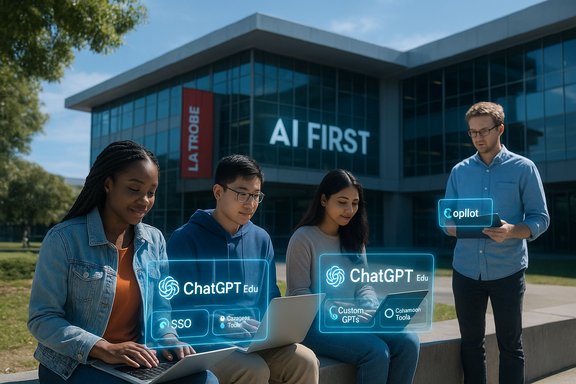
OpenAI’s ChatGPT Edu has won a decisive early foothold at La Trobe University, with the institution committing to a campus‑wide deployment of 40,000 licences by the end of the 2027 financial year and an initial tranche of 5,000 licences to be rolled out in the current year — a move that places OpenAI’s education offering at the centre of La Trobe’s newly declared “AI‑first” strategy even as Microsoft’s Copilot remains a supported tool for staff.
La Trobe’s announcement formalises a multi‑year collaboration with OpenAI to embed ChatGPT Edu across teaching, research and campus operations. The university says the deal will provide students and staff with priority access to OpenAI’s education package, enable integration of OpenAI tools into courses (including an AI Master of Business Administration), and support research use cases that leverage advanced models and developer tooling. The rollout timetable specified by the university places an initial 5,000 licences into circulation in the current financial year, scaling to full campus coverage (approximately 40,000 licences) by the end of the 2027 financial year. This institutional choice follows an earlier period during which Microsoft’s Copilot featured prominently in La Trobe’s planning. According to reporting, Microsoft Copilot was both trialled and considered central to early strategy work; however, the university will now deploy ChatGPT Edu at scale to students and researchers while continuing to make Copilot available to staff. La Trobe has not publicly detailed the operational or contractual reasons for that shift.
At the same time, the net gains are conditional: the value depends on how rigorously La Trobe operationalises governance, secures contractual privacy guarantees, audits deployments, and redesigns academic processes to reflect the new capabilities. The technical and political landscape is also changing quickly — national infrastructure deals and local compute campuses (such as the NEXTDC S7 plan) may reduce some sovereignty concerns over the coming years, but those projects are multi‑year and subject to approvals and commercial finalisation.
La Trobe’s move represents a clear, public instance of higher education institutions transitioning from pilot‑era caution to production‑scale use of generative AI. The success of that transition will be decided not by license counts, but by the university’s ability to translate product capabilities into robust governance, aligned pedagogy, and secure research practice — all while preserving academic standards and institutional autonomy.
Source: iTnews OpenAI gets edge over Microsoft Copilot at La Trobe
 Background / Overview
La Trobe’s announcement formalises a multi‑year collaboration with OpenAI to embed ChatGPT Edu across teaching, research and campus operations. The university says the deal will provide students and staff with priority access to OpenAI’s education package, enable integration of OpenAI tools into courses (including an AI Master of Business Administration), and support research use cases that leverage advanced models and developer tooling. The rollout timetable specified by the university places an initial 5,000 licences into circulation in the current financial year, scaling to full campus coverage (approximately 40,000 licences) by the end of the 2027 financial year. This institutional choice follows an earlier period during which Microsoft’s Copilot featured prominently in La Trobe’s planning. According to reporting, Microsoft Copilot was both trialled and considered central to early strategy work; however, the university will now deploy ChatGPT Edu at scale to students and researchers while continuing to make Copilot available to staff. La Trobe has not publicly detailed the operational or contractual reasons for that shift.What La Trobe is buying into: ChatGPT Edu explained
What ChatGPT Edu provides
- Dedicated education product: ChatGPT Edu is OpenAI’s offering tailored for higher education, providing administrative controls, single sign‑on, and custom workspaces for campuses.
- Expanded model access and higher limits: Education packages typically include higher message limits and access to the latest flagship models (OpenAI’s public statements indicate access to GPT‑5 family capabilities for enterprise/education customers where negotiated).
- Privacy and administrative controls: Features promoted for campus deployments include domain verification, configurable data‑retention windows, SCIM/SSO integrations, audit logs, and options that OpenAI says prevent campus conversation data from being used to train public models.
- Curriculum tooling: The product supports custom GPTs and developer toolkits (Codex‑style coding assistants, AgentKit) that institutions can use to create course‑specific assistants or research tools.
Why universities are adopting this class of product
Universities cite three pragmatic reasons for campus‑scale AI procurement: equity of access (students get the same tools regardless of personal subscription), pedagogical innovation (AI embedded in coursework and assessment design), and research acceleration (computational assistance for literature review, coding, experimental design). La Trobe frames its move squarely around those goals and ties the partnership to national priorities for AI workforce development.The competitive context: ChatGPT Edu vs Microsoft Copilot at La Trobe
A brief timeline and institutional posture
- Microsoft Copilot was an early focus in La Trobe’s initial AI strategy work, receiving trials and internal consideration.
- The university subsequently announced a formal collaboration with OpenAI to roll out ChatGPT Edu to students and researchers at scale, while stating that Microsoft Copilot would continue to be deployed to staff.
- The result is a dual‑tool environment: Copilot remains part of the staff productivity stack, while ChatGPT Edu is positioned as the primary student and research‑facing generative AI platform.
Why ChatGPT Edu may outcompete Copilot for student adoption
- User familiarity and consumer brand momentum: Students already use ChatGPT widely. A campus licence removes paywall friction and brings the familiar ChatGPT interface under institutional controls.
- Custom GPTs and classroom‑level sharing: OpenAI’s custom GPT creation and sharing workflows make it straightforward for instructors to build course‑specific bots (study aids, marking rubrics, coding tutors) and distribute them to cohorts.
- Dedicated education features: The explicit focus on education requirements (data governance options, education‑grade SLAs, and classroom tools) can tilt institutional preference toward a product labelled and packaged for academic use.
Strengths and immediate benefits for La Trobe
Democratising access and student experience
La Trobe’s decision to provide campus‑wide ChatGPT Edu licences is explicitly framed as an equity measure: every student will have the same AI tools, removing subscription cost‑barriers and normalising responsible AI use across disciplines. For undergraduates and postgraduates alike, that can mean easier access to personalised tutoring, writing support, and coding assistance.Curriculum innovation and new offerings
The university has committed to embedding AI into curricula and launching what it calls Australia’s first AI MBA — a strong signal that La Trobe intends to convert technology buying into academic product differentiation. With vendor support for curriculum integration and tools like Codex and AgentKit, La Trobe can prototype new course modalities rapidly.Research enablement and industry collaboration
OpenAI’s announced partnerships and infrastructure investments in Australia (see NEXTDC MoU and the S7 hyperscale project) create a local ecosystem that research institutions can tap for compute partnerships and projects — an attractive proposition for universities seeking high‑end GPU capacity or industry engagement.Risks, governance challenges and unanswered questions
1. Academic integrity and assessment design
Deploying ChatGPT at scale reopens the perennial debate over plagiarism, contract cheating, and assessment validity. Universities that make the tool widely available must redesign assessment rubrics, invest in digital literacy programs, and deliver clear academic integrity policies that acknowledge AI assistance rather than pretend it does not exist.2. Data governance, IP and research confidentiality
While OpenAI advertises options for data‑protection and for excluding campus inputs from model training, practical deployment requires technical validation: configuration of retention windows, secure SSO, tenant isolation, and contractual guarantees about research IP handling. Institutions must confirm contractual specifics — statements of capability are not the same as legally enforceable obligations. Any claims about data not being used for training should be verified in the executed contract and in the product’s contractual annexes.3. Vendor lock‑in and platform fragmentation
A dual‑tool environment (Copilot for staff, ChatGPT for students) raises operational complexity. Staff and students using different assistants can create friction — for example, differences in prompt behaviour, model outputs, or enterprise integration points. There’s also a procurement risk: committing core pedagogy and assessment models to a single vendor makes future migration costly.4. Security, sovereignty and supply‑chain considerations
La Trobe is Australian‑based and the OpenAI for Australia initiative signals a push toward localised infrastructure (e.g., the NEXTDC S7 campus). However, until local compute and sovereign hosting arrangements are fully operational and legally binding, questions remain about where sensitive inputs (student research data, human subjects data, commercial collaborations) will be processed and stored. Organisations must map specific workloads to appropriate environments and apply conservative handling for sensitive data.5. Why Copilot was de‑emphasised: an evidence gap
Reporting indicates La Trobe shifted the centre of its AI strategy from Copilot to ChatGPT Edu but the university has declined to state publicly the contractual or technical drivers behind that decision. The lack of an explicit justification is notable; observers should treat any retrospective rationales attributed to cost, capability, or governance as claims that need verification against procurement documents.Verification of the big claims (what’s corroborated and what remains provisional)
- La Trobe’s numbers — 5,000 licences in 2026 and 40,000 by 2027 — are confirmed in La Trobe’s official announcement and echoed in contemporaneous coverage. These figures are stated by the university as the rollout targets.
- OpenAI’s education product features and the existence of a dedicated ChatGPT Edu product for campus deployments (SSO, admin console, training/enterprise support) are documented on OpenAI’s education pages and in product materials. Institutions should still obtain and verify the product annexes in procurement contracts.
- NEXTDC’s MoU to host an OpenAI‑anchored S7 hyperscale AI campus (planned initial delivery in H2 2027, S7 capacity up to 550MW) has been publicly announced by NEXTDC and reported by major outlets (NEXTDC press release, Reuters/industry reporting). Those infrastructure plans remain subject to approvals, funding and construction timelines.
- The broader workforce training initiative involving OpenAI and major Australian employers (Commonwealth Bank, Coles, Wesfarmers) to upskill more than a million Australians is a stated aim of OpenAI for Australia and is being reported across national coverage; individual corporate commitments vary in scope and sequencing and are subject to further detail from the companies involved.
Operational checklist for universities adopting campus‑scale generative AI
Universities can look to a practical checklist when evaluating campus AI deals; La Trobe’s approach highlights many of these items in practice:- Contractual guarantees on data use and IP: Ensure the contract explicitly states whether campus data can be used for model training, and what protections apply to research outputs.
- Technical controls and integration: SSO/SAML, SCIM, admin console, audit logs, role‑based access control and tenant isolation are essential.
- Assessment redesign and policy updates: Update academic integrity policies, provide faculty with guidance on permitted student use cases, and redesign assessments to focus on higher‑order skills less vulnerable to generative assistance.
- DLP and workload classification: Classify what content is permitted to be sent to public models and what must remain on secure, on‑prem or sovereign compute.
- Human‑in‑the‑loop (HITL) and transparency: Preserve review checkpoints where AI outputs inform but do not replace human assessment in grading, research review, or policy documents.
- Training and literacy programs: Deliver mandatory AI literacy and ‘how to use’ training for staff and students before wide rollout.
- Exit and portability clauses: Ensure data, configuration exports, and migration support are contractually defined to reduce vendor lock‑in risk.
Strategic implications for Microsoft, OpenAI and higher education
For Microsoft
Microsoft retains a strong enterprise position via Copilot across staff productivity stacks and application embedding (Office, Teams), but campus adoption decisions like La Trobe’s underline a commercial reality: institutions will pick the product that best matches classroom needs and student familiarity rather than a single‑vendor enterprise integration. Microsoft’s strategy of continuing to support Copilot in staff environments keeps it in play for administrative and operational workflows, but consumer brand momentum and education‑specific packaging create pressure points the company must address with tailored education offerings or deeper campus integrations.For OpenAI
OpenAI’s “for countries” initiative, the partnership with NEXTDC, and campus‑scale educational deals demonstrate a push to localise both compute and relationships. That strategy reduces latency and sovereignty concerns and strengthens institutional marketing for ChatGPT Edu. However, success will depend on robust contractual and technical guarantees around privacy, research IP and operational transparency.For higher education
La Trobe’s move will likely encourage other research‑intensive universities to accelerate formal procurement, not simply rely on ad‑hoc student use. The shift from “we don’t allow it” to “we provide it responsibly” is now established as a mainstream policy approach — but it requires a commensurate investment in governance, staff training, and IT controls.Verdict: measured optimism, conditional on governance
La Trobe’s decision to adopt ChatGPT Edu at scale is a sensible acknowledgement of reality: students and researchers will use generative AI, and providing institutionally‑managed access is a stronger control posture than forbidding use or leaving it wholly unmanaged. The benefits — improved access, pedagogical experimentation and research acceleration — are tangible and strategically defensible.At the same time, the net gains are conditional: the value depends on how rigorously La Trobe operationalises governance, secures contractual privacy guarantees, audits deployments, and redesigns academic processes to reflect the new capabilities. The technical and political landscape is also changing quickly — national infrastructure deals and local compute campuses (such as the NEXTDC S7 plan) may reduce some sovereignty concerns over the coming years, but those projects are multi‑year and subject to approvals and commercial finalisation.
What to watch next
- Published procurement documents and the executed contract annexes between La Trobe and OpenAI (for specifics on data use and retention).
- Detailed rollout timelines and pilot reports from La Trobe’s first 5,000 licence cohort (to evaluate adoption, academic impacts, and integrity incidents).
- Progress and regulatory approvals for NEXTDC’s S7 hyperscale campus and any firming of sovereign hosting commitments.
- How Microsoft responds in campus markets — whether through education‑focused Copilot variants, new partner arrangements, or deeper campus integrations.
- The uptake and content of the employer‑facing training programs with CommBank, Coles and Wesfarmers, and how that shapes workforce expectations for students coming out of university.
La Trobe’s move represents a clear, public instance of higher education institutions transitioning from pilot‑era caution to production‑scale use of generative AI. The success of that transition will be decided not by license counts, but by the university’s ability to translate product capabilities into robust governance, aligned pedagogy, and secure research practice — all while preserving academic standards and institutional autonomy.
Source: iTnews OpenAI gets edge over Microsoft Copilot at La Trobe
