

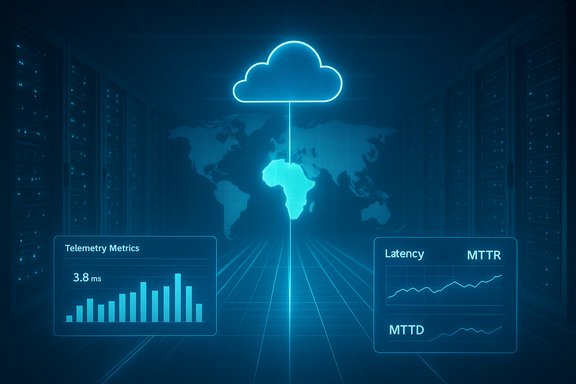
Lakeside Software has launched a new SysTrack Cloud region in Microsoft Azure’s India footprint, promising lower latency, stronger data residency controls, and simplified scaling for enterprises operating in India and nearby markets—and the move arrives at a moment when hyperscale cloud capacity, AI-readiness, and regulatory locality are rising to the top of IT procurement checklists.
Source: The Manila Times Lakeside Software Expands Global Footprint with New SysTrack Cloud Region in Azure India
 Background
What Lakeside announced and why it matters
On November 5, 2025, Lakeside Software announced availability of a dedicated SysTrack Cloud region in Azure India, enabling customers to deploy SysTrack workloads natively inside the India geography. The company framed the expansion as a response to customer demand for lower latency, regional data residency, and easier scalability for Digital Employee Experience (DEX) telemetry and analytics. SysTrack is Lakeside’s AI-driven DEX platform for endpoint telemetry, performance analytics, and proactive IT remediation. The platform already runs natively on Azure and has been increasingly positioned as a turnkey observability and DEX solution for large enterprises. Availability in a local Azure region reduces network round-trips for telemetry ingestion and gives local IT teams greater control over where employee telemetry is stored and processed.The market forces behind the move
Three intersecting trends make a local SysTrack Cloud region strategically important:- Latency and user experience: DEX telemetry and interactive remediation workflows are sensitive to latency; putting telemetry ingestion and analytics closer to users improves responsiveness and troubleshooting speed.
- Data residency and compliance: Geopolitical and regulatory pressure has made many enterprises and public-sector buyers insist that telemetry and analytics remain within national borders unless explicitly permitted otherwise.
- Hyperscaler investment in India: Microsoft’s multi-billion-dollar expansion in India (announced as a US$3 billion investment for cloud and AI infrastructure) is increasing capacity and connectivity across the country, making local region deployments more practical and scalable.
Overview of technical and operational benefits
Performance: lower latency and faster troubleshooting
Deploying SysTrack components and storage in an Azure India region reduces the network distance between endpoints and processing services, which can materially reduce round-trip times for telemetry and interactive root-cause workflows. For DEX use cases—where admins might need near-real-time visibility into application responsiveness or to push remediation actions—these latency improvements often translate into faster mean-time-to-detection (MTTD) and mean-time-to-resolution (MTTR).- Real benefits:
- Quicker ingestion of endpoint telemetry for live dashboards.
- Reduced delays in agent-server communication for remediation actions.
- Faster interactive diagnostic sessions for remote support teams.
Data residency and compliance controls
Local hosting addresses procurement and legal requirements for organizations that must keep employee telemetry and analytics inside India. This is increasingly relevant for regulated industries and government buyers. The distinction between data residency (where stored data resides) and in-country processing (where live processing/inference occurs) is critical; local regions are a necessary but not always sufficient condition for satisfying sovereign or sectoral regulations. IT teams should always validate contractual terms, audit rights, and exception handling for cross-border processing.Scalability and cost control
A local region gives Lakeside and its customers the ability to scale SysTrack hosting capacity without cross-region egress or long-haul dependencies. In cloud terms, locality can reduce egress costs on internal telemetry flows and simplify ability-to-scale planning for enterprises growing their DEX footprint. Lakeside positions SysTrack as a cost-saver—claiming reductions in IT spend tied to improved visibility and remediation—which becomes more achievable when operational overheads (latency, egress) are reduced by a nearby region. However, vendor savings claims should be validated per-deployment; Lakeside’s “save 20% on annual IT costs per employee” statement is a vendor-cited figure and requires evaluation against customer-specific baselines.Strategic context: India, Azure, and DEX adoption
India’s digital maturity and enterprise readiness
Independent surveys show Indian workplaces are rapidly maturing digitally. A Zoho Workplace study reported that about 71% of Indian employees are in organizations at advanced levels of digital maturity, above a global average of roughly 61%—a stat Lakeside cited in its announcement to underscore the market need for stronger DEX tooling. That elevated maturity matters because mature digital workplaces have higher expectations for performance, employee productivity, and measurable ROI from workplace tooling.Microsoft’s infrastructure play
Microsoft’s recent investments and expansion of Azure’s regional footprint across Asia—including a multi-billion-dollar India investment and new region launches—establish the network density and capacity required for third-party SaaS vendors to offer performant, localised services. For vendors like Lakeside, the availability of an Azure India region lowers the friction for enterprise procurement teams to adopt cloud-hosted DEX offerings.Partner ecosystem and channel acceleration
Lakeside included quotes from strategic partners in its release—Kyndryl, Lenovo, and SPNX—which suggests a channel-first approach to scaling adoption in India. For enterprise buyers, mature partners mean easier integration with managed services, faster deployment, and established operational handoffs (support SLAs, runbooks, escalation paths). Partners also help translate vendor-level capabilities into measurable operational outcomes (reduced incident volume, faster remediation, device right-sizing programs).What this means in practice for IT teams
Immediate operational checks to perform
- Data residency requirements: Confirm whether your regulatory obligations require in-country processing, data at rest residency, or both; review contractual language around exceptions, lawful requests, and audit rights.
- Network topology and peering: Evaluate ExpressRoute/Direct Connect equivalents, local peering, and transit paths to ensure endpoint traffic reaches the new region on low-latency links.
- Agent and telemetry configuration: Plan agent rerouting or reconfiguration so endpoint telemetry flows to the India region rather than a distant global region.
- Cost modeling: Recalculate egress, storage, compute, and support costs with the local region in mind; factor in any discounts or local pricing differences.
- Disaster recovery and redundancy: Map how the new region fits into multi-region DR architectures—locality can help performance but it’s not a substitute for geo-redundant failover plans.
Recommended deployment checklist
- Validate regulatory and procurement acceptance of Azure India as a host for telemetry.
- Run a latency pilot from representative office and remote networks to the new region and compare to current baselines.
- Conduct a security-controls analysis: encryption-in-transit and at-rest, key management (including where keys are held), and role-based access controls for operations teams.
- Request a documented exception policy from Lakeside and Azure for cross-region processing or incident-driven failover.
- Pilot with a limited set of endpoints and representative apps to measure MTTD/MTTR delta before broad rollout.
Technical caveats and nuanced risks
Data-locality is not absolute sovereignty
Hosting telemetry in-region reduces exposure to cross-border transfer, but it does not immunize telemetry from lawful access requests or supply-chain dependencies. Contracts and operational controls (where support personnel are located, where backups replicate, who can access logs) determine the real legal posture. IT leaders must insist on clear, auditable commitments if their procurement drivers cite sovereign or sector-specific data constraints.Performance vs. consolidation trade-offs
A local region provides lower latency but may fragment operations if every vendor demands a local footprint. There is an operational tax associated with multi-region vendor deployments: more subscriptions, multi-region monitoring, and potentially more complex DR testing. Organizations must weigh the improved user experience against operational overhead.Vendor claims need methodical validation
Lakeside has marketed SysTrack as delivering measurable cost-savings and operational efficiencies. The company’s public collateral cites potential savings (for example, a claim of roughly 20% on annual IT costs per employee), but those numbers are vendor claims and depend heavily on assumptions about incident rates, remediation efficiencies, and labor cost models. Prospective buyers should demand customer case studies, measurement methodologies, and the ability to reproduce savings in pilot environments before relying on headline ROI numbers.Regulatory and policy uncertainty
India’s data protection and digital governance landscape continues to evolve. While local regions reduce transactional friction today, future regulatory changes could impose additional obligations (e.g., localization of encryption keys, stricter audit regimes). Organizations should adopt a design that balances locality with flexibility to respond to changing legal requirements.Vendor and cloud-provider considerations
What to ask Lakeside before you deploy
- Request an explicit data flow diagram showing exactly where telemetry is collected, processed, stored, and backed up.
- Ask for the security and compliance stack for the India region: certifications, SOC reports, and data handling SOPs for support staff.
- Obtain the SLA and documented exception scenarios (capacity constraints, security incidents) that could trigger cross-region routing.
- Review the cost model for storage, compute, and long-term archive in India vs. other regions.
What to verify with Microsoft/Azure
- Confirm the Azure India region’s Availability Zone count and supported services for the specific SysTrack architecture (VM SKUs, managed services, Azure SQL/Blob compatibility).
- Check details on network connectivity options (ExpressRoute locations, local peering fabric) and any region-specific price differences.
- Obtain Microsoft’s published guidance on residency commitments and how they map to in-country processing for partner-hosted services.
Practical deployment scenarios and examples
Scenario A: Large financial services firm (regulated telemetry)
A bank with strict finance-sector regulations needs endpoint telemetry retained in India, must be auditable to regulators, and requires <50 ms telemetry ingestion latency for certain trading-floor support workflows. Deploying SysTrack in Azure India allows telemetry to stay in-country and provides faster diagnostics for critical workstations. Before full roll-out, the bank must validate contractual audit rights, request encryption key locality, and confirm that Lakeside’s support personnel access is controlled under required legal safeguards.Scenario B: Global enterprise with distributed teams
A multinational company needs a hybrid approach: keep India-region telemetry for Indian employees but retain a global analytics pool for cross-country benchmarking. This requires careful pipeline design—either dual writes, selective aggregation, or anonymized metric forwarding—to keep personally identifiable telemetry in India while sharing aggregated signals globally.Scenario C: Managed service provider (MSP) delivering DEX-as-a-Service
An MSP partner can leverage Lakeside’s India region to offer localized managed DEX services for customers that require in-country hosting, bundling SysTrack with their operational playbooks and DR plans. The MSP must verify partner enablement details from Lakeside (API access, multi-tenant models, role separation) and ensure Azure tenancy architecture aligns with customers’ procurement rules.How to measure success: KPIs for a SysTrack India deployment
- Reduction in MTTD and MTTR for user-impacting incidents (baseline vs. post-deployment).
- Change in average time-to-remediation for high-latency or app-performance issues.
- Volume reduction in repeat tickets due to proactive remediation.
- Measured egress and operational cost delta before and after moving telemetry to the India region.
- Compliance posture validation: percentage of telemetry and logs demonstrably stored and processed in-country per audit.
Strengths, opportunities, and potential pitfalls — a critical assessment
Clear strengths
- Locality-driven performance: Real improvements in interactive troubleshooting and telemetry ingestion latency.
- Procurement enablement: Simplifies buying decisions for regulated and government customers who prioritize in-country hosting.
- Ecosystem traction: Partner endorsements from major system integrators and device OEMs accelerate go-to-market and managed service offerings.
Compelling opportunities
- Platform-led TCO gains: When validated, DEX platforms like SysTrack can reduce repetitive incident costs and improve device lifecycle decisions, potentially lowering IT spend.
- AI-driven insights at scale: Local telemetry datasets enable faster inference and near-real-time insights for local operational use cases.
- MSP and systems integrator play: Partners can bundle localized SysTrack services with managed workplace offerings, enabling faster adoption.
Real risks and cautions
- Marketing vs. measured outcomes: Vendor ROI claims require careful, empirical pilots to validate in a specific environment. Lakeside’s percentage savings figure is a vendor-provided metric that should be validated against customer-specific baselines.
- Operational complexity: Multi-region vendor footprints can increase operational overhead if not centrally managed.
- Legal nuances: “In-country hosting” does not remove all lawful access or compliance complexity; the precise contractual wording and operational controls matter more than region labels.
Practical guidance: a 90-day plan for adoption
- Day 0–15: Requirements and procurement
- Catalog regulatory obligations and map telemetry categories to legal tiers.
- Initiate conversations with Lakeside and Azure account teams; request region-specific documentation and SLAs.
- Day 15–45: Pilot planning and connectivity
- Configure network peering or ExpressRoute segments to the Azure India region.
- Select a representative pilot group of endpoints and applications.
- Day 45–75: Pilot execution
- Deploy SysTrack into the India region for the pilot group.
- Run latency, ingestion, and remediation-bench tests; collect KPI baselines.
- Day 75–90: Review and scale decision
- Analyze pilot results against success criteria (MTTD/MTTR, ticket volume, cost delta).
- Decide on phased roll-out, contract amendments, and partner-run models.
Conclusion
Lakeside Software’s launch of a SysTrack Cloud region in Azure India is a pragmatic, timely move that aligns product placement with where enterprise demand—and hyperscaler capacity—are rapidly converging. The immediate benefits are straightforward: lower latency for telemetry and remediation, stronger data residency controls, and a smoother procurement path for regulated buyers. The strategic backdrop—Microsoft’s India investment and a digitally mature workforce—amplifies the potential value for enterprise IT teams and MSP partners. At the same time, organizations should approach the announcement with operational rigor: validate vendor ROI claims in pilots, demand concrete documentation about data flows and audit rights, and design deployments that balance locality with the agility to adapt to evolving regulation and multi-region operational needs. When executed thoughtfully, a local SysTrack deployment on Azure India can materially improve employee experience, reduce operational friction, and make proactive IT more achievable—just not without careful measurement and contractual clarity.Source: The Manila Times Lakeside Software Expands Global Footprint with New SysTrack Cloud Region in Azure India
