

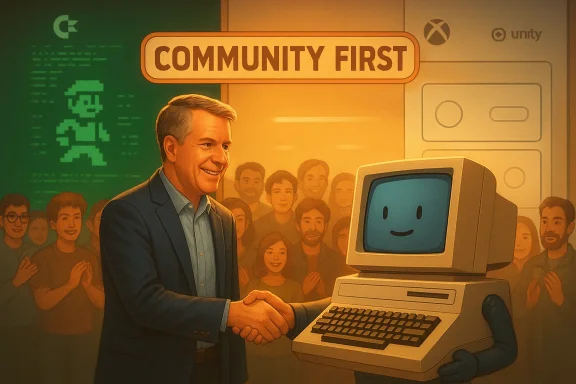
Larry “Major Nelson” Hryb’s move to join the newly revived Commodore as a community development advisor is a tidy, symbolic bridge between two eras of gaming — the hulking nostalgia of the Commodore 64 and the modern, platform-driven world Hryb helped shape at Xbox — but it’s also a cautious, pragmatic step for both sides: Commodore gains community‑building credibility, and Hryb keeps his options open while he considers his next full‑time role.
Important nuance: Hryb himself reportedly clarified on social media that this is an advisory role and “not my full time gig,” indicating he intends to keep his calendar open for other commitments or a potential return to platform work. That clarification has been quoted in some coverage; however, the granular social post chain is not uniformly archived in press outlets, so that exact phrasing should be understood as Hryb’s stated intent rather than a formal, contract‑level job description published by Commodore. Treat his “not full time” wording as a contemporaneous public clarification rather than a legal guarantee.
For Hryb, the engagement is likewise shrewd: it keeps him visible and productive within the gaming scene while leaving room for future full‑time roles. That ambiguity benefits both parties in the short term, but it raises a clear test for the medium term: will Commodore convert the initial PR win into a stable, community‑centric business that honors heritage while building new pathways for creators and players?
If Commodore can deliver on developer tools, reliable products, and genuine community revenue models — and if Hryb’s advisory input translates into demonstrable community programs — the brand has a credible shot at turning sentimental demand into a sustainable modern platform. If not, the revival risks becoming another high‑visibility nostalgia footnote: liked in photos, but not substantively different from previous attempts. Either way, this hire puts community engagement at the center of the Commodore story, and that alone is the right first move.
Commodore’s rebirth is now a test case: can a heritage technology brand be shepherded back into relevance primarily through community care, creator partnerships, and transparent product stewardship? Larry Hryb’s involvement gives the reboot a credible playbook to follow — but credibility must be proven in deliveries, not just headlines. The next 12 months will tell whether Commodore’s future is a sustainable second act or a wistful cameo in a retro highlight reel.
Source: Windows Central Ex-Xbox exec Major Nelson joins Commodore, but it's not his "full time gig"
 Background
Who is Larry “Major Nelson” Hryb?
For nearly two decades Larry Hryb was one of the most visible public faces of Xbox, serving as director of programming for Xbox Live and building a community-first playbook that influenced how game platforms speak to players. After stepping back from Microsoft in 2023, Hryb joined Unity as director of community and advocacy, a tenure that lasted roughly 18 months before his departure earlier in 2026. These moves position him today as a senior industry communicator with deep institutional experience in audience engagement and brand stewardship.What is “Commodore” today?
The Commodore name carries immense cultural weight: the original Commodore 64 (C64) is widely recognized as the best‑selling single model of personal computer ever made. Estimates for lifetime C64 sales vary by source — the commonly cited range is between about 12.5 and 17 million units — and Guinness World Records still lists the C64 as the highest‑selling desktop model in history. The original Commodore company filed for bankruptcy in 1994; the brand has subsequently changed hands several times. In 2025 a fan‑led acquisition organized by Christian “Peri Fractic” Simpson (known from the Retro Recipes channel) completed a takeover of the Commodore trademarks and assets and has since relaunched the brand with retro‑minded hardware like the Commodore 64 Ultimate.The announcement: what happened and what was said
On March 11, 2026, multiple outlets reported that Hryb had joined Commodore International as a Community Development Advisor, a role framed as advisory and community‑facing rather than an operational, full‑time executive position. Commodore’s leadership — led by Christian Simpson, who steered the fan‑led acquisition — described the hire as part of a push to “welcome a new generation” while supporting the passionate existing fan base. Hryb’s public comments emphasized the primacy of community partnerships in rebooting legacy brands.Important nuance: Hryb himself reportedly clarified on social media that this is an advisory role and “not my full time gig,” indicating he intends to keep his calendar open for other commitments or a potential return to platform work. That clarification has been quoted in some coverage; however, the granular social post chain is not uniformly archived in press outlets, so that exact phrasing should be understood as Hryb’s stated intent rather than a formal, contract‑level job description published by Commodore. Treat his “not full time” wording as a contemporaneous public clarification rather than a legal guarantee.
Why this hire matters (on paper)
- Commodore gains a community architect who literally helped invent modern platform communications at one of the industry’s largest properties. Hryb’s playbook — blogs, podcasts, direct social engagement, event coordination — is textbook for platform‑centric audience development. Putting that experience at Commodore’s disposal is a signal the reboot is serious about community, not only nostalgia.
- For Hryb, the role is low friction: an advisory remit lets him leverage his brand and relationships without immediately taking on the operational burdens of product or P&L ownership. That’s attractive to senior industry figures weighing multiple opportunities — from consultancy to a potential return to a major platform.
- For the community, it’s an explicit acknowledgement that the modern Commodore intends to grow by partnering with the hobbyist ecosystem — hardware modders, indie developers, retro publishers and content creators — rather than attempting a closed, corporate reboot. That alignment is crucial to avoid alienating the very fans the brand relies on.
Commodore’s recent trajectory: revival, product, and friction
Fan‑led acquisition and the Commodore 64 Ultimate
Christian Simpson’s campaign to reassemble the Commodore trademarks culminated in a 2025 purchase that brought a fan‑driven ethos to the company’s operations. The new Commodore has launched products including the Commodore 64 Ultimate — a modern, minimalist take on the original hardware with updated internals and retro styling — and has announced a roadmap emphasizing regular releases. Early commercial results and crowdfunding momentum suggest genuine market demand for nostalgia‑driven hardware executed with contemporary manufacturing quality.Legacy risks and legal headaches
Reviving a storied brand is rarely just a feel‑good story. The Commodore name carries legacy IP entanglements, past bankruptcies, and legal disputes over trademark use. The original firm’s bankruptcy in 1994 created a complicated asset trail, and subsequent attempts to monetize the name have sometimes drawn litigation and confusion. The new Commodore’s team has publicly acknowledged these complexities while emphasizing the fan acquisition as an intention to do things differently. Bringing a recognizable industry figure like Hryb into the fold helps legitimize the effort, but it doesn’t erase the brand’s legal or operational risks.Major Nelson’s playbook: what he brings to Commodore
Community architecture, not hardware engineering
Hryb’s strengths are audience strategy and platform communications: building feedback loops between developers, creators, and players; staging events and digital channels to foster loyalty; and translating community sentiment into product or policy changes. Commodore needs this acumen precisely because the product play — a retro hardware line and software ecosystem — will survive or fail based on authentic community buy‑in. Expect Hryb to help shape outreach programs, creator partnerships, and event strategies rather than tinkering with board layouts or firmware.Practical deliverables he could drive (realistic, short list)
- Structured creator partner programs that reward streamers, modders, and preservation projects.
- An independent developer portal and SDK guidance for C64‑style software and modern ports.
- A roadshow-style program: community meetups, hands‑on demo nodes at retro events, and a managed “show and tell” calendar to surface user mods and hacks.
- Clear customer support and transparency practices to avoid the backlash that often follows retro product launches with limited supply or vague delivery timelines.
Strategic upside: what Commodore and Hryb can achieve together
- Rewiring nostalgia into sustainable engagement. Commodore’s brand power is enormous, but nostalgia alone doesn’t create longevity. Professionalizing community relations can convert one‑time buyers into recurring participants: contributors to app ecosystems, mod marketplaces, or subscription arms tied to preservation and educational content.
- Reaching new demographics. A serious outreach program could introduce the C64 story and ecosystem to younger coders and retro newcomers — not just collectors — expanding the potential market for hardware, peripherals, and licensed content. This is a classic “heritage brand modernized” play.
- Building an R&D feedback loop. If Commodore wants to experiment with modern hardware (ARM‑based developer kits, FPGA recreations, hybrid software platforms), Hryb’s channels could be the fastest, lowest‑cost route to meaningful user testing and adoption.
Risks and credibility checks
Risk 1 — Advisory role vs. operational capacity
An advisory title is useful for optics, but real transformation requires operational bandwidth. If Hryb’s involvement remains limited to a few high‑visibility endorsements or occasional consulting sessions, fans and partners may feel shortchanged. The difference between symbolic and substantive involvement matters, especially when product delivery timelines and warranty or supply issues are at stake. Note: Hryb’s public clarification that this is an advisory role and “not my full time gig” raises precisely this ambiguity. Treat advisory announcements as opening moves — not guaranteed long‑term resource commitments.Risk 2 — Supply, quality, and regulatory questions
Retro hardware revivals often stumble on production scale, quality control, and the tricky IP situation around bundled ROMs or software. Commodore’s new team must show that they control supply chains, comply with software licensing, and can support hardware returns. Community goodwill is fragile; early missteps can produce long tails of distrust that are expensive to fix.Risk 3 — Brand trust and legacy authenticity
The Commodore community includes both die‑hard preservationists and casual nostalgic buyers. Misaligning product choices (e.g., locked firmware, DRM, or heavy up‑charging for “official” nostalgia) risks alienating the enthusiasts who sustained the brand through decades. Hryb’s involvement can help mediate these tensions — but only if Commodore’s roadmap reflects tangible concessions to the hobbyist base, such as mod‑friendly designs and open documentation.What this doesn’t mean: the Xbox comeback narrative
The media loves a neat arc — Hryb leaves Xbox in 2023, is briefly at Unity, then reappears in a Commodore announcement, and people ask: is he coming back to Xbox? The answer should be cautious. Advisory work with Commodore does not equate to a formal return to Microsoft or Xbox. Hryb’s public statements have left that door ajar (“I will never say never” type of language has appeared historically), but there’s no confirmed full‑time rehire or official Xbox appointment tied to this Commodore advisory role. Any speculation that this announcement is a backdoor to regain an internal Xbox position is just that: speculation. Hryb’s move more directly signals that senior platform veterans are choosing flexible, community‑facing work as a next step, not necessarily immediate operational returns to prior employers.The community reaction: cautious optimism
Early response from retro communities, content creators, and industry observers has been a mix of excitement and careful skepticism. On one hand, the move validates Commodore’s seriousness; on the other, fans are wary until they see sustained support: developer tools, open modding permissions, reliable supply, and transparent communication. Hryb’s presence raises the bar for communication, because it sets expectations for frequent, clear, and honest engagement. If Commodore flubs the basics — shipping delays, ambiguous warranties, or contested IP use — Hryb’s brand could either smooth things over or be pulled into the conflict.A closer look at the numbers and heritage
- The Commodore 64’s place in history is not hyperbole: it remains the best‑selling desktop computer model of all time according to Guinness World Records, with independent estimates for lifetime sales generally landing in the ~12.5–17 million units range. Those figures underscore the scale of the brand’s cultural footprint and why modern companies seek to tap Carpenter‑level nostalgia.
- Commodore’s bankruptcy in 1994 is more than historical color: it created a chain of asset sales and IP fragmentation that subsequent owners and revival teams have had to navigate. That legal and archival complexity is material to the new company’s ability to distribute both hardware and the legacy software catalog in a clean, licensed way.
What we should watch next (measurable signals)
- Product cadence and transparency. Will Commodore publish a realistic public roadmap with delivery windows, production estimates, and quality metrics? A concrete schedule — with independent audits or third‑party manufacturing partners named — would be a strong trust signal.
- Developer tooling and documentation. An SDK, modding guide, or developer portal within 6–12 months would indicate the brand is serious about enabling creators beyond one‑off nostalgia kits.
- Creator programs and revenue share. Will Commodore fund creator initiatives or revenue‑share models that let streamers and modders monetize their work on Commodore hardware or app stores? These programs will be decisive for long‑term ecosystem health.
- Hryb’s cadence of involvement. Track whether Hryb’s role evolves from advisory to operational or if he takes on board positions, recurring public programming, or hands‑on event calendars. Any move toward a formal executive title would be a major signal that Commodore is doubling down on structured community management.
Final analysis: pragmatic nostalgia wins when it’s earned
Commodore’s reboot combines a rare asset — a globally recognized vintage brand — with a modern commerce and community environment that rewards openness, repeatability, and creator participation. Hiring Larry Hryb as a community development advisor is a smart, pragmatic move: it gives Commodore an experienced translator between legacy fandom and contemporary creator culture. But advisory hires are cosmetic unless backed by sustained operational discipline: clear product roadmaps, licensing transparency, and investment in tooling.For Hryb, the engagement is likewise shrewd: it keeps him visible and productive within the gaming scene while leaving room for future full‑time roles. That ambiguity benefits both parties in the short term, but it raises a clear test for the medium term: will Commodore convert the initial PR win into a stable, community‑centric business that honors heritage while building new pathways for creators and players?
If Commodore can deliver on developer tools, reliable products, and genuine community revenue models — and if Hryb’s advisory input translates into demonstrable community programs — the brand has a credible shot at turning sentimental demand into a sustainable modern platform. If not, the revival risks becoming another high‑visibility nostalgia footnote: liked in photos, but not substantively different from previous attempts. Either way, this hire puts community engagement at the center of the Commodore story, and that alone is the right first move.
Commodore’s rebirth is now a test case: can a heritage technology brand be shepherded back into relevance primarily through community care, creator partnerships, and transparent product stewardship? Larry Hryb’s involvement gives the reboot a credible playbook to follow — but credibility must be proven in deliveries, not just headlines. The next 12 months will tell whether Commodore’s future is a sustainable second act or a wistful cameo in a retro highlight reel.
Source: Windows Central Ex-Xbox exec Major Nelson joins Commodore, but it's not his "full time gig"
