

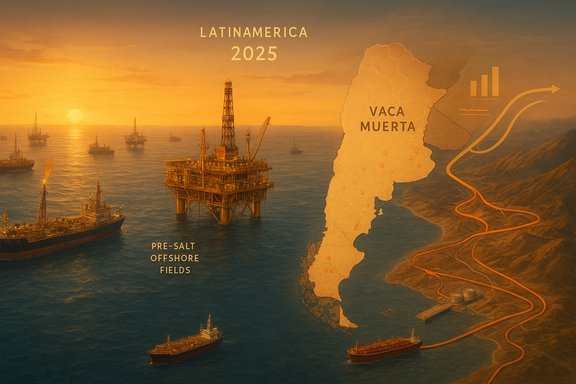
Latin America’s oil and gas industry closed 2025 as a study in contrasts: rapid deepwater expansion and shale-driven gas growth on one hand, and political, fiscal, and infrastructure constraints on the other. The region’s headline stories — Guyana’s breakout offshore surge, Brazil’s pre-salt dominance, and Argentina’s Vaca Muerta-driven gas renaissance — sit alongside stagnation in Mexico, renewed sanctions pressures on Venezuela, and uneven recoveries in Ecuador, Peru, and Trinidad & Tobago. This feature synthesizes the user‑provided EnergiesNet briefing with independent reporting and official statements to produce a verified, critical account of the sector’s strengths, weaknesses, and what to watch in 2026.
Background
Latin America’s hydrocarbon landscape in 2025 was shaped by three intersecting forces: a still-robust appetite for liquid and gaseous hydrocarbons driven by fiscal needs and energy security; a wave of deepwater and shale projects attracting multinational capital; and mounting climate and social pressures that complicate permitting and long‑term planning. Offshore projects in the Guyana‑Suriname‑Brazil corridor and infrastructure moves around Argentina’s Vaca Muerta stand out as the year’s most consequential developments, while legacy producers such as Mexico and Venezuela faced clearer headwinds.This analysis cross‑checks the EnergiesNet coverage with company releases, regulator bulletins, and independent reporting to verify key figures and identify areas of divergence or uncertainty. For the most load‑bearing claims — production volumes, major project FIDs and sanctions developments — at least two independent sources were consulted to assess reliability and expose conflicting estimates where they exist.
Guyana: from emerging frontier to regional heavyweight
The size of the boom
Guyana’s offshore ascent continued in 2025, with ExxonMobil and partners accelerating sanctioned developments on the Stabroek block. Company announcements and government data show multiple FPSOs online or in late construction, driving monthly production into the high hundreds of thousands of barrels per day by late 2025. ExxonMobil’s public release in September described further capacity additions and forecasted growth toward nearly 900,000 bpd by year‑end as new FPSOs come online and sanctioned projects advance.Why Guyana matters
- Guyana’s rule‑of‑law and predictable contractual framework have made it an outsize magnet for deepwater capital, generating offshore development at a pace rare for a nation of its size.
- The presence of large international operators (ExxonMobil, Hess, CNOOC) and the rapid succession of FPSO startups create an industrial cluster effect: local services, supply chains, and fiscal receipts scale quickly.
- Strategically, Guyana is evolving into a non‑OPEC, high‑growth supplier that will influence Atlantic basin trade flows and provide diversified crude to global buyers.
Risks and caveats
- Rapid revenue inflows create governance and macroeconomic risks: Dutch disease, inflationary pressure, and political disputes over tax terms and public spending allocations.
- Project timelines and some public forecasts remain contingent on FPSO delivery schedules, which face global supply‑chain and fabrication constraints. Company releases are authoritative on sanctioned capacity, but independent tracking of actual flows and OPEC/secondary reporting should be treated as corrective when discrepancies appear.
Brazil: pre‑salt strength and strategic balance
Production and the pre‑salt story
Brazil consolidated its position as Latin America’s largest producer in 2025, with the pre‑salt basin accounting for the majority of new growth. Petrobras and partner fields continued to set production records across pre‑salt assets; Petrobras’ operational bulletins and ANP monthly numbers show sustained increases in pre‑salt output and a string of new platform and FPSO startups contributing to national growth. Petrobras reported record pre‑salt volumes in 2024 and successive quarters of higher output through 2025.Policy and investment posture
Brazil’s approach continues to be pragmatic: attract investment into high‑quality deepwater assets while preserving an energy plan that allows room for renewables and gas. Auction rounds remained well‑subscribed in 2025 and Petrobras pursued higher‑value, deeper pre‑salt projects that deliver scale and export potential.Transition balancing act
Brazil is increasingly treating gas as a dual tool — domestic fuel for power and industry, and exportable feedstock as LNG markets firm. The country’s energy strategy appears to prioritize a balanced transition: leveraging the fiscal benefits of oil revenues while deploying gas and renewables to reduce emissions intensity over time. The pre‑salt’s capital intensity and production scale make it central to fiscal planning, and Petrobras’ operational outputs underscore that reality.Argentina: Vaca Muerta converts potential into production
Shale‑led gains
Argentina’s 2025 performance was anchored by Vaca Muerta. Multiple industry reports and government data indicate strong double‑digit increases in both oil and gas output year‑over‑year, driven by accelerated well completions, midstream expansions (pipeline throughput increases), and incentives for gas offtake. Analysts projected near‑record oil output and material gas growth; S&P and other industry trackers documented expectations and observed spikes consistent with EnergiesNet’s overview.Infrastructure unlocking growth
The completion of new pipeline capacity and takeaway projects in 2025 reduced bottlenecks that had previously constrained commercialization of Vaca Muerta volumes. That policy‑and‑capex combo enabled exporters and domestic gas users to take on more supply, and opened the door to future LNG export projects.Economic and political fragility
Argentina’s production gains are tempered by macroeconomic fragility: high inflation, currency volatility, and fiscal pressures could erode investment momentum without continued reforms and credible long‑term contracts. The government’s ability to monetize hydrocarbons while stabilizing the macro environment will be decisive for sustainable growth.Mexico: stalemate and structural risk
Flat output and institutional uncertainty
Mexico’s oil production showed little growth in 2025, with state company Pemex continuing to manage high debt and operational challenges while the policy landscape for private participation remained unclear. Reuters reporting in late 2025 confirmed that Pemex’s production hovered near 1.6 million bpd and that leadership changes and ongoing restructuring pointed to operational stress rather than a clear path to growth.The policy dilemma
Under President Claudia Sheinbaum’s administration, the sector faced conflicting signals: a rhetorical tilt toward energy sovereignty and cleaner energy, but no decisive framework to reassure private contractors or stimulate new licensing. That institutional ambiguity translates into deferred exploration budgets and slowed upstream activity. Without a transparent, investor‑friendly roadmap — or a clear path to resolve Pemex’s balance‑sheet issues — Mexico risks long‑term stagnation relative to regional peers.Venezuela: short‑term rebounds, structural constraints
Sanctions and stop‑start dynamics
Venezuela’s 2025 trajectory was dominated by geopolitics. Periodic license accommodations for Western operators and ad hoc workarounds temporarily boosted flows, but renewed U.S. enforcement actions and maritime interdictions constrained export channels later in the year. Reporting showed that Chevron’s operations produced temporary uplifts before licensing uncertainties and U.S. measures reduced their near‑term impact; PDVSA’s continued reliance on barter, discounts, and non‑Western partners creates an unstable recovery path.Technical and investment gaps
Long‑standing capital and maintenance shortfalls, dilapidated upstream infrastructure, and limited access to modern financing mean Venezuela’s recovery hinges on political change and the restoration of credible commercial contracts. Short‑term production numbers mask deeper reliability and quality issues (equipment, refining bottlenecks, and logistics).Ecuador, Peru, Trinidad & Tobago, and Suriname: nuanced local pictures
Ecuador: rebound with strings attached
Ecuador’s 2025 output bounced back from mid‑year pipeline disruptions, but the recovery is fragile. Force majeure events tied to pipeline erosion and social unrest disrupted flows earlier in the year, and while production recovered some volumes, aging infrastructure and protest risk leave future output uncertain. Official and market reports documented a sharp mid‑season drop followed by partial recovery, underscoring persistent vulnerabilities.Peru: mature declines and LNG steadiness
Peru registered continued decline in mature onshore oil fields, while its LNG infrastructure (Camisea and related facilities) maintained export flows. Government incentives for offshore exploration were slow to translate into activity. The structural challenge is clear: limited near‑term upstream upside, but steady midstream/existing LNG revenues provide fiscal breathing room.Trinidad & Tobago: incremental gas gains, long road to peak
Trinidad and Tobago’s gas story in 2025 was one of stabilization rather than dramatic recovery. Brownfield projects (compression, tie‑backs) and a small number of start‑ups brought incremental gains, but production remained substantially below historical peaks. Public and industry reporting placed 2024–2025 averages in the mid‑2 bcf/d range, with optimistic project pipelines (Calypso, Aphrodite, Cypre) capable of reversing declines only if FIDs and cross‑border arrangements progress on schedule. There is variance among reported figures — some industry commentaries and local reporting suggest modestly higher 2025 averages, but these are sensitive to short‑term ramp profiles and reporting conventions.Suriname: exploration excitement, production still in future
Suriname remains an exploration hotspot with multiple material discoveries in Blocks 52 and 58. Petronas, TotalEnergies, APA, and others continued appraisal drilling in 2025, delivering discoveries that industry consultancies estimate could support FPSO clusters. However, no material commercial gas export production had started by the end of 2025; development timelines point to first production later in the decade, contingent on FIDs and financing. Petronas’ press releases and Wood Mackenzie assessments confirm discoveries and resource potential but stop short of immediate production promises.Regional trends and the energy transition
Offshore and gas: the dominant near‑term themes
- Deepwater oil projects and pre‑salt expansion have become the primary engines of growth, particularly in Brazil and Guyana.
- Natural gas — both conventional and unconventional (shale in Argentina) — is being prioritized as a transitional fuel and an exportable commodity (LNG), bolstering midstream investment and pipeline projects.
Climate pressures versus fiscal realities
Many governments face a dilemma: global climate commitments push for emissions reductions and reduced fossil dependence, while immediate fiscal needs, energy security, and employment pressures incentivize continued hydrocarbon development. Colombia represents the most explicit policy pivot — pausing new licensing in line with climate goals — but most other countries are pragmatically balancing both priorities.Investment flows and investor preferences
Capital continues to flow to scale projects with predictable regulatory frameworks and good subsurface economics: deepwater pre‑salt blocks and large shale plays. Projects that combine high IRR and clear export or domestic offtake routes secure financing; high political risk or unclear fiscal terms push investors away or force risk‑sharing structures and higher returns.Strengths and notable achievements
- Scaleable growth engines: Guyana and Brazil provide the clearest examples of how large, well‑managed offshore plays can transform national energy profiles in under a decade. ExxonMobil’s program on the Stabroek block (multiple FPSOs and announced projects) exemplifies rapid industrialization and capital deployment.
- Shale commercialization: Argentina’s Vaca Muerta shows how shale basins outside the U.S. can reach industrial scale when pipeline and export infrastructure align with drilling and completion activity. The resulting boost in gas and condensate volumes materially improves energy self‑sufficiency and export potential.
- Resilient midstream and LNG platforms: Countries with mature LNG and midstream capacity — Brazil, Trinidad & Tobago, Peru (Camisea) — retain optionality to monetize gas for domestic use and exports.
Risks and fault lines
- Policy uncertainty and state enterprise distress: Pemex’s indebtedness and governance challenges in Mexico, and PDVSA’s structurally impaired assets in Venezuela, highlight how state‑owned companies can become binding constraints on national production. Leadership churn and unclear private‑sector pathways increase execution risk.
- Geopolitical and sanctions exposure: Venezuela’s shifting sanction environment and maritime interdictions demonstrate how geopolitics can abruptly curtail export channels, leaving production stranded and inventories afloat.
- Infrastructure fragility and social opposition: Ecuador’s pipeline erosions, Peru’s local opposition to offshore and onshore projects, and community resistance to Amazon drilling underscore the physical and social vulnerabilities that can shut down production rapidly.
- Transition mismatch: While climate policies increasingly shape debate, the pace of renewable buildout and the need for fiscal revenues mean hydrocarbons will remain central for several years — creating a policy tension that governments must manage carefully to avoid stranded assets or lost fiscal windows.
What to watch in 2026
- Guyana’s next licensing round and the startup cadence of additional FPSOs (Uaru, Whiptail, Hammerhead) — these will determine whether forecasts toward 900k+ bpd are sustainable.
- Brazil’s post‑election energy strategy and Petrobras’ auction outcomes — continued pre‑salt investment is central to Brazil’s fiscal and energy outlook.
- Mexico’s regulatory posture and Pemex restructuring outcomes — investor clarity on licensing and partnerships will decide whether Mexico reverses its stagnation.
- Argentina’s LNG export plans and macro stabilization — successful commercialization of Vaca Muerta gas to export markets will hinge on fiscal and currency management.
- Suriname’s appraisal results and any final investment decisions for Block 58/52 clusters — FIDs there would reshape Caribbean supply potential.
- Venezuela: the interplay between sanction enforcement and shipping interdictions, and whether new maritime and legal dynamics permanently change trading patterns.
- Trinidad & Tobago’s ability to secure new upstream FIDs (Calypso, Manatee, Aphrodite) to restore feedstock for LNG and petrochemicals.
- Ecuador and Peru’s capacity to translate new contractual incentives into private financing and socially accepted projects without fresh protests or force majeures.
Editorial verdict: uneven progress, pragmatic choices
Latin America’s 2025 energy story is neither collapse nor unalloyed triumph; it is a complex, country‑by‑country mosaic. The region possesses the technical resources, investor interest, and midstream capacity to sustain significant hydrocarbon production for years to come. At the same time, political volatility, legacy state‑company burdens, social opposition, and the accelerating energy transition create a high‑stakes operating environment where policy clarity, transparency, and infrastructure robustness matter more than ever.Three practical takeaways:
- Countries that combine clear fiscal terms, predictable regulation, and robust security of tenure (Guyana, parts of Brazil, segments of Argentina’s shale strategy) will continue to attract capital and deliver production growth.
- Producers dependent on state enterprises (Mexico, Venezuela) need credible reform or partnership frameworks to restore investor confidence and operational capacity.
- Social license and climate commitments will increasingly shape project timelines, financing conditions, and market access; operators and governments must embed robust community engagement and emissions mitigation to avoid costly delays.
Final notes on data and verifiability
This feature used the EnergiesNet briefing provided by the user as a baseline and cross‑checked headline production numbers, major project developments, and sanction dynamics against official company announcements, regulator bulletins, and independent reporting. For example, ExxonMobil’s Guyana announcements and Petrobras’ production bulletins confirm the region’s deepwater growth trajectory. Where official company releases were available they were used to verify production capacity and sanctioned FIDs; where secondary reporting diverged (notably in some national production averages), that discrepancy is flagged and treated cautiously. Readers should treat short‑term monthly figures as provisional and consult OPEC/ANP/official government bulletins for the most recent, formalized statistics.Key external confirmations cited within the article include ExxonMobil’s Guyana statements and Petrobras’ production reports for pre‑salt output. Several independent journalistic reports and industry trackers were used to validate claims about Pemex, Venezuela sanctions activity, Suriname discoveries, and Argentina’s Vaca Muerta growth. Where numbers differ across sources, the divergence is explicitly noted.
Latin America’s energy future will be written in project milestones, policy stability, and the ability of governments to convert resource wealth into sustainable income — all while managing an accelerating global push to decarbonize. The next 12–18 months will clarify whether the region sustains the optimistic growth curves of 2025 or confronts the fiscal and social limits that have tripped past booms.
Source: EnergiesNet 2025 Latin Oil & Gas: Uneven Progress - EnergiesNet
