

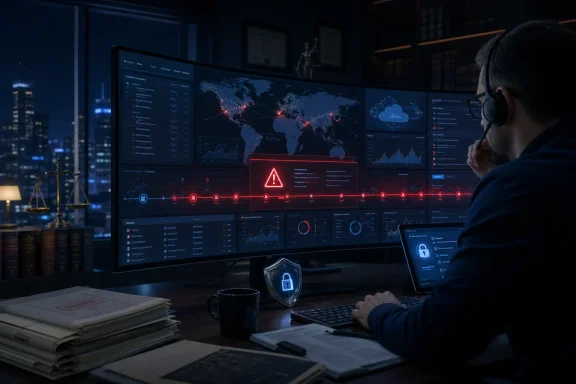
The most important cybersecurity question a law firm leader can ask is deceptively simple: what happens if a high-severity alert fires at 3 a.m. on a Sunday? The answer reveals whether the firm has a genuine security capability or merely an expensive collection of security products waiting for someone to open a dashboard the next morning.
For law firms, this is no longer a theoretical exercise reserved for the largest global partnerships. Confidential client records, litigation strategy, intellectual property, financial information, deal documents, privileged communications, and personally identifiable information make legal organizations unusually valuable targets. A security incident can bring more than technology downtime; it can interrupt active representation, threaten professional obligations, trigger client-notification decisions, and damage a reputation built over decades.
The uncomfortable reality is that many firms have improved their security stack without fully improving their security posture. They may own endpoint detection and response tools, multi-factor authentication, email security, cloud backups, vulnerability scanners, and a SIEM platform. Yet ownership is not the same as operational coverage. If nobody is empowered and prepared to investigate and contain an attack outside normal business hours, the firm remains exposed during precisely the window attackers prefer.
Cybersecurity is often treated as an IT department responsibility. That is only partly true. IT operates the systems, but firm leadership decides how much risk the organization accepts, which services receive funding, who has authority during a crisis, and whether continuity of legal services is a real priority.
The “3 a.m. question” should therefore be asked by managing partners, executive committees, COOs, general counsel, and firm administrators—not only by technical leaders.
A useful version of the question is:
A credible answer identifies specific people, clear escalation paths, documented authority, measurable service levels, and rehearsed containment actions. It explains what happens before a threat turns into an outage, extortion event, or confidentiality crisis.
A single compromise can expose information that would be difficult for attackers to obtain directly from the client. That makes legal organizations appealing targets for financially motivated ransomware groups, business email compromise operators, opportunistic criminals, and sophisticated espionage-focused actors.
In many cases, the threat is not simply that files will be encrypted. It is that files will be copied first, then used as leverage. Modern extortion campaigns frequently depend on data theft as much as disruption.
Each integration, vendor connection, user identity, administrator account, and exception process can create another route into the environment.
The rapid adoption of generative AI adds another layer. AI-enabled drafting, research, summarization, transcription, document review, and knowledge-management tools can provide meaningful productivity gains. But they also raise difficult questions about data classification, client consent, retention, access control, third-party processing, prompt injection, and unapproved use of consumer AI services.
The result is an expanding attack surface at a time when adversaries are moving faster.
That does not mean all attacks begin after midnight. Initial access may occur days, weeks, or months before a major incident becomes visible. A stolen password may sit unused. An unpatched internet-facing appliance may be compromised quietly. A malicious email attachment may create a foothold that remains dormant while the attacker maps the environment.
But once an intruder has access, the clock matters.
That changes the security conversation for law firms.
A response measured in “the next business day” is not a response model. It is a post-incident discovery model.
Attackers may use overnight hours to:
But the tools are only one part of the operating model.
A SIEM can collect logs, but it cannot automatically understand every legal workflow. An EDR platform can generate a high-confidence alert, but it may not be authorized to isolate a managing partner’s laptop without human review. MFA can reduce account-takeover risk, but poorly managed authentication exceptions, legacy protocols, token theft, and social engineering can still create openings.
Technology generates information. People, process, authority, and preparation determine whether that information becomes action.
A credible model identifies a continuously staffed internal security operations center, a managed detection and response provider, a managed security service provider with defined response coverage, or a documented on-call rotation with sufficient expertise and authority.
An inbox that is reviewed each morning is not continuous monitoring. Neither is a mobile notification sent to an exhausted IT director who is expected to decide whether an event is serious without support.
However, automation has limits. A high volume of failed sign-in attempts may be a password-spray attack, a misconfigured application, or a user working from an unfamiliar location. A large document download may indicate data staging—or it may be an associate preparing for a filing deadline.
Human analysts provide context, judgment, and escalation discipline. The objective is not to choose between AI and people. The objective is to use automation for speed and scale while preserving human accountability for meaningful decisions.
A 24/7 response model should spell out whether responders can:
For example:
The notification plan should identify primary and backup contacts, define severity levels, and account for the fact that email may be unavailable or compromised during an incident.
The firm should also know whether its provider will call, send secure text messages, use an emergency application, or rely on a ticketing system that nobody checks after hours.
A generic monitoring team may see a large file transfer at 1:30 a.m. and classify it as suspicious. In a law firm, the activity may be related to an emergency injunction, a major transaction, a cross-border filing deadline, a trial preparation session, or production work involving a large discovery set.
Conversely, the same activity could be a warning that an attacker is staging privileged documents for exfiltration.
That requires knowledge of:
A provider that treats every late-night document download as malicious will overwhelm the firm with noise. A provider that dismisses every unusual file transfer as “probably legal work” may miss data theft. Mature monitoring finds the balance through baselining, documentation, threat intelligence, and analyst judgment.
They can generate polished phishing messages, imitate business language, analyze publicly available information, automate reconnaissance, and support malicious code development. Voice cloning and synthetic media further complicate verification procedures for urgent financial, client, and administrative requests.
For law firms, the implications are especially serious because attackers can impersonate partners, clients, opposing counsel, court personnel, vendors, and finance personnel.
Firms should reinforce:
Leadership should establish clear requirements for:
Automated containment can prevent damage at machine speed, particularly when an endpoint launches known ransomware behavior or a user account exhibits a clear sign of compromise. But automation also carries operational risk. A poorly tuned rule that disables the wrong account, isolates a litigation-support server, or blocks access during a critical filing can create its own disruption.
The goal is controlled automation, not blind automation.
Firms should define which events justify immediate action, which require analyst validation, and which demand leadership approval. They should test these policies in tabletop exercises and simulations rather than discovering flaws during a live incident.
Under-investment presents the opposite danger. Lean IT teams often carry enormous responsibility: help desk support, onboarding, procurement, system upgrades, Microsoft 365 administration, vendor management, compliance work, and cybersecurity. Expecting the same small team to continuously monitor complex security tools around the clock is frequently unrealistic.
That is not a criticism of internal IT staff. It is an argument for matching operating expectations with resources.
A large international firm may support an internal SOC, dedicated threat hunters, incident responders, security engineers, and governance staff. A smaller or midsize firm may be better served by a well-vetted MDR provider, a strategic internal IT leader, and an outside incident response relationship.
The right model depends on the firm’s size, client base, risk profile, geographic footprint, technology environment, regulatory obligations, and internal expertise.
But none of those investments automatically answers the central operational question: what happens when an attack begins outside office hours?
A strong law firm cybersecurity program is not defined by the number of dashboards on display or the number of vendor logos in a board presentation. It is defined by the ability to detect, investigate, contain, communicate, and recover when it matters most.
At 3 a.m., the difference between a contained alert and a firm-wide crisis may come down to whether an experienced person sees the signal, understands the legal context, has authority to act, and knows exactly whom to call.
That is the standard leaders should demand. Not perfect security, because no firm can guarantee that. Not a promise that every alert is harmless. But a tested, accountable capability that ensures someone is watching when the rest of the firm is asleep.
For law firms, this is no longer a theoretical exercise reserved for the largest global partnerships. Confidential client records, litigation strategy, intellectual property, financial information, deal documents, privileged communications, and personally identifiable information make legal organizations unusually valuable targets. A security incident can bring more than technology downtime; it can interrupt active representation, threaten professional obligations, trigger client-notification decisions, and damage a reputation built over decades.
The uncomfortable reality is that many firms have improved their security stack without fully improving their security posture. They may own endpoint detection and response tools, multi-factor authentication, email security, cloud backups, vulnerability scanners, and a SIEM platform. Yet ownership is not the same as operational coverage. If nobody is empowered and prepared to investigate and contain an attack outside normal business hours, the firm remains exposed during precisely the window attackers prefer.
 The 3 A.M. Test Is a Governance Question, Not Just an IT Question
Cybersecurity is often treated as an IT department responsibility. That is only partly true. IT operates the systems, but firm leadership decides how much risk the organization accepts, which services receive funding, who has authority during a crisis, and whether continuity of legal services is a real priority.The “3 a.m. question” should therefore be asked by managing partners, executive committees, COOs, general counsel, and firm administrators—not only by technical leaders.
A useful version of the question is:
A vague answer is a warning sign. So are answers centered on technology rather than operations:If a security alert indicates that a user account is compromised at 3 a.m. on a weekend, who sees it, who investigates it, who can act on it, and when is firm leadership informed?
- “The SIEM will alert us.”
- “Our EDR product has automated protection.”
- “Our IT director gets the notifications.”
- “We review alerts every morning.”
- “The managed service provider can help if we call them.”
- “We have cyber insurance.”
A credible answer identifies specific people, clear escalation paths, documented authority, measurable service levels, and rehearsed containment actions. It explains what happens before a threat turns into an outage, extortion event, or confidentiality crisis.
Why Law Firms Remain High-Value Targets
Law firms occupy a uniquely attractive position in the information economy. They often hold sensitive material from multiple clients, industries, and jurisdictions, while also serving as trusted intermediaries in transactions, disputes, investigations, and regulated matters.A single compromise can expose information that would be difficult for attackers to obtain directly from the client. That makes legal organizations appealing targets for financially motivated ransomware groups, business email compromise operators, opportunistic criminals, and sophisticated espionage-focused actors.
The data is valuable long before a case closes
A law firm may possess:- Draft merger and acquisition documents
- Deal-room files and due-diligence material
- Patent strategy and trade-secret records
- Litigation holds, witness preparation, and discovery collections
- Employment investigations and human-resources records
- Tax, estate, and financial-planning information
- Client credentials, billing records, and payment details
- Email archives containing sensitive commercial communications
In many cases, the threat is not simply that files will be encrypted. It is that files will be copied first, then used as leverage. Modern extortion campaigns frequently depend on data theft as much as disruption.
Legal operations also create complex attack surfaces
The typical law firm environment is more complicated than it appears from the outside. Legal professionals depend on cloud collaboration suites, document management systems, e-discovery platforms, remote-access services, mobile devices, email, secure file-sharing portals, court filing systems, and specialized practice-management applications.Each integration, vendor connection, user identity, administrator account, and exception process can create another route into the environment.
The rapid adoption of generative AI adds another layer. AI-enabled drafting, research, summarization, transcription, document review, and knowledge-management tools can provide meaningful productivity gains. But they also raise difficult questions about data classification, client consent, retention, access control, third-party processing, prompt injection, and unapproved use of consumer AI services.
The result is an expanding attack surface at a time when adversaries are moving faster.
Attackers Do Not Keep Business Hours
Cybercriminals tend to exploit the periods when organizations have the least visibility and the slowest decision-making. Nights, weekends, public holidays, and major events create ideal conditions because the number of available responders is lower and the chance of immediate interruption falls.That does not mean all attacks begin after midnight. Initial access may occur days, weeks, or months before a major incident becomes visible. A stolen password may sit unused. An unpatched internet-facing appliance may be compromised quietly. A malicious email attachment may create a foothold that remains dormant while the attacker maps the environment.
But once an intruder has access, the clock matters.
Modern intrusions can accelerate with alarming speed
Current threat reporting has made one point unmistakable: the time between initial access and meaningful attacker action can be extremely short. In some incidents, lateral movement begins within minutes. In the fastest cases, data collection or exfiltration can begin almost immediately after access is obtained.That changes the security conversation for law firms.
A response measured in “the next business day” is not a response model. It is a post-incident discovery model.
Attackers may use overnight hours to:
- Authenticate with stolen or abused credentials.
- Enumerate cloud tenants, file shares, and directory services.
- Identify privileged accounts and security tooling.
- Create persistence through new accounts, OAuth permissions, remote tools, or scheduled tasks.
- Search document repositories for high-value matters.
- Disable backups, tamper with logging, or impair defensive tools.
- Move laterally into servers, cloud applications, and identity systems.
- Stage data for exfiltration.
- Encrypt systems or issue extortion demands.
Security Stack Versus Security Posture
The difference between a security stack and a security posture is central to the 3 a.m. question.A security stack is what the firm has purchased
A modern law firm security stack might include:- EDR or XDR on Windows endpoints and servers
- MFA for Microsoft 365, remote access, and privileged accounts
- Email filtering and anti-phishing controls
- SIEM logging and event correlation
- Vulnerability scanning and patch management
- Cloud backup and immutable backup capabilities
- Security awareness training
- Mobile device management
- DNS filtering and secure web gateways
- Identity and access management
- Data loss prevention controls
- Secure file-sharing and encryption tools
But the tools are only one part of the operating model.
A security posture is what the firm can actually do
A strong cybersecurity posture describes the organization’s practical ability to:- Detect suspicious behavior promptly
- Determine whether activity is benign or malicious
- Investigate scope and impact
- Contain an attack quickly
- Preserve evidence
- Communicate accurately
- Restore normal operations
- Learn from the event and improve controls
A SIEM can collect logs, but it cannot automatically understand every legal workflow. An EDR platform can generate a high-confidence alert, but it may not be authorized to isolate a managing partner’s laptop without human review. MFA can reduce account-takeover risk, but poorly managed authentication exceptions, legacy protocols, token theft, and social engineering can still create openings.
Technology generates information. People, process, authority, and preparation determine whether that information becomes action.
The Minimum Standard for a Credible 24/7 Answer
Firm leadership does not need to become expert in threat hunting or endpoint telemetry. It does, however, need a clear answer to several practical questions.Who receives the alert?
The first question is not whether an alert exists, but who receives it in real time.A credible model identifies a continuously staffed internal security operations center, a managed detection and response provider, a managed security service provider with defined response coverage, or a documented on-call rotation with sufficient expertise and authority.
An inbox that is reviewed each morning is not continuous monitoring. Neither is a mobile notification sent to an exhausted IT director who is expected to decide whether an event is serious without support.
Is a skilled human triaging the event?
Automation is increasingly essential. It can collect evidence, correlate events, identify unusual behavior, suppress low-value noise, and trigger predefined actions faster than a person can.However, automation has limits. A high volume of failed sign-in attempts may be a password-spray attack, a misconfigured application, or a user working from an unfamiliar location. A large document download may indicate data staging—or it may be an associate preparing for a filing deadline.
Human analysts provide context, judgment, and escalation discipline. The objective is not to choose between AI and people. The objective is to use automation for speed and scale while preserving human accountability for meaningful decisions.
What can the responder do immediately?
Monitoring without response authority produces dangerous delay.A 24/7 response model should spell out whether responders can:
- Isolate a Windows endpoint from the network
- Disable or suspend a compromised user account
- Revoke active sessions and refresh tokens
- Block a malicious IP address, domain, or sender
- Disable suspicious mailbox rules or forwarding settings
- Reset credentials for privileged accounts
- Quarantine a malicious email campaign
- Restrict file-sharing access
- Escalate to incident response counsel, cyber insurance, or forensics partners
How fast does containment begin?
Leaders should ask for measurable targets rather than assurances.For example:
- How quickly are high-severity alerts acknowledged?
- How quickly is a qualified analyst assigned?
- What is the expected time to isolate a confirmed compromised endpoint?
- What incidents require immediate leadership escalation?
- What is the provider’s response time outside business hours?
- Are those targets contractual, documented, and tested?
Who is notified, and how?
A serious incident can require rapid decisions involving IT, firm management, legal ethics, risk, communications, practice leaders, outside counsel, cyber insurance carriers, and forensic specialists.The notification plan should identify primary and backup contacts, define severity levels, and account for the fact that email may be unavailable or compromised during an incident.
The firm should also know whether its provider will call, send secure text messages, use an emergency application, or rely on a ticketing system that nobody checks after hours.
Legal-Specific Context Is Not Optional
Cybersecurity monitoring is not merely a technical service. It is a contextual service.A generic monitoring team may see a large file transfer at 1:30 a.m. and classify it as suspicious. In a law firm, the activity may be related to an emergency injunction, a major transaction, a cross-border filing deadline, a trial preparation session, or production work involving a large discovery set.
Conversely, the same activity could be a warning that an attacker is staging privileged documents for exfiltration.
The difference lies in interpretation
Effective security monitoring must distinguish between normal high-pressure legal work and abnormal behavior that only resembles it.That requires knowledge of:
- Document management platforms and practice systems
- Court and transaction deadlines
- Secure file-transfer workflows
- E-discovery data movement
- Remote work patterns
- Delegated mailbox access
- Matter-based access controls
- Executive and partner travel habits
- High-risk client communications
- Third-party vendors used for litigation support or document processing
A provider that treats every late-night document download as malicious will overwhelm the firm with noise. A provider that dismisses every unusual file transfer as “probably legal work” may miss data theft. Mature monitoring finds the balance through baselining, documentation, threat intelligence, and analyst judgment.
AI Changes Both Sides of the Security Equation
The discussion around AI-driven cybersecurity threats is often exaggerated, but the underlying shift is real. Attackers can use generative AI to make social engineering faster, more convincing, more personalized, and easier to scale.They can generate polished phishing messages, imitate business language, analyze publicly available information, automate reconnaissance, and support malicious code development. Voice cloning and synthetic media further complicate verification procedures for urgent financial, client, and administrative requests.
For law firms, the implications are especially serious because attackers can impersonate partners, clients, opposing counsel, court personnel, vendors, and finance personnel.
The most dangerous AI risk may still be ordinary trust
AI does not eliminate the need for traditional controls. It makes those controls more important.Firms should reinforce:
- Out-of-band verification for payment or banking changes
- MFA that resists phishing where feasible
- Strong identity governance
- Least-privilege access
- Rapid patching of exposed systems
- Documented help-desk identity verification
- Monitoring for impossible travel, token abuse, and suspicious mailbox behavior
- Restrictions on unapproved AI tools handling client data
AI adoption inside the firm needs governance
Law firms should not respond by banning innovation indiscriminately. AI tools can improve productivity, client service, and knowledge access. But adoption must be governed with the same care applied to any system that handles confidential client information.Leadership should establish clear requirements for:
- Approved AI platforms and vendors
- Data handling and retention terms
- Authentication and access controls
- Matter-specific restrictions
- Human review of AI outputs
- Logging and auditability
- Vendor incident notification
- Training on prohibited data entry
- Procedures for detecting shadow AI use
A Practical 3 A.M. Readiness Checklist
A law firm can test its real readiness without commissioning a lengthy assessment first. Leadership should request concise, written answers to the following questions.Monitoring and detection
- Is security monitoring truly 24/7/365, including holidays?
- Which systems feed security telemetry into the monitoring service?
- Are Microsoft 365, endpoints, servers, firewalls, VPNs, cloud applications, document systems, and identity platforms covered?
- What gaps exist in logging or visibility?
- Who validates whether a high-severity alert is a real incident?
Response and authority
- Can the security team actively contain a threat after hours?
- Which actions can be taken without waiting for firm approval?
- Who has authority to isolate a system or disable an account?
- What happens if the affected user is a partner, executive, or critical administrator?
- Is there a documented emergency change process?
Escalation and communications
- Who receives an urgent overnight call?
- Are backup contacts current?
- Does the plan include IT, executive leadership, communications, legal ethics, cyber insurance, and outside incident response resources?
- Are communication channels available if email and collaboration systems are affected?
- Does the plan distinguish an alert, a security incident, and a confirmed data breach?
Recovery and resilience
- Are backups isolated, tested, and protected from routine administrative compromise?
- How long would it take to restore critical systems?
- Are the firm’s highest-priority applications defined in advance?
- Can staff work securely if normal systems are unavailable?
- Has the firm rehearsed a ransomware or cloud-account takeover scenario?
Vendor accountability
- Does the managed provider offer monitoring only, or managed detection and response?
- What service-level commitments exist for high-severity events?
- Is active containment included, optional, or billable?
- Can the firm review incident reports and response timelines?
- Is the provider’s role clear in the incident response plan?
The Risks of Over-Automation and Under-Investment
It would be easy to conclude that the answer is simply to automate more. That would be incomplete.Automated containment can prevent damage at machine speed, particularly when an endpoint launches known ransomware behavior or a user account exhibits a clear sign of compromise. But automation also carries operational risk. A poorly tuned rule that disables the wrong account, isolates a litigation-support server, or blocks access during a critical filing can create its own disruption.
The goal is controlled automation, not blind automation.
Firms should define which events justify immediate action, which require analyst validation, and which demand leadership approval. They should test these policies in tabletop exercises and simulations rather than discovering flaws during a live incident.
Under-investment presents the opposite danger. Lean IT teams often carry enormous responsibility: help desk support, onboarding, procurement, system upgrades, Microsoft 365 administration, vendor management, compliance work, and cybersecurity. Expecting the same small team to continuously monitor complex security tools around the clock is frequently unrealistic.
That is not a criticism of internal IT staff. It is an argument for matching operating expectations with resources.
Building the Right Model for the Firm
There is no single cybersecurity operating model suitable for every legal organization.A large international firm may support an internal SOC, dedicated threat hunters, incident responders, security engineers, and governance staff. A smaller or midsize firm may be better served by a well-vetted MDR provider, a strategic internal IT leader, and an outside incident response relationship.
The right model depends on the firm’s size, client base, risk profile, geographic footprint, technology environment, regulatory obligations, and internal expertise.
Three realistic approaches
- Internal security operations
This model provides the greatest direct control and can deliver deep institutional knowledge. It also requires sustained investment in staffing, coverage, training, tooling, and retention. For most firms, continuous in-house coverage is costly and difficult to maintain. - Managed detection and response
An MDR service can provide 24/7 monitoring, threat triage, investigation, and in some cases containment. The firm must still validate coverage, authority, integrations, escalation procedures, and service levels. “Managed” should never be assumed to mean “fully handled.” - Hybrid operations
Many firms benefit from a hybrid approach: internal IT and security leaders retain governance and business context, while an external SOC provides continuous monitoring and operational scale. This often offers a practical balance between control, expertise, and cost.
The Bottom Line: Someone Must Be Watching
Law firms have made meaningful progress in cybersecurity. MFA, EDR, cloud security, email protection, logging, backups, and security awareness efforts are all valuable components of modern defense.But none of those investments automatically answers the central operational question: what happens when an attack begins outside office hours?
A strong law firm cybersecurity program is not defined by the number of dashboards on display or the number of vendor logos in a board presentation. It is defined by the ability to detect, investigate, contain, communicate, and recover when it matters most.
At 3 a.m., the difference between a contained alert and a firm-wide crisis may come down to whether an experienced person sees the signal, understands the legal context, has authority to act, and knows exactly whom to call.
That is the standard leaders should demand. Not perfect security, because no firm can guarantee that. Not a promise that every alert is harmless. But a tested, accountable capability that ensures someone is watching when the rest of the firm is asleep.
References
- Primary source: Legal Reader
Published: 2026-07-24T20:05:42+00:00
The 3 A.M. Question Every Law Firm Leader Should Be Asking Their IT Team - Legal Reader
When it comes to cybersecurity, there’s a critical gap that most law firm leaders don’t see and even fewer explicitly ask about: What happens at 3 a.m.?www.legalreader.com