

Lenovo’s 2026 ThinkPad and ThinkCentre roadmap, as revealed in an exclusive leak, points to a sweeping refresh that blends ambitious mechanical innovation, Intel’s new Panther Lake silicon, and a clear push to mainstream on-device AI — and while the headline devices look exciting on paper, several practical questions remain about pricing, sustained performance, and real-world durability.
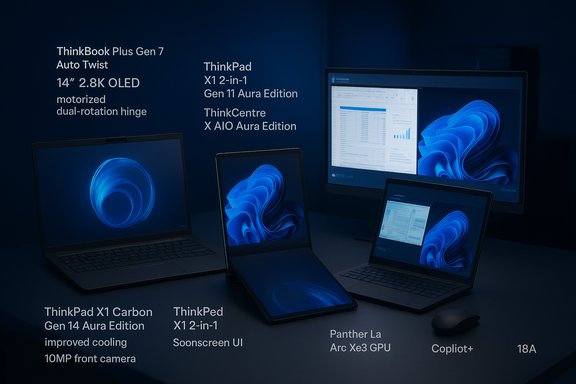
Lenovo’s purported 2026 portfolio — headlined by the motorized ThinkBook Plus Gen 7 Auto Twist, the revamped ThinkPad X1 family, the performance‑focused ThinkPad X9 15p Aura Edition, and a near‑square ThinkCentre X AIO Aura Edition — dovetails with Intel’s formal launch of the Panther Lake platform (Core Ultra Series 3), which Intel positions as its first “AI PC” family on the Intel 18A node. Intel’s Panther Lake messaging confirms the platform is designed for broad deployment across thin‑and‑light, creator, and desktop form factors — with a modular multi‑chiplet architecture, a new Arc‑derived integrated GPU that scales up to 12 Xe cores, and a platform‑level on‑device AI capability measured in Platform TOPS. These platform capabilities explain why OEMs like Lenovo are planning to ship Copilot+ and related AI experiences widely across their 2026 SKUs. At the same time, independent hardware press and retailer listings picked up early Panther Lake SKUs and part numbers, which reinforces the leak’s claim that Core Ultra X7 and X9 silicon will populate the premium ThinkPad lineups in early 2026. Treat each product‑level claim in the leak as plausible and consistent with Intel’s platform statements, while remembering that OEM productization, thermal tuning, and software stacks still determine real user experience.
The camera upgrade to 10MP with 110° FOV is notable because high‑resolution webcams simplify tasks like document scans, multi‑person video conferencing, and tighter crops for low‑bandwidth streams. If Lenovo’s claimed distortion correction and image processing are robust, this will be one of the more practical hardware improvements for business users.
Intel’s Panther Lake platform is publicly described as supporting high‑rate LPDDR5x at rates consistent with the leak’s 9,600 MT/s figure, which strengthens the technical plausibility of the X9’s memory claims. However, laptop vendors must balance power delivery and thermal headroom to actually make those memory speeds meaningful in real workloads.
Source: Windows Latest Exclusive: This is Lenovo's ThinkPad lineup for 2026, including ThinkBook Plus with rotatable display and ThinkCentre X AIO
 Background
Lenovo’s purported 2026 portfolio — headlined by the motorized ThinkBook Plus Gen 7 Auto Twist, the revamped ThinkPad X1 family, the performance‑focused ThinkPad X9 15p Aura Edition, and a near‑square ThinkCentre X AIO Aura Edition — dovetails with Intel’s formal launch of the Panther Lake platform (Core Ultra Series 3), which Intel positions as its first “AI PC” family on the Intel 18A node. Intel’s Panther Lake messaging confirms the platform is designed for broad deployment across thin‑and‑light, creator, and desktop form factors — with a modular multi‑chiplet architecture, a new Arc‑derived integrated GPU that scales up to 12 Xe cores, and a platform‑level on‑device AI capability measured in Platform TOPS. These platform capabilities explain why OEMs like Lenovo are planning to ship Copilot+ and related AI experiences widely across their 2026 SKUs. At the same time, independent hardware press and retailer listings picked up early Panther Lake SKUs and part numbers, which reinforces the leak’s claim that Core Ultra X7 and X9 silicon will populate the premium ThinkPad lineups in early 2026. Treat each product‑level claim in the leak as plausible and consistent with Intel’s platform statements, while remembering that OEM productization, thermal tuning, and software stacks still determine real user experience. What the leak says — an executive summary
- Lenovo will debut a production version of the Auto Twist rotatable display concept as the ThinkBook Plus Gen 7 Auto Twist, with a motorized dual‑rotation hinge, 14″ 2.8K OLED, Intel Core Ultra Series 3 options, and Copilot+ PC features; launch is said to be CES 2026 with retail availability from June 2026 and a starting price near $1,499.
- The ThinkPad X1 Carbon Gen 14 Aura Edition and ThinkPad X1 2‑in‑1 Gen 11 Aura Edition get a major internal redesign for repairability and thermals, adopt Core Ultra X7 Series 3 silicon with up to 12‑Xe integrated graphics and an NPU target in the tens of TOPS, and feature a new 10MP wide‑FOV camera. The leak claims a 9/10 iFixit repairability score.
- The ThinkPad X9 15p Aura Edition is described as a 15.3″ creator/prosumer machine with Core Ultra X9 Series 3 silicon (up to 45W TDP), up to 64 GB LPDDR5x and a large 88Wh battery, plus a full‑size SD card reader and a 6‑speaker audio setup.
- A near‑square, 27.6″ ThinkCentre X AIO Aura Edition (16:18 aspect) is positioned at creators/data professionals with a DeskView‑enabled Smart AI camera and split‑screen AIO/monitor modes. The same leak outlines a ThinkCentre X Tower aimed at local model tuning and heavier AI workloads, including optional NVIDIA RTX 5090 or dual RTX 5060 Ti configurations.
Deep dive: ThinkBook Plus Gen 7 Auto Twist — how the rotatable hinge matters
What the leak claims
- Motorized dual‑rotation hinge with an electromotor that rotates the screen faster and more quietly than the 2024 concept.
- Modes: notebook, tablet, and a “sharing” orientation that automatically adjusts the display to posture or presentation angle.
- Core hardware: 14″ 2.8K OLED 120 Hz, up to 32 GB LPDDR5x, up to 2 TB PCIe SSD, Intel Core Ultra Series 3 CPUs, up to a 10MP MIPI front camera, 75 Wh battery, and Dolby Atmos–tuned rotating speakers.
- Ports include dual Thunderbolt 4, USB‑A, HDMI 2.1 and more; starting weight ~1.4 kg and target price ~ $1,499 with availability said to begin in June 2026.
Why this is significant
Motorized form‑factor innovations are no longer a pure R&D showpiece: Lenovo has already shipped rollable‑screen hardware before (ThinkBook Plus Gen 6 Rollable in 2025), so the company has engineering experience to evolve motorized hinges into a product that could be reliable enough for SMB users. That prior commercialization reduces the technical leap between concept and production. A quieter, more durable hinge and rotating audio assembly — if executed well — solves real usability challenges for 2‑in‑1 devices that previously relied on manual twisting. For professionals who present frequently or use tablet modes for note taking, the Auto Twist could be a productivity differentiator rather than a novelty.Risks and caveats
- Mechanical assemblies add failure modes. Motors, gear trains, and ribbon‑cable flex points can wear differently in real‑world usage. The leak claims smoother, quieter operation and improved durability, but those are inherently verifiable only after hands‑on testing and long‑term reliability reports.
- Weight and thermal trade‑offs: fitting motors and a 75Wh battery in a 14″ chassis will influence thickness and internal thermals. Buyers should watch independent reviews for sustained CPU/GPU/NPU workloads to confirm Lenovo’s claims about everyday dependability.
- Pricing and availability in leaks often shift. The ~$1,499 entry price should be treated as provisional until Lenovo publishes final SKUs and regional pricing.
ThinkPad X1 Carbon Gen 14 & X1 2‑in‑1 Gen 11 — business flagships getting a 2026 reboot
Key leaked highlights
- New internal layout: components placed on both sides of the motherboard to free internal volume for better cooling and a larger haptic touchpad; claimed 20% improved heat dissipation and ability to sustain ~30W loads.
- Silicon: Intel Core Ultra X7 Series 3 with up to 12 Xe integrated GPU cores and an NPU delivering NPU TOPS figures advertised at the platform level.
- Camera upgrade: up to 10MP wide‑FOV camera with advanced distortion correction and 110° FOV — a rare and welcome resolution bump for front‑facing cameras in business laptops.
- Repairability claim: an alleged iFixit score of 9/10, echoed in secondary reporting but not yet visible on iFixit’s site; treat this as an unconfirmed but encouraging sign if validated.
Analysis
Lenovo’s reported redesign to spread components across both sides of the motherboard is a sensible engineering trade: it can reduce thermal bottlenecks and enable denser memory and battery configurations while preserving thinness. The real test will be whether that packaging choice improves sustained performance without forcing aggressive fan profiles that harm acoustics. The leak’s 30W sustained figure is useful guidance, but independent benchmarks that run prolonged multi‑core CPU loads and integrated GPU stress tests are the only way to validate it.The camera upgrade to 10MP with 110° FOV is notable because high‑resolution webcams simplify tasks like document scans, multi‑person video conferencing, and tighter crops for low‑bandwidth streams. If Lenovo’s claimed distortion correction and image processing are robust, this will be one of the more practical hardware improvements for business users.
Things to verify at launch
- Does the claimed iFixit 9/10 repairability score appear in a public teardown and, if so, what specifically contributed to that rating?
- How does the X1’s thermal profile perform under sustained multi‑threaded and mixed CPU+NPU loads?
- Are Linux drivers and enterprise management tools (vPro, Secured‑Core options) fully supported in initial SKUs? The leak notes Windows 11 and Linux availability for some models, but driver maturity for new NPUs and Arc Xe3 graphics varies by platform.
ThinkPad X9 15p Aura Edition — big chassis, big ambition
Leaked specification highlights
- 15.3″ 16:10 2.8K OLED, up to 1,100 nits peak HDR brightness and 120Hz VRR support.
- Up to Intel Core Ultra X9 Series 3 with a maximum TDP target of 45W and up to Intel Arc 12Xe graphics.
- Memory: up to 64 GB LPDDR5x 9600 MT/s; Storage up to 2TB PCIe Gen5; Battery: 88 Wh.
- Camera: up to 10MP MIPI front camera; Audio: six‑speaker system; Ports include 3x Thunderbolt 4 and a full‑size SD card reader.
Why this matters
The X9 15p is clearly aimed at creators and prosumers who need a high‑brightness OLED, expanded memory capacity, and a dedicated focus on long battery life — unusual for machines that target high sustained performance. The inclusion of a full‑size SD card reader is a practical, welcome decision for photographers and video professionals who routinely rely on external media.Intel’s Panther Lake platform is publicly described as supporting high‑rate LPDDR5x at rates consistent with the leak’s 9,600 MT/s figure, which strengthens the technical plausibility of the X9’s memory claims. However, laptop vendors must balance power delivery and thermal headroom to actually make those memory speeds meaningful in real workloads.
Concerns
- Sustained 45W performance in a slim 15.3″ chassis depends heavily on Lenovo’s cooling design; top‑end clock speeds reported in early benchmark leaks do not guarantee sustained multi‑hour throughput for rendering or ML fine‑tuning.
- High‑rate LPDDR5x and a bright OLED increase power draw; the 88Wh battery is generous, but buyers should wait for independent battery life tests under realistic mixed workloads.
ThinkCentre X AIO Aura Edition and ThinkCentre X Tower — Lenovo’s desktop play for creators and AI
ThinkCentre X AIO (leaked highlights)
- Unique near‑square 27.6″ 16:18 QHD IPS panel at 2560×2880, intended to show two A4 pages vertically and improve productivity for data and document workflows.
- Up to Intel Core Ultra X7 Series 3, up to 64GB LPDDR5x, optional Smart AI camera (DeskView document digitization), Harman Kardon 4‑speaker audio, and split‑screen AIO/monitor mode.
ThinkCentre X Tower (leaked highlights)
- Desktop tower supporting Intel Core Ultra 9 processors, optional NVIDIA GeForce RTX 5090 32G or dual RTX 5060 Ti configurations, and memory up to 4×64GB DDR5‑6400. Lenovo reportedly positions the chassis and its “AI Fusion Solution” to enable local training/fine‑tuning of models up to ~70 billion parameters.
Accessories and sensor ambitions
The leak lists several PC accessories and a novel Sensor Hub multimodal assistant:- ThinkPad Dual‑Mode Wireless ANC Foldable Headset 8550 (Bose‑tuned audio, Teams certified, up to 58 hours playback) and a ThinkPad Bluetooth Presenter Mouse with an AI shortcut for on‑device AI, plus a magnetic‑closure 16″ Mag Backpack.
- Lenovo Sensor Hub assistant — a bundled multimodal sensing module (camera, radar, microphones, environmental sensors) that processes presence and environmental inputs locally to adjust system performance and privacy in real time; leak suggests a $99 starting price and June 2026 availability.
Cross‑checks, corroboration, and how to treat leak claims
- Intel’s Panther Lake platform and Core Ultra Series 3 promotional materials validate major platform building blocks referenced repeatedly in the leak: Intel 18A process, a multi‑chiplet design, Xe3 GPU scaling, and platform TOPS for on‑device AI. Those public Intel materials make Lenovo’s Panther Lake placement highly plausible.
- Multiple independent outlets reproduced and expanded the Windows Latest leak (including TweakTown, IT Home, Gizmochina, and other hardware outlets), providing consensus that Lenovo’s CES 2026 lineup will lean on Panther Lake silicon and include several unusual form factors like the 16:18 AIO. These outlets corroborate the core leak narrative while also repeating the leak‑level caveat that final specs and prices will probably change.
- NVIDIA’s public RTX 50 series announcement and vendor pressrooms confirm availability of desktop and laptop RTX 50 SKUs in the same general timeframe, which lends plausibility to Lenovo’s claim of RTX 5090 options in tower configurations — again, plausible but awaiting Lenovo’s official SKU lists.
- When the leak offers exact prices and availability months (for example, Auto Twist availability in June 2026 and ThinkCentre X Tower starting at ~$1,500 in March 2026), treat those as provisional. Historical pattern: leaked MSRP and availability windows often shift between early disclosures and final retail pages.
Practical guidance for buyers and IT planners
- If you need predictable, certified hardware for enterprise deployment in the next 3–6 months, wait for Lenovo’s official CES press release and Intel validated SKUs before committing. The leak gives a clear directional view but not procurement‑ready part numbers.
- For creative professionals considering the X9 15p: prioritize real sustained‑load benchmarks (rendering, ML inference) and independent battery-life testing before making a purchase decision. Memory bandwidth and thermal tuning will determine whether top specs convert to real productivity gains.
- If the Auto Twist or other motorized form factors appeal to you, factor in the cost and potential long‑term maintenance implications of moving parts. Ask Lenovo for rated hinge‑cycle durability numbers and for specifics on warranty coverage for mechanical components.
- For enterprise fleet managers: require clarified driver and image support for Linux and enterprise management tools (vPro, Secured‑Core, MDM flows) before standardizing on Panther Lake‑based devices — new iGPUs and NPUs often need firmware and driver maturity to be fully supported in large deployments.
Final verdict — innovation with caveats
Lenovo’s 2026 roadmap, as portrayed in the Windows Latest leak, is impressive in scope: mechanical innovation (Auto Twist and Rollable concepts), a clear embrace of Intel’s Panther Lake AI platform across laptops and desktops, and practical desktop re‑imagining for creators with the near‑square AIO. The technical building blocks are plausible and supported by Intel’s public Panther Lake disclosures and by corroborating hardware reporting. However, the story is not yet complete. The productization of motors, durable flexible displays, high‑rate LPDDR5x memory in thin chassis, and on‑device AI depend on firmware, thermal engineering, driver maturity, and long‑term hardware reliability. Buyers should celebrate the ingenuity but reserve final judgments until Lenovo publishes official specs, pricing, and regional availability and until independent reviewers validate sustained performance and mechanical longevity. The leak sets expectations for a bold CES showing; what remains to be seen is whether the engineering and software stacks can transform these intriguing concepts into dependable, enterprise‑grade hardware.Source: Windows Latest Exclusive: This is Lenovo's ThinkPad lineup for 2026, including ThinkBook Plus with rotatable display and ThinkCentre X AIO
