

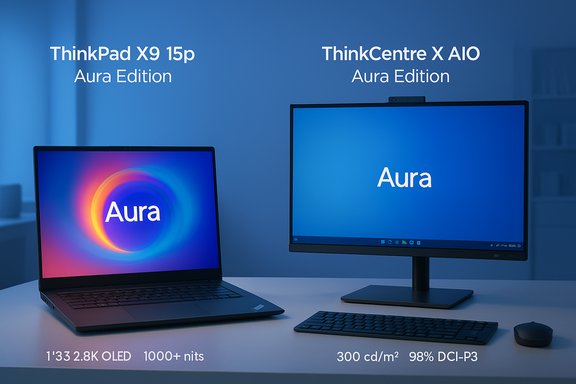
Lenovo’s leaked “Aura” slate for 2026 paints a bold picture: a refreshed ThinkPad family that chases high‑brightness OLEDs, on‑device AI, and workstation‑class performance in thinner, lighter shells — and that ambition is most visible in the leaked ThinkPad X9 15p Aura Edition and the near‑square ThinkCentre X AIO Aura Edition shown in the same trove of documents. The leaks promise a 15.3″ 2.8K OLED, an Intel Core Ultra X9 Series 3 option, up to 64 GB LPDDR5x, and a full‑size SD reader for the X9 15p, while the ThinkCentre X AIO leak describes a 27.6″ 16:18 QHD panel, Core Ultra X7 silicon, and a DeskView‑enabled Smart AI camera that can turn the AIO into a document‑digitizing monitor. These claims are broadly consistent across the internal leak material and the independent coverage that picked it up, but several important technical and commercial caveats remain before any purchase or enterprise rollout decisions are made.
Background
Why these leaks matter now
Lenovo’s 2026 refresh — as depicted in the leaked materials — lines up with Intel’s Panther Lake (Core Ultra Series 3) rollout and a wider industry push to integrate on‑device NPUs, beefed‑up integrated GPUs, and high‑brightness OLED panels into mainstream business and creator devices. Panther Lake’s modular chiplet approach and higher integrated GPU/NPU budgets are the technical foundation vendors cite when pitching Copilot+‑style local AI features, and Lenovo’s internal roadmap (the leak) appears to map those platform-level capabilities directly into several ThinkPad, Yoga, IdeaPad, and ThinkCentre form factors.What we have (and what we don’t)
The leaked documents provide detailed hardware lineups and suggested TDP targets, panel choices, and even marketing-focused features (like DeskView). However, most of these claims come from internal roadmaps and pre‑production materials rather than retail spec sheets, so final SKUs, firmware, pricing, and regional availability remain unconfirmed until Lenovo’s official announcements. The leaks also include benchmark snippets and repairability claims that are plausible but not yet independently verified.ThinkPad X9 15p Aura Edition — specifications and first impressions
Core specifications (leaked)
- Display: 15.3″ 16:10 2.8K OLED, up to 1,000–1,100 nits peak HDR brightness, 120 Hz VRR, OLED AOFT, optional touch and ARAS.
- Processor: Up to Intel Core Ultra X9 Series 3 (reported target: 45 W TDP in high‑performance configurations).
- Memory: Up to 64 GB LPDDR5x at 9,600 MT/s.
- Graphics: Up to Intel Arc 12Xe integrated graphics (iGPU scaling to 12 Xe cores reported in Panther Lake materials).
- Storage: Up to 2 TB M.2 2280 PCIe Gen 5 SSD.
- Battery: 88 Whr.
- Ports: 3 × Thunderbolt 4, 1 × USB‑A (10 Gbps), 1 × HDMI 2.1, 1 × full‑size SD card reader, 1 × audio combo jack.
- Camera: Up to 10 MP MIPI front camera, IR option; audio: six speakers (B2B + tweeter) and two Elevoc‑enhanced microphones.
- Weight / dimensions: Starting at ~1.5 kg (3.08 lbs); thickness 7.25–17.9 mm (leaked range).
Why the X9 could be a serious creator machine
The X9 15p’s spec sheet reads like a deliberate creator/prosumer play. A 15.3″ 2.8K OLED with 1,000+ nits peak brightness and 120 Hz VRR will offer both color fidelity and dynamic range important for photo and video workflows, while a full‑size SD card reader addresses a common pain point for content professionals. The option for up to 64 GB LPDDR5x at very high data rates (9,600 MT/s) paired with an X9‑class CPU suggests Lenovo intends the platform for sustained compute and local AI inference workloads. The inclusion of a six‑speaker audio system and higher‑resolution camera further underscores this focus on media‑forward tasks.Practical doubts and engineering tradeoffs
- Thermal limits vs. thinness: A 45 W nominal TDP Core Ultra X9 part in a 15.3″ thin chassis is an ambitious target; sustained multi‑hour workloads (rendering, model fine‑tuning) will depend heavily on Lenovo’s cooling design and power‑limiting firmware. Short turbo spikes look good in early engineering benchmarks, but sustained performance is what matters in real creative workloads.
- Battery life: High brightness OLED + high memory bandwidth + a 45 W CPU will increase system power draw. The 88 Whr battery is generous, but real‑world mixed workloads could expose significant runtime variance; independent battery tests will be critical.
- Memory and upgradability: Soldered LPDDR5x at 9,600 MT/s delivers performance and power benefits but eliminates user upgradability. For long‑term buyers, the ability to choose larger RAM at purchase matters because field upgrades will likely be impossible.
- Driver and Linux readiness: The leak mentions Ubuntu availability for some configurations, but Linux driver maturity for bleeding‑edge integrated GPUs and NPUs has historically lagged Windows. Enterprises and developers who require Linux should confirm vendor driver support before procurement.
ThinkCentre X AIO Aura Edition — a near‑square AIO for creators and data pros
Leaked specifications
- Display: 27.6″ near‑square 16:18 QHD IPS at 2,560 × 2,880, 60 Hz, 1,000:1 contrast, ~300 cd/m² typical brightness; DCI‑P3 ≈98%.
- Processor: Up to Intel Core Ultra X7 Series 3.
- Memory: Up to 64 GB LPDDR5x at 9,600 MT/s.
- Graphics: Up to Intel Arc 12Xe (integrated) with optional discrete GPUs in tower variants.
- Camera: Optional Smart AI camera with DeskView (document digitization), optional HPD; up to 16 MP sensor with 4M binned mode and 4K recording capability (leaked range).
- Storage: 2 × M.2 PCIe 2280 SSD slots; audio: 4 × Harman Kardon certified speakers and 4 microphones with intelligent noise cancellation.
- Ports: Rear and side I/O including Thunderbolt, USB‑C, USB‑A, and HDMI 2.1 (leaked layout).
What makes the AIO different
The 16:18 aspect ratio is an unconventional but sensible choice for document‑heavy, vertical workflows: programmers, legal professionals, data analysts, and creators who work with tall content stands to gain more usable vertical pixels per workspace. The optional DeskView camera — which can digitize placed paper or perform specialized scanning workflows — aims to turn the AIO into both a PC and a productivity tool, and the dual‑purpose split‑screen AIO/monitor mode would let the device act as a traditional monitor for a second PC while still running its internal Windows environment.Concerns and enterprise considerations
- Panel brightness and HDR: The reported 300 cd/m² typical brightness and 1,000:1 contrast suggest a good quality IPS panel but not the high HDR peak brightness fans of HDR content might expect from OLEDs. For color‑critical work, calibration and local dimming behavior (if any) will matter.
- Camera & privacy: Smart AI cameras and DeskView features are compelling, but enterprises will need clear policy and privacy controls; optional physical shutters and HPD (human presence detection) are sensible, but IT should validate management integration.
How plausible are these claims? Cross‑checks and verification
Platform alignment with Intel Panther Lake
The leaked specifications match what Intel has publicly described for its Panther Lake platform: a multi‑tile, 18A node family with a stronger Arc‑derived integrated GPU (up to 12 Xe cores) and platform TOPS marketing for NPU throughput. Independent hardware reporting and early benchmark leaks referenced in the same leak packet further corroborate the presence of Core Ultra X7/X9 SKUs in premium OEM roadmaps, making Lenovo’s mapping technically plausible. That doesn’t prove final SKUs will match leaked numbers verbatim, but it increases the technical credibility of the roadmap details.Memory rates and storage claims
High‑rate LPDDR5x at 9,600 MT/s is consistent with the platform specs and appears repeatedly in the leaked roadmap for premium SKUs. Likewise, using PCIe Gen5 M.2 2280 SSDs in a 15‑inch creator laptop is within current engineering norms. These are plausible technical choices, but their real‑world performance depends on thermal headroom and vendor power‑profile tuning.What’s less verified
- Repairability rating: The leak includes an iFixit 9/10 repairability claim for parts of the lineup; the leak’s own analysis flags this as unconfirmed until a public teardown appears. Treat the repairability claim as encouraging but unverified.
- Exact TOPS and NPU performance in real apps: The platform TOPS figures are marketing aggregates and don’t map directly to specific application speedups; independent benchmarks using representative workloads will be required to validate real AI inference benefits.
Strengths: what Lenovo appears to be getting right
- Purposeful segmentation: Lenovo’s rumored mapping places higher NPU/iGPU configurations where they make sense (creator and prosumer ThinkPad X9, IdeaPad Pro, Yoga Pro), while keeping efficient X7 options for thin‑and‑light business SKUs — a practical product strategy that balances power and battery life across the portfolio.
- Display and I/O pragmatism: Bringing a high‑brightness, high‑quality OLED to a 15.3″ chassis and restoring a full‑size SD card slot are clear, user‑centric choices for image and video professionals who often complain about port omissions.
- Real‑world AI features: DeskView and optional Smart AI camera ideas tie hardware to practical productivity features rather than pure marketing; these are the sort of integrated features that can improve daily workflows if delivered with good software and privacy controls.
Risks and open questions
- Sustained performance vs. thermal reality: A 45 W X9 CPU and 12‑Xe integrated GPU in a thin 15.3″ chassis will be at the mercy of Lenovo’s cooling and power delivery. Expect OEM firmware to heavily influence real‑world performance and acoustics.
- Software, driver, and OS maturity: NPUs and Arc‑derived iGPUs require mature drivers to deliver application performance, especially on Linux. Enterprises should not assume feature parity across operating systems until vendor support pages and release notes confirm it.
- SKU complexity and buyer confusion: Lenovo’s broad lineup and aggressive SKU fragmentation (different CPUs, RAM, displays, and GPU options) will make procurement harder — verify exact SKUs and power profiles when specifying machines for business or creative teams.
- Pricing and availability: The leak mentions CES timelines and tentative retail windows, but historical leak behavior shows pricing and dates often shift before formal launch. Treat leaked price targets as provisional.
Practical advice for buyers and IT decision makers
- Confirm the exact SKU and power profile before purchasing. Look beyond the model name — check the CPU part number, NPU/vTOPS claims, RAM type (LPDDR5x), display SKU (touch vs. non‑touch, 60 vs. 120 Hz), and whether the RAM is soldered.
- If you require Linux, validate driver support for the NPU and Arc iGPU from Lenovo’s enterprise pages and the Linux community prior to procurement. Early Panther Lake driver maturity is likely to trail Windows initial support.
- For creators who prioritize color accuracy and HDR, double‑check panel calibration, peak brightness in HDR scenes, and whether the vendor offers factory calibration or calibration‑capable models.
- If local AI inference or Copilot+/LLM workflows are mission‑critical, require vendor documentation on TOPS mapping to real workloads and insist on pilot testing with your software stack. Platform TOPS are marketing aggregates and don’t directly guarantee application speedups.
- Factor in upgradability needs: soldered LPDDR5x will limit future RAM expansion. Buy for expected long‑term memory needs or choose a different model that supports user upgrades.
The bottom line
The leaked ThinkPad X9 15p Aura Edition and ThinkCentre X AIO Aura Edition sketch a credible, well‑targeted evolution of Lenovo’s lineup: stronger integrated graphics and NPUs where they matter, high‑quality OLEDs for creators, and practical productivity features like the DeskView camera and full‑size SD card readers. The technical claims align with Intel’s Panther Lake platform messaging and independent retailer/benchmark leaks, which raises the plausibility of the roadmap. That said, the leap from internal roadmap to shipping product involves crucial implementation choices — thermal design, firmware power profiles, driver maturity, and regional SKU decisions — and these will determine whether the leaked ambition translates into real‑world value. Treat the leaks as a strong signal of Lenovo’s direction, but wait for formal spec sheets and independent reviews before committing procurement budgets or making firm purchasing decisions.Conclusion
Lenovo’s Aura‑branded leak outlines a future where ThinkPad and ThinkCentre devices pursue both visual fidelity and on‑device AI capability, targeting creators and professionals with concrete hardware features that matter in daily workflows. The ThinkPad X9 15p promises a rare combination of a high‑brightness OLED, a full‑size SD reader, and up to 64 GB of LPDDR5x memory; the ThinkCentre X AIO’s near‑square display and DeskView camera aim to redefine the AIO as a productivity appliance for vertical workflows. These are promising directions that align with broader industry trends around Panther Lake and local AI acceleration, but purchasers should demand final SKUs, power profiles, driver roadmaps, and independent testing to validate the tradeoffs — particularly around sustained performance, battery life, and OS support — before upgrading fleets or investing in the newest Aura hardware.Source: Windows Report Lenovo’s Upcoming ThinkPad X9 15p Aura Edition & ThinkCentre X AIO Aura Edition Leaks Online
