

Lenovo’s CES 2026 showcase sketched a clear roadmap for the company’s next phase: purpose-built, AI-ready business hardware paired with a broader ecosystem play that aims to move from device features to ambient, cross-device intelligence. The announcements — from the Space Frame–reengineered ThinkPad X1 Carbon Gen 14 Aura Edition and the performance-first ThinkPad X9 15p Aura Edition, to the motorized ThinkBook Plus Gen 7 Auto Twist and the ThinkCentre X family — were anchored by a headline preview of Lenovo Qira, a “Personal Ambient Intelligence System” intended to bring continuity, context, and agentic AI behaviors across PCs, phones, and wearables. These moves make Lenovo’s CES message simple and strategic: lead the enterprise and SMB market into the Copilot+ era by pairing silicon-driven on-device AI with system-level services and improved serviceability.
Lenovo framed CES 2026 as a demonstration of “Smarter AI for All” — a sweeping narrative that connects new hardware, modular repairability, and enterprise-grade AI infrastructure. The company’s portfolio refresh was organized around three linked themes:
At the same time, several claims are vendor-weighted or demonstrative. Repairability scores, thermal percentage gains, and local fine-tuning limits deserve independent verification. For enterprises, the prudent path is to pilot, validate, and insist on clear governance before widespread deployment. When Lenovo’s hardware, services and AI software line up in the field — and when third‑party audits confirm privacy and performance claims — the company’s CES vision could translate into a practical, deployable strategy for AI‑augmented work.
Lenovo’s CES story is a credible blueprint: smarter devices, better serviceability, and a cross-device AI layer that aims to be useful rather than intrusive. The difference between aspiration and operational reality will come down to the pace of software maturity, the transparency of data practices, and the hard work of systems integration in real organizations. In that test, Lenovo’s breadth gives it an advantage — but success will be earned in labs, pilot programs, and the long slog of enterprise adoption.
Source: Lenovo StoryHub Lenovo at CES 2026: Smarter AI Meets Purposeful Business Innovation - Lenovo StoryHub
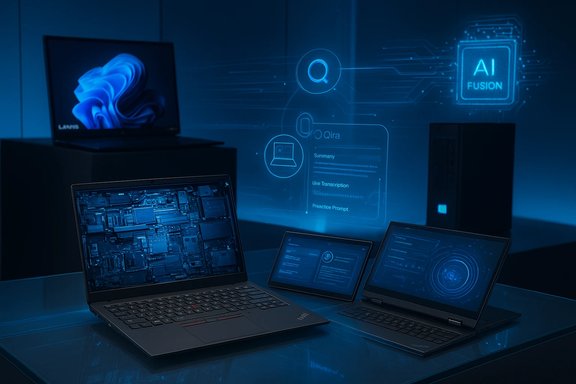 Background and overview
Lenovo framed CES 2026 as a demonstration of “Smarter AI for All” — a sweeping narrative that connects new hardware, modular repairability, and enterprise-grade AI infrastructure. The company’s portfolio refresh was organized around three linked themes:- Purposeful hardware redesigns that prioritize serviceability and sustained performance (the Space Frame design in new ThinkPad X1 models).
- Practical, staged AI experiences that combine on-device NPUs with cloud augmentation (the Copilot+ PC vision and device-tiered feature sets).
- Cross-device continuity enabled by a system-level agent, Lenovo Qira, which Lenovo says will begin rolling out on select Lenovo and Motorola devices in 2026.
What Lenovo announced at CES 2026
New commercial hardware highlights
- ThinkPad X1 Carbon Gen 14 Aura Edition & ThinkPad X1 2‑in‑1 Gen 11 Aura Edition: Both adopt Lenovo’s new Space Frame interior layout, claim improved heat dissipation and serviceability, include a 10MP wide-FOV camera option, and target Copilot+ business experiences with Intel Core Ultra X7 Series 3 silicon. Lenovo also emphasized recyclable materials and plastic-free primary packaging in these systems.
- ThinkPad X9 15p Aura Edition: A 15.3‑inch mobile workstation-style laptop pitched at creators and prosumers, featuring up to Intel Core Ultra X9 Series 3 CPUs, up to 64 GB LPDDR5x 9600 MT/s, an 88Wh battery, and a 2.8K OLED 120Hz panel calibrated by X‑Rite. Lenovo positions it as a desktop‑class performer with mobile endurance.
- ThinkBook Plus Gen 7 Auto Twist: The motorized, dual-rotation hinge moves from concept to commercial product. The hinge automatically adjusts the display to posture or sharing scenarios and includes rotating front-facing speakers that follow the screen orientation. Lenovo lists a June 2026 availability window.
- ThinkCentre X AIO Aura Edition & ThinkCentre X Tower: The AIO uses a nearly square 27.6‑inch 16:18 QHD display tailored to creators and data professionals; the Tower is a 34‑liter chassis aimed at local AI model tuning with dual‑GPU options and an emergent AI Fusion Solution that Lenovo says will enable local post‑training and fine‑tuning for models up to 70 billion parameters.
Services and ecosystem
- Lenovo Qira: Presented as a Personal Ambient Intelligence System and previewed across Lenovo and Motorola demos, Qira is described as an agent capable of preserving context across devices, offering features like meeting summaries, on-device composition, live transcription and translation, and proactive suggestions. Lenovo emphasizes a hybrid local-first architecture to balance latency, privacy, and capability.
- Lenovo Premier Support for Devices Suite: Refreshed support offerings include integrated AI agents for self-service escalation, 24/7 availability across markets, and optional proactive maintenance with Premier Support Plus — positioning services as a differentiator for IT teams rolling out AI-enabled fleets.
- Proofs-of-concept and peripherals: ThinkPad Rollable XD Concept, AI glasses and a wearable “AI Perceptive Companion” (Project Maxwell), new ANC headset with Bose tech, and multi-mode mice and bags that extend the Aura experience.
Technical realities: what’s credible and what needs verification
Lenovo’s pitch blends credible platform-level promises with vendor-forward metrics that require validation. Independent coverage and Lenovo’s own releases confirm many headline points: Qira exists as a previewed cross-device agent, the Auto Twist is moving to production, and the ThinkCentre X family targets on-premise model tuning. Reuters, The Verge and other outlets corroborated the major product announcements. However, several specific claims warrant close scrutiny before IT buyers make purchasing or deployment decisions:- Repairability (iFixit 9/10 claim): Lenovo states the new ThinkPad X1 series achieved a 9/10 iFixit repairability score. Multiple outlets repeated the same number following Lenovo’s announcement, but as of this writing there is no publicly available iFixit teardown to independently verify the score. Treat the iFixit number as a vendor-cited milestone pending a direct iFixit report. Caveat emptor.
- Sustained power / thermal gains: Lenovo quotes “up to 20% better heat dissipation” and the ability to maintain 30W sustained on some X1 models. These are useful engineering claims, but sustained performance in real workloads depends heavily on firmware, driver interaction and ambient conditions. Independent, third‑party benchmarks under long-running loads will be the definitive test.
- NPU TOPS and model capacity: Lenovo references “next‑gen NPUs” and cites large model fine‑tuning targets (the AI Fusion claim of up to 70 billion parameters on the Tower). The practical meaning of those numbers depends on the runtime stack, memory bandwidth, and whether “post-training” implies full-precision fine-tuning or lower-cost parameter-efficient methods (LoRA, adapters). Independent verification from benchmarked fine-tuning workflows or vendor documentation will better quantify real capability.
- Data governance and local-first claims: Lenovo frames Qira and the Sensor Hub as privacy-minded local-first systems, but the devil is in implementation: what metadata is retained, how long context is cached, what syncs to cloud partners, and the default opt-in/opt-out settings. Enterprises must insist on technical governance documentation and third-party audits before wide deployments.
Why this matters for business and IT buyers
Lenovo’s CES lineup reflects a broader industry inflection: endpoint devices are being re-architected not just for peak benchmarks but for predictable, low-latency AI behaviors in everyday workflows. For IT leaders, the implications are concrete:- Operational efficiency: Improved serviceability and modular parts reduce mean time to repair (MTTR) and total cost of ownership (TCO) when paired with Lenovo’s Premier Support and TruScale Device as a Service offerings. For organizations that prefer onsite maintenance or longer refresh cycles, repairability is a genuine operational win — if the claims match real-world service flows.
- Performance for AI-aware applications: Copilot+ experiences require a blend of CPU/GPU/NPU performance; Lenovo’s alignment with Intel’s Core Ultra (Panther Lake) roadmap and the new Arc‑derived integrated GPUs puts its devices in a position to run many on-device inference tasks. That said, the suitability of a device for specific AI workloads (speech, translation, large-context summarization, or generative editing) depends on the SKU’s NPU TOPS and memory configuration. Validate by workload.
- Edge-first trust models: Products like the ThinkCentre X Tower and Sensor Hub let organizations keep sensitive data and model tuning local — a critical capability for regulated industries. Lenovo’s positioning of AI Fusion for on-premise post-training is meaningful for organizations unwilling to send proprietary corpora to cloud providers, if the required management and auditing tooling is mature.
Strengths: what Lenovo gets right
- Ecosystem thinking: Lenovo couples endpoints, services, and infrastructure — a realistic strategy for businesses that want a single partner for devices, lifecycle services and on-prem AI infrastructure. It simplifies procurement and alignment of support SLAs.
- Practical, serviceable hardware innovations: The Space Frame redesign and modular daughterboard approach aim to lower repair costs and improve thermal headroom. For fleet operators, modular USB-C ports, replaceable batteries and keyboard assemblies matter more than minor spec improvements.
- Device-tiered AI and hybrid architecture: Lenovo’s hybrid “local-first” framing for Qira and Copilot+ features is aligned with industry best practice: do latency-sensitive tasks locally, and push higher-level orchestration or partner integrations to secure cloud services. This balances responsiveness with compliance.
- Breadth of hardware choices: From ultraportable ThinkPad X1s to a full-size X9 15p and desktop ThinkCentre X Tower, Lenovo offers a coherent hardware ladder for different job functions — an important strength for centralized procurement and asset management.
Risks and open questions
- Privacy and ambient sensing: Qira demos include multimodal perception and Sensor Hub inputs (vision, radar, acoustic). While useful, continuous, cross-device context raises legitimate privacy and compliance concerns in regulated environments. Clear consent, robust data minimization, and auditable logs will be essential.
- Feature fragmentation by SKU: Lenovo has signaled a staged feature matrix — richer on higher-end NPUs, lighter on mainstream devices. For IT, this means inconsistent user experiences across the fleet unless procurement is tightly controlled.
- Vendor metrics vs. real workloads: Claims like “20% better heat dissipation” or “sustain 30W” are meaningful only in the context of specific workloads. Buyers must request or perform sustained-workload validation tests (video encode, long transcription, batch inference) before assuming those gains translate to everyday results.
- Third-party ecosystem maturity: Qira’s value depends on deep integrations with third-party apps and partner models (Lenovo cited partners in previews). If integrations are shallow or inconsistent, the cross-device continuity promise will underdeliver.
- Unverified claims (iFixit, model capacity specifics): Several widely reported figures currently lack independent confirmation (for example, the iFixit 9/10 score and the practical limits of the AI Fusion post-training claim). Treat these as vendor-forward until verified.
Practical recommendations for IT and procurement teams
- Test before roll-out: Assemble a pilot of target SKUs (X1 Carbon Gen 14, X9 15p, Auto Twist) and measure:
- Sustained CPU/GPU/NPU workloads under real usage scenarios.
- Battery behavior and thermal throttling over extended tasks.
- Repair workflows (time and parts availability) with local service partners.
- Define a Qira governance checklist:
- Document what data Qira stores locally vs. what syncs to the cloud.
- Verify default consent flows and admin controls for enterprise deployments.
- Insist on an exportable audit log and model provenance for any local fine-tuning activities.
- Enforce SKU consistency for critical roles:
- For power users who require Copilot+ features reliably, standardize configurations with verified NPUs and RAM.
- For knowledge-workers where uniform experience matters, avoid mixed-tier fleets unless workflows tolerate variance.
- Validate lifecycle and support SLAs:
- Confirm replacement part availability, RMA times, and local repair network coverage for the regions where devices will be deployed.
- Evaluate Premier Support options and test the AI-powered self‑service escalation paths.
- Plan for secure on‑prem AI:
- If you plan to use ThinkCentre X Tower / AI Fusion for local fine-tuning, require documentation on encryption-at-rest, access controls for data and models, and a tested rollback plan for model artifacts.
The competitive landscape: where Lenovo fits
Lenovo’s CES messaging aligns with a broader industry movement: OEMs and silicon partners (Intel, Qualcomm, NVIDIA) are packaging local inference engines and Copilot-like integrations into shipped systems. Competitors are also announcing AI-first endpoints and ecosystem services. Lenovo’s advantage is breadth — it sells the PC endpoints, the enterprise servers, and a global services footprint — which gives it a plausible path to deliver the “one vendor” continuity many enterprises prefer. That said, competitive differentiation in real deployments will be determined by driver quality, privacy transparency, and the maturity of cross-device integrations.What to watch next
- Independent iFixit teardown and third‑party sustained performance reviews of the ThinkPad X1 updates. These will confirm whether repairability and thermal claims are realized in service workflows.
- Qira’s privacy and admin documentation, plus a public SDK or enterprise API, which will indicate whether the platform is truly enterprise‑ready or primarily consumer-focused.
- Real-world demonstrations of AI Fusion local fine-tuning: concrete performance numbers, supported model formats, and management tooling for model governance will show whether on‑prem fine‑tuning at 70B parameters is practical for SMBs or limited to specialist enterprise workloads.
- Availability and pricing confirmations across regions; Lenovo shared US estimates and Q1/Q2 2026 windows for various SKUs, but regional configuration choices and enterprise discounts will affect procurement decisions.
Final analysis — measured optimism for practical AI adoption
Lenovo’s CES 2026 announcements are more than a collection of flashy demos. They represent a conscious pivot to purpose-built, serviceable hardware engineered around on-device AI and a system-level view of continuity. Qira is a bold, platform-level bet: if executed with transparent privacy, rigorous admin controls, and consistent cross-device integrations, it could materially improve productivity by making AI contextual rather than ephemeral.At the same time, several claims are vendor-weighted or demonstrative. Repairability scores, thermal percentage gains, and local fine-tuning limits deserve independent verification. For enterprises, the prudent path is to pilot, validate, and insist on clear governance before widespread deployment. When Lenovo’s hardware, services and AI software line up in the field — and when third‑party audits confirm privacy and performance claims — the company’s CES vision could translate into a practical, deployable strategy for AI‑augmented work.
Lenovo’s CES story is a credible blueprint: smarter devices, better serviceability, and a cross-device AI layer that aims to be useful rather than intrusive. The difference between aspiration and operational reality will come down to the pace of software maturity, the transparency of data practices, and the hard work of systems integration in real organizations. In that test, Lenovo’s breadth gives it an advantage — but success will be earned in labs, pilot programs, and the long slog of enterprise adoption.
Source: Lenovo StoryHub Lenovo at CES 2026: Smarter AI Meets Purposeful Business Innovation - Lenovo StoryHub
