

Lenovo’s CES 2026 salvo wasn’t a cautious refresh cycle — it was a deliberate, high‑visibility argument that the Windows PC world still has room for weird, wonderful, and experimental hardware, from rollable laptops to floating all‑in‑one displays and palm‑sized mini‑PCs. What stood out at Lenovo’s Tech World at CES was not only the breadth of devices but the company’s confidence in shipping both pragmatic Copilot+ PCs and attention‑grabbing concept products, a dual strategy that positions Lenovo as the closest thing the Windows ecosystem has to the experimental spirit Surface once championed.
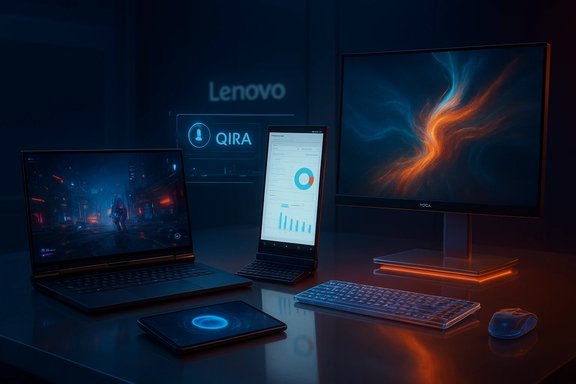
Lenovo used CES 2026 to frame a two‑track message: first, a broad lineup of Aura Edition Copilot+ PCs built around Intel’s third‑generation Core Ultra (Panther Lake) silicon and practical AI features; second, a set of concept devices and peripherals that push form factors and interaction models forward. The centerpieces were bold — two rollable laptop concepts (one gaming, one productivity), a striking Yoga AIO i Aura Edition all‑in‑one with a 32‑inch 4K OLED at 165Hz, a palm‑sized Yoga Mini, futuristic transparent‑looking desktop displays, and a new ecosystem AI called Lenovo Qira that Lenovo describes as a “Personal Ambient Intelligence System.” This show of variety is not accidental. Lenovo is leveraging scale (it remains one of the largest PC vendors globally) to experiment across price tiers and form factors simultaneously — a capability that lets it validate niche ideas without risking the entire product portfolio. At CES the company argued that hybrid AI experiences (local NPU inference plus cloud reasoning) and deeper cross‑device continuity are now viable differentiators — and that delivering them requires both hardware variety and a system‑level orchestration layer.
That said, several critical proofs remain:
Lenovo’s message at CES was simple: be bold, and build both the ordinary and extraordinary. The PC industry — and especially Windows users who miss the era of form‑factor experimentation — will be watching closely to see whether those bold ideas become everyday options or remain the compelling dreams of a trade‑show stage.
Source: Windows Central Lenovo has become what Surface was supposed to be about — crazy cool PCs
 Background / Overview
Lenovo used CES 2026 to frame a two‑track message: first, a broad lineup of Aura Edition Copilot+ PCs built around Intel’s third‑generation Core Ultra (Panther Lake) silicon and practical AI features; second, a set of concept devices and peripherals that push form factors and interaction models forward. The centerpieces were bold — two rollable laptop concepts (one gaming, one productivity), a striking Yoga AIO i Aura Edition all‑in‑one with a 32‑inch 4K OLED at 165Hz, a palm‑sized Yoga Mini, futuristic transparent‑looking desktop displays, and a new ecosystem AI called Lenovo Qira that Lenovo describes as a “Personal Ambient Intelligence System.” This show of variety is not accidental. Lenovo is leveraging scale (it remains one of the largest PC vendors globally) to experiment across price tiers and form factors simultaneously — a capability that lets it validate niche ideas without risking the entire product portfolio. At CES the company argued that hybrid AI experiences (local NPU inference plus cloud reasoning) and deeper cross‑device continuity are now viable differentiators — and that delivering them requires both hardware variety and a system‑level orchestration layer. What Lenovo Announced: Highlights and Verified Specs
Rollable laptops: two concepts, different intents
- Legion Pro Rollable Concept (gaming) — a horizontally expandable rollable display that provides a wider, more immersive aspect ratio for gaming and content. Early hands‑on coverage shows a mechanism that expands the width of the display to create a more cinematic field of view for games. The hardware remains a concept at CES with no immediate retail timeline.
- ThinkPad Rollable XD / ThinkBook rollable productivity concept — a vertically extendable rollable screen that expands workspace for documents and creative tools. Lenovo’s demo shows the screen extending from the lid and, in certain modes, displaying widgets and controls on the lid when not extended. This productivity‑oriented rollable emphasizes practical workflows and a more conservative aesthetic compared with the gaming variant. Coverage confirms these are proof‑of‑concept designs rather than finalized SKUs.
Yoga AIO i Aura Edition: a new direction for Windows AiOs
Lenovo’s Yoga AIO i Aura Edition is positioned as a creator‑grade all‑in‑one with a 31.5‑inch 4K OLED panel that supports a 165Hz refresh rate and Dolby Vision — an unusually high refresh rate for a 4K OLED AiO. The design uses a transparent base and adaptive lighting that can sync with content or provide visual notifications, giving a “floating” visual effect. Lenovo lists options up to Core Ultra X7 Series 3 silicon, a 16MP Face ID webcam, and Dolby Atmos audio. Retail windows were suggested for Q2 2026 with starting prices reported in early coverage. Multiple independent outlets and Lenovo’s press materials corroborate the 32‑inch 4K OLED 165Hz spec and product positioning.Yoga Mini i (1L 11): mini PC reimagined
Lenovo showed a palm‑sized cylindrical mini PC — the Yoga Mini i (1L 11) — with a circular aluminum chassis, Intel Core Ultra class processors, and interesting proximity/accelerometer features for fast file sharing (tap‑to‑share interactions). The product represents the mini‑PC trend accelerated by attention to design and local AI features. The press materials position it as a compact Copilot+ capable device for constrained workspaces.Peripherals: transparent mechanical keyboard and mouse
Lenovo’s new 900 Wireless Low Profile Mechanical Keyboard & Mouse pair — with transparent components, low‑profile mechanical switches, and wireless connectivity — was presented as a style statement meant to complement the Aura Edition aesthetic. Hands‑on photos at CES reinforced the futuristic, Apple‑era nostalgic look.Lenovo Qira: a cross‑device, agentic AI
Lenovo previewed Qira, a personal ambient intelligence that the company says will operate across Lenovo and Motorola devices (appearing as Lenovo Qira or Motorola Qira). It’s pitched as an agentic system that can proactively summarize meetings, draft messages, surface “next moves,” and continue work across wearables, phones, and PCs. Lenovo describes Qira as hybrid — small, latency‑sensitive models run locally on capable devices, while heavier reasoning and cross‑device aggregation occur in cloud backends. Reuters and Lenovo’s own releases confirm Qira and its partner integrations.Why this feels like “what Surface was supposed to be”
Microsoft’s Surface line once served as Windows hardware’s innovation showcase: unique hinge designs, pen interactions, and unexpected form factors (Surface Book, Surface Duo, Surface Studio). Over the last few years Microsoft has scaled back many of its more experimental Surface projects — the company discontinued or quietly wound down several niche Surface products and narrowed its hardware focus. Independent coverage documents a retreat from experimental hardware around 2023, leaving Microsoft’s hardware largely centered on the Surface Pro and Surface Laptop families. That retreat created a vacuum for bold experiments in the Windows PC space. Lenovo’s approach at CES — balancing mainstream Copilot+ PCs with demonstrative, sometimes theatrical concepts — resembles the breadth Surface once offered. The distinction is that Lenovo is doing both at scale: shipping lots of regular PCs while simultaneously showing what the future might look like. That combination matters because it keeps niche innovation visible to consumers, developers, and accessory makers without putting the entire company at risk.Critical analysis — strengths and the market case
Strengths
- Portfolio breadth plus scale — Lenovo can both test wild ideas and ship mass‑market Copilot+ PCs because of its global manufacturing, distribution, and enterprise footprint. That means concept ideas can realistically be productized if market signals are positive.
- Coherent AI story — pairing hardware form factor experiments with a system‑level AI (Qira) and cloud/edge infrastructure signals an integrated strategy. This reduces the chance that concepts are merely visual stunts and increases the chance they drive meaningful software experiences. Lenovo’s partnerships (Azure, NVIDIA and others) reinforce that capability.
- Design that generates press and developer interest — physical innovations such as rollable displays and floating AiO designs provoke conversation, attract developer curiosity, and can catalyze accessory ecosystems. That PR value is not trivial; it shapes perception and buyer interest.
- Real hardware specs behind some concepts — the Yoga AIO i Aura Edition’s 31.5‑inch 4K OLED @ 165Hz is a concrete, verifiable product spec, not just a vague mockup. Having production‑level devices with ambitious specs anchors the more speculative concepts.
Strategic implications for the Windows PC market
- OEMs that can combine mainstream product volume with a stream of experiments increase the chances that new interaction models (foldable, rollable, wearable) find early adopters and developer support, which benefits the entire ecosystem.
- Lenovo’s Qira, if successfully integrated and governed, could offer a continuity advantage — especially for enterprises already buying Lenovo endpoints and services. However, this only becomes a true advantage if privacy, admin controls, and transparent governance are well implemented.
Risks, unknowns, and red flags
1) Concept device durability and real‑world engineering
Rollable displays and motorized hinges are mechanically complex. Concepts that impress on stage can reveal durability and repairability issues in long‑term use. Independent teardown and long‑term testing (thermal throttling, hinge wear, dust ingress) are crucial before calling these devices commercially viable. Lenovo has a track record of moving concepts to market, but the devil is always in execution.2) Pricing and market fit
Niche form factors often carry high premiums. A rollable gaming laptop, for example, may be mechanically expensive, limiting adoption. The market for premium, unconventional hardware is small; that’s acceptable for concept validation but risky if such devices are ramped prematurely to mass production. Expect pricing to be a gating factor for mainstream success.3) Qira — privacy, governance, and enterprise controls
Qira’s pitch—ambient, cross‑device, and agentic—raises complex technical and governance questions. How is user consent managed? What is stored locally vs. synced to cloud services? What audit trails and admin controls exist for enterprise deployments? Lenovo’s materials emphasize hybrid, local‑first models and user control, but independent audits, clear documentation, and enterprise APIs are necessary for widespread trust and adoption. Until those are public, the agent remains a promising preview rather than a deployable service.4) Fragmented feature gating by hardware
Lenovo has said richer Qira features will be gated to devices with larger NPUs and more local resources. This creates a variable feature matrix that can confuse buyers and IT teams. Enterprises will need clear SKU matrices and procurement guidance to ensure consistent user experiences.5) Supply chain, serviceability, and repairability
Very compact or mechanically complex designs are harder to repair. Enterprises and prosumers care about serviceability and long lifecycle support. Lenovo has talked about repairability in business lines, but independent validation (teardowns, iFixit-style scoring) will be necessary to confirm claims for new form factors.How to evaluate Lenovo’s new devices (practical guidance)
- Request SKU datasheets and feature matrices before purchase to understand which Qira experiences are local vs. cloud‑based on the SKU.
- Insist on independent third‑party testing (thermals, sustained performance, and hinge stress testing) for rollable or motorized designs.
- For enterprise rollouts, validate Qira governance: exportable audit logs, consent flows, encryption at rest, and admin policy controls.
- Pilot high‑visibility, small cohorts for novel form factors to gather real feedback on durability and user productivity.
- Compare total cost of ownership including repairs and expected lifecycle for non‑standard hardware.
What Lenovo’s approach means for Windows and for Microsoft
Lenovo’s CES strategy effectively puts pressure on the Windows ecosystem to keep innovating. For Microsoft, which has narrowed its own Surface experiments and refocused on a smaller set of core devices, the result is a more crowded sea of ingenuity driven by OEMs and silicon partners. Lenovo’s experiments create more points of differentiation for Windows OEMs and give developers and accessory companies something to react to, which can accelerate new usage models for Windows 11 and Copilot+ experiences. Meanwhile, Microsoft’s role may shift toward enabling these experiences via platform APIs and certification rather than being the sole hardware innovator.Final assessment — measured optimism
Lenovo’s CES 2026 showcase is both ambitious and pragmatic. The company didn’t just show fanciful prototypes; it anchored the show with production‑grade Aura Edition devices and an explicit platform play (Qira) that ties into enterprise services and partnerships. That combination matters: it makes the “weird” credible and gives experimental ideas a practical path to shipping.That said, several critical proofs remain:
- durability and serviceability for mechanically complex designs;
- transparent governance and enterprise tooling for Qira;
- clear pricing and SKU matrices so buyers know what they’re getting.
Lenovo’s message at CES was simple: be bold, and build both the ordinary and extraordinary. The PC industry — and especially Windows users who miss the era of form‑factor experimentation — will be watching closely to see whether those bold ideas become everyday options or remain the compelling dreams of a trade‑show stage.
Quick reference: verified device claims covered in this piece
- Yoga AIO i Aura Edition: 31.5" 4K OLED @ 165Hz, adaptive lighting, up to Intel Core Ultra X7 Series 3.
- Rollable laptop concepts: Legion Pro Rollable (gaming) and ThinkPad/ThinkBook rollable productivity concept (proofs‑of‑concept; no retail dates).
- Qira: previewed Personal Ambient Intelligence with hybrid local/cloud architecture and partner integrations; staged rollout on select Lenovo and Motorola devices in 2026.
Source: Windows Central Lenovo has become what Surface was supposed to be about — crazy cool PCs
