

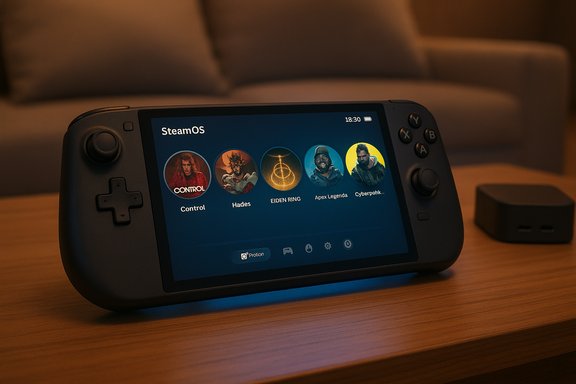
Lenovo’s handheld ambitions are taking a potentially decisive pivot: reports suggest the next Legion Go 2 could ship in a “Powered by SteamOS” configuration instead of Windows 11, offering the same high-end hardware but swapping the PC operating system for Valve’s console‑focused Linux build — a move aimed squarely at players who want console‑style simplicity and sustained performance from a handheld gaming PC.
Background / Overview
The Legion Go series has already established Lenovo as one of the few OEMs willing to push bold experiments in the handheld gaming PC market. The Legion Go Gen 2 (commonly referred to as Legion Go 2) doubled down on a larger OLED panel, improved battery capacity, and options for AMD’s newest mobile APUs — but the device shipped primarily as a Windows 11 handheld, which created friction for some portable‑first users. Lenovo’s official product pages and press material list the Legion Go Gen 2’s hardware ambitions — an 8.8‑inch PureSight OLED display, support for AMD Ryzen Z2 family processors, and a 74 Whr battery — and position the device as a flagship handheld for demanding portable play. What’s changed this week is the software angle. Industry reporting — presented as an exclusive by Windows Latest and amplified by outlets including Digital Trends — claims Lenovo is preparing a SteamOS variant of the Legion Go 2 for a CES 2026 reveal. The idea: keep the proven Legion Go 2 hardware, preinstall Valve’s SteamOS, and market a handheld that feels and behaves more like a living‑room console when you pick it up.Same hardware, different OS — what the leak says
The SteamOS rumor is straightforward in form: identical Legion Go 2 hardware, different operating system. Multiple outlets reporting on the leak list the same key specifications associated with Lenovo’s Gen‑2 hardware and with established leaks and OEM material:- Up to an AMD Ryzen Z2 Extreme processor (desktop‑class-ish mobile APU in Lenovo’s handheld SKU window).
- Up to 32 GB LPDDR5X memory (reported as 8000 MHz in leaks).
- Up to a 2 TB M.2 2242 PCIe Gen4 SSD plus a microSD slot supporting large cards (reports list up to 2 TB).
- An 8.8‑inch PureSight OLED touchscreen at WUXGA / 1920 × 1200 (16:10), 144 Hz refresh and HDR‑caliber color coverage (DCI‑P3), with brightness figures reported in the leak around 500 nits.
- A 74 Whr battery and USB‑C charging with a 65 W adapter; two USB‑C ports with USB4 + DisplayPort 1.4 capability, a 3.5 mm combo jack, and the usual Wi‑Fi/Bluetooth radio stack.
Why SteamOS is the headline — the case for swapping Windows 11
At its core, the SteamOS argument is a user‑experience one: Valve’s SteamOS (as delivered on the Steam Deck and other SteamOS‑first handhelds) is designed around controller navigation, fast suspend‑and‑resume, and a home‑first UI that removes much of the desktop clutter that makes Windows feel like the wrong tool for thumbstick‑first devices. SteamOS’s UI and system posture are intentionally console‑like, meaning users who want to pick up a device and immediately play a game without managing a desktop or a mouse/keyboard workflow often prefer that experience. Reviews and community reporting repeatedly praise SteamOS for a “gamepad‑first” flow and for a suspend/resume behavior that simply fits handheld interruption patterns. There’s also a performance argument. A leaner OS stack with a Linux kernel and Valve‑tuned GPU drivers can deliver more predictable, sustained performance on thermally constrained hardware in specific workloads. Several reviewers and engineers have shown measurable headroom differences between lean Linux sessions and full Windows desktop sessions in constrained devices, especially when the Windows session includes many background services and desktop shells. That’s the problem Microsoft is trying to address with its Xbox Full Screen Experience for Windows 11 handhelds — a console‑style shell that boots into the Xbox app and trims desktop overhead — but SteamOS remains a turnkey solution recognized by many handheld‑first users.- Key practical benefits of SteamOS on handhelds:
- Controller‑first UI and a home launch surface that feels familiar to console players.
- Proton compatibility layer that runs a large catalog of Windows games on Linux with minimal user tinkering for many titles.
- Suspend/resume behavior that is mature on Valve’s platform and maps well to handheld usage patterns.
Microsoft’s response: the Xbox Full Screen Experience (FSE)
The software trade is not one‑sided. Microsoft has been rolling out the Xbox Full Screen Experience (FSE) for Windows 11 handhelds: a lightweight session that boots directly into the Xbox app, suppresses much of the Explorer shell and desktop ornamentation, and prioritizes controller navigation and resources for games. Microsoft’s messaging frames FSE as a way to achieve console‑like behavior without abandoning the Windows ecosystem, preserving access to the full range of Windows‑only apps, DRM systems, and anti‑cheat frameworks. The practical implication: Windows handhelds can now present a far less PC‑like surface and recover some memory and CPU headroom that would otherwise be held by the desktop shell. That narrows one of SteamOS’s main UX advantages. But it does not change the low‑level technical differences — kernel, driver stacks, and certain platform optimizations — that still leave performance and power‑behavior tradeoffs between Windows and Valve’s Linux stack. Reviewers and testers report that FSE can free up measurable resources and reduce background interference, but results vary by title and hardware.What this means for games, compatibility, and anti‑cheat
A SteamOS‑first Legion Go 2 would come with Proton and Valve’s compatibility tooling preinstalled, giving many Windows games a good chance of running out of the box. But the compatibility story remains imperfect:- Proton and Valve’s work have improved compatibility for a massive library of titles, and Valve continues to close the gap for many mainstream games. The Steam Deck ecosystem demonstrates that a large percentage of modern games run well with Proton.
- Anti‑cheat and kernel‑mode protections remain the primary sticking point for some multiplayer and competitive titles. Some publishers implement kernel‑level anti‑cheat systems or Secure Boot constraints that make Linux/Proton support difficult or impossible without vendor cooperation. Recent industry stories show that titles with new kernel‑level anti‑cheat plans (or strong Secure Boot requirements) can block Proton users until those vendors provide Linux‑friendly paths. That’s a live, non‑trivial caveat for anyone whose primary library includes competitive multiplayer titles protected by kernel anti‑cheat systems.
Strengths of a potential Legion Go 2 SteamOS variant
- Cleaner handheld UX — SteamOS delivers a controller‑oriented home experience that reduces friction between picking up the device and playing, which is the core appeal for many handheld buyers.
- Potential performance/thermal advantages — a tuned Linux stack plus Valve’s driver optimizations can translate to steadier sustained performance in some titles and workloads.
- Steam‑native extras — features like per‑title compatibility ratings, Valve’s controller mapping, and Steam Input are integrated and tuned for handheld play.
- Tidy product differentiation — for Lenovo, a SteamOS SKU can appeal to a distinct subset of gamers and can be a relatively low‑risk SKU expansion if the hardware is unchanged.
Risks, unknowns, and real‑world caveats
- This is a reported leak, not an OEM confirmation. At the time of reporting, Lenovo has not formally announced a SteamOS Legion Go 2 SKU; the story rests on industry reporting described as an exclusive and on leak materials. Buyers should treat timing, pricing, and region availability as speculative until Lenovo or Valve confirms details at an official event such as CES 2026.
- Anti‑cheat realities: Proton has improved but remains dependent on vendor cooperation for certain kernel‑level anti‑cheat systems. Some online and competitive games will remain problematic on Linux until publishers implement Linux‑friendly anti‑cheat or Valve and anti‑cheat vendors reach workable solutions. That’s not theoretical — it’s a persistent, documented limitation in 2025.
- SKU fragmentation confusion: Lenovo’s line has already shown multiple configurations (different screens, battery sizes, and SoC SKUs). A SteamOS SKU might be limited to certain configurations (top‑end Z2 Extreme models, or perhaps only specific regions), producing buyer confusion if retailers don’t clearly list OS and exact hardware. Buyers must validate specific SKU numbers and region listings when preorders appear.
- Battery and thermals: The Legion Go 2 hardware (8.8‑inch OLED at 144 Hz driving a Z2 Extreme) is power‑hungry. Even with a 74 Whr battery, real‑world battery life in AAA titles will be bounded; fast refresh and high clocks trade life for performance. SteamOS may help efficiency in some cases, but it won’t perform miracles against physics and thermodynamics.
- Value layering: earlier Lenovo SteamOS handhelds (such as a SteamOS edition of the Legion Go S) sometimes shipped later and were priced differently from Windows SKUs, creating a mixed experience in availability and price parity. If Lenovo repeats that approach, early adopters who want SteamOS out of the box may pay a premium or face a delayed supply window. Historical behavior suggests price and timing can be unpredictable.
For buyers: practical buying guidance
- If you hate the Windows handheld experience and value instant, controller‑first play above all else, waiting for a confirmed SteamOS Legion Go 2 could be worthwhile — but only if the titles you care about are SteamOS/Proton‑compatible. Use Valve’s compatibility lists and community ProtonDB checks to validate your must‑play games.
- If you need specific multiplayer/competitive titles that use kernel‑level anti‑cheat or Windows‑only launchers, stick with the Windows 11 Legion Go 2 variant for now; Microsoft’s Xbox Full Screen Experience narrows the UX gap and preserves maximum compatibility.
- If you prioritize modularity, docking, or large‑scale PC interoperability (Steam + Epic + GOG + native Windows apps), remember SteamOS is optimized for Steam; switching to Windows later is possible but may carry setup overhead and update management. Confirm the device’s warranty and return policy around OS swaps before buying.
What to watch for at CES 2026
- Official confirmation from Lenovo — the single most important event; a Lenovo announcement would clarify SKU availability, regional distribution, price points, and whether the SteamOS variant is a global SKU or limited run.
- Valve’s involvement — whether Valve will certify the SteamOS Legion Go 2 as a “Steam Deck‑compatible partner device” or provide optimized Proton and driver toolsets for the specific Legion Go 2 hardware. Certification would materially reduce buyer risk.
- Pricing and SKU mapping — will Lenovo offer SteamOS on only top‑end Z2 Extreme models, or across the lineup? Will SteamOS SKUs be priced differently than Windows SKUs? Expect fragmentation unless Lenovo explicitly simplifies its SKU matrix.
- Anti‑cheat statements from publishers — any major publisher statements about Linux/Proton support will shape the list of playable day‑one multiplayer titles on a SteamOS handheld.
The strategic play: why Lenovo might choose SteamOS
For Lenovo, offering both Windows and SteamOS SKUs makes sense strategically. The hardware investment is largely fixed; the delta is a software image and a supply‑chain/marketing treatise that targets different user mindsets:- A Windows Legion Go 2 is the all‑purpose handheld for power users who want desktop compatibility, full PC ecosystems, and a single device that can run productivity apps and Windows‑only titles.
- A SteamOS Legion Go 2 would be a focused offering for players who prize console‑like immediacy, simplified ergonomics, and the Steam curated handheld flow.
Final analysis and verdict
The reported Legion Go 2 SteamOS SKU is a believable, potentially meaningful market move that matches both Lenovo’s recent product strategy and broader industry behavior: Valve has shown that a Linux‑based handheld OS can create real consumer demand, and Microsoft has responded on Windows’ side with FSE — but both ecosystems offer distinct tradeoffs.- If true, a SteamOS Legion Go 2 would give buyers a factory‑tuned console‑style handheld with flagship‑class hardware, attractive to players who value a frictionless pick‑up‑and‑play experience and who accept the Proton/anti‑cheat caveats.
- If false, or if the SKU is delayed or limited, shoppers who need immediate availability should continue to treat the Windows 11 Legion Go 2 as the known quantity that preserves the broadest compatibility and leverages Microsoft’s new Full Screen Experience to reduce handheld friction.
Quick reference — what to verify when (and if) Lenovo announces a SteamOS Legion Go 2
- SKU OS and hardware mapping — confirm which hardware configs ship with SteamOS vs Windows.
- Pricing and launch regions/dates — will the SteamOS model be cheaper, more expensive, or identical in price? Historical launches of SteamOS variants have varied.
- Valve certification and driver support — look for explicit Valve/Steam certification or published compatibility testing.
- Anti‑cheat and multiplayer compatibility list — ask Lenovo/Valve which popular online titles are officially supported or known to work.
- Return policy and warranty around OS images — verify warranty terms if you plan to switch OS after purchase.
Source: Digital Trends Your next Legion Go 2 might run SteamOS instead of Windows 11
