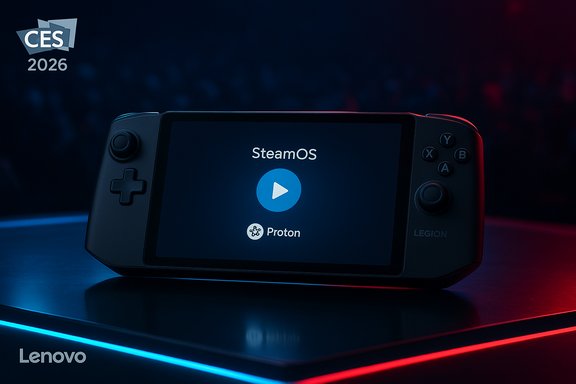
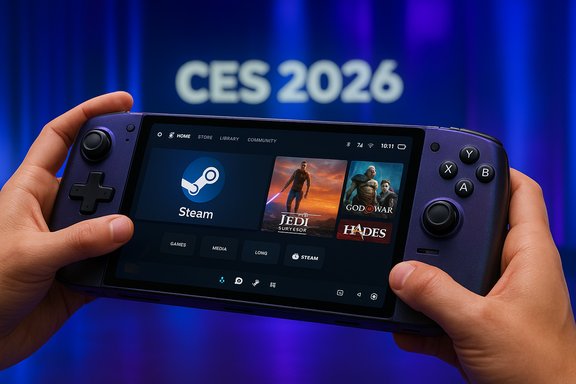
Lenovo’s handheld strategy may be preparing its boldest pivot yet: multiple industry reports claim the company is testing a SteamOS variant of the Legion Go Gen 2 and could put that model on stage at CES 2026 — a move that would directly challenge Windows‑first handheld assumptions and accelerate the “SteamOS versus Windows” debate for portable PC gaming.
Lenovo launched the Legion Go Gen 2 (marketed as Legion Go Gen 2 / Legion Go 2 in some regions) as a follow‑on to its original Legion Go handheld with an emphasis on high‑refresh OLED, bigger battery, and AMD’s new Ryzen Z2 family tuned for handhelds. Official product materials and widespread coverage confirm the device’s core hardware: an 8.8‑inch PureSight OLED panel at up to 144 Hz, an upgraded 74 Wh battery, and configurations that can include the AMD Ryzen Z2 Extreme APU paired with up to 32 GB LPDDR5X and up to 2 TB PCIe NVMe storage.
On the software side the Legion Go Gen 2 shipped with Windows 11 as Lenovo’s default platform, but the handheld landscape has been shifting fast. Valve’s SteamOS footprint expanded beyond the Steam Deck in 2024–2025, and Microsoft introduced a streamlined, console‑style Windows shell for handhelds — the Xbox Full‑Screen Experience (FSE) — with OEM rollouts planned through 2026. Against that backdrop, reports from recent tech coverage claim Lenovo will also offer an official SteamOS variant of its flagship handheld and may present it alongside other concept hardware at CES 2026.
This article verifies the hardware claims, assesses the credibility of the SteamOS reporting, explains the technical and commercial stakes for Lenovo and Microsoft, and lays out the risks, tradeoffs, and what to watch for at CES 2026.
The broader takeaway is already clear: the handheld PC market is entering a new phase where the OS choice meaningfully shapes the user experience. Valve’s SteamOS and Microsoft’s Xbox FSE are competing for the same battleground — sustained performance, battery life, and console‑like simplicity — and OEMs like Lenovo are positioned to decide whether to hedge and offer both or to pick a side.
For consumers, the prudent approach is to scrutinize SKU details, wait for independent reviews that include thermals and sustained framerate testing, and treat any CES announcements as the start of validation — not the final word. For Microsoft, the doors are open to reclaiming the handheld UX by delivering a lightweight, performance‑focused Windows experience that preserves the economic value of Game Pass and desktop compatibility. For Valve and the Linux community, third‑party OEM SteamOS devices continue to make the Linux handheld story more than just the Steam Deck: it’s a multi‑vendor platform fight for the future of PC handhelds.
The CES 2026 stage may answer whether the next era of portable PC gaming will be a Windows‑centric story with a console shell, a multi‑OS marketplace where SteamOS reigns for performance‑minded users, or a hybrid market where both approaches coexist — each optimized for different types of players.
Source: Windows Report Lenovo Reportedly Has a SteamOS Legion Go 2 in the Pipeline; Likely to Be Showcased at CES 2026
 Background
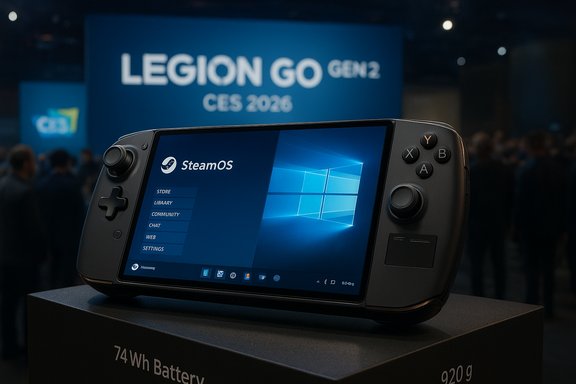
Lenovo launched the Legion Go Gen 2 (marketed as Legion Go Gen 2 / Legion Go 2 in some regions) as a follow‑on to its original Legion Go handheld with an emphasis on high‑refresh OLED, bigger battery, and AMD’s new Ryzen Z2 family tuned for handhelds. Official product materials and widespread coverage confirm the device’s core hardware: an 8.8‑inch PureSight OLED panel at up to 144 Hz, an upgraded 74 Wh battery, and configurations that can include the AMD Ryzen Z2 Extreme APU paired with up to 32 GB LPDDR5X and up to 2 TB PCIe NVMe storage.On the software side the Legion Go Gen 2 shipped with Windows 11 as Lenovo’s default platform, but the handheld landscape has been shifting fast. Valve’s SteamOS footprint expanded beyond the Steam Deck in 2024–2025, and Microsoft introduced a streamlined, console‑style Windows shell for handhelds — the Xbox Full‑Screen Experience (FSE) — with OEM rollouts planned through 2026. Against that backdrop, reports from recent tech coverage claim Lenovo will also offer an official SteamOS variant of its flagship handheld and may present it alongside other concept hardware at CES 2026.
This article verifies the hardware claims, assesses the credibility of the SteamOS reporting, explains the technical and commercial stakes for Lenovo and Microsoft, and lays out the risks, tradeoffs, and what to watch for at CES 2026.
What’s actually confirmed: the hardware baseline
Lenovo’s second‑generation handheld is a spec step forward
Lenovo’s product communications and independent hands‑on coverage converge on the same basic hardware story for the Legion Go Gen 2:- Processor: Configurable with AMD’s new Ryzen Z2 family, including the higher‑end Z2 Extreme, an 8‑core / 16‑thread Zen‑5‑based APU optimized for handheld power envelopes.
- Memory: Options up to 32 GB LPDDR5X (8000 MT/s).
- Storage: Up to 2 TB M.2 PCIe Gen4 NVMe (2242 form factor in many OEM SKUs) plus microSD expansion in some regions.
- Display: 8.8‑inch PureSight OLED at 1920×1200 (16:10) and a 144 Hz refresh mode with VRR support.
- Battery: 74 Wh battery (notable for handhelds), with fast‑charging support via USB‑C.
- Controls and I/O: Detachable Legion TrueStrike controllers (Hall‑effect sticks), multiple USB‑C / USB4 ports, microSD slot, and a hardware kickstand.
- Weight: ~920 g with controllers attached (varies by config).
The SteamOS rumor: what’s being reported — and what isn’t
The core claim
A recent exclusive from an industry outlet states that Lenovo is developing a SteamOS version of the Legion Go Gen 2 (using the same Z2 Extreme hardware configurations) and that the device could be announced or shown at CES 2026. The report lists identical hardware to the Windows model — meaning the difference would be entirely software‑side: SteamOS preinstalled, Valve’s Steam Deck UI and compatibility layer (Proton/ProtonDB pathways), and likely the same certified Steam compatibility tooling Valve now rolls out for non‑Valve hardware.What’s confirmed and what remains rumor
- Confirmed: Lenovo publicly shipped Legion handhelds with both Windows and SteamOS variants previously (e.g., a SteamOS edition of earlier Legion Go S was official), and Lenovo’s Legion Go Gen 2 hardware specs and pricing tiers are public and confirmed in manufacturer materials.
- Reported / unconfirmed: A factory‑shipped SteamOS edition of the Legion Go Gen 2 specifically, with a CES 2026 showcase. Multiple outlets have discussed this possibility; some outlets characterize it as a near‑term plan, while others caution it remains exploratory or unannounced. At the time of writing the SteamOS Gen 2 claim is still best described as a credible media report rather than an official Lenovo press release.
Why this matters: software defines the handheld experience
The Windows problem on handhelds
Windows 11 is a full desktop operating system. Even with a trimmed shell like Xbox FSE, Windows brings:- Background services and desktop overhead that consume RAM and power.
- Frequent UI interactions (notifications, OneDrive prompts, full desktop interactions) that are awkward on a purely gamepad‑first device.
- Greater driver complexity and variance that can complicate sustained performance and thermals.
What Valve brings to the table
Valve’s SteamOS, Proton layer, and the Deck‑era compatibility pipelines offer:- A gamepad‑first UI tuned for navigation with controllers.
- Compatibility tooling that surfaces per‑title “Verified / Playable / Unsupported” signals across devices.
- An update cadence that prioritizes handheld compatibility fixes, controller mappings, and driver tweaks for AMD RDNA handheld GPUs.
Technical implications: performance, battery, and compatibility
Performance and thermal behavior
Running SteamOS often reduces background CPU and RAM pressure, allowing the gaming stack to get more of the SoC’s thermal and performance headroom. On the Legion Go Gen 2’s hardware:- The Ryzen Z2 Extreme is designed to operate in a configurable 15–35 W envelope, with OEMs tuning sustained TDP for thermals versus performance.
- A lighter OS shell typically improves sustained GPU clocks and lowers jitter during long sessions, especially when VRR is active and background paging is minimized.
- The 74 Wh battery is generous for a handheld with a 144 Hz OLED but high refresh will still be power‑hungry in AAA titles — any software‑level efficiency gain matters.
Game compatibility and anti‑cheat
SteamOS leverages Proton to translate Windows APIs, and Proton has matured dramatically. Still, several issues remain:- Some anti‑cheat systems still rely on Windows kernel hooks or drivers — until anti‑cheat vendors offer Linux‑compatible solutions, a fraction of competitive multiplayer titles may be problematic on SteamOS.
- Valve’s verification labels help, but buyers should confirm support for specific titles before relying on a handheld solely for competitive online gaming.
- Cloud‑based titles and streaming services are an important workaround for titles that won’t run natively on Linux.
Software ecosystems: Game Pass and Windows‑exclusive features
One of Microsoft’s strategic assets is Xbox Game Pass and the integration of Game Pass features into Windows and the Xbox ecosystem. Tradeoffs if OEMs push SteamOS include:- Potential friction for Game Pass subscribers who want easy access to PC Game Pass titles that rely on Microsoft‑specific services or DRM.
- Windows‑first features (e.g., certain middleware, Xbox PC app exclusives) that are not trivially ported to SteamOS.
- The Xbox FSE rollout is Microsoft’s answer to these tensions; it aims to make Windows handhelds behave more like consoles while preserving access to the PC game ecosystem and Game Pass.
Commercial dynamics: pricing, segmentation, and OEM strategy
Price pressure and SKU differentiation
Historically, SteamOS SKUs can be priced lower than comparable Windows SKUs because of Windows licensing fees. Past Lenovo handheld launches demonstrated that:- A SteamOS edition can be positioned as a cost‑saver and performance‑oriented alternative.
- Windows models have leverage for users who demand wide‑ranging software compatibility, administrative tools, or Game Pass integration.
- A high‑end Windows SKU targeted at users who want Game Pass, Windows apps, and maximum compatibility.
- A SteamOS SKU targeted at gamers who prioritize battery life, sustained performance, and a console‑like experience out of the box.
The Microsoft response: Xbox FSE and the race to optimize Windows
Microsoft’s Xbox Full‑Screen Experience is explicitly a product response to the SteamOS momentum: a low‑overhead, gamepad‑first Windows shell that vendors can opt to enable on handhelds. The success of FSE will hinge on:- How quickly Microsoft can deliver a stable, OEM‑friendly rollout across the Windows supply chain.
- Whether FSE actually closes the performance gap versus SteamOS in real world sustained workloads.
- Developer and anti‑cheat vendor cooperation to ensure Game Pass and competitive titles run reliably in FSE mode.
Strategic strengths and risks for Lenovo
Strengths in offering a SteamOS Gen 2
- Performance optics: Delivering a SteamOS variant that demonstrates measurable gains would be a powerful marketing statement and could win hardcore handheld buyers.
- Choice and differentiation: Selling both Windows and SteamOS SKUs lets Lenovo offer choice without re‑engineering hardware. That flexibility may expand addressable market share.
- Valve partnership precedent: Lenovo has already shipped SteamOS handhelds in the Legion lineup, reducing the integration friction for a Gen 2 SteamOS SKU.
Risks and unanswered questions
- Software support and updates: SteamOS on an advanced handheld requires sustained driver and firmware support. OEMs must commit to longer‑term Linux driver updates and power management tuning.
- Anti‑cheat and multiplayer: Without cross‑industry anti‑cheat fixes, some multiplayer titles may remain inaccessible or unstable on SteamOS.
- Fragmentation: Multiple OS SKUs across the same hardware line create inventory complexity and post‑sale confusion about which features or accessories are supported.
- Warranty and support: OEM support for Linux variants must be clear to buyers; customers worry about repairs, replacements, and Return Merchandise Authorizations (RMAs) for non‑Windows systems.
What Microsoft should — and likely will — do
Microsoft isn’t powerless in this shift. Practical steps that protect Windows’ relevance in handheld gaming:- Accelerate FSE feature parity and OEM enablement — make the lightweight shell broadly available and easy to preinstall or switch to, and ensure OEMs can toggle it in locked/validated ways.
- Work with anti‑cheat vendors — provide certification paths and technical guidance to adapt major anti‑cheat stacks to Windows FSE and to minimize platform fragmentation.
- Improve idle/background efficiency — target Windows services and telemetry that penalize handhelds; reduce the overhead of non‑game foreground processes.
- Incentivize Game Pass integration — make Game Pass a killer feature of Windows handhelds in a way Steam and Valve can’t easily replicate.
For consumers: what to watch and how to decide
Checklist before buying a handheld (Windows or SteamOS)
- Confirm the exact SKU and its preinstalled OS.
- Check whether your must‑play titles are SteamOS‑verified or run well under Proton.
- Verify online/multiplayer support if you play competitive titles (anti‑cheat caveats).
- Compare battery life claims in reviews for real‑world usage, not just marketing numbers.
- Evaluate accessories, docks, and warranty coverage for your region and OS variant.
If you already own a Windows handheld
- Keep an eye on the Xbox FSE rollout: an update could significantly change the experience without needing to buy new hardware.
- Understand that installing SteamOS yourself is an option for enthusiasts, but it can void some vendor support and may require manual firmware or driver work.
What to expect at CES 2026
CES 2026 will be the practical proving ground for these industry crosscurrents. If Lenovo showcases a SteamOS Legion Go Gen 2, expect the presentation to focus on:- Side‑by‑side performance and battery comparisons with the Windows variant.
- Controller and UI demos showing SteamOS’s gamepad navigation and Steam compatibility labeling.
- Commentary about regional SKUs and pricing, including whether SteamOS pricing is lower to reflect licensing savings.
- Valve and OEM remarks about compatibility programs and how Proton and SteamOS updates will be distributed to non‑Valve hardware.
Final assessment: plausible — but not a done deal
An official SteamOS edition of the Legion Go Gen 2 is plausible and strategically sensible for Lenovo: it leverages existing hardware, satisfies a clear segment of the gaming market, and builds on a prior successful SteamOS partnership. However, the claim remains a media report until Lenovo or Valve issue formal confirmation.The broader takeaway is already clear: the handheld PC market is entering a new phase where the OS choice meaningfully shapes the user experience. Valve’s SteamOS and Microsoft’s Xbox FSE are competing for the same battleground — sustained performance, battery life, and console‑like simplicity — and OEMs like Lenovo are positioned to decide whether to hedge and offer both or to pick a side.
For consumers, the prudent approach is to scrutinize SKU details, wait for independent reviews that include thermals and sustained framerate testing, and treat any CES announcements as the start of validation — not the final word. For Microsoft, the doors are open to reclaiming the handheld UX by delivering a lightweight, performance‑focused Windows experience that preserves the economic value of Game Pass and desktop compatibility. For Valve and the Linux community, third‑party OEM SteamOS devices continue to make the Linux handheld story more than just the Steam Deck: it’s a multi‑vendor platform fight for the future of PC handhelds.
The CES 2026 stage may answer whether the next era of portable PC gaming will be a Windows‑centric story with a console shell, a multi‑OS marketplace where SteamOS reigns for performance‑minded users, or a hybrid market where both approaches coexist — each optimized for different types of players.
Source: Windows Report Lenovo Reportedly Has a SteamOS Legion Go 2 in the Pipeline; Likely to Be Showcased at CES 2026