

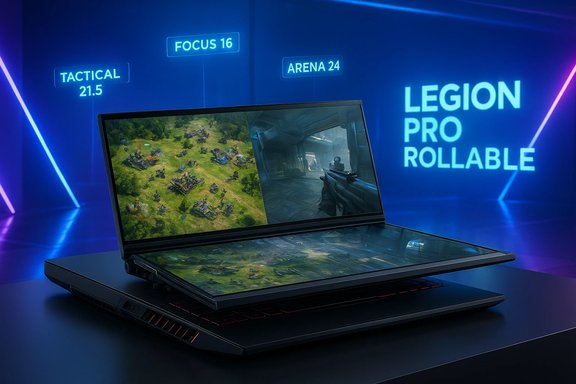
Lenovo’s Legion Pro Rollable concept at CES 2026 marks the company’s boldest attempt in years to rethink what a gaming laptop can be, replacing a fixed, cramped screen with a horizontally rollable PureSight OLED that slides from a standard 16-inch panel to a 21.5-inch ultrawide or a full 24-inch “arena” display. Presented as a concept built on the high-end Legion Pro 7i chassis, the Rollable pairs flagship-class silicon with a tensioned, dual-motor mechanism intended to keep the flexible OLED taut and reduce the creasing, glare, and vibration that have hampered earlier rollable prototypes. The result is a provocative answer to a long-standing gripe among mobile gamers: how to get true ultrawide desktop-like screen space without hauling a separate monitor.
Lenovo introduced rollable OLED technology to laptops at CES 2025 with the ThinkBook Plus Gen 6 Rollable, which extended a 14-inch panel vertically to about 16.7 inches and framed the feature as an AI-enabled productivity boost. The Rollable family now expands that idea into the Legion gaming lineup, swapping vertical expansion for horizontal unfolding to create ultrawide gameplay environments in a single, travel-ready chassis.
The Legion Pro Rollable is presented as a proof-of-concept rather than a shipping product. As such, specifications and market details remain provisional, but the demonstration makes clear Lenovo’s ambition: to deliver configurable display geometries—“Focus,” “Tactical,” and “Arena” modes—that suit practice drills, team play, and full competitive training without requiring an external monitor.
Key design objectives Lenovo emphasized:
Highlights carried over from Legion Pro 7i lineage:
Manufacturers of rolling and folding displays have historically faced similar reliability questions. Conservative buyers and enterprise procurement teams typically wait for rigorous durability certifications (e.g., cycle counts, ingress protection) before adopting mechanically novel devices for mission-critical use. That kind of certification is not yet public for the Rollable.
Key differences:
Potential long-term outcomes:
For buyers and teams that prize portability without sacrificing screen size, the Rollable promises an attractive middle ground—if it can prove reliable and affordable. For everyone else, the device is a fascinating preview of the possible future for laptops: displays that change shape to match what you need, when you need it. The next milestone will not be another concept demo but real-world units undergoing extended durability tests and rigorous performance benchmarks. Only then will the Rollable’s promise of bringing ultrawide, desktop-like training to a single portable machine be validated.
Source: Windows Central Lenovo makes its first major gaming innovation in years
 Background
Lenovo introduced rollable OLED technology to laptops at CES 2025 with the ThinkBook Plus Gen 6 Rollable, which extended a 14-inch panel vertically to about 16.7 inches and framed the feature as an AI-enabled productivity boost. The Rollable family now expands that idea into the Legion gaming lineup, swapping vertical expansion for horizontal unfolding to create ultrawide gameplay environments in a single, travel-ready chassis.The Legion Pro Rollable is presented as a proof-of-concept rather than a shipping product. As such, specifications and market details remain provisional, but the demonstration makes clear Lenovo’s ambition: to deliver configurable display geometries—“Focus,” “Tactical,” and “Arena” modes—that suit practice drills, team play, and full competitive training without requiring an external monitor.
Design and engineering: How Lenovo tries to solve the rollable problem
A tension-based, dual-motor system
The Legion Pro Rollable uses a dual-motor, tension-based design to extend and retract the OLED panel horizontally. The motors pull a flexible display from a housing in the laptop lid while a tensioning mechanism keeps the panel taut across its full width. This is a crucial engineering choice because flexible OLEDs are prone to micro-creasing, rippling, and variations in surface reflectivity when not uniformly tensioned.Key design objectives Lenovo emphasized:
- Maintain a flat, crease-free image across the entire span of the display.
- Minimize motor noise and vibration so the mechanism doesn’t distract during sensitive gameplay.
- Avoid mechanical slack that would introduce visible artefacts and tactile instability.
Chassis and mechanical trade-offs
Rolling a panel requires space to stow the extra display, and Lenovo’s design appears to preserve a relatively slim profile while integrating the rollable drum into the lid. However, prototypes reveal unavoidable trade-offs:- Lid thickness and a visible housing gap may be larger than conventional laptops to accommodate the roll.
- The mechanism adds weight and moving parts, increasing potential failure modes compared with static displays.
- The dual-motor assembly and tension system add cost and complexity that will likely be reflected in the final price.
Display modes: Focus, Tactical, Arena — what they mean for gamers
Lenovo pitched three distinct display configurations, each targeting a different training or play scenario:- Focus Mode (16-inch): A standard 16:10 experience for refining aim and reflexes, where increased vertical resolution helps target acquisition and single-player practice.
- Tactical Mode (21.5-inch): An ultrawide mid-configuration Lenovo says is aimed at “peripheral awareness, rotation drills, and team coordination.” This level of expansion provides extra horizontal FOV without going fully widescreen.
- Arena Mode (24-inch): A full ultrawide environment meant to mimic dedicated 24-inch monitors, offering the broadest peripheral cues for scrims, full-team practices, and tournament-level drills.
The promise and the pitfalls of ultrawide on a laptop
Ultrawide resolution and aspect ratios deliver real benefits for some genres and training:- Improved peripheral visibility in FPS and MOBA titles.
- Better situational awareness and simultaneous view of multiple UI elements.
- Workspace benefits for content creators and multitaskers using split-screen workflows.
- Game support and UI scaling: Not every title natively supports ultrawide aspect ratios, and stretched or cropped interfaces can reduce competitive clarity.
- Pixel density and resolution scaling: Expanding the screen increases required pixel push for a given fidelity; mobile GPUs must compensate, potentially lowering framerates unless power and cooling scale with the display.
- Thermal and power implications: Running a larger OLED at high refresh rates influences battery life and thermal headroom significantly.
Performance foundation: Legion Pro 7i DNA and flagship silicon
The Rollable concept is intentionally built on the Legion Pro 7i foundation, inheriting both performance ambitions and thermal engineering.Highlights carried over from Legion Pro 7i lineage:
- Top-tier Intel Core Ultra processors targeted at mobile H-class performance.
- Up to NVIDIA GeForce RTX 5090 Laptop GPU options—Lenovo spokespeople presented the Rollable as compatible with the latest RTX 50-series laptop GPUs.
- Advanced cooling technologies: Legion’s Coldfront vapor and hyperchamber approaches are designed to sustain high TDPs for prolonged gaming sessions, which will be critical if the rollable is used for extended scrim practice in Arena Mode.
- GPU value: Early generations of flagship mobile GPUs often command a steep premium over the next tier with incremental performance gains. The RTX 5090 Laptop GPU represents the top of the mobile stack, but for many buyers the RTX 5080 or similar may offer more bang per buck.
- Thermal realities: Expanding the screen does not change the power consumed by the CPU/GPU, but it alters the heat distribution and possibly the chassis airflow. Legion’s established cooling systems are robust, but the addition of moving lid components and internal drums may constrain thermal pathways.
Use cases: Who benefits from a rollable ultrawide gaming laptop?
Lenovo framed the Rollable as particularly useful for esports athletes who travel frequently. That positioning holds weight: professional gamers often need to practice on the move and cannot always rely on local venues to provide a full-size monitor. A rollable laptop offers:- Portability with variable workspace: travel-ready laptop that can mimic a desk monitor when needed.
- Single-device solution: eliminates the need to carry a portable external monitor and dock.
- Flexibility in training: different modes for different practice regimes (aiming drills vs. team rotations).
- Content creators and streamers who need temporary ultrawide real estate when away from studio setups.
- Hybrid workers and digital nomads who want desktop-like screen space in hotel rooms or co-working spaces.
- Gamers with limited desk space who prefer a single machine that can expand for certain sessions.
Durability, reliability, and repairability concerns
Mechanical displays introduce new maintenance vectors that static screens do not:- Moving parts wear: Motors, bearings, and tensioning components have finite lifespans and face failure modes not present in fixed displays.
- Accidental damage: The rollable drum and lid gap could expose sensitive components to dust, liquid ingress, or impacts.
- Long-term display uniformity: Even subtle, repeated micro-bending can cause long-term degradation in flexible OLED layers if not perfectly engineered.
- Repair complexity: Integrated flexible panels and proprietary mechanical assemblies will likely complicate repairs and increase servicing costs.
Manufacturers of rolling and folding displays have historically faced similar reliability questions. Conservative buyers and enterprise procurement teams typically wait for rigorous durability certifications (e.g., cycle counts, ingress protection) before adopting mechanically novel devices for mission-critical use. That kind of certification is not yet public for the Rollable.
Practical concerns observed during early demonstrations
Hands-on impressions from multiple media previews indicate several early practical issues worth noting:- Motor noise and vibration: Some demos showed audible motors and minor vibration while the display extended or retracted. Successful productization will require these to be nearly silent and smooth.
- Housing gap and lid profile: Accommodating the drum requires a slightly different lid architecture; some prototypes reveal a visible seam or bulge that could catch on bags or straps.
- UI and game compatibility: Not all games or professional tools scale cleanly to ultrawide aspect ratios; effective rollable UX will require OS-level and game-level tools to manage aspect transitions smoothly.
- Price and positioning: With flagship silicon, novel mechanical engineering, and a premium OLED, the Rollable will likely be expensive relative to conventional gaming laptops.
Comparison to ThinkBook Plus Rollable and competing concepts
The ThinkBook Plus Rollable (CES 2025) demonstrated vertical expansion for productivity and served as a technology demonstrator for rollable OLED mechanics in a laptop form factor. The Legion Pro Rollable diverges by targeting horizontal expansion and ultrawide gaming use cases.Key differences:
- Orientation and use-case: ThinkBook emphasized productivity and AI workflows with vertical extension; Legion focuses on horizontal FOV expansion for gaming and training.
- Mechanical stresses: Horizontal rolling must preserve panel tension across a wider span; creasing is arguably more visible and more problematic when movement in fast-paced games highlights any artifacts.
- Thermal packaging: Gaming platforms require higher TDPs and more aggressive cooling, complicating the integration of rollable drums and sealing.
Business and market implications
Lenovo’s push signals several important market signals:- Rollable displays are moving from novelty to plausible consumer products. The jump from ThinkBook’s vertical roll to Legion’s horizontal roll within a single year indicates rapid engineering maturation.
- Esports and pro-segment needs are influencing hardware innovation. Vendors see a market in competitive players who demand mobile platforms that do not compromise on training fidelity.
- Premium pricing will be accepted by a subset of consumers seeking single-device solutions; mainstream adoption will hinge on cost, durability, and software support.
Risks and unknowns: What remains unverified or problematic
While the concept is compelling, several claims remain unverified or warrant caution:- Commercial release timeline and pricing: Lenovo presented the Rollable as a concept with no confirmed release date or MSRP. Concepts often shift or cancel before productization, so purchase-minded readers should treat availability as speculative.
- Long-term durability and cycle life: Lifecycle testing results (e.g., how many roll cycles before degradation) have not been publicly documented. Until independent durability tests are available, reliability claims should be taken cautiously.
- Motor noise and mechanical reliability: Early demos suggested audible motors and minor vibration—both of which must be tamed for serious adoption. The final product would need near-silent actuation and robust fail-safes.
- Performance trade-offs at full ultrawide: Running modern titles at native ultrawide resolutions and high refresh rates increases GPU load. Mobile RTX 5090-class hardware may handle many games well, but sustained high-framerate competitive play at larger resolutions will push thermals and battery consumption.
- Game and ecosystem support: Some competitive titles implement HUD and FOV restrictions to avoid unfair advantages from ultrawide displays. Tournament rules and game developers may limit ultrawide use in official competitions, impacting the esports-focused pitch.
Recommendations for buyers and prosumer buyers
- If longevity and repairability are primary concerns: Wait for third-party durability reviews and clear warranty/service offerings. Moving parts change the maintenance calculus.
- If cutting-edge mobility and single-device workflows are essential: The Rollable concept is promising. Pros who travel frequently and need on-the-go ultrawide experiences should track the product’s transition from concept to shipping SKU.
- If value-per-dollar is a deciding factor: Consider mid-tier GPUs (e.g., RTX 5080-equivalent mobile) until early adopters deflate premium pricing on flagship mobile GPUs. The performance delta may not justify the added cost.
- For esports teams and tournament players: Verify game and tournament rules regarding ultrawide displays. If official play supports the format and the Rollable proves reliable, it could become a useful travel practice tool—just ensure its usage does not contravene match conditions.
Software and UX: What needs to be solved beyond hardware
A rollable laptop needs matching software intelligence to be truly useful:- OS-level display transitions: Smooth transitions between aspect ratios with quick, context-aware scaling and snapping are essential. Windows-level detection and layout persistence will reduce friction.
- Game-aware profiles: Games should be detected and display profiles applied automatically to optimize FOV, HUD placement, and scaling.
- Motor actuation controls: Users should be able to bind roll states to hotkeys, macros, or app profiles, and preview or reverse transitions quickly.
- Protective fail-safes: Software should detect obstructions or system states that make actuation unsafe (e.g., low battery or physical blockage) and prevent accidental damage.
The bigger picture: Will rollable laptops reshape portable gaming?
Rollable laptops do not guarantee mass-market disruption, but they represent a logical step in a multi-year trend: making displays adaptable to tasks rather than forcing users to buy more devices. If Lenovo can deliver a silent, durable mechanism and align hardware capability with true ultrawide gaming experience, the Rollable could influence both product design and user expectations.Potential long-term outcomes:
- Broader adoption of flexible displays across laptop segments—productivity, creativity, and gaming.
- New form-factor standards and UI conventions for variable-aspect displays.
- Growth of niche professional markets (esports, streaming) for single-device ultrawide solutions.
Conclusion
Lenovo’s Legion Pro Rollable concept at CES 2026 is an ambitious, technically sophisticated attempt to convert a chronic laptop limitation—limited screen real estate—into a competitive advantage for gamers who travel. By combining high-end Legion performance DNA with a tension-based dual-motor rollable OLED, Lenovo is aiming for a pragmatic ultrawide solution rather than a headline-grabbing novelty. The concept is smartly aligned with esports use-cases and broader prosumer demands for flexible workspace, but it also surfaces predictable engineering and market risks: mechanical durability, motor noise, cost, and software support.For buyers and teams that prize portability without sacrificing screen size, the Rollable promises an attractive middle ground—if it can prove reliable and affordable. For everyone else, the device is a fascinating preview of the possible future for laptops: displays that change shape to match what you need, when you need it. The next milestone will not be another concept demo but real-world units undergoing extended durability tests and rigorous performance benchmarks. Only then will the Rollable’s promise of bringing ultrawide, desktop-like training to a single portable machine be validated.
Source: Windows Central Lenovo makes its first major gaming innovation in years
