

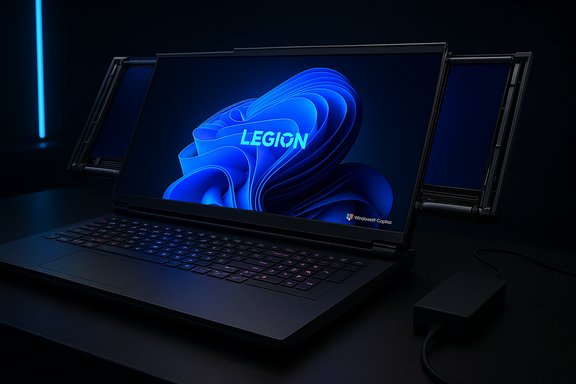
Lenovo appears to be preparing a bold follow-up to its rollable-screen experiment: leaked promotional material obtained by Windows Latest shows a Legion‑branded laptop with a horizontally expanding OLED display that rolls out from both sides to deliver an ultrawide 21:9 panel for gaming, and the report says the machine will ship with an Intel Core Ultra processor and Windows 11 sometime in early 2026.
Lenovo’s move into rollable displays is not hypothetical. The company commercially launched the ThinkBook Plus Gen 6 Rollable earlier this year, proving the concept at scale and giving engineers a real‑world testbed for motors, flexible POLED panels, and firmware that governs mechanical safety and display flattening. Lenovo’s own press materials and Intel’s coverage of the ThinkBook Rollable describe a motorized spindle, a flexible POLED, and reliability targets in the tens of thousands of cycles — claims that have been widely reported. That first rollable — aimed squarely at business users — expands vertically from a conventional 14‑inch footprint to a roughly 16.7‑inch portrait mode. Reviewers noted both the wonder and the trade‑offs: visible creases at certain angles, a thicker chassis to house the mechanism, and a premium price that places it in the “early‑adopter engineering showcase” category rather than mass consumer territory. The new leak positions Lenovo to take the same mechanical foundations and apply them to the Legion line — the company’s performance‑and‑gaming brand — which is where a horizontal, ultrawide expansion makes sense. The Windows Latest material shows what appears to be a lid that widens mechanically, pulling out two hidden strips of flexible OLED from the right and left of the central panel until the full 21:9 surface is formed. The story also says Lenovo will ship this device with an Intel Core Ultra CPU and Windows 11.
However, the most load‑bearing specifics in the leak — final display size, GPU SKU and TGP, pricing, and exact launch date — are not yet independently verified by Lenovo or multiple outlets. Until Lenovo publishes official specs or additional reputable outlets corroborate the promotional material, treat the Windows Latest story as a credible but unconfirmed scoop. For reference, Lenovo’s own CES 2025 materials and mainstream press coverage verified the ThinkBook Rollable’s hardware and durability claims; equivalent public confirmation does not yet exist for a Legion rollable.
Lenovo’s rollable journey has moved from concept to shipping hardware once already; a Legion‑branded rollable that delivers a true ultrawide OLED while preserving gaming performance is an intriguing and logical next move. The secret sauce will be whether Lenovo can harmonize mechanics, thermals, software, and pricing into a package that’s compelling beyond the spectacle. For now, the Windows Latest leak gives us the first glimpse of what could be the market’s first portable ultrawide gaming laptop — but the most important evidence will come when Lenovo puts official specs, pricing, and a real unit in reviewers’ hands.
Source: Windows Latest Exclusive: This is Lenovo Legion Pro Rollable with display that expands, launches 2026 with Windows 11
 Background
Lenovo’s move into rollable displays is not hypothetical. The company commercially launched the ThinkBook Plus Gen 6 Rollable earlier this year, proving the concept at scale and giving engineers a real‑world testbed for motors, flexible POLED panels, and firmware that governs mechanical safety and display flattening. Lenovo’s own press materials and Intel’s coverage of the ThinkBook Rollable describe a motorized spindle, a flexible POLED, and reliability targets in the tens of thousands of cycles — claims that have been widely reported. That first rollable — aimed squarely at business users — expands vertically from a conventional 14‑inch footprint to a roughly 16.7‑inch portrait mode. Reviewers noted both the wonder and the trade‑offs: visible creases at certain angles, a thicker chassis to house the mechanism, and a premium price that places it in the “early‑adopter engineering showcase” category rather than mass consumer territory. The new leak positions Lenovo to take the same mechanical foundations and apply them to the Legion line — the company’s performance‑and‑gaming brand — which is where a horizontal, ultrawide expansion makes sense. The Windows Latest material shows what appears to be a lid that widens mechanically, pulling out two hidden strips of flexible OLED from the right and left of the central panel until the full 21:9 surface is formed. The story also says Lenovo will ship this device with an Intel Core Ultra CPU and Windows 11.What the leak says (quick facts)
- The device is branded Lenovo Legion and marketed as a high‑performance, portable gaming laptop that converts into an ultrawide.
- The display reportedly expands horizontally — unrolling from both edges — changing from a standard 16:9 (or 16:10-style) footprint to an ultrawide 21:9 aspect ratio suitable for gaming.
- The laptop is said to use an Intel Core Ultra series processor (the same family increasingly used across Lenovo’s 2025 Legion lineup).
- The OS listed in the leak is Windows 11, with a Copilot key and Lenovo’s AI software stack mentioned in marketing images.
- Launch timing: early 2026, with a likely CES announcement window indicated by the report.
Why the idea makes technical sense — and what Lenovo already solved
From vertical to horizontal: reusing proven mechanics
Lenovo’s ThinkBook Rollable already validated the hardest parts of a rollable mainstream laptop: controlled motors and spindle, a tension or support frame that keeps a flexible POLED flat once extended, and firmware that detects obstructions and stops motion instantly. Those are nontrivial engineering challenges — lubrication, wear, flex fatigue, EMI/driver coordination, and fail‑safe interlocks — and having them in the field gives Lenovo a big head start on a second generation product. Translating that into a horizontal expansion changes the geometry but not the core problem set: you still need a roller mechanism robust enough to store display surface in a spool, rails that extend and lock solidly to prevent wobble, and a surface‑support frame that prevents ripples or micro‑creases when the panel is under gaming loads. The ThinkBook proved a motorized rollable can be shipped; a horizontal variant is engineering work, not invention — but it’s still difficult.Materials and durability
Lenovo’s published figures for the ThinkBook Rollable — where available — list reliability testing in the tens of thousands of cycles for rolling events and lid openings. Independent coverage and Lenovo’s own marketing materials cite multi‑thousand cycle test targets (e.g., 20,000 roll cycles or better for the display, and 30,000 hinge open/close tests for the lid in some releases). Those durability targets make a rollable laptop plausible for a niche premium product, provided the seal and motor tolerances are tight and environmental contamination is prevented.Thermals and chassis volume: an advantage for Legion
Gaming chassis are thicker and built around larger heat pipes, room for vapor chambers, and higher‑TGP components. That extra internal volume provides two benefits for a rollable Legion:- more space to incorporate the roller assembly and motors in the lid without forcing an ultra‑thin, fragile housing;
- better cooling for the likely discrete GPU that a Legion will include, which lessens the thermal trade‑offs of adding mechanical complexity.
What we can reasonably expect (and what remains unknown)
What’s likely
- Discrete GPU: A Legion Pro‑branded rollable almost certainly includes an NVIDIA RTX laptop GPU in the current‑gen family. Lenovo’s flagship Legion gear has historically leaned on NVIDIA at the top end, and a product pitching “portable ultrawide gaming” will need a discrete GPU to justify the positioning.
- High refresh rate OLED: The unrolled display will likely be an OLED panel with at least 120 Hz and possibly higher — Legion gaming SKUs routinely target 120–240 Hz PureSight OLED options, and refresh rate is a selling point for gaming.
- Intel Core Ultra: The leak specifically calls out Intel Core Ultra, which matches Lenovo’s product direction for many 2025 Legion models that shipped with Core Ultra H‑series silicon.
- Thicker chassis and better cooling: Expect a thicker lid and base than thin‑and‑light Legion models; that’s a trade‑off necessary to house rollers and robust GPU cooling.
What is not yet verified
- Exact display diagonal and native resolution: The Windows Latest leak did not publish a specific screen size before and after expansion (only the aspect ratio target of 21:9 when fully extended). That means we don’t yet know whether the base display will be a 14", 15", or 16" class panel that expands horizontally to some ultrawide diagonal.
- GPU SKU and TGP: The promotional leak mentions performance positioning but not explicit GPU model or TGP, which matters for thermals and actual gaming performance. No official Lenovo page lists a rollable Legion yet.
- Price and availability: The leak suggests early‑2026 timing (likely CES 2026) but offers no MSRP. Given the ThinkBook Rollable’s $3,299–$3,499 pricing, a discrete‑GPU Legion rollable will probably be substantially more expensive than mainstream Legion laptops — possibly by a significant margin.
UX and software questions: will Windows 11 be ready?
Windows 11 today supports many display orientations and variable resolutions, but it has no native “rollable display” management layer the same way it supports foldable screen states or external displays with standardized handedness. The early ThinkBook Rollable experience exposed this reality: the hardware can deliver novel form factors faster than mainstream OS-level APIs and app ecosystem support have matured. Review coverage of the ThinkBook Rollable repeatedly noted software friction and the lack of a seamless OS framework for managing unusual aspect ratios and dynamic physical transformations. For a Legion rollable to feel like a purpose‑built gaming device, Lenovo will need to supply robust software:- Display mode switching that reflows HUDs and UI affordances between 16:9 and 21:9 smoothly.
- Game profile handling so titles that don’t scale well to 21:9 get letterboxing or intelligent UI repositioning.
- Firmware and safety interlocks to prevent accidental extension when the lid is pressed or obstructed.
- AI utilities leveraging Copilot and Lenovo’s software to adapt window layouts for streaming, recording, or multi‑task gaming workflows.
Strengths of a Legion rollable
- True portable ultrawide: A rollable lid that converts a normal laptop footprint into a 21:9 gaming screen creates a unique one‑device workflow — gaming, streaming capture, and cinematic single‑player experiences all benefit from an ultrawide without an external monitor.
- Engineering continuity: Lenovo already solved core mechanical problems on the ThinkBook Rollable; reusing validated motors and tension frames reduces the risk compared with a first‑time prototype.
- Cooling and performance envelope: The Legion chassis is built for high TGP parts, meaning the rollable mechanism can sit alongside robust GPU and CPU cooling rather than compete for space with thin‑and‑light components.
- Novelty value for streamers and creators: Content creators could find immediate value — an ultrawide laptop that packs into a normal backpack has clear appeal for streamers who work from multiple locations. The novelty factor also drives visibility and halo effect for the Legion brand.
Risks and likely compromises
- Price vs. value: The ThinkBook Rollable launched at ~$3,300–$3,500 for a business machine that lacks a discrete GPU. A Legion rollable with a discrete RTX GPU and beefier cooling will likely command a premium that places it above many desktop+monitor combos. Consumers comparing dollar‑for‑pixel and raw performance could find the value proposition hard to justify.
- Durability concerns over the long term: Even with 20k+ roll cycle ratings, real‑world conditions (dust ingress, travel knocks, humidity) create long‑tail failure modes. Visible crease formation, while reportedly subtle on early units, is a known risk for flexible OLED tech and could worsen with heavy use — especially if gamers habitually extend/retract the panel multiple times per day. Independent hands‑on reviews of the ThinkBook Rollable already flagged crease visibility under certain angles.
- Software and game compatibility: Many older games and even some modern titles have UI assumptions built around 16:9 or 16:10. Without careful per‑title handling, HUDs or menus can appear stretched, misplaced, or simply unreadable in a 21:9 window. Unless Lenovo and game developers provide profiles or automatic fixes, the ultrawide experience could be mixed.
- Mass market appetite: The first generation of rollables will be niche. The ThinkBook Rollable’s early pricing and mechanical novelty positioned it as a collectible more than a mainstream buy; a gamer‑focused variant faces the same uphill battle balancing novelty, practicality, and cost.
Practical buying guidance and alternatives
If you’re a gamer thinking about a rollable Legion, weigh these points in your decision matrix:- Real usage patterns: Do you need ultrawide gaming on the go often enough to justify the price and likely compromises?
- Desktop alternatives: For many buyers, a high‑end Legion laptop plus an external 34” ultrawide monitor at home delivers higher sustained performance for less money.
- Portability trade‑offs: Expect a heavier chassis and a larger power brick for top performance — the rollable lid doesn’t remove the physics of battery drain and thermal limits.
- Warranty and service: Investigate Lenovo’s warranty and repair terms for mechanical rollable components; verify whether roll cycles and mechanical failures are covered.
How this fits Lenovo’s roadmap
Lenovo’s 2025 product cadence shows a clear pattern: the company is betting heavily on new form factors (rollable, under‑display cameras, handheld consoles) while also pushing AI features across business and gaming lines. The ThinkBook Rollable’s public release demonstrated manufacturing readiness for flexible POLED motorized systems, and Lenovo’s Legion family continues to adopt Intel Core Ultra and NVIDIA GPUs for flagship performance. Combining these trends into a Legion rollable is a logical extension of both engineering and brand strategy: reuse validated hardware and sell a high‑value, attention‑grabbing premium Legion SKU.Bottom line — separating the signal from the noise
The Windows Latest leak is plausible and aligns with two important facts: Lenovo already ships a rollable laptop and Lenovo’s Legion lineup is built to accommodate thicker, more capable hardware that can house the mechanical mechanisms needed for a rollable lid. That makes a horizontally expanding ultrawide Legion a believable next step.However, the most load‑bearing specifics in the leak — final display size, GPU SKU and TGP, pricing, and exact launch date — are not yet independently verified by Lenovo or multiple outlets. Until Lenovo publishes official specs or additional reputable outlets corroborate the promotional material, treat the Windows Latest story as a credible but unconfirmed scoop. For reference, Lenovo’s own CES 2025 materials and mainstream press coverage verified the ThinkBook Rollable’s hardware and durability claims; equivalent public confirmation does not yet exist for a Legion rollable.
What to watch next (short checklist)
- Official Lenovo product page updates or a press release referencing a Legion rollable.
- CES 2026 or other early‑2026 trade show teases and Lenovo keynote content.
- Independent hands‑on reviews that validate build quality, crease behavior, and the durability of the roller mechanism.
- Precise pricing and GPU/TGP disclosures that determine whether this device is a high‑end niche showcase or a slightly more accessible halo product.
Lenovo’s rollable journey has moved from concept to shipping hardware once already; a Legion‑branded rollable that delivers a true ultrawide OLED while preserving gaming performance is an intriguing and logical next move. The secret sauce will be whether Lenovo can harmonize mechanics, thermals, software, and pricing into a package that’s compelling beyond the spectacle. For now, the Windows Latest leak gives us the first glimpse of what could be the market’s first portable ultrawide gaming laptop — but the most important evidence will come when Lenovo puts official specs, pricing, and a real unit in reviewers’ hands.
Source: Windows Latest Exclusive: This is Lenovo Legion Pro Rollable with display that expands, launches 2026 with Windows 11
