

Sometimes the most direct route to a spectacular 4K gaming experience is also the most expensive one, and the Lenovo Legion Tower 7i (Gen 10) is a perfect example of that trade-off. With a discounted price of $3,899.99 at Lenovo, this pre-built desktop targets enthusiasts who want top-tier performance without assembling their own machine. Its mix of an Intel Core Ultra 7 265K, NVIDIA GeForce RTX 5080, 32GB of RAM, and 2TB of storage puts it squarely in the premium class, where every component is chosen to maximize frame rates, visual fidelity, and convenience. The question is not whether it is powerful enough for modern games, but whether its lofty price makes sense in a market that is already pushing high-end PCs into luxury territory.
The Legion Tower 7i (Gen 10) sits at an interesting point in the current gaming-PC market. It is not merely a fast desktop; it is Lenovo’s statement that a pre-built system can compete with a custom-built flagship rig while offering warranty support, curated components, and a cleaner upgrade path than many boutique systems. In that sense, it is aimed at buyers who value time, convenience, and predictability as much as raw performance.
What makes the system notable is how aggressively it leans into the new GPU generation. Lenovo’s PSREF lists the Tower 7i (34IAS10) with up to an Intel Core Ultra 7 265K and up to an RTX 5080, and NVIDIA positions the RTX 5080 as a card built for high-end 4K gaming and DLSS 4 features such as Multi Frame Generation. That combination is exactly why premium prebuilts like this exist: they package bleeding-edge hardware in a way that is ready to go out of the box.
The timing matters, too. In 2026, 4K gaming is no longer a theoretical showcase feature, but it still demands serious silicon if you want high settings, ray tracing, and strong frame rates all at once. NVIDIA has continued pushing DLSS 4 and Multi Frame Generation as a major part of the story, and that changes how buyers think about performance targets. A machine like the Legion Tower 7i is therefore not just about native raster horsepower; it is about embracing the modern upscaling-and-frame-generation ecosystem that defines high-end PC gaming today.
The value equation becomes clearer once you map those costs against the alternatives. A self-built system with similar performance might save money, but it would still require sourcing the same scarce, expensive parts and accepting the time and risk of assembly. For many buyers, that trade is worth it, especially when the goal is not “best value” but “best result with the least friction.” That is precisely the audience Lenovo is targeting.
The Legion Tower 7i also benefits from Lenovo’s brand position. This is not an anonymous white-box desktop with unclear support terms. It is a known product from a large OEM, which matters when you are spending four thousand dollars and want recourse if something goes wrong. The higher the asking price, the more support becomes part of the value proposition.
The RTX 5080 is the real headline feature. NVIDIA markets it as a 4K-capable card with DLSS 4 support, and the company has repeatedly framed Multi Frame Generation as a major performance multiplier in supported titles. For buyers looking at 4K with ray tracing, that is a meaningful advantage because it shifts the discussion from “can it run?” to “how far can it push visual quality before the compromises become obvious?”
The 32GB memory configuration also feels appropriately modern. It is not extravagant by workstation standards, but it is the kind of capacity that prevents the machine from feeling constrained in the years ahead. For a buyer spending nearly $4,000, that sense of future-proofing is part of the appeal.
This also reflects how 4K gaming has evolved. A few years ago, it was enough to say a system could “run” at 4K. Now the bar is much higher: buyers expect high or ultra presets, RT effects where supported, and frame rates that feel smooth on a large display. NVIDIA’s DLSS 4 stack matters here because it reduces the performance penalty of those visual ambitions.
For many games, that distinction is acceptable because the overall experience is what matters. Cyberpunk 2077, Forza Horizon 5, Gears 5, and Call of Duty: Black Ops 6 are exactly the kind of titles that benefit from a GPU like this, especially when the goal is both fidelity and responsiveness. The Legion Tower 7i is built for that premium experience, not for bargain-hunting.
Thermals are also the area where user expectations can get complicated. The FAQ snippet in the provided Windows Central material notes that the Tower 7i can reach 90–105°C during demanding long gaming sessions and may throttle in some cases. That is a reminder that high-end performance hardware is often operating close to its limits, and that factory cooling quality matters as much as the components themselves.
The possibility of thermal paste or liquid-metal tuning also underscores an uncomfortable truth: even expensive prebuilts can occasionally benefit from hands-on refinement. That will not bother every buyer, but the people spending this much often do expect polished thermals out of the box. If Lenovo gets that part right, it strengthens the premium case; if not, it invites comparison with custom PCs.
This matters especially in a GPU-driven era where the graphics card is often the first part people want to replace later. If the chassis, power delivery, and layout are friendly to upgrades, then the owner can treat the machine as a platform instead of a one-time purchase. That is a more sustainable proposition, both financially and practically.
The fact that the system comes with a 2TB SSD is useful, but it also hints at the sort of compromise premium buyers may want to revisit later. If you install multiple large games, 2TB disappears quickly, especially with modern file sizes. The upside is that a machine at this price should make adding more storage feel routine rather than risky.
The inclusion of Thunderbolt 4 and a broad spread of USB connectivity makes the machine practical for real-world use, not just gaming. Premium desktops increasingly need to serve as entertainment hubs, content creation boxes, and general-purpose workstations. The more ports you get on the front and back, the less you have to rely on docks and adapters.
Design is subjective, of course, but buyers in this price range usually want the machine to look intentional. A plain beige-box aesthetic would undersell the hardware, while a gaudy case would make it harder to fit into a living room or office. Lenovo’s approach is more restrained, and that likely broadens the appeal.
NVIDIA’s current messaging helps drive that market shift. By emphasizing DLSS 4, Multi Frame Generation, and 4K performance, the company is making upscale performance feel more attainable, even if the hardware still costs a great deal. That can be good for consumers who want better experiences, but it also reinforces a world where premium gaming has become a software-and-hardware bundle rather than just a faster card.
There is also a competitive implication for other OEMs. If Lenovo can pair an RTX 5080 with a thoughtfully designed tower and keep the machine relatively serviceable, rivals will need to answer with similar cooling, better port selection, or more aggressive pricing. In a market where GPU performance headlines often dominate, the best desktop brand can still win by delivering the best total package.
For buyers, the right question is whether they want the highest-end experience with the least hassle. If the answer is yes, the Legion Tower 7i makes a convincing case. If the answer is “I want the best value per dollar,” then the system’s luxurious price will remain a hard pill to swallow.
Source: Windows Central https://www.windowscentral.com/hard...-ungodly-specs-you-will-see-why-its-so-pricy/
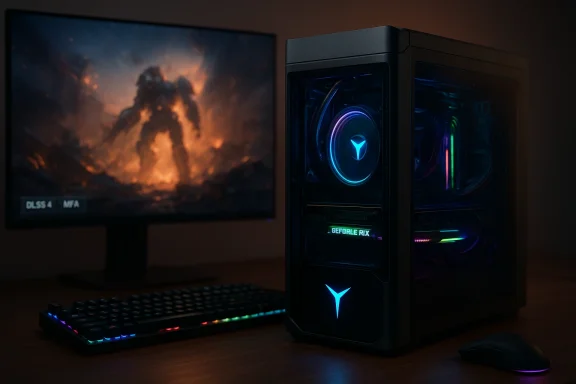 Overview
The Legion Tower 7i (Gen 10) sits at an interesting point in the current gaming-PC market. It is not merely a fast desktop; it is Lenovo’s statement that a pre-built system can compete with a custom-built flagship rig while offering warranty support, curated components, and a cleaner upgrade path than many boutique systems. In that sense, it is aimed at buyers who value time, convenience, and predictability as much as raw performance.What makes the system notable is how aggressively it leans into the new GPU generation. Lenovo’s PSREF lists the Tower 7i (34IAS10) with up to an Intel Core Ultra 7 265K and up to an RTX 5080, and NVIDIA positions the RTX 5080 as a card built for high-end 4K gaming and DLSS 4 features such as Multi Frame Generation. That combination is exactly why premium prebuilts like this exist: they package bleeding-edge hardware in a way that is ready to go out of the box.
The timing matters, too. In 2026, 4K gaming is no longer a theoretical showcase feature, but it still demands serious silicon if you want high settings, ray tracing, and strong frame rates all at once. NVIDIA has continued pushing DLSS 4 and Multi Frame Generation as a major part of the story, and that changes how buyers think about performance targets. A machine like the Legion Tower 7i is therefore not just about native raster horsepower; it is about embracing the modern upscaling-and-frame-generation ecosystem that defines high-end PC gaming today.
Why this PC costs so much
At first glance, the price looks hard to defend. Even at the reduced $3,899.99 sale price, the Legion Tower 7i remains a major purchase, and the original MSRP of $4,329.99 pushes it deeper into enthusiast-only territory. That sticker shock is not accidental; it reflects the cost of pairing a premium CPU platform with one of the fastest consumer GPUs available, plus the usual markup that comes with pre-assembly, support, and branded design.The value equation becomes clearer once you map those costs against the alternatives. A self-built system with similar performance might save money, but it would still require sourcing the same scarce, expensive parts and accepting the time and risk of assembly. For many buyers, that trade is worth it, especially when the goal is not “best value” but “best result with the least friction.” That is precisely the audience Lenovo is targeting.
The premium pre-built tax
A premium pre-built carries what enthusiasts often call a convenience premium. You are paying for the chassis, cable management, thermal tuning, warranty coverage, and a validated component stack that Lenovo has already made work together. For some shoppers, that premium feels excessive; for others, it is the cost of avoiding the uncertainty that can come with DIY builds.The Legion Tower 7i also benefits from Lenovo’s brand position. This is not an anonymous white-box desktop with unclear support terms. It is a known product from a large OEM, which matters when you are spending four thousand dollars and want recourse if something goes wrong. The higher the asking price, the more support becomes part of the value proposition.
- The RTX 5080 is the anchor of the price.
- The Core Ultra 7 265K adds expensive modern CPU capability.
- 32GB of RAM is sensible for high-end gaming and multitasking.
- A 2TB SSD is useful, even if some readers would want faster or larger storage.
- The enclosure, cooling, and support package all contribute to the final bill.
Hardware that defines the experience
The core appeal of the Tower 7i lies in its parts list. Lenovo’s configuration uses the Intel Core Ultra 7 265K, a 20-core chip with performance and efficiency cores tuned for modern gaming and background workloads. Paired with the RTX 5080, it forms a high-end CPU/GPU pairing that should avoid the sorts of bottlenecks that can appear when one component outpaces the other.The RTX 5080 is the real headline feature. NVIDIA markets it as a 4K-capable card with DLSS 4 support, and the company has repeatedly framed Multi Frame Generation as a major performance multiplier in supported titles. For buyers looking at 4K with ray tracing, that is a meaningful advantage because it shifts the discussion from “can it run?” to “how far can it push visual quality before the compromises become obvious?”
CPU and GPU balance
Balanced high-end systems are often more satisfying than lopsided ones. A GPU like the RTX 5080 can only stretch its legs if the CPU can keep feeding it data, and Intel’s Core Ultra 7 265K gives the system enough headroom for gaming, streaming, and desktop multitasking at once. That matters especially in modern AAA games that now mix rendering load with simulation, AI-driven effects, and background services.The 32GB memory configuration also feels appropriately modern. It is not extravagant by workstation standards, but it is the kind of capacity that prevents the machine from feeling constrained in the years ahead. For a buyer spending nearly $4,000, that sense of future-proofing is part of the appeal.
- 20 CPU cores help with multitasking and heavy background workloads.
- 16GB of GDDR7 VRAM on the RTX 5080 supports demanding textures and 4K workloads.
- 4K output support is a built-in design goal, not an afterthought.
- The combination is optimized for high-refresh 1440p as well as 4K gaming.
4K gaming is the point, not the bonus
A PC like this is sold on the promise of uncompromised visual quality. Lenovo’s pitch, and Windows Central’s framing of the machine, both center on the idea that this system can handle modern AAA games at 4K with high settings and ray tracing while preserving strong frame rates. That is where the Legion Tower 7i earns its keep.This also reflects how 4K gaming has evolved. A few years ago, it was enough to say a system could “run” at 4K. Now the bar is much higher: buyers expect high or ultra presets, RT effects where supported, and frame rates that feel smooth on a large display. NVIDIA’s DLSS 4 stack matters here because it reduces the performance penalty of those visual ambitions.
Native rendering versus upscaling
There is an important nuance here. A lot of the performance excitement around the RTX 5080 comes from NVIDIA’s upscaling and frame-generation features rather than brute-force native rendering alone. That does not make the results less impressive, but it does change how enthusiasts interpret the numbers. Pure raster performance and modern AI-assisted performance are not the same thing, and buyers should know which one they care about most.For many games, that distinction is acceptable because the overall experience is what matters. Cyberpunk 2077, Forza Horizon 5, Gears 5, and Call of Duty: Black Ops 6 are exactly the kind of titles that benefit from a GPU like this, especially when the goal is both fidelity and responsiveness. The Legion Tower 7i is built for that premium experience, not for bargain-hunting.
- 4K gaming is now about quality plus smoothness.
- DLSS 4 helps make ultra settings more practical.
- Multi Frame Generation can transform perceived performance in supported titles.
- The strongest use case is for gamers with large 4K panels or high-end TVs.
- Competitive esports players may care less than cinematic-single-player fans.
Cooling, thermals, and the realities of sustained load
Performance is only meaningful if the machine can sustain it. Lenovo’s desktop design emphasizes liquid and fan cooling, and that is essential for a system combining a high-power Intel CPU and a flagship-class GPU. Without strong thermal management, a premium PC can end up looking great on paper while behaving like a much cheaper machine under load.Thermals are also the area where user expectations can get complicated. The FAQ snippet in the provided Windows Central material notes that the Tower 7i can reach 90–105°C during demanding long gaming sessions and may throttle in some cases. That is a reminder that high-end performance hardware is often operating close to its limits, and that factory cooling quality matters as much as the components themselves.
Why cooling matters more at the high end
At this price tier, cooling is not a secondary feature. It is part of the product’s identity because it determines whether the system feels fast in real use or merely benchmark-fast for a few minutes at a time. Enthusiasts buying a machine like this want repeatable performance, quiet-enough acoustics, and confidence that the system will not degrade under long sessions.The possibility of thermal paste or liquid-metal tuning also underscores an uncomfortable truth: even expensive prebuilts can occasionally benefit from hands-on refinement. That will not bother every buyer, but the people spending this much often do expect polished thermals out of the box. If Lenovo gets that part right, it strengthens the premium case; if not, it invites comparison with custom PCs.
- Sustained gaming loads test the system more than launch-day demos do.
- Thermal headroom affects noise, boost behavior, and longevity.
- A premium desktop should feel stable during hours, not just minutes, of play.
- Buyers who overclock or tinker may still want room for optimization.
- Cooling quality is a major differentiator in the pre-built market.
Upgradeability and long-term ownership
One of the strongest arguments in favor of the Legion Tower 7i is that it is not a sealed appliance. Lenovo highlights tool-free access, additional storage possibilities, memory slots, and room for future component changes. For a premium desktop, that flexibility is important because it helps justify the upfront cost by extending the system’s useful life.This matters especially in a GPU-driven era where the graphics card is often the first part people want to replace later. If the chassis, power delivery, and layout are friendly to upgrades, then the owner can treat the machine as a platform instead of a one-time purchase. That is a more sustainable proposition, both financially and practically.
What upgradeability really means
Upgradeability is often oversold, so it is worth being precise. A tool-free side panel is convenient, but it does not automatically make every upgrade simple. Cable routing, motherboard layout, cooling clearance, and PSU capacity all influence how painless future changes will be. Still, compared with many compact pre-builts, Lenovo’s tower design should be relatively forgiving.The fact that the system comes with a 2TB SSD is useful, but it also hints at the sort of compromise premium buyers may want to revisit later. If you install multiple large games, 2TB disappears quickly, especially with modern file sizes. The upside is that a machine at this price should make adding more storage feel routine rather than risky.
- Tool-free access lowers the barrier to maintenance.
- Extra RAM slots create room for expansion.
- PCIe SSD slots make storage growth practical.
- Cooling upgrades remain possible for enthusiasts.
- A roomy tower is easier to live with over several years.
Ports, design, and desk appeal
Lenovo has also been careful to position the Legion Tower 7i as something you can actually live with on a desk. The styling is compact but premium, with RGB lighting and a chassis that tries to strike the balance between gamer flair and corporate restraint. That is a subtle but important part of the value proposition because not every buyer wants a machine that looks like a theme park exhibit.The inclusion of Thunderbolt 4 and a broad spread of USB connectivity makes the machine practical for real-world use, not just gaming. Premium desktops increasingly need to serve as entertainment hubs, content creation boxes, and general-purpose workstations. The more ports you get on the front and back, the less you have to rely on docks and adapters.
A premium PC should feel premium everywhere
This is where OEM desktops can sometimes beat DIY builds. A good pre-built does not just deliver good frame rates; it also gets the physical details right, from front-panel access to tidy internal layout to easy peripheral hookups. The Legion Tower 7i appears designed with that whole experience in mind.Design is subjective, of course, but buyers in this price range usually want the machine to look intentional. A plain beige-box aesthetic would undersell the hardware, while a gaudy case would make it harder to fit into a living room or office. Lenovo’s approach is more restrained, and that likely broadens the appeal.
- Thunderbolt 4 helps future-proof the desktop for fast peripherals.
- Plenty of USB ports reduce dongle clutter.
- The tower is compact enough to fit a modern gaming setup.
- RGB lighting adds a familiar enthusiast touch.
- The case design aims for premium without excess.
The broader market context
This PC is also a snapshot of where the desktop market is heading. Flagship gaming systems are increasingly defined by GPUs, AI-assisted rendering, and premium pricing that was once reserved for custom workstations. That means buyers are being asked to think differently about value: not “what does this cost compared with midrange desktops?” but “how much am I willing to pay to remove compromises?”NVIDIA’s current messaging helps drive that market shift. By emphasizing DLSS 4, Multi Frame Generation, and 4K performance, the company is making upscale performance feel more attainable, even if the hardware still costs a great deal. That can be good for consumers who want better experiences, but it also reinforces a world where premium gaming has become a software-and-hardware bundle rather than just a faster card.
Consumer versus enterprise expectations
For consumers, the Legion Tower 7i is about play, spectacle, and convenience. For enterprise-adjacent buyers, or creators who blur the line between work and gaming, the appeal is a bit different: stable drivers, strong multitasking, and a chassis that can be maintained over time. That dual identity is part of why high-end desktops remain relevant in the age of laptops and consoles.There is also a competitive implication for other OEMs. If Lenovo can pair an RTX 5080 with a thoughtfully designed tower and keep the machine relatively serviceable, rivals will need to answer with similar cooling, better port selection, or more aggressive pricing. In a market where GPU performance headlines often dominate, the best desktop brand can still win by delivering the best total package.
- The high-end PC market is now shaped by AI-assisted rendering.
- Buyers increasingly compare system experience, not just raw specs.
- OEM competition now includes thermals, noise, and serviceability.
- Premium desktops are becoming lifestyle products as much as gaming hardware.
- The Legion Tower 7i reflects a market where luxury and utility overlap.
Strengths and Opportunities
The Legion Tower 7i’s biggest strength is that it delivers a coherent flagship experience rather than a random pile of expensive parts. It is designed to be impressive from the first boot, and that makes it attractive to buyers who want top performance now and an easier upgrade path later. The machine also benefits from the current maturity of DLSS 4 and RTX 50-series messaging, which makes the hardware feel more relevant than a simple spec sheet might suggest.- Excellent 4K gaming headroom
- Strong CPU/GPU balance for modern AAA titles
- Tool-free access supports upgrades and maintenance
- Premium cooling design gives it a better chance at sustained performance
- A broad port selection improves desk usability
- NVIDIA’s software stack adds meaningful value in supported games
- Lenovo’s warranty and assembly reduce buyer friction
Risks and Concerns
The most obvious risk is price. Even at a discount, this is still a very expensive gaming desktop, and buyers can easily cross-shop toward custom builds or competing prebuilts if the configuration is not exactly what they want. Thermal behavior is another concern, especially when long gaming sessions can push temperatures into uncomfortable territory.- Very high entry cost for mainstream buyers
- Storage feels a bit conservative for the price
- Reported high temperatures may concern enthusiasts
- Frame-generation reliance may not satisfy purists
- Pre-built component choices can limit tuning flexibility
- High-end pricing narrows the audience dramatically
- 2TB storage may fill quickly with modern game installs
Looking Ahead
The Legion Tower 7i is likely to be remembered less as a bargain and more as a signal of where premium gaming desktops are headed. The combination of expensive silicon, AI-assisted graphics, and polished OEM packaging suggests that the next wave of high-end PCs will be judged on how well they integrate performance, cooling, and ease of ownership rather than on raw component lists alone. That is a meaningful shift for the industry.For buyers, the right question is whether they want the highest-end experience with the least hassle. If the answer is yes, the Legion Tower 7i makes a convincing case. If the answer is “I want the best value per dollar,” then the system’s luxurious price will remain a hard pill to swallow.
- Watch for more RTX 5080-based prebuilts to compete on cooling and acoustics
- Expect stronger emphasis on DLSS 4 and frame generation in marketing
- Look for price drops or bundle offers as the market matures
- Compare thermals carefully before buying any premium tower
- Pay attention to storage and memory options, not just the GPU
- See whether Lenovo’s next revision trims cost without sacrificing quality
Source: Windows Central https://www.windowscentral.com/hard...-ungodly-specs-you-will-see-why-its-so-pricy/
Last edited:
