

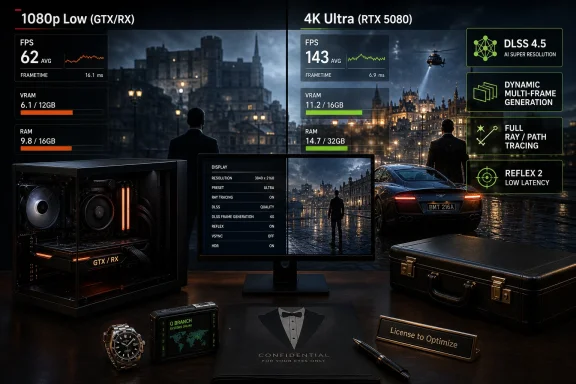
IO Interactive has updated the Windows PC requirements for 007 First Light ahead of its May 27, 2026 launch on PC, PlayStation 5, and Xbox Series X|S, with a later Nintendo Switch 2 release planned for the summer. The headline is not that the minimum spec is brutal; it is that the top-end spec has become a showcase for the newest NVIDIA rendering stack. For Windows gamers, this is another reminder that “PC requirements” now describe several different games at once: the one you can run, the one you can admire, and the one hardware vendors want you to buy toward.
The minimum configuration for 007 First Light is almost reassuringly ordinary by 2026 standards. IO Interactive lists an Intel Core i5-9500 or AMD Ryzen 5 3500, 16GB of RAM, and either a GeForce GTX 1660 or Radeon RX 5700 with 6GB of VRAM for 1080p at 30 frames per second on the Low preset. The SSD requirement and 80GB storage footprint are no longer notable so much as inevitable.
That floor matters because it keeps the game from becoming an RTX-only prestige object. A GTX 1660 is not a modern luxury card; it is the sort of GPU still found in many surviving midrange gaming PCs, school machines, hand-me-down builds, and small-form-factor rigs that have dodged upgrade fever. IO’s baseline says the studio still wants a broad Windows audience, not just a ray-tracing demo reel.
But the marketing gravity is obviously elsewhere. The Ultra tier targets 4K at 200-plus frames per second using DLSS 4.5, and it asks for a GeForce RTX 5080, 16GB of VRAM, 32GB of RAM, and a Core i5-13600K or Ryzen 7 7700X. That is less a conventional recommendation than a statement of technological alignment: 007 First Light is being positioned as a Bond game, an IO Interactive game, and a PC graphics showcase all at once.
The most interesting detail is what IO says is not enabled across the lower tiers. DLSS is not part of the Minimum, Recommended, or Enthusiast targets, which means the 1080p and 1440p numbers should be read as native-style expectations rather than upscaling-assisted marketing math. That makes the mainstream spec table more useful than many recent PC requirement grids, even if the Ultra tier is deliberately written in the language of frame generation and aspiration.
The first Enthusiast tier keeps that same CPU and RAM requirement but moves the GPU up to an RTX 4070 or Radeon RX 7800 XT with 12GB of VRAM for 1440p at 60 frames per second on High. This is arguably the most important line in the table. 1440p has become the practical enthusiast resolution for PC gaming, and the 12GB VRAM requirement reflects where modern high-quality assets have pushed the market.
The second Enthusiast tier targets 4K at 60 frames per second on High, again with the Core i5-13500 or Ryzen 5 7600 and 16GB of RAM, but now with an RTX 4080 or Radeon RX 7900 XTX and 16GB of VRAM. That is a steep but coherent ask. Native 4K remains expensive, and the GPU list makes clear that IO is not pretending otherwise.
The shape of the table tells a useful story. CPU requirements mostly plateau after the Recommended tier, while GPU and VRAM demands climb in a predictable staircase. For Windows users deciding where to spend money, the signal is straightforward: once you reach a competent current-generation six-core CPU, the real battle is graphics horsepower and memory bandwidth.
That distinction is more important than it looks. IO is not saying that 32GB is required to play the game well. It is saying that the no-compromise, AI-assisted, 4K, extremely high-frame-rate experience belongs to a class of PC where 32GB has become normal. That aligns with where high-end Windows gaming is already going, especially as launchers, overlays, capture tools, browsers, Discord, RGB utilities, driver suites, and kernel-level anti-cheat systems squat in the background.
For sysadmins and technically minded Windows users, this is also where consumer gaming specs overlap with workstation habits. A 32GB machine is not just better for games; it is more forgiving for multitasking, streaming, modding, and content creation. The Ultra tier may be a gaming headline, but the memory recommendation is really about the whole PC becoming heavier.
Still, the restraint below Ultra is welcome. Some recent PC releases have used system requirements as vague threat letters, implying massive RAM and VRAM needs without clearly distinguishing between playable, good, and absurdly high-end targets. IO’s table at least separates those worlds.
That is not inherently deceptive. Frame generation and reconstruction are now part of the PC graphics stack, and pretending otherwise would be nostalgic theater. If the technology is good, latency is controlled, image stability holds up, and the game feels responsive, players will judge the result on the monitor rather than on a philosophical purity test.
But it does change how buyers should interpret the spec. A 200-plus FPS DLSS-assisted target does not mean the game’s engine is natively throwing 200-plus unique 4K frames per second at the GPU. It means the GPU, AI model, renderer, and display pipeline are collaborating to create that experience. For competitive shooters, that distinction can be decisive; for a cinematic third-person Bond game, it may be far less damaging.
The bigger risk is expectation management. NVIDIA’s newest features tend to look miraculous in controlled footage and more complicated in the wild, where motion, UI elements, film grain, camera cuts, driver revisions, and game-specific implementation choices all matter. IO’s challenge is not merely to support DLSS 4.5, but to make it feel invisible.
IO is a logical studio to attempt it. The modern Hitman trilogy was built around dense spaces, theatrical lighting, readable disguise systems, and environments that rewarded observation. Bond is a different fantasy, but it shares the need for spaces that are legible at a glance and stylish under scrutiny.
The danger is that path tracing becomes a feature for screenshots rather than play. In stealth-adjacent games, lighting is not only decoration; it is feedback. If a rendering mode changes the readability of interiors or adds visual noise in the name of realism, it can work against the player. The best version of 007 First Light will use path tracing to deepen atmosphere without turning every mission into a showroom.
There is also the platform reality. Console versions must run without the same PC-exclusive path-traced ceiling, and the Switch 2 version arrives later still. That means IO cannot design the entire game around one extreme PC path. The renderer may scale, but the missions have to remain fundamentally coherent across devices.
Yet the feature story is unmistakably NVIDIA-led. DLSS 4.5, dynamic multi-frame generation, super resolution, and ray reconstruction are named attractions, and the Ultra tier lists only the RTX 5080. That does not mean AMD hardware will run the game poorly. It does mean the top-end marketing narrative is being written around GeForce.
This is the modern PC gaming bargain. Vendor-specific features can fund engineering effort, provide early optimization paths, and give a game a technical identity at launch. They can also fragment the experience, leaving players to ask whether the “real” version of a game is the one their GPU vendor can accelerate most elegantly.
For WindowsForum readers, the practical point is simple: the table is not vendor-neutral at the bleeding edge. If you are planning a GPU purchase specifically around 007 First Light, the Ultra claim is a GeForce claim. If you already own a strong Radeon card, the 1440p and 4K High targets are the lines to watch more closely.
But the inclusion should not be mistaken for long-term reassurance. By May 2026, Windows 10 is already past its mainstream consumer support era, and many security-conscious users will be weighing extended support options, hardware upgrades, or migration plans. A new AAA release supporting Windows 10 does not change the broader operating-system direction.
The more interesting Windows angle is driver maturity. A game launching with advanced NVIDIA features, path tracing, and broad GPU support will live or die partly on driver cadence. Day-one Game Ready drivers, hotfixes, shader compilation behavior, and crash telemetry may matter as much as the published CPU and GPU rows.
This is where PC gaming remains both superior and exhausting. The platform can scale from a GTX 1660 to an RTX 5080, from 1080p Low to 4K AI-assisted ultra-high frame rates. It can also turn launch week into a ritual of driver updates, graphics menu spelunking, overlay disabling, and forum troubleshooting.
That is not just a kindness; it is part of shipping a modern big-budget game responsibly. Bond as a franchise has global reach, and 007 First Light is likely to attract players who do not normally buy IO’s stealth sandboxes. Accessibility features reduce friction for disabled players, yes, but they also help living-room players, handheld players, non-native speakers, older players, and anyone using unconventional hardware.
Input flexibility is especially important for PC. The Windows ecosystem includes keyboard-and-mouse purists, Xbox controllers, DualSense users, adaptive controllers, Steam Input layers, third-party pads, and accessibility devices. A stylish spy game that fumbles remapping would be failing the platform.
Autocomplete for certain actions and quick-time events is also worth noting. QTEs have long been a hostile design pattern for many players, especially when they gate cinematic set pieces or punish reaction-time differences. Letting players smooth those moments is a sign that IO understands spectacle should not become an accessibility trap.
That matters for PC requirements because design ambition has a hardware cost. If First Light contains larger action sequences, more cinematic traversal, heavier set pieces, and more dramatic lighting than Hitman, then the spec escalation is not surprising. IO is not building a pure assassination sandbox with a tuxedo skin; it is trying to translate Bond into a modern third-person action-adventure without abandoning the studio’s systemic instincts.
The risk is tonal. Too much Hitman, and Bond becomes Agent 47 with hair and a license to quip. Too much blockbuster action, and IO risks sanding away the very systemic craft that made it the most interesting steward for the license. The PC feature list suggests the studio wants both: dense, polished spaces and cinematic excess.
That is a hard target, but it is also why this game has drawn attention from players who might otherwise shrug at licensed projects. Bond games have a long, uneven history, and the shadow of GoldenEye 007 is both blessing and curse. IO does not need to recreate that moment; it needs to prove that Bond can be a systems-driven PC and console game in 2026 rather than a nostalgia act.
This is the new split-screen reality of PC gaming. One player will run First Light at 1080p Low on a six-year-old GPU and be happy to have a stable Bond adventure. Another will treat the same game as a reason to justify an RTX 5080, a high-refresh 4K display, and the newest DLSS feature stack.
Developers have to serve both without letting either side define the whole product. If IO over-optimizes for the showcase tier, the game risks becoming another launch-week benchmark curiosity. If it underdelivers at the high end, the NVIDIA partnership becomes a hollow sticker on the box.
The most promising sign is the specificity of the non-DLSS tiers. By giving conventional targets for 1080p, 1440p, and 4K without leaning on upscaling for those rows, IO gives players a clearer baseline. That is good PC citizenship, and the industry could use more of it.
Source: Game Informer 007 First Light: Here Are The Full PC Specs And Requirements
 Bond Arrives With a Spec Sheet Built for the Upsell
The minimum configuration for 007 First Light is almost reassuringly ordinary by 2026 standards. IO Interactive lists an Intel Core i5-9500 or AMD Ryzen 5 3500, 16GB of RAM, and either a GeForce GTX 1660 or Radeon RX 5700 with 6GB of VRAM for 1080p at 30 frames per second on the Low preset. The SSD requirement and 80GB storage footprint are no longer notable so much as inevitable.That floor matters because it keeps the game from becoming an RTX-only prestige object. A GTX 1660 is not a modern luxury card; it is the sort of GPU still found in many surviving midrange gaming PCs, school machines, hand-me-down builds, and small-form-factor rigs that have dodged upgrade fever. IO’s baseline says the studio still wants a broad Windows audience, not just a ray-tracing demo reel.
But the marketing gravity is obviously elsewhere. The Ultra tier targets 4K at 200-plus frames per second using DLSS 4.5, and it asks for a GeForce RTX 5080, 16GB of VRAM, 32GB of RAM, and a Core i5-13600K or Ryzen 7 7700X. That is less a conventional recommendation than a statement of technological alignment: 007 First Light is being positioned as a Bond game, an IO Interactive game, and a PC graphics showcase all at once.
The most interesting detail is what IO says is not enabled across the lower tiers. DLSS is not part of the Minimum, Recommended, or Enthusiast targets, which means the 1080p and 1440p numbers should be read as native-style expectations rather than upscaling-assisted marketing math. That makes the mainstream spec table more useful than many recent PC requirement grids, even if the Ultra tier is deliberately written in the language of frame generation and aspiration.
The Middle of the Table Is Where Most Windows Gamers Actually Live
The Recommended tier aims for 1080p at 60 frames per second on Medium settings with a Core i5-13500 or Ryzen 5 7600, 16GB of RAM, and either an RTX 3060 Ti or Radeon RX 6700 XT with 8GB of VRAM. That is a very different machine from the minimum build, especially on the CPU side. The jump from an older six-core part to newer midrange CPUs suggests IO expects simulation, streaming, traversal, or background systems to matter once the frame-rate target doubles.The first Enthusiast tier keeps that same CPU and RAM requirement but moves the GPU up to an RTX 4070 or Radeon RX 7800 XT with 12GB of VRAM for 1440p at 60 frames per second on High. This is arguably the most important line in the table. 1440p has become the practical enthusiast resolution for PC gaming, and the 12GB VRAM requirement reflects where modern high-quality assets have pushed the market.
The second Enthusiast tier targets 4K at 60 frames per second on High, again with the Core i5-13500 or Ryzen 5 7600 and 16GB of RAM, but now with an RTX 4080 or Radeon RX 7900 XTX and 16GB of VRAM. That is a steep but coherent ask. Native 4K remains expensive, and the GPU list makes clear that IO is not pretending otherwise.
The shape of the table tells a useful story. CPU requirements mostly plateau after the Recommended tier, while GPU and VRAM demands climb in a predictable staircase. For Windows users deciding where to spend money, the signal is straightforward: once you reach a competent current-generation six-core CPU, the real battle is graphics horsepower and memory bandwidth.
16GB Survives, But 32GB Is Becoming the Prestige Line
For years, 16GB of system memory has been the default answer to the question “How much RAM does a gaming PC need?” 007 First Light does not overthrow that rule, but it does place a marker. Every tier up to 4K High stays at 16GB, while Ultra moves to 32GB.That distinction is more important than it looks. IO is not saying that 32GB is required to play the game well. It is saying that the no-compromise, AI-assisted, 4K, extremely high-frame-rate experience belongs to a class of PC where 32GB has become normal. That aligns with where high-end Windows gaming is already going, especially as launchers, overlays, capture tools, browsers, Discord, RGB utilities, driver suites, and kernel-level anti-cheat systems squat in the background.
For sysadmins and technically minded Windows users, this is also where consumer gaming specs overlap with workstation habits. A 32GB machine is not just better for games; it is more forgiving for multitasking, streaming, modding, and content creation. The Ultra tier may be a gaming headline, but the memory recommendation is really about the whole PC becoming heavier.
Still, the restraint below Ultra is welcome. Some recent PC releases have used system requirements as vague threat letters, implying massive RAM and VRAM needs without clearly distinguishing between playable, good, and absurdly high-end targets. IO’s table at least separates those worlds.
DLSS 4.5 Turns the Ultra Tier Into a Different Kind of Promise
The phrase “4K at 200+ FPS” would once have been read as a raw performance claim. In 2026, it is impossible to read it that way. IO’s Ultra target explicitly depends on DLSS 4.5, including dynamic multi-frame generation and super resolution, which means the number describes an end-user output experience rather than a traditional rendered-frame workload.That is not inherently deceptive. Frame generation and reconstruction are now part of the PC graphics stack, and pretending otherwise would be nostalgic theater. If the technology is good, latency is controlled, image stability holds up, and the game feels responsive, players will judge the result on the monitor rather than on a philosophical purity test.
But it does change how buyers should interpret the spec. A 200-plus FPS DLSS-assisted target does not mean the game’s engine is natively throwing 200-plus unique 4K frames per second at the GPU. It means the GPU, AI model, renderer, and display pipeline are collaborating to create that experience. For competitive shooters, that distinction can be decisive; for a cinematic third-person Bond game, it may be far less damaging.
The bigger risk is expectation management. NVIDIA’s newest features tend to look miraculous in controlled footage and more complicated in the wild, where motion, UI elements, film grain, camera cuts, driver revisions, and game-specific implementation choices all matter. IO’s challenge is not merely to support DLSS 4.5, but to make it feel invisible.
Path Tracing Is the Luxury Feature With Real Design Consequences
Path tracing is often presented as a graphics checkbox, but it is really a design commitment. Once a game starts leaning into physically richer lighting, reflections, shadows, and material response, the art direction has to survive both with and without the feature. That is especially tricky for a Bond game, where glass, metal, polished interiors, moody safehouses, wet streets, casinos, vehicles, and expensive fabrics are practically part of the license.IO is a logical studio to attempt it. The modern Hitman trilogy was built around dense spaces, theatrical lighting, readable disguise systems, and environments that rewarded observation. Bond is a different fantasy, but it shares the need for spaces that are legible at a glance and stylish under scrutiny.
The danger is that path tracing becomes a feature for screenshots rather than play. In stealth-adjacent games, lighting is not only decoration; it is feedback. If a rendering mode changes the readability of interiors or adds visual noise in the name of realism, it can work against the player. The best version of 007 First Light will use path tracing to deepen atmosphere without turning every mission into a showroom.
There is also the platform reality. Console versions must run without the same PC-exclusive path-traced ceiling, and the Switch 2 version arrives later still. That means IO cannot design the entire game around one extreme PC path. The renderer may scale, but the missions have to remain fundamentally coherent across devices.
The AMD Side of the Table Is Present, But the Showcase Is NVIDIA’s
To IO’s credit, the non-Ultra requirements include AMD alternatives throughout the table. A Radeon RX 5700 appears at minimum, RX 6700 XT at recommended, RX 7800 XT at 1440p High, and RX 7900 XTX at 4K High. That gives Radeon owners something more concrete than the usual “equivalent GPU” shrug.Yet the feature story is unmistakably NVIDIA-led. DLSS 4.5, dynamic multi-frame generation, super resolution, and ray reconstruction are named attractions, and the Ultra tier lists only the RTX 5080. That does not mean AMD hardware will run the game poorly. It does mean the top-end marketing narrative is being written around GeForce.
This is the modern PC gaming bargain. Vendor-specific features can fund engineering effort, provide early optimization paths, and give a game a technical identity at launch. They can also fragment the experience, leaving players to ask whether the “real” version of a game is the one their GPU vendor can accelerate most elegantly.
For WindowsForum readers, the practical point is simple: the table is not vendor-neutral at the bleeding edge. If you are planning a GPU purchase specifically around 007 First Light, the Ultra claim is a GeForce claim. If you already own a strong Radeon card, the 1440p and 4K High targets are the lines to watch more closely.
Windows 10 Still Gets a Seat, But the Clock Is Loud
IO lists Windows 10 and Windows 11 64-bit across the requirements, which will please holdouts who have not moved to Windows 11. That support matters for a large segment of PC gamers who remain on Windows 10 because their systems are stable, their workflows are settled, or their hardware does not meet Windows 11’s official requirements.But the inclusion should not be mistaken for long-term reassurance. By May 2026, Windows 10 is already past its mainstream consumer support era, and many security-conscious users will be weighing extended support options, hardware upgrades, or migration plans. A new AAA release supporting Windows 10 does not change the broader operating-system direction.
The more interesting Windows angle is driver maturity. A game launching with advanced NVIDIA features, path tracing, and broad GPU support will live or die partly on driver cadence. Day-one Game Ready drivers, hotfixes, shader compilation behavior, and crash telemetry may matter as much as the published CPU and GPU rows.
This is where PC gaming remains both superior and exhausting. The platform can scale from a GTX 1660 to an RTX 5080, from 1080p Low to 4K AI-assisted ultra-high frame rates. It can also turn launch week into a ritual of driver updates, graphics menu spelunking, overlay disabling, and forum troubleshooting.
Accessibility Is Quietly the More Important Launch Feature
The PC spec table will get the attention, but IO’s accessibility list may matter more to a wider range of players. The studio has outlined audio profiles, customizable subtitles, input remapping, sensitivity and dead-zone adjustments, inversion options, audio output choices, menu narration, input activation settings, and autocomplete support for certain actions and quick-time events.That is not just a kindness; it is part of shipping a modern big-budget game responsibly. Bond as a franchise has global reach, and 007 First Light is likely to attract players who do not normally buy IO’s stealth sandboxes. Accessibility features reduce friction for disabled players, yes, but they also help living-room players, handheld players, non-native speakers, older players, and anyone using unconventional hardware.
Input flexibility is especially important for PC. The Windows ecosystem includes keyboard-and-mouse purists, Xbox controllers, DualSense users, adaptive controllers, Steam Input layers, third-party pads, and accessibility devices. A stylish spy game that fumbles remapping would be failing the platform.
Autocomplete for certain actions and quick-time events is also worth noting. QTEs have long been a hostile design pattern for many players, especially when they gate cinematic set pieces or punish reaction-time differences. Letting players smooth those moments is a sign that IO understands spectacle should not become an accessibility trap.
IO Is Selling a Bond Fantasy, Not Just a Hitman Reskin
The obvious comparison for 007 First Light is Hitman, because IO Interactive’s reputation rests on that trilogy’s clockwork murder dioramas. But Bond changes the contract. The player is not merely an intruder in a social puzzle; he is a reckless young spy in an origin story, with action, gadgets, car chases, and globe-trotting spectacle baked into the premise.That matters for PC requirements because design ambition has a hardware cost. If First Light contains larger action sequences, more cinematic traversal, heavier set pieces, and more dramatic lighting than Hitman, then the spec escalation is not surprising. IO is not building a pure assassination sandbox with a tuxedo skin; it is trying to translate Bond into a modern third-person action-adventure without abandoning the studio’s systemic instincts.
The risk is tonal. Too much Hitman, and Bond becomes Agent 47 with hair and a license to quip. Too much blockbuster action, and IO risks sanding away the very systemic craft that made it the most interesting steward for the license. The PC feature list suggests the studio wants both: dense, polished spaces and cinematic excess.
That is a hard target, but it is also why this game has drawn attention from players who might otherwise shrug at licensed projects. Bond games have a long, uneven history, and the shadow of GoldenEye 007 is both blessing and curse. IO does not need to recreate that moment; it needs to prove that Bond can be a systems-driven PC and console game in 2026 rather than a nostalgia act.
The Spec Sheet Says More About 2026 PC Gaming Than About Bond
Read narrowly, the 007 First Light requirements answer a buyer’s question: can my PC run this game? Read broadly, they describe the current state of the Windows gaming market. The low end is still alive, the middle is increasingly 8GB to 12GB of VRAM, 4K remains expensive, and the high end is now inseparable from AI-assisted rendering.This is the new split-screen reality of PC gaming. One player will run First Light at 1080p Low on a six-year-old GPU and be happy to have a stable Bond adventure. Another will treat the same game as a reason to justify an RTX 5080, a high-refresh 4K display, and the newest DLSS feature stack.
Developers have to serve both without letting either side define the whole product. If IO over-optimizes for the showcase tier, the game risks becoming another launch-week benchmark curiosity. If it underdelivers at the high end, the NVIDIA partnership becomes a hollow sticker on the box.
The most promising sign is the specificity of the non-DLSS tiers. By giving conventional targets for 1080p, 1440p, and 4K without leaning on upscaling for those rows, IO gives players a clearer baseline. That is good PC citizenship, and the industry could use more of it.
The Upgrade Math Before May 27
The practical reading of IO’s table is less dramatic than the Ultra line suggests. Most players do not need to rebuild their PCs for 007 First Light, but many will need to be honest about their target resolution, VRAM, and tolerance for lowered settings.- Players with older 6GB GPUs should expect the 1080p Low experience, not a miracle unlocked by wishful tweaking.
- Players with RTX 3060 Ti or RX 6700 XT-class hardware are positioned for the most conventional 1080p 60 FPS target.
- Players aiming for 1440p High should treat 12GB of VRAM as the meaningful comfort line.
- Players aiming for native-style 4K High are in RTX 4080 or RX 7900 XTX territory, which remains a premium tier.
- Players chasing the advertised 4K 200-plus FPS Ultra experience are buying into NVIDIA’s DLSS 4.5 ecosystem as much as IO’s game.
A License to Render, If the Launch Holds Together
The PC requirements for 007 First Light are encouraging precisely because they are not one thing. They are forgiving at the floor, serious in the middle, expensive at 4K, and wildly aspirational at the top. That is what a major Windows release looks like in 2026: scalable enough to run on yesterday’s hardware, ambitious enough to sell tomorrow’s, and dependent enough on drivers, upscalers, and reconstruction that launch quality will be judged as much in settings menus as in opening missions. If IO can make the mainstream tiers stable and the Ultra tier feel like more than a vendor showcase, Bond’s return to PC could be more than a handsome benchmark; it could be the rare licensed blockbuster that understands the platform it is landing on.Source: Game Informer 007 First Light: Here Are The Full PC Specs And Requirements
